Overview
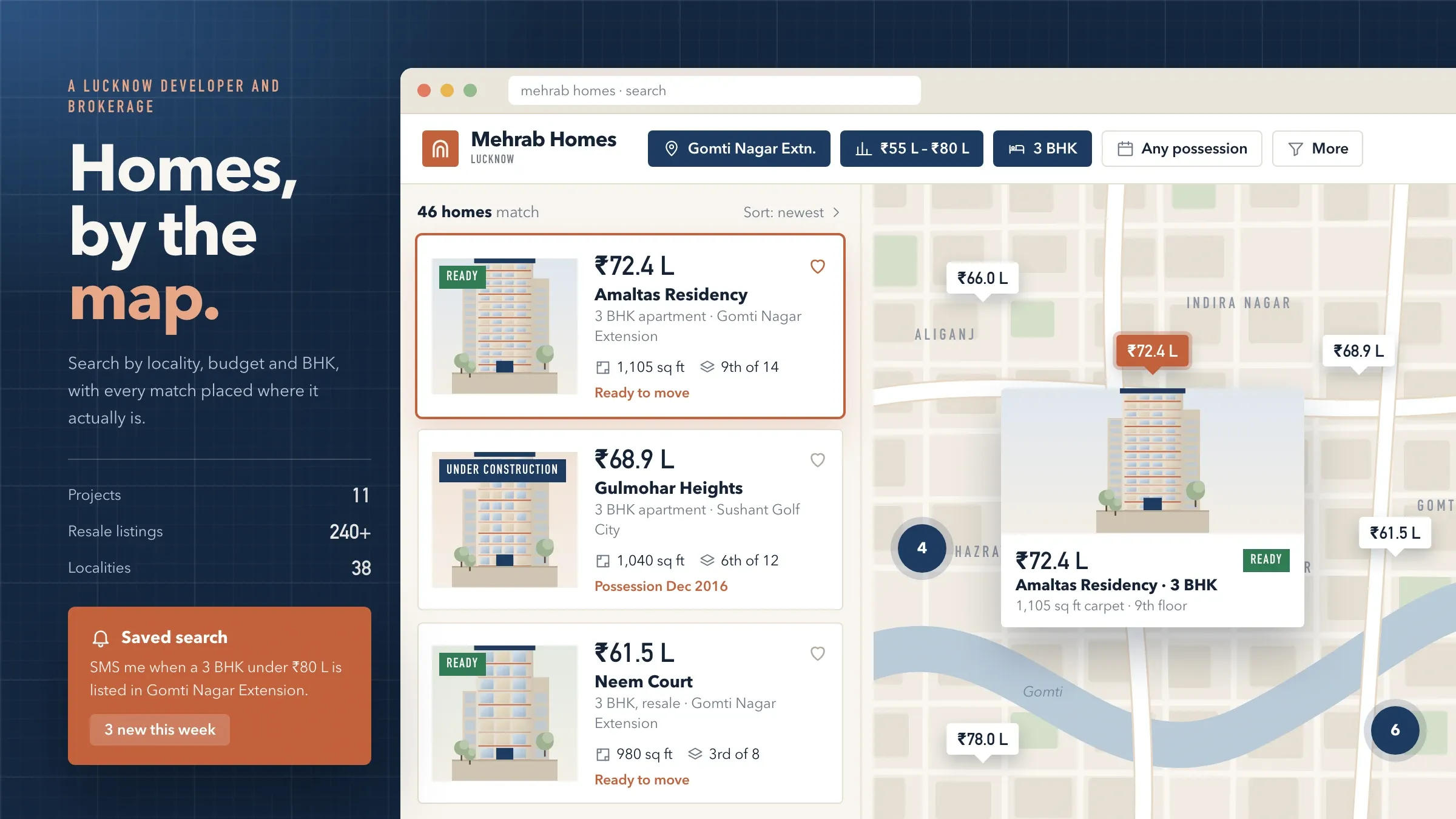
Real estate listing portal for a developer and brokerage: property search with maps, project microsites, and lead capture sent straight to sales.
- Client
- A real estate developer and brokerage in Lucknow
- Industry
- Real estate
- Location
- Lucknow, Uttar Pradesh, India
- Year
- 2014
- Duration
- 6 months
At a glance
- The challenge
Buyers couldn't see what was for sale, and the sales team couldn't see who wanted to buy.
- What buyers and the sales team told us
We spent the first month with the sales team, site managers and recent buyers.
- Search the way buyers search
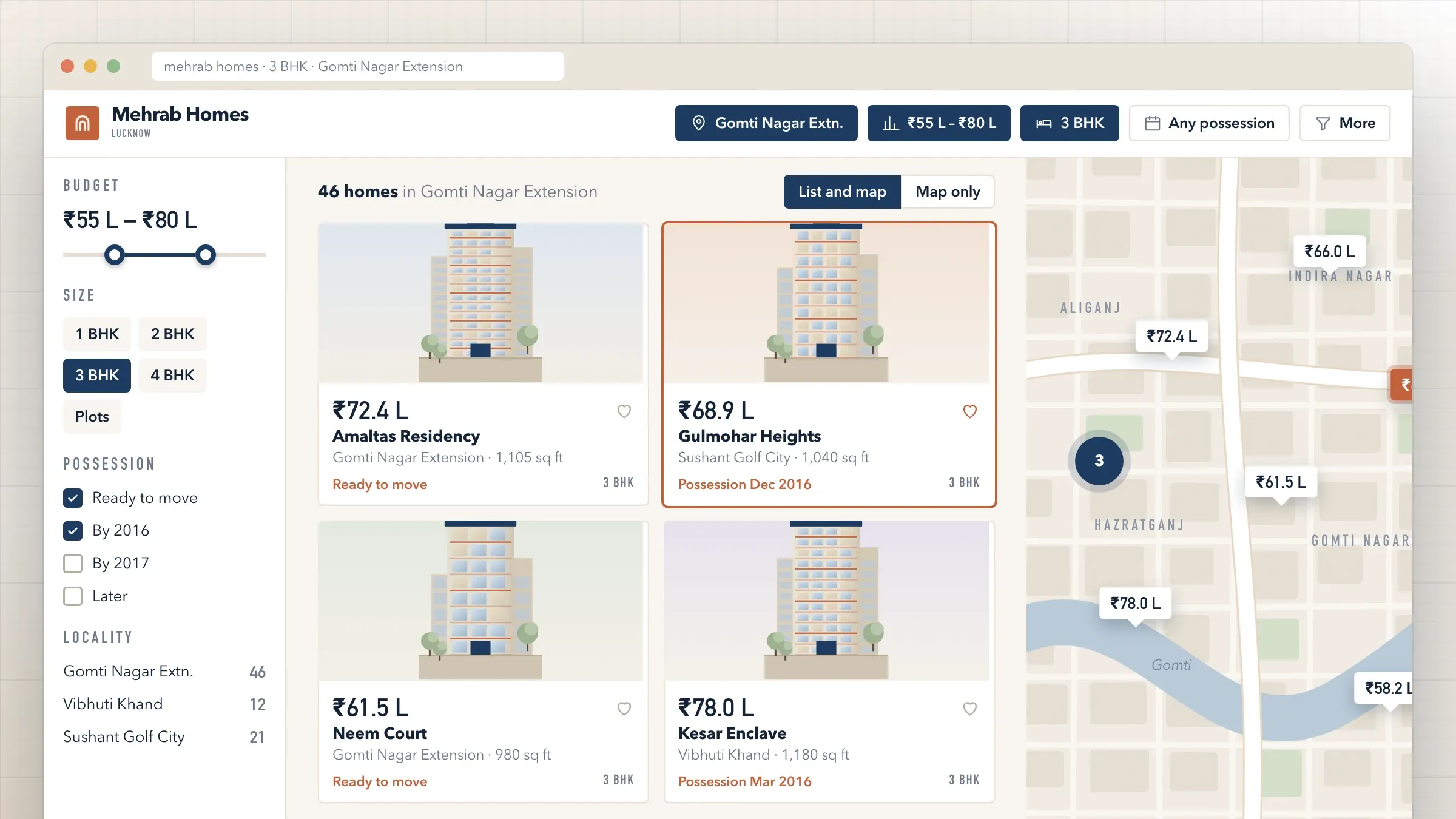
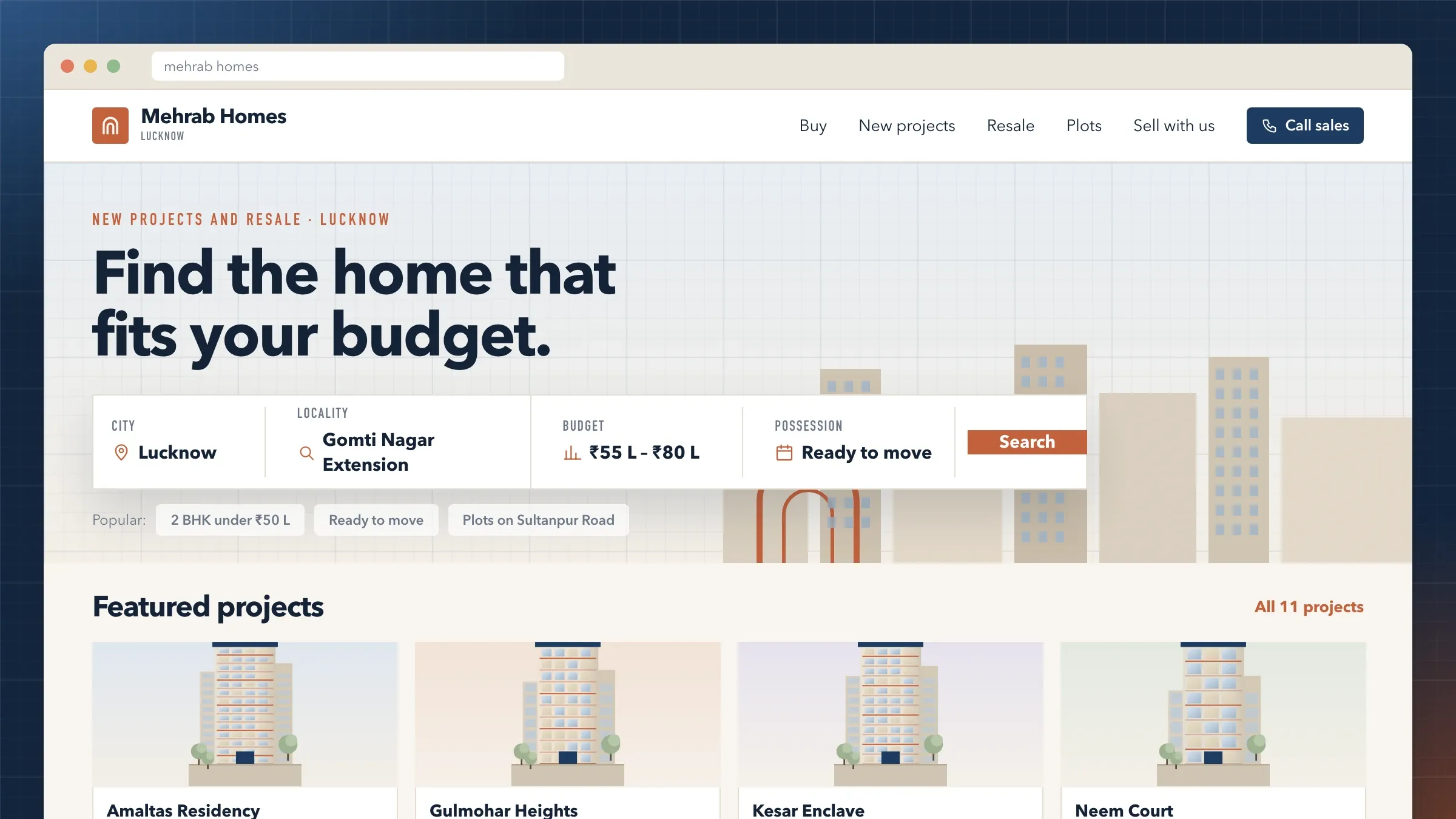
The portal lets buyers search by city, locality, budget, size (1, 2, 3 or 4 BHK, plots and shops), property type and possession date, with ready-to-move and under-construction homes clearly separated.
- A microsite for every project
Every new project gets its own microsite inside the portal, ready on the first day of bookings:
- Every enquiry becomes a lead
Every enquiry is captured as a lead with its source:
- Inventory that stays current
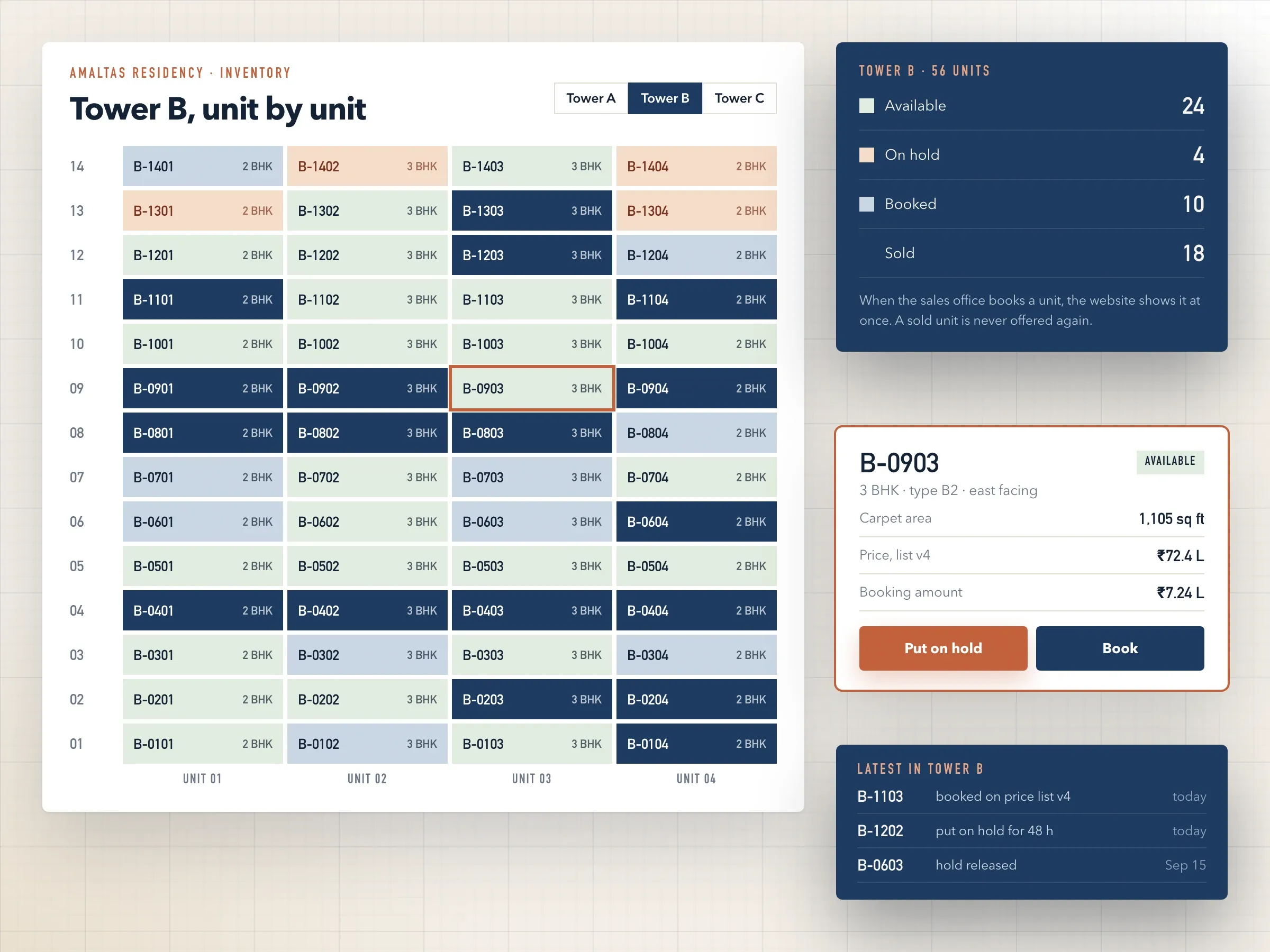
Each project's inventory is tracked unit by unit: tower, floor and unit, marked available, on hold, booked or sold.
- How it's built
The portal is built on Laravel and MySQL, with jQuery and Bootstrap for a responsive front end that works on phones and desktops.
- Launch and the years after
The portal launched alongside the company's next project, whose microsite went live on the first day of bookings.
- The outcome
Buyers find properties on their own, at any hour, with prices and availability that stay current.
The challenge
Buyers couldn’t see what was for sale, and the sales team couldn’t see who wanted to buy. The company sold new projects and resale properties through printed brochures, price lists, spreadsheets and phone calls.
Prices and availability went out of date within days of printing. Enquiries from newspaper ads, property portals and site visits were written into personal notebooks, so leads were lost when a salesperson was busy, on leave or moved on. Every project launch meant designing new brochures and starting the marketing from scratch.
What buyers and the sales team told us
We spent the first month with the sales team, site managers and recent buyers.
- Buyers start with budget, locality and possession date. Everything else came later, so search had to lead with those three.
- They want to see where it is. Distance to work, schools, hospitals and the main road decided more visits than any brochure photo.
- Sales lost leads in the gaps between an ad running and someone calling back. Speed of reply mattered more than anything else.
- The sales office kept the real availability, on a sheet that nobody outside it could see.
Search the way buyers search
The portal lets buyers search by city, locality, budget, size (1, 2, 3 or 4 BHK, plots and shops), property type and possession date, with ready-to-move and under-construction homes clearly separated. Results show on a list or on a map, with nearby properties grouped so the map stays readable.
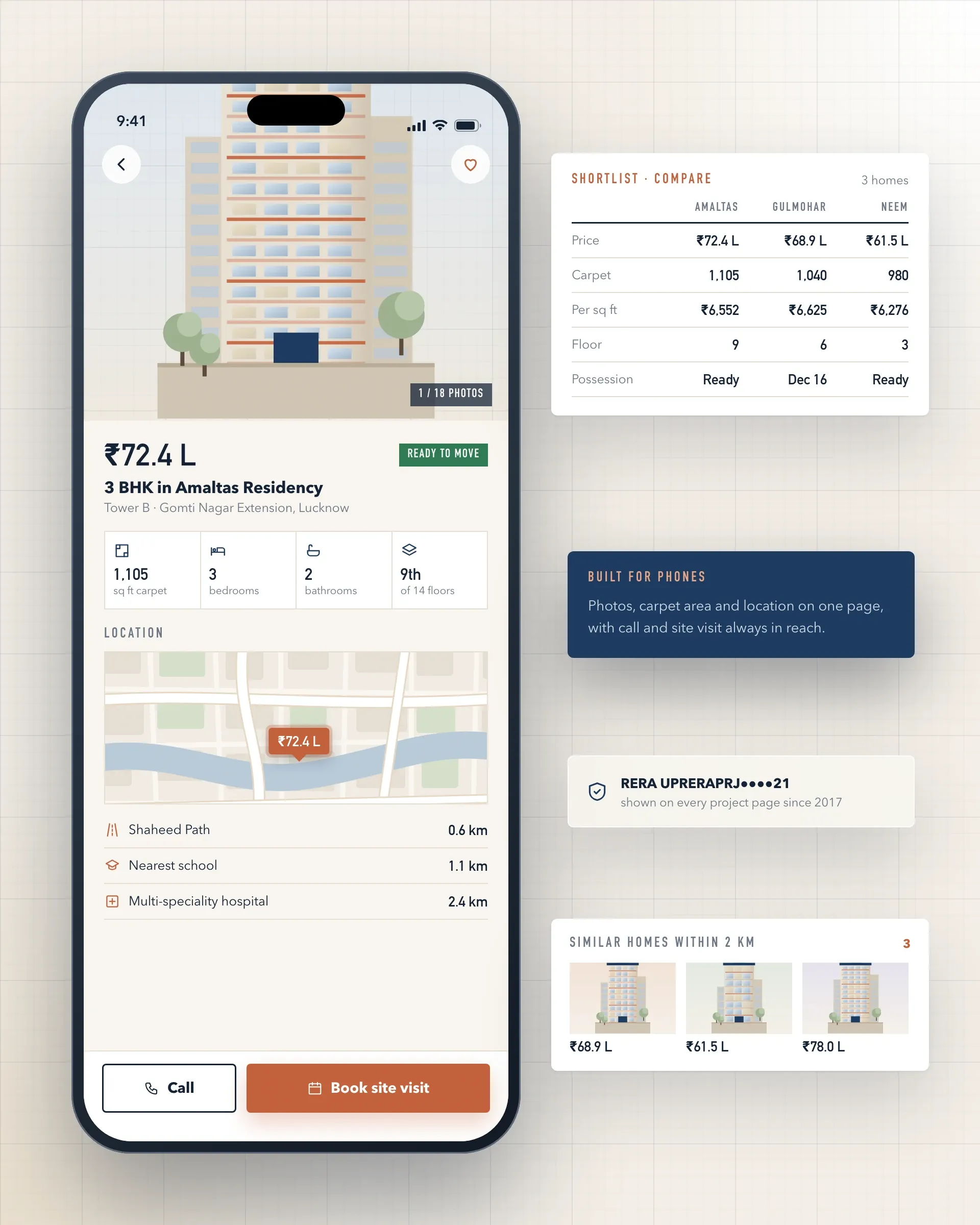
Buyers can shortlist properties, compare them side by side, and see each property’s photos, floor plan, carpet area, amenities and location on one page. The portal was built to work on the phones buyers were starting to use for everything, not only on desktop.
A microsite for every project
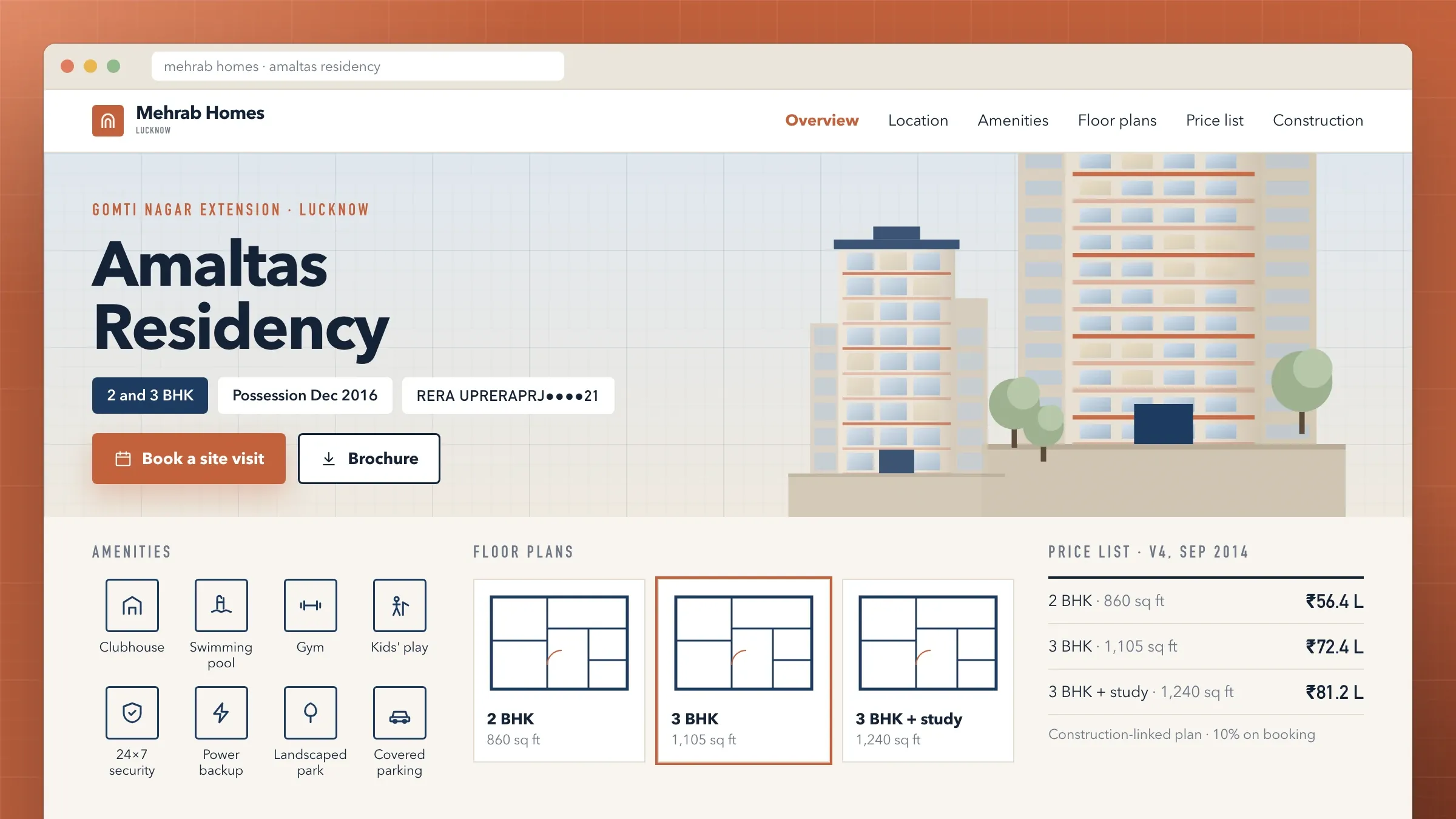
Every new project gets its own microsite inside the portal, ready on the first day of bookings:
- the location map with the distances that matter;
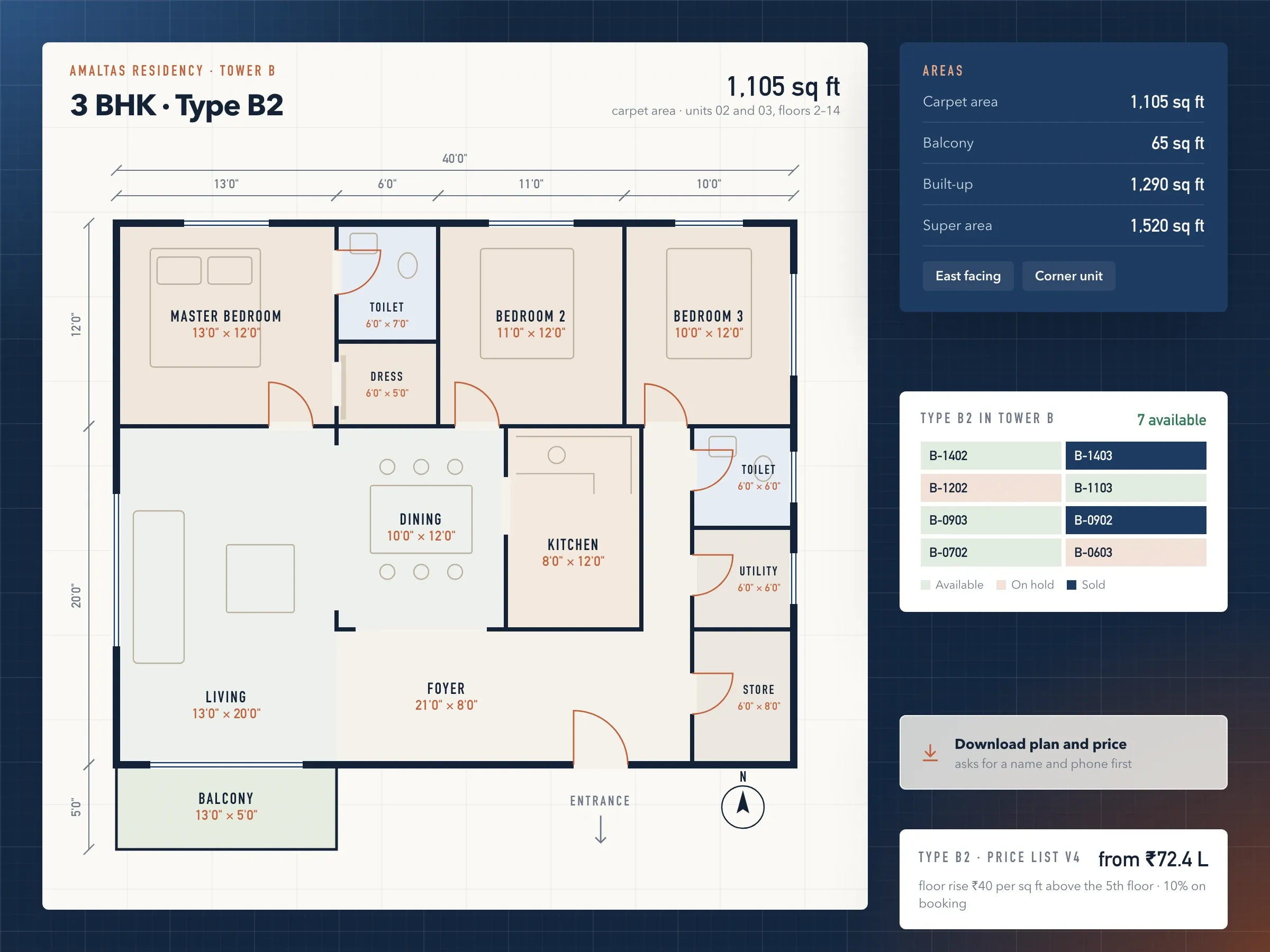
- amenities, specifications and floor plans for each unit type;
- the price list and the construction-linked payment plan;
- a brochure download that asks for a name and phone number first;
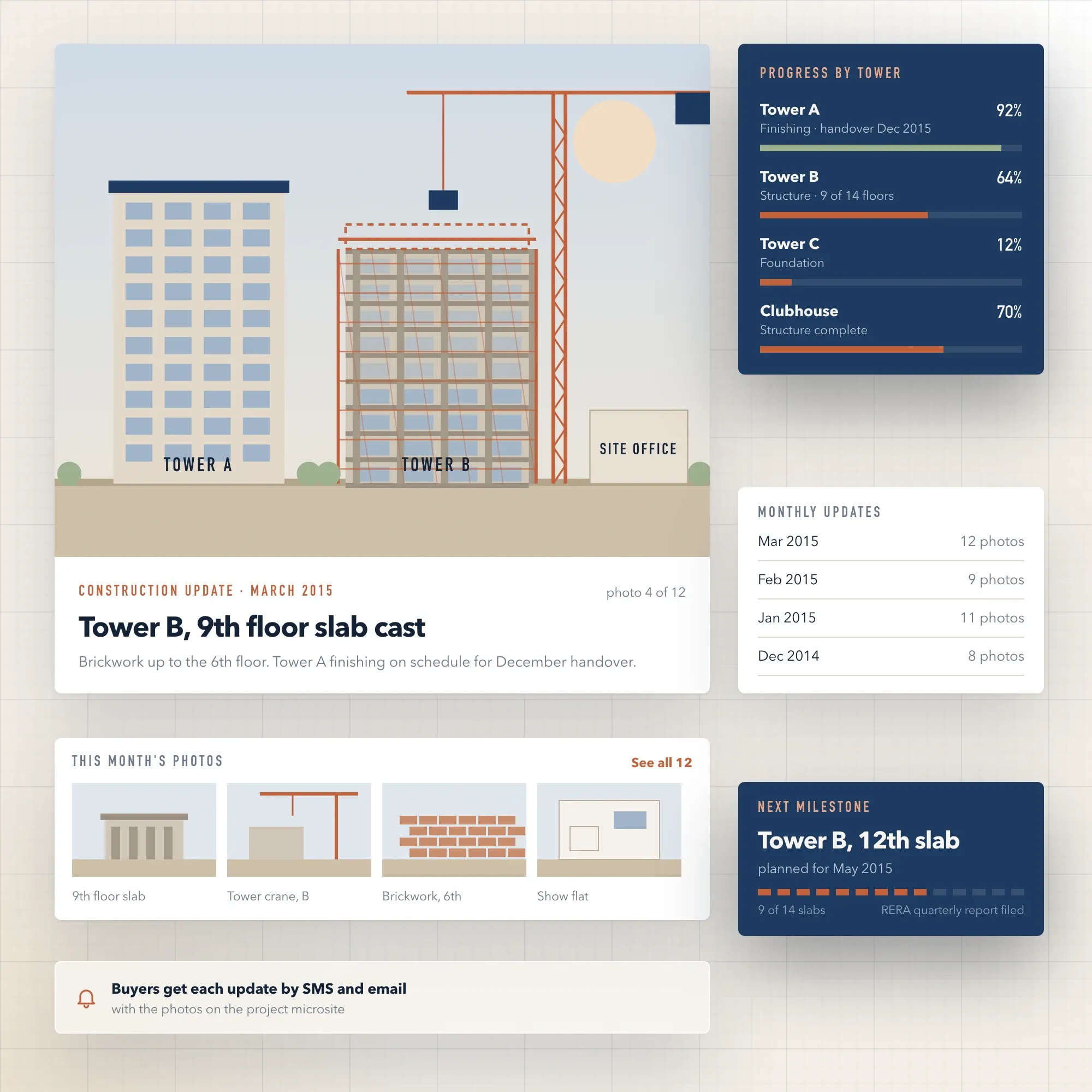
- construction updates with photos, month by month;
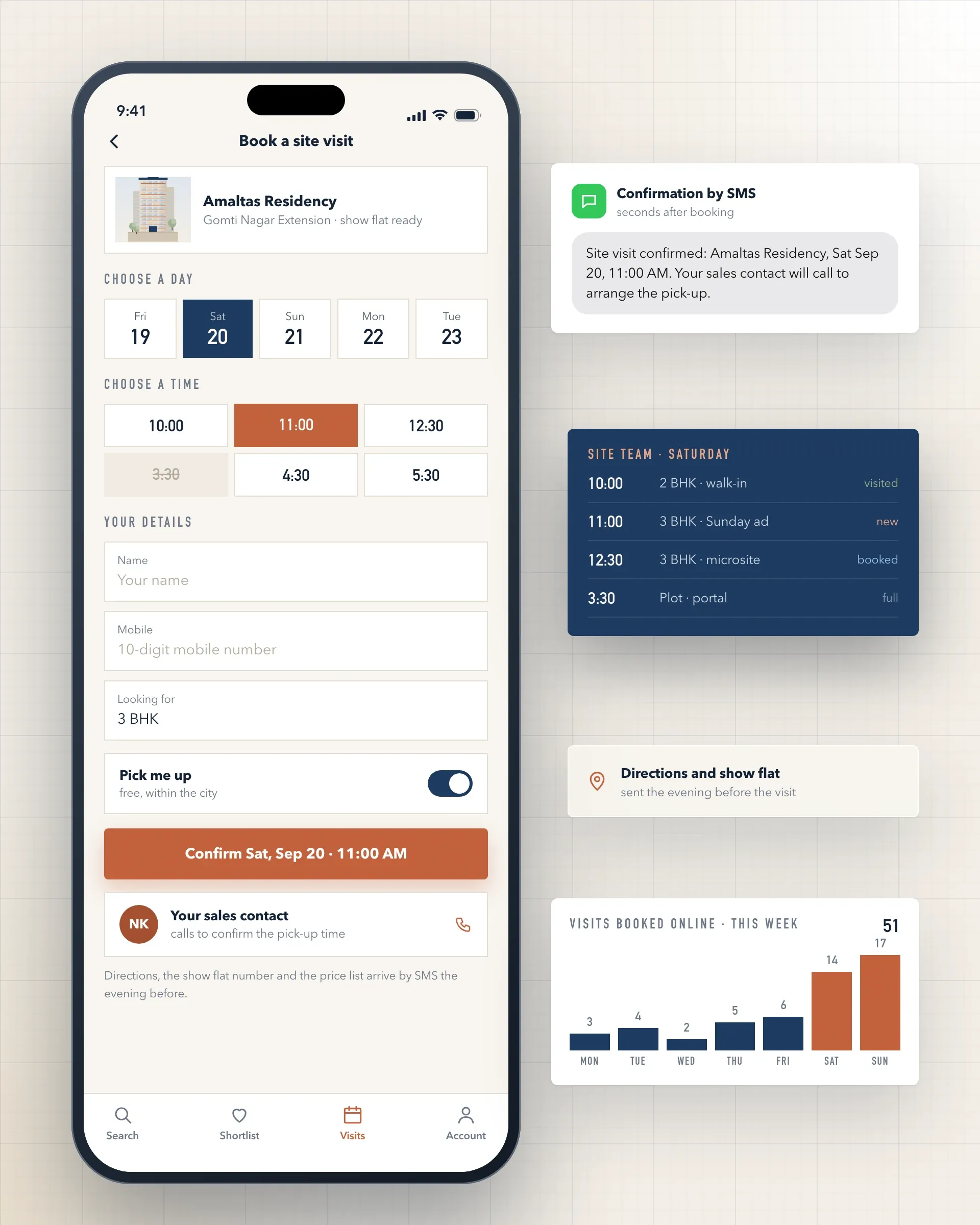
- site visit booking with a choice of date and time.
The team creates a new microsite from the admin panel, so a launch no longer starts with a blank page.
Every enquiry becomes a lead
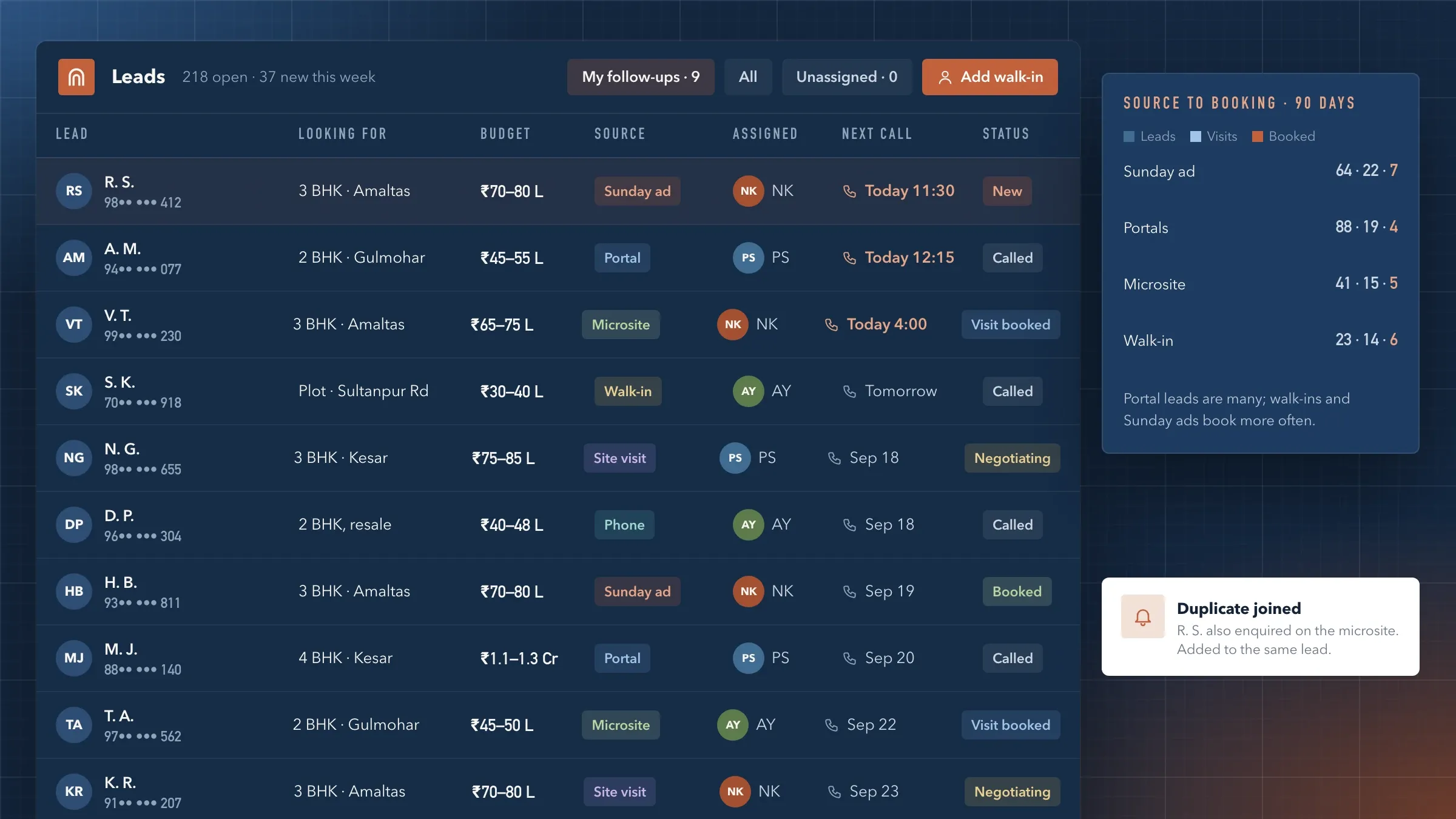
Every enquiry is captured as a lead with its source:
- forms on the portal and on each microsite;
- dedicated phone numbers and landing pages for each newspaper ad, so every ad can be measured;
- enquiries forwarded by property portals, read from their emails automatically;
- walk-ins and site visits, entered by the site team on the spot.
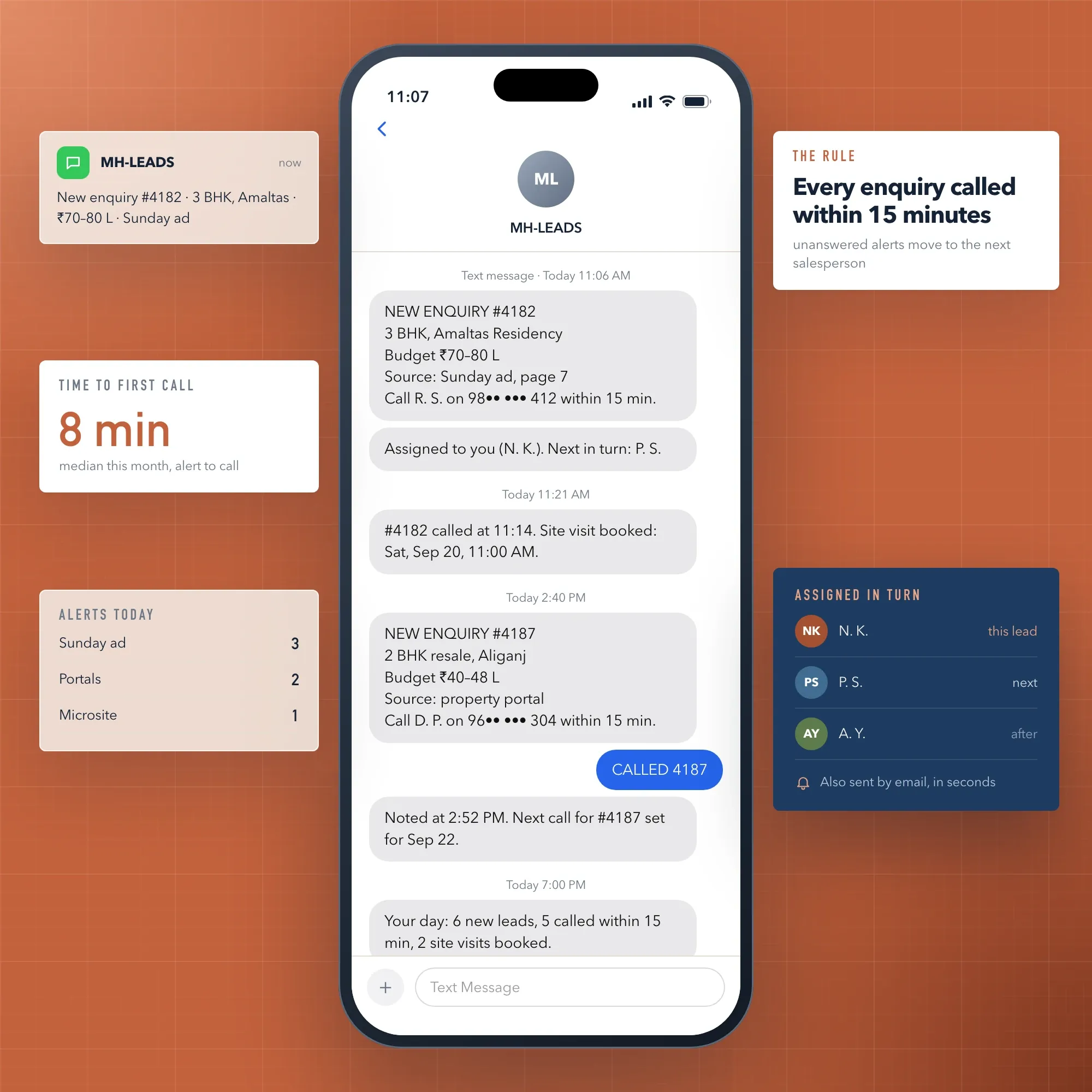
New leads are assigned to salespeople in turn and alerted by SMS and email the moment they arrive. Duplicate enquiries from the same buyer join their existing lead instead of starting a new one. Each salesperson has a follow-up list with the next call date for every lead, and managers see which sources bring buyers who actually visit and book.
Inventory that stays current
Each project’s inventory is tracked unit by unit: tower, floor and unit, marked available, on hold, booked or sold. When the sales office books a unit, the website shows it straight away, so a sold unit is never offered again. Price list changes are saved as new versions, and every booking records the price list it was made on.
How it’s built
The portal is built on Laravel and MySQL, with jQuery and Bootstrap for a responsive front end that works on phones and desktops. Google Maps powers map search and location pages, photos and floor plans are stored on Amazon S3, and an SMS gateway sends lead alerts.
Every locality, project and property has its own clean address, title and description, all listed in a sitemap, so buyers searching for homes in a locality find the right page.
Launch and the years after
The portal launched alongside the company’s next project, whose microsite went live on the first day of bookings. Existing projects and resale listings were loaded and checked against the sales office’s records before launch.
We supported the portal for years afterwards. New projects and listings were added, and when RERA came into force in 2017, each project’s RERA registration number was added to its microsite and advertising pages.
The outcome
Buyers find properties on their own, at any hour, with prices and availability that stay current. Every enquiry reaches the right salesperson within seconds and stays on record, managers see which sources bring buyers who book, and each new project launches with its own microsite on day one.
How the project ran
6 months in 6 phases
- Month 1
Discovery
Sessions with the sales team and site managers, every brochure, price list and spreadsheet reviewed, and the questions buyers asked most written down.
- Month 2
Design
Search, property pages and project microsites designed around budget, locality and possession date, the three things buyers filtered by first.
- Months 3–4
Portal and inventory
The listing portal, map search, project microsites and unit-level inventory, with every live project loaded and checked against the sales office's records.
- Month 5
Leads and alerts
Lead capture from every source, assignment to salespeople, SMS and email alerts and the follow-up list.
- Month 6
Launch
Launched alongside the company's next project, with its microsite live on the first day of bookings.
- 2015 onwards
The years after
New projects and resale listings added regularly, and RERA registration numbers added to every project once the law came into force in 2017.
What we delivered
- Discovery
- Product design
- Web app
- Lead management
- Cloud
- Maintenance and support
Inside the project
7 pictures
Questions and answers
10 answered
What did FIRELIFE Ventures build for a real estate developer in Lucknow?
FIRELIFE Ventures built a real estate listing portal for a developer and brokerage in Lucknow. Buyers search properties by locality, budget, size and possession date, on a list or a map, each new project gets its own microsite, and every enquiry reaches the right salesperson within seconds.
What is a real estate listing portal?
A real estate listing portal is a website where buyers search properties by location, price, size and type, see photos, floor plans and maps, and contact the seller. For a developer or brokerage, it also captures every enquiry as a sales lead.
What features should a real estate portal have?
The essentials are property search with filters, map search, detailed property pages with photos and floor plans, enquiry forms that reach the sales team instantly, live availability, and an admin panel so listings and prices can be updated without a developer.
What is a project microsite in real estate?
A project microsite is a dedicated set of pages for one housing or commercial project, with its own location map, amenities, floor plans, price list, payment plans and enquiry form, so each launch can be marketed on its own.
How does lead capture work on a property portal?
Every enquiry form records the property, the buyer's details and where they came from, whether a newspaper ad, a property portal, a site visit or a search. The lead is assigned to a salesperson and alerted by SMS and email at once, and the sales team sees every lead in one panel.
How does unit-level inventory help a developer?
Each tower, floor and unit is tracked as available, on hold, booked or sold. The website and the sales team see the same live status, so a unit is never offered twice or sold after it is gone.
What is RERA, and how does it affect real estate websites?
RERA, India's Real Estate (Regulation and Development) Act of 2016, requires registered projects to show their RERA registration number in advertising. The portal added each project's registration number to its microsite when the law came into force in 2017.
How is the portal found in search?
Every locality, project and property has its own page with a clear address, title and description, listed in a sitemap, so buyers searching for homes in a locality land on the right page.
How long does it take to build a real estate portal?
The portal took six months from discovery to launch, including map search, project microsites, unit-level inventory, lead capture and the admin panel. A smaller listing site can launch sooner.
Can FIRELIFE Ventures build a real estate portal for my business?
Yes. FIRELIFE Ventures builds property portals, project websites, inventory and lead management for developers and brokerages, and supports them after launch. Start a project through the contact page.
More from the portfolio
All portfolio-
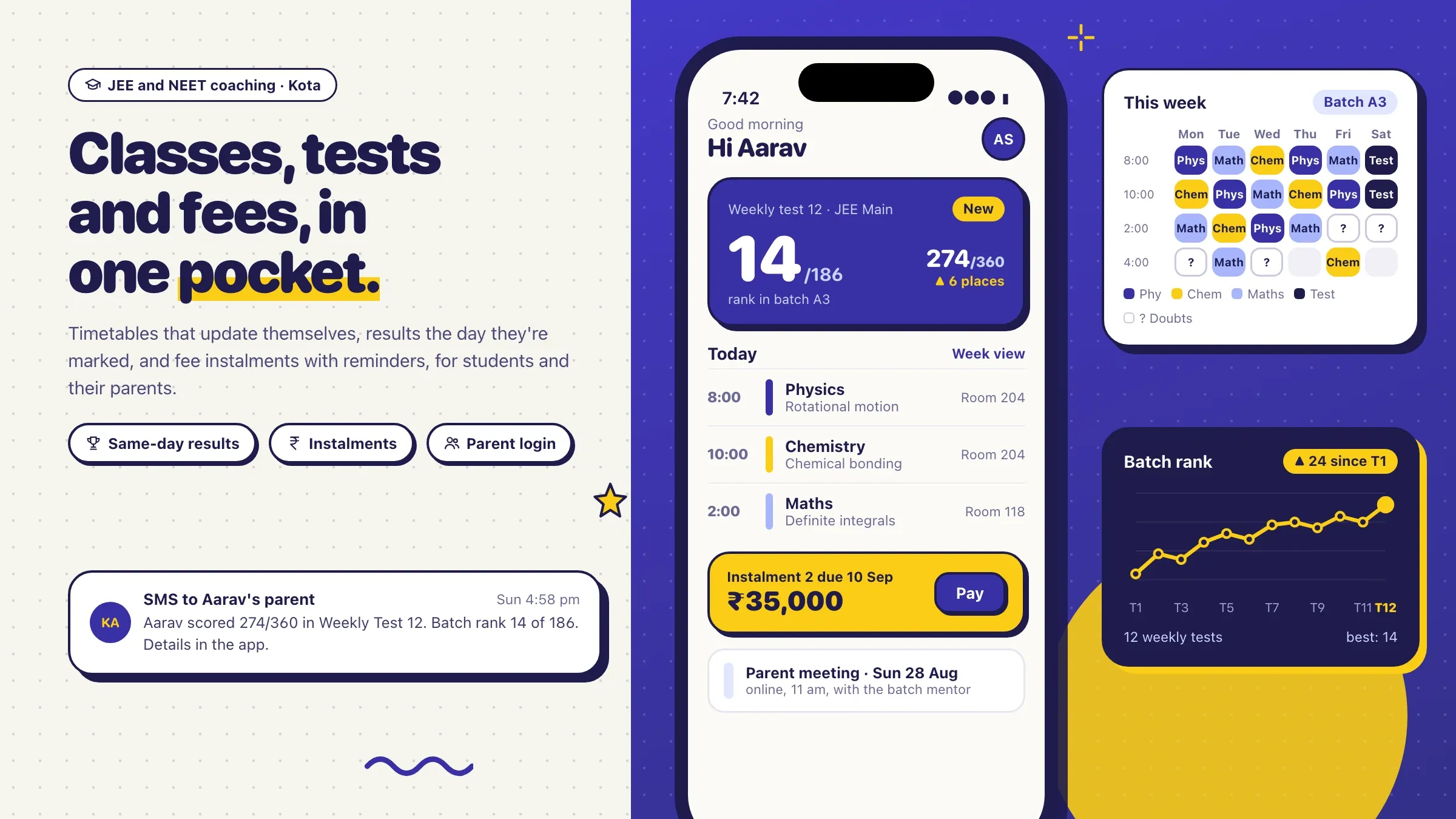 Coaching Institute Portal A coaching institute management portal for a JEE and NEET coaching institute in Kota: online admissions, fee instalments with reminders, batch timetables, OMR and online test results, and an app for students and parents.
-
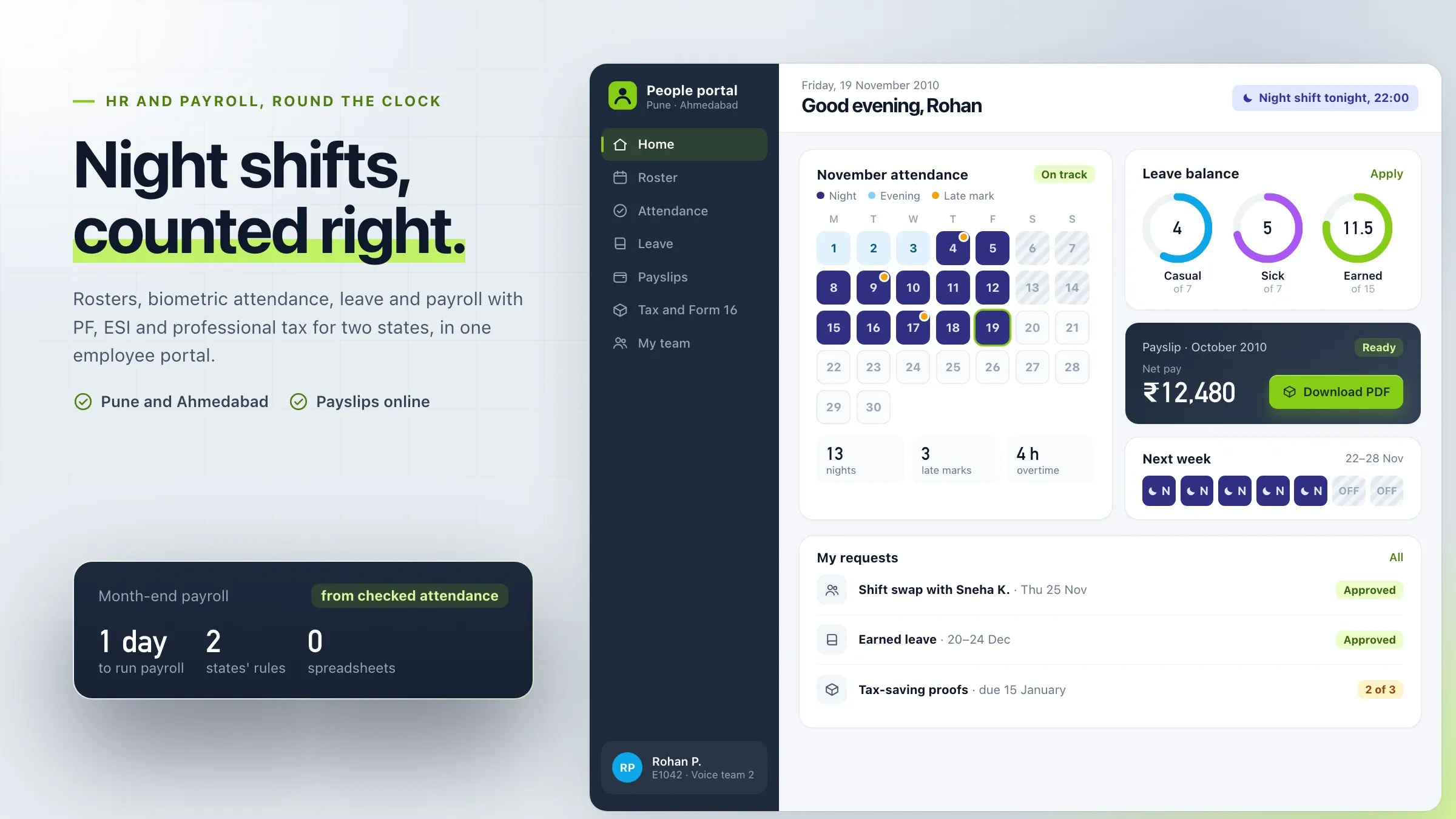 Attendance and Payroll Portal An employee self-service HR and payroll portal for a customer support company working round the clock in Pune and Ahmedabad: shift rosters, biometric attendance, leave, payroll with PF, ESI and professional tax for two states, and payslips online.
-
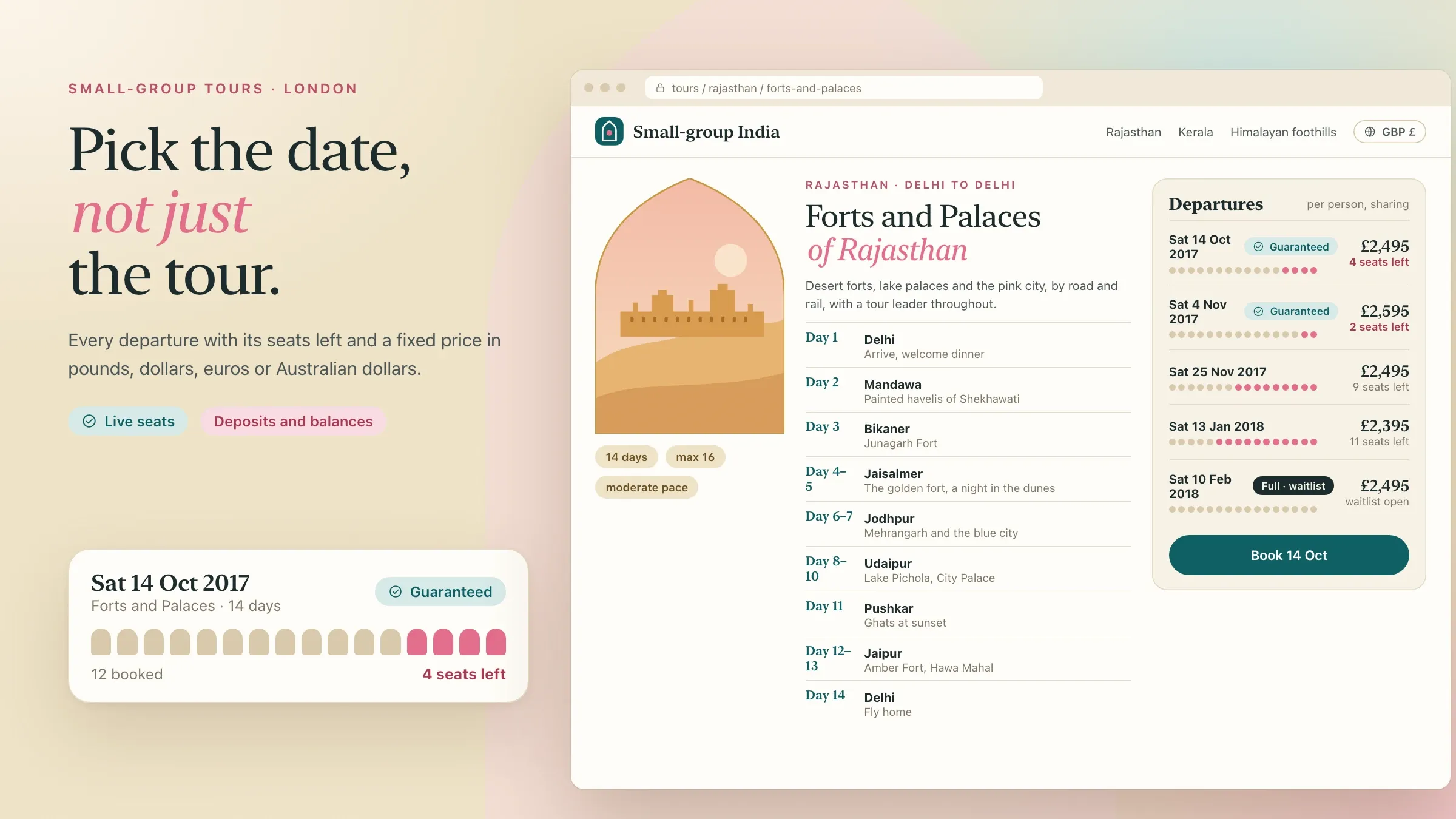 Small-Group Tour Booking A tour booking platform for a London tour operator running small-group tours in India: live seats for every departure, deposits and balances in four currencies, room sharing for solo travellers, a travel agent portal and rooming lists for the ground team.
Need something like this built?
Tell us what you want to build and where you are with it, and we'll get back to you.
Start a project