Overview
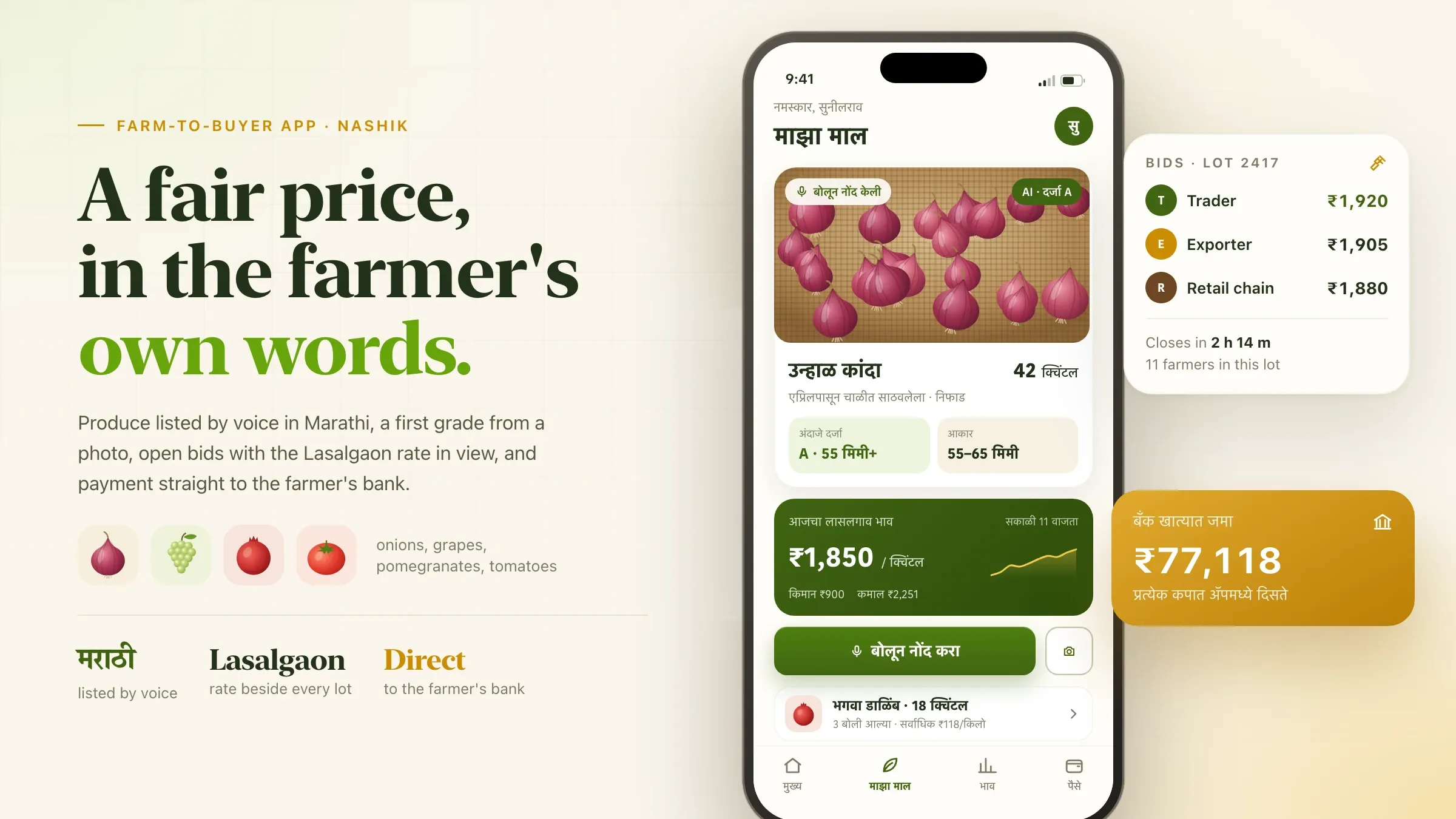
Agritech trading app for a farmer producer company: produce listed by voice in Marathi, AI quality grading from photos, buyer bidding and direct payments.
- Client
- A farmer producer company in Nashik
- Industry
- Agriculture
- Location
- Nashik, Maharashtra, India
- Year
- 2025
- Duration
- 6 months
At a glance
- The challenge
Farmers grew the produce, but others set the price.
- Field visits
We spent the first month in villages, at collection centres and at the Lasalgaon market, beside farmers, quality staff and buyers.
- Listing produce by voice
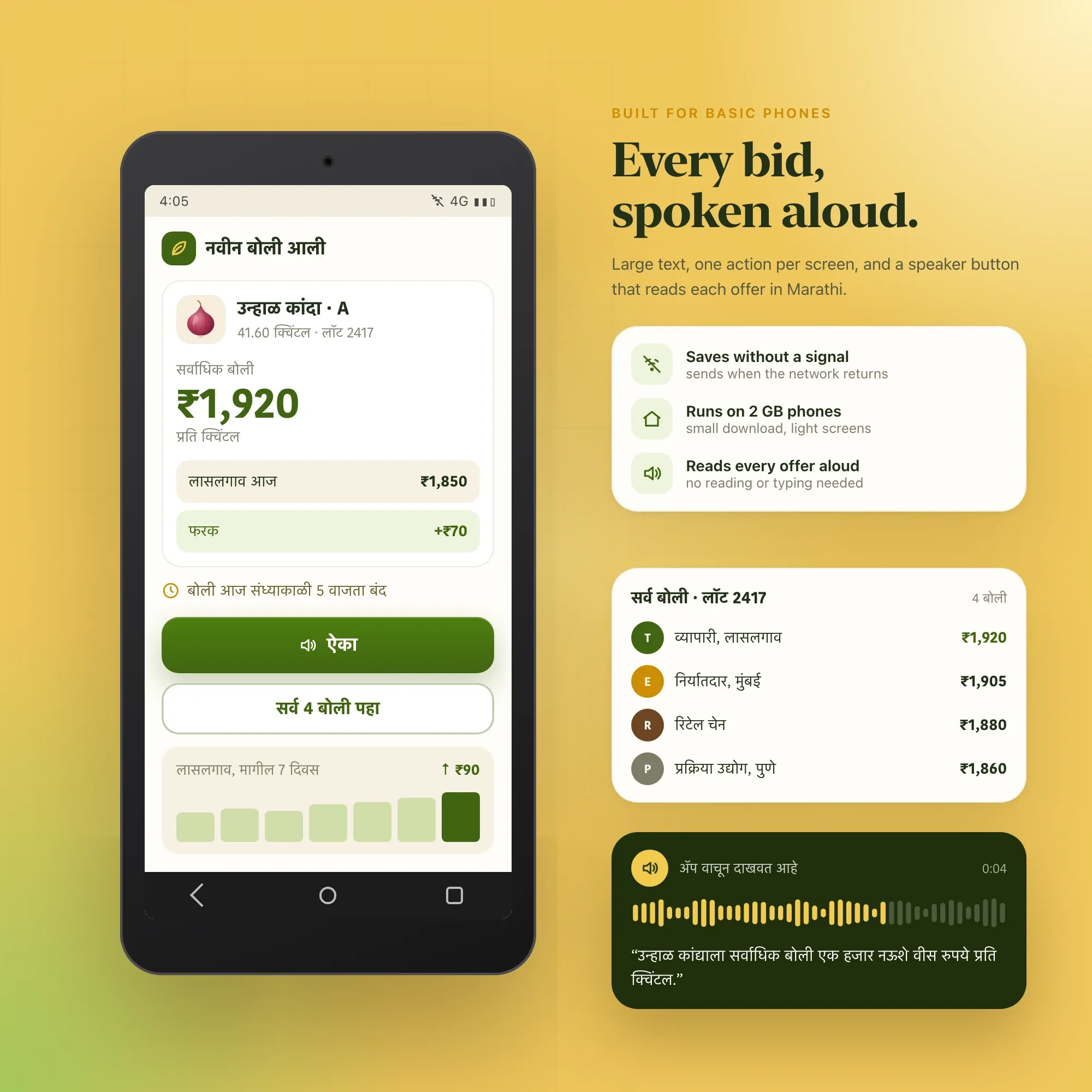
The farmer app speaks Marathi.
- Grading from photos and at the centre
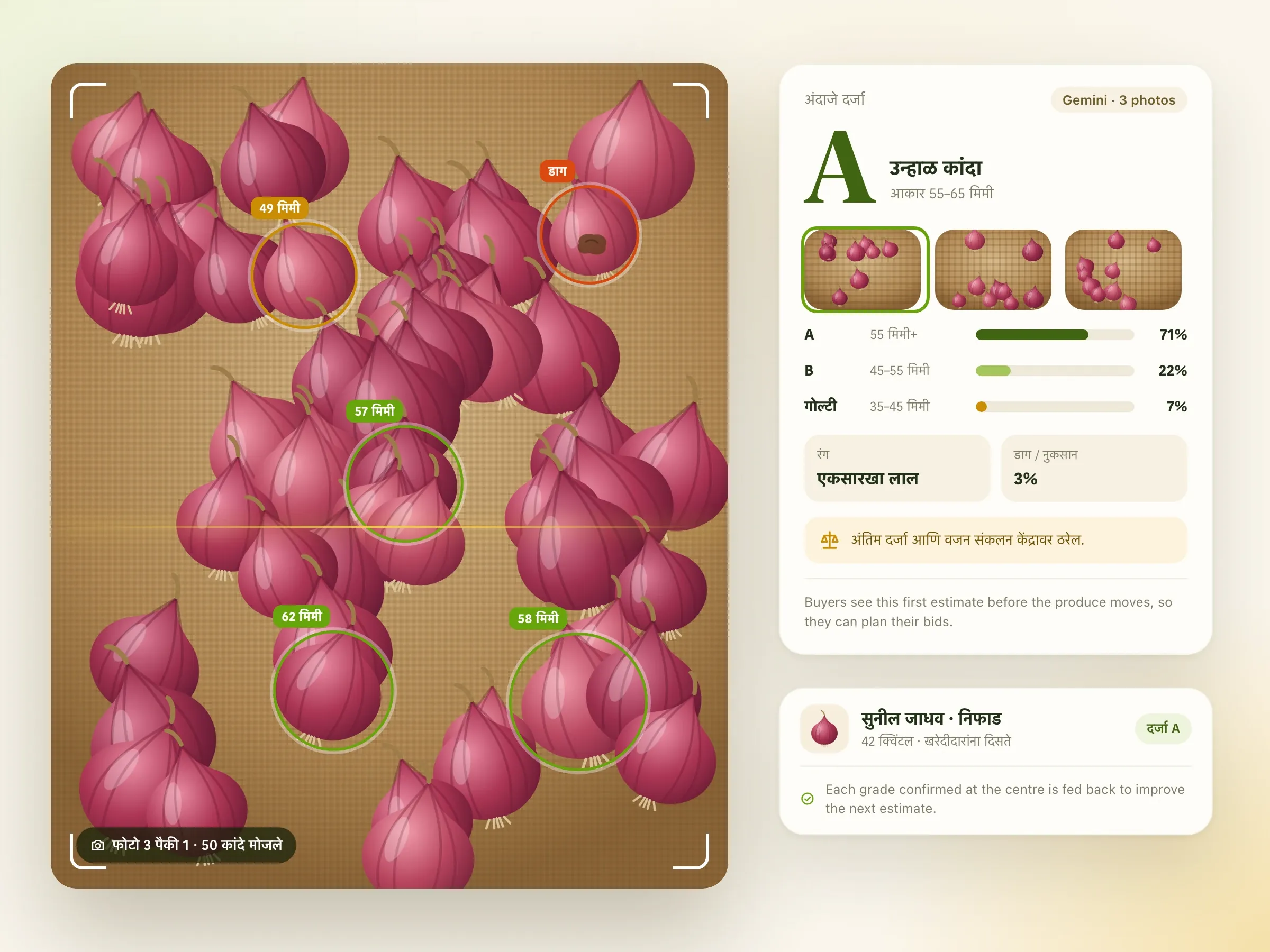
A photo of the produce gives an AI estimate of its grade, from size, colour and visible damage.
- Buyers, bids and truckloads
Buyers, including traders, exporters, processors and retail chains, see graded lots by crop, grade, quantity and location in their own app.
- Prices in the open
Today's prices at the nearby mandis, including Lasalgaon, appear beside every lot, so farmers can judge each offer against the market.
- Payments farmers can see
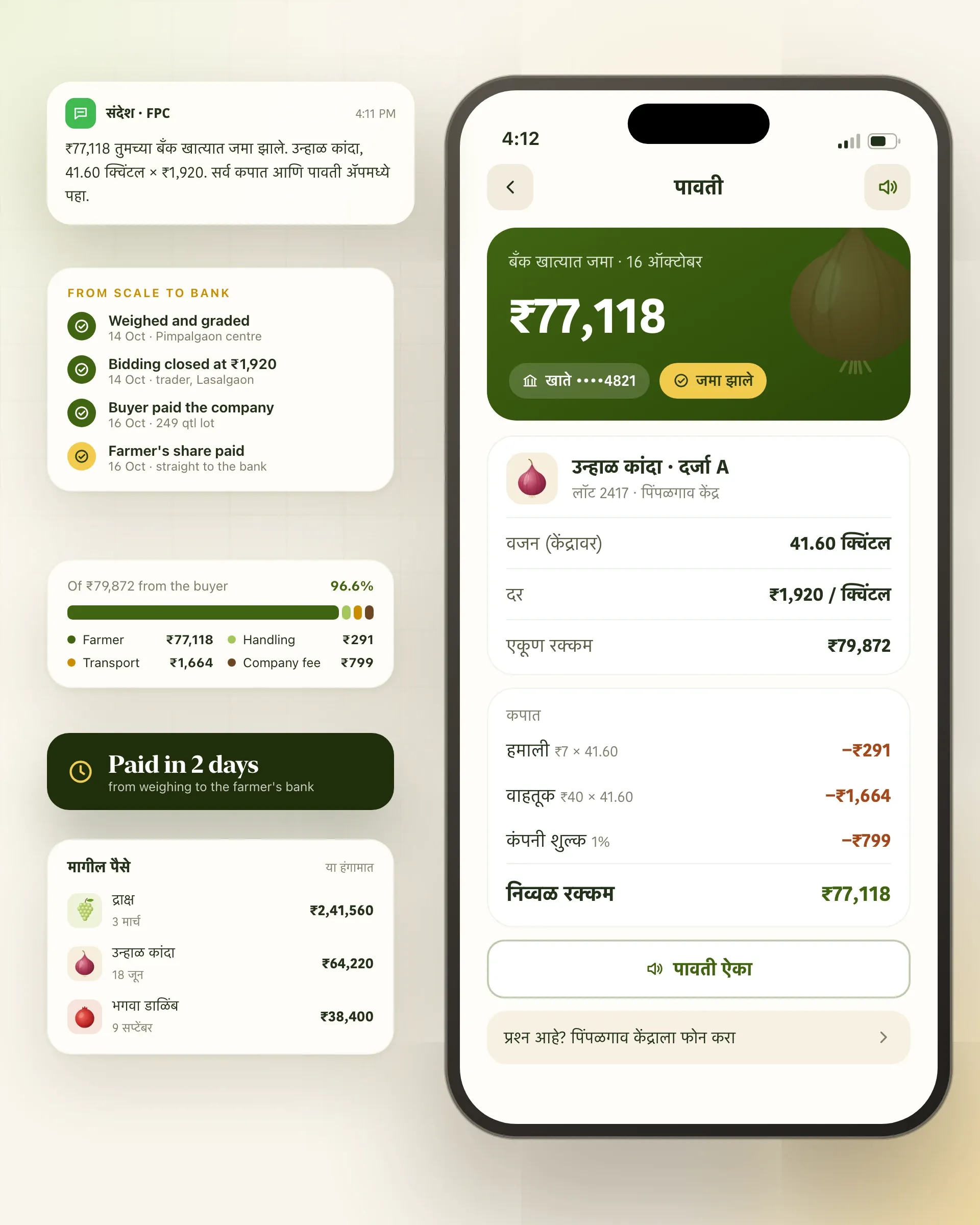
When a buyer pays through the platform, each farmer's share is worked out from the weight and grade of their produce.
- Built for the field
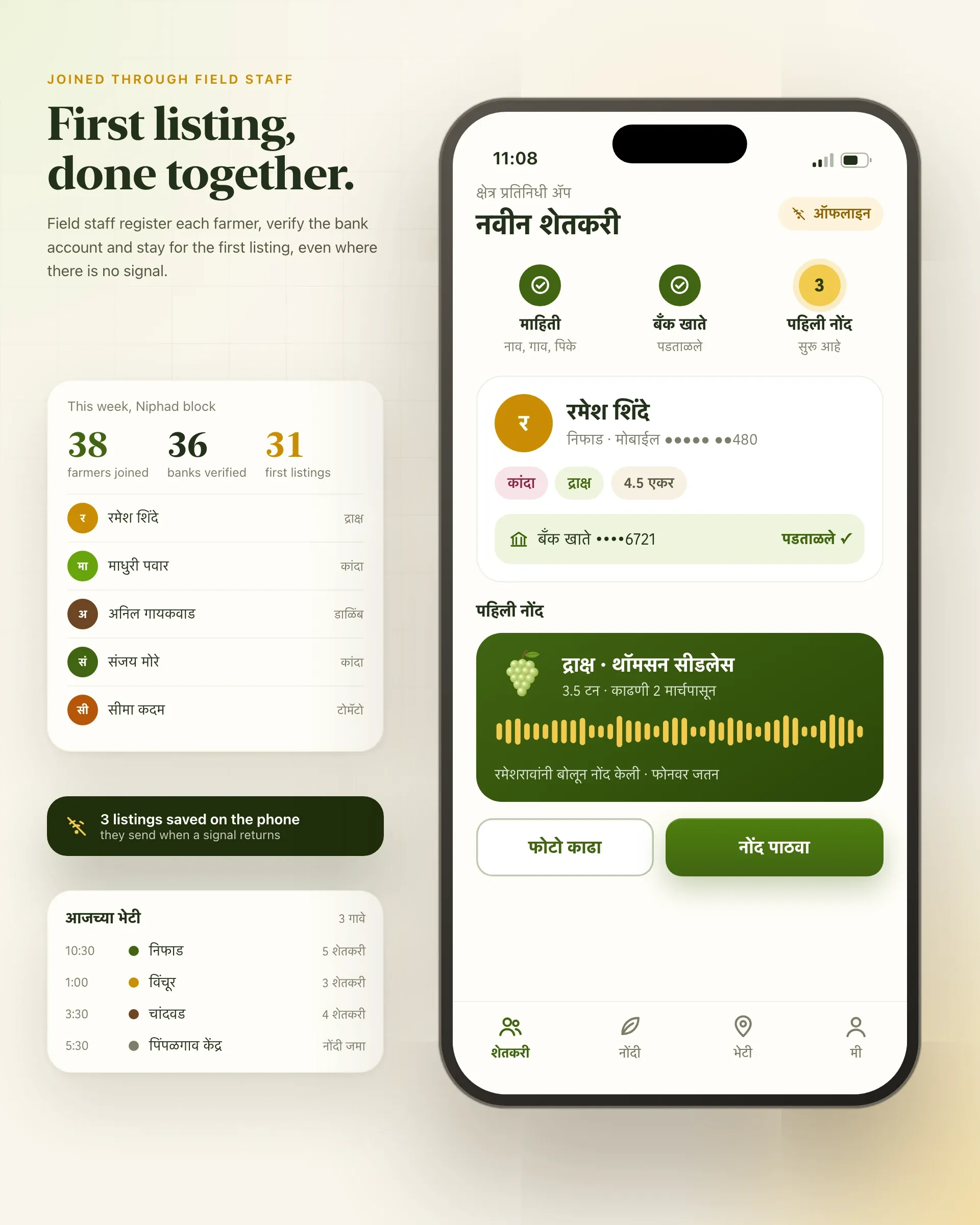
Farmers join through the company's field staff, who register them, verify their bank accounts and help with their first listing.
- How it's built
The farmer and buyer apps are built in Flutter, on a FastAPI backend in Python with PostgreSQL.
- The outcome
Farmers now list their produce in their own language without typing, and sell to buyers they could not reach before.
The challenge
Farmers grew the produce, but others set the price. The farmer producer company’s members grow onions, grapes, pomegranates and tomatoes around Nashik, home to Lasalgaon, one of Asia’s largest onion markets, and most of them sold through commission agents at the mandi.
Prices were uncertain until the day of sale, payments could take weeks, and quality was judged by eye. The company ran collection centres but found buyers by phone. Many farmers were not comfortable typing on a smartphone, and buyers such as traders, exporters, processors and retail chains wanted consistent grades and reliable supply that small farmers alone couldn’t offer.
Field visits
We spent the first month in villages, at collection centres and at the Lasalgaon market, beside farmers, quality staff and buyers.
- Farmers talk, they don’t type. Voice was the only interface everyone could use.
- Grade decides price, and grading at the mandi felt like a judgement nobody could question.
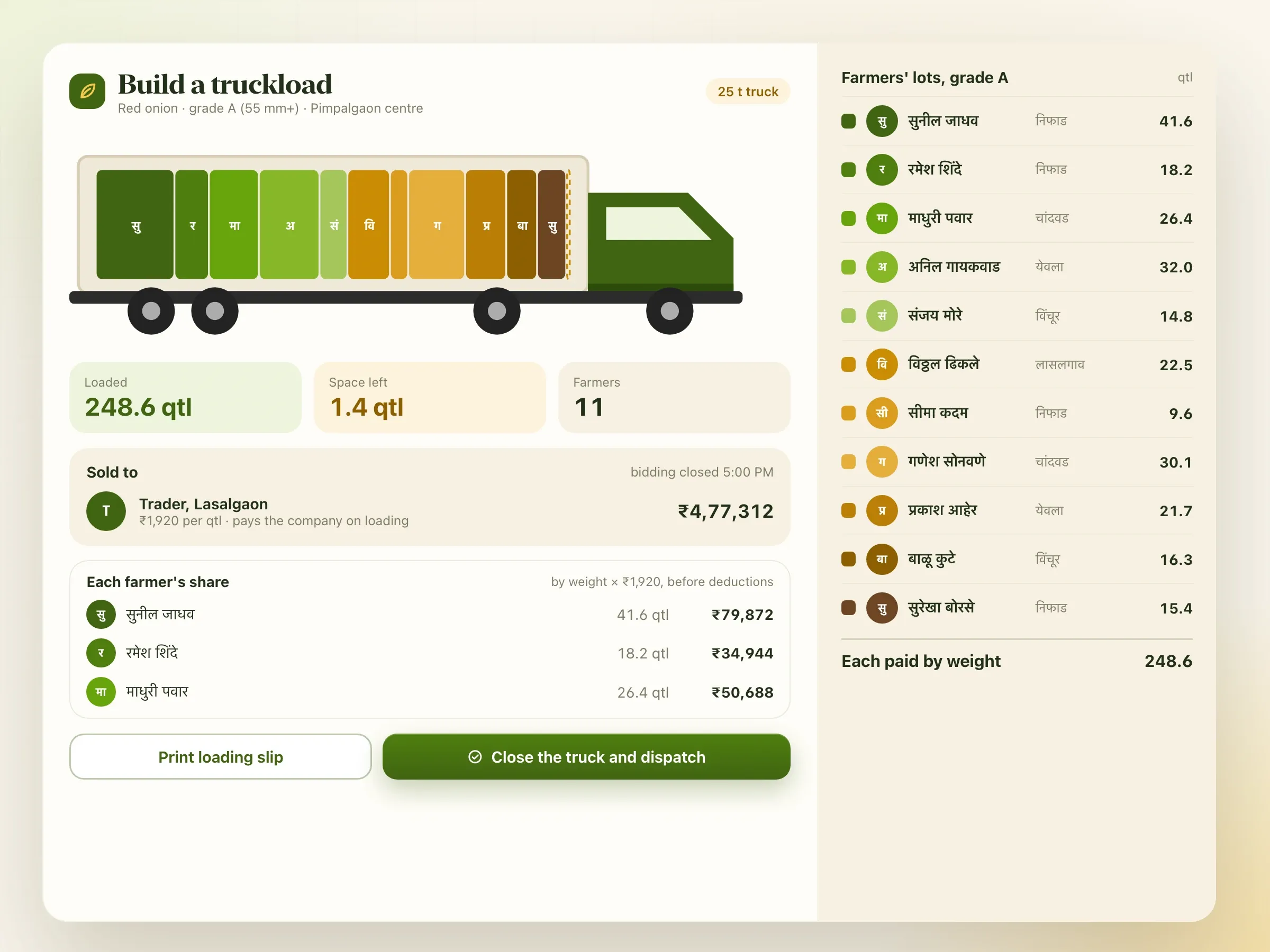
- Small farmers sell small lots, but big buyers want full truckloads of one grade.
- Late payment hurt more than low prices. Farmers needed to know when they would be paid, and how much was deducted.
Listing produce by voice
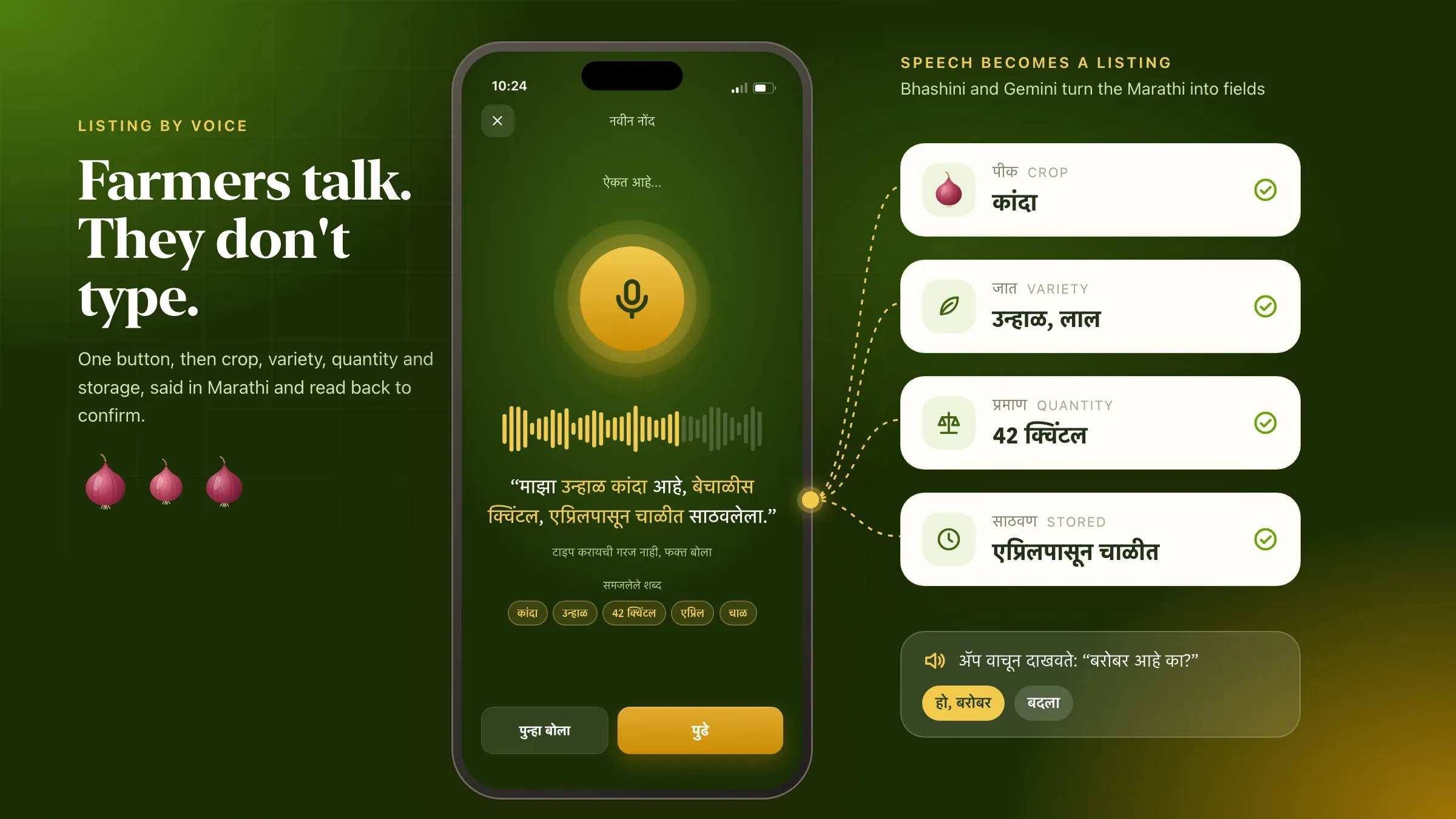
The farmer app speaks Marathi. To list produce, a farmer presses one button and says the crop, variety, quantity and expected harvest date. The app turns the speech into a listing and reads it back for the farmer to confirm or correct, by voice. Farmers who store onions after the rabi harvest can list stored onions too, with the date they went into storage.
Grading from photos and at the centre
A photo of the produce gives an AI estimate of its grade, from size, colour and visible damage. The estimate lets buyers plan before the produce moves.
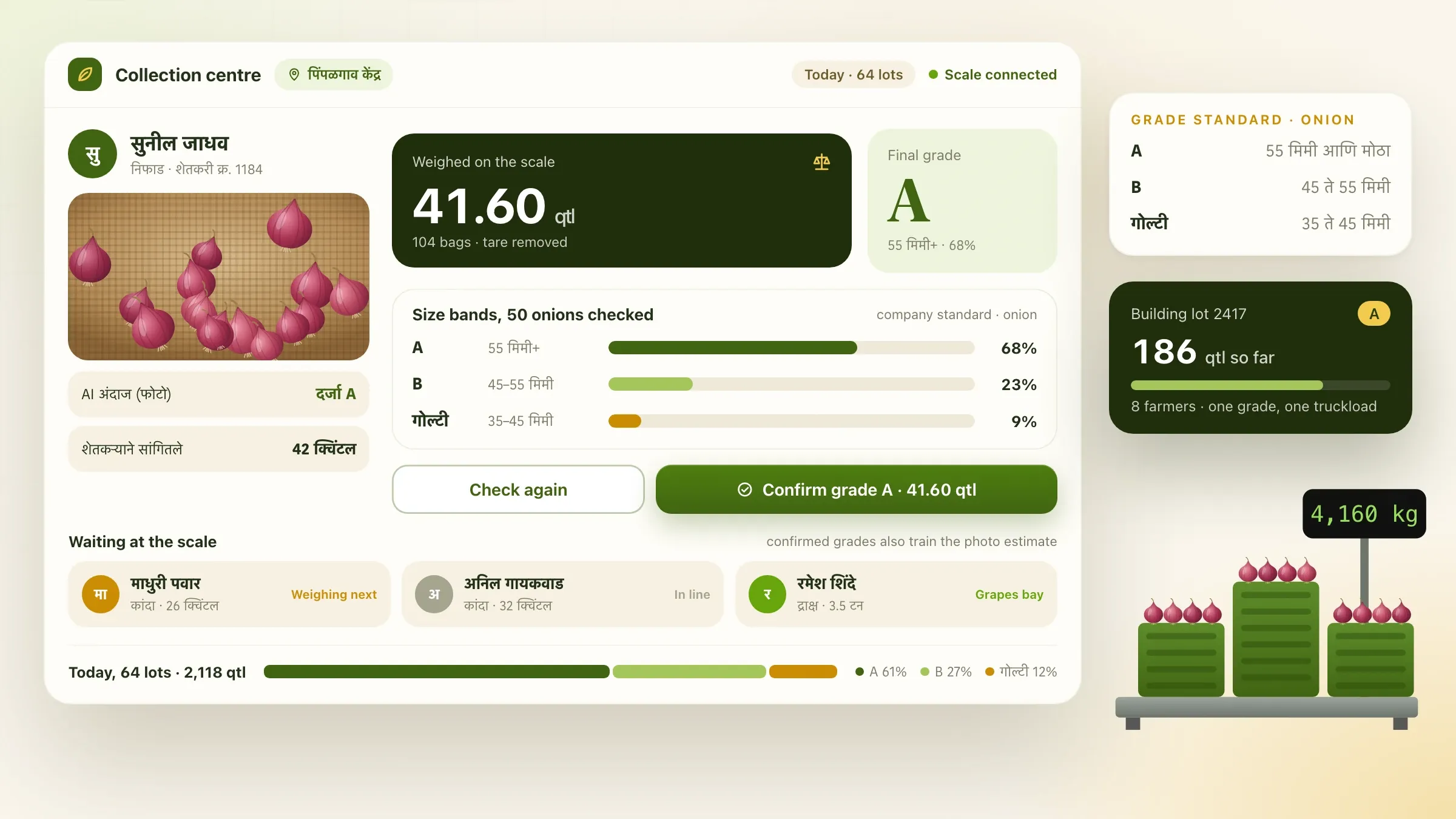
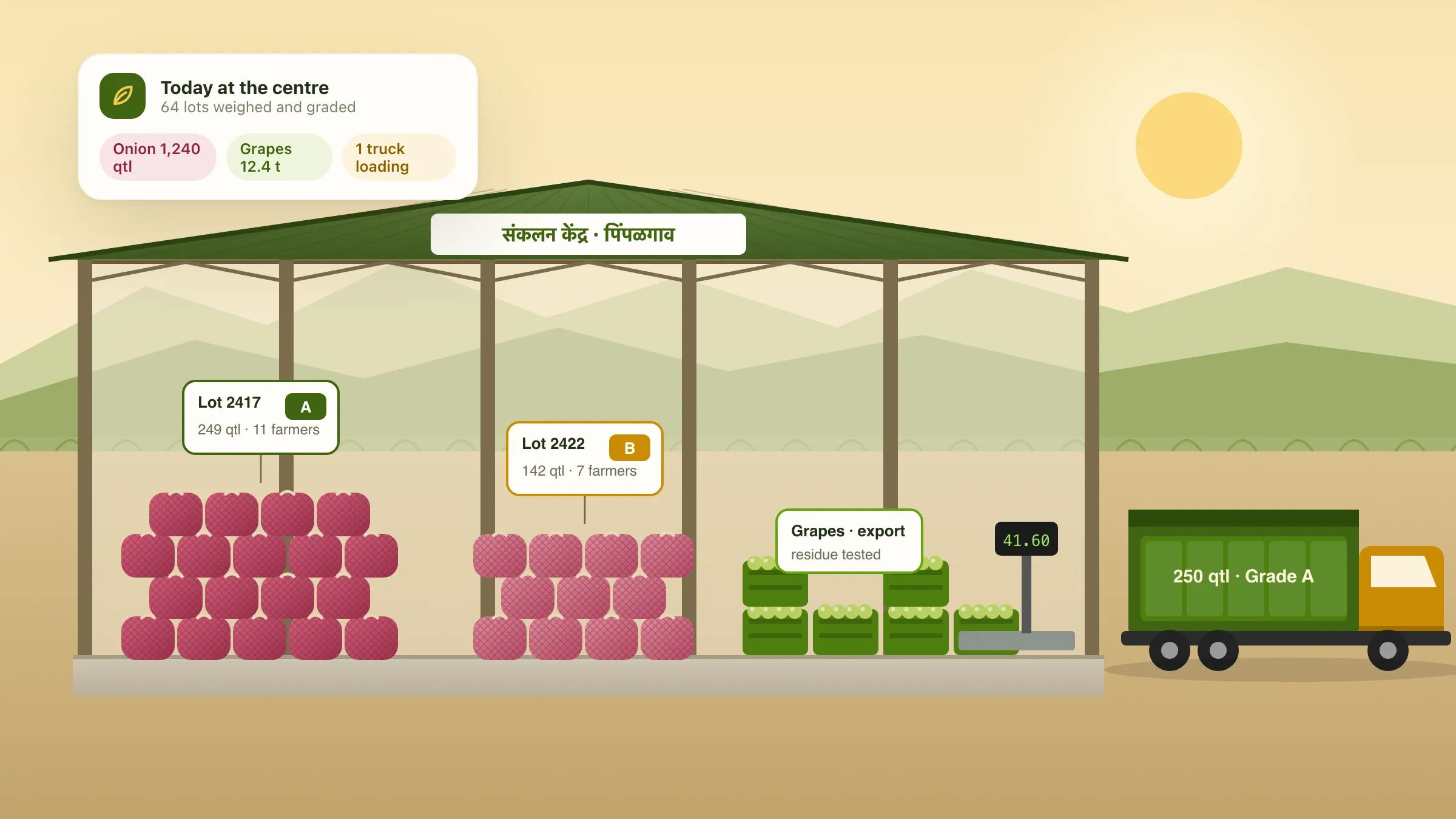
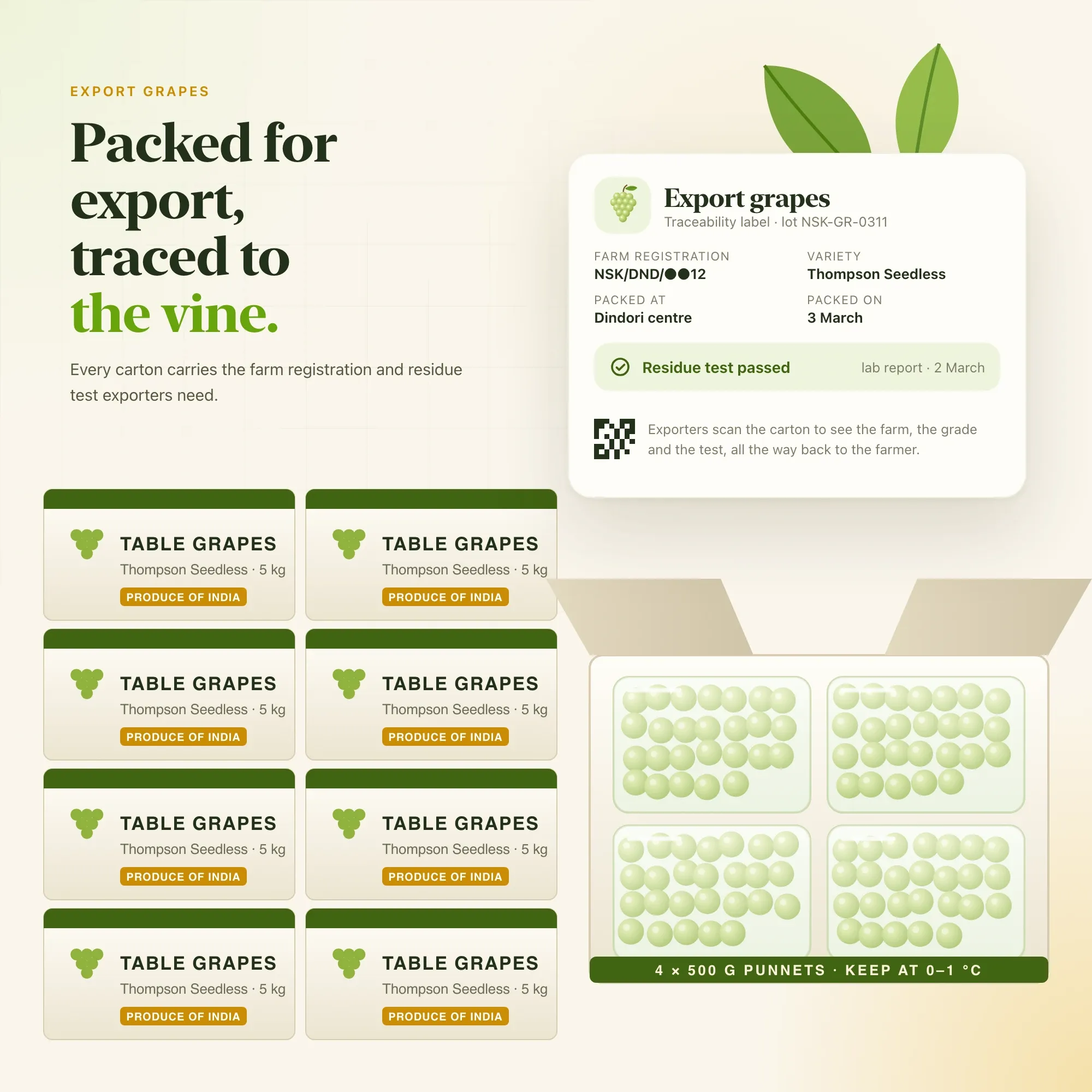
The final grade is set at the collection centre. Quality staff weigh each farmer’s produce and confirm its grade on the platform, using the company’s own grade standards for each crop, such as size bands for onions. Every confirmed grade is fed back to improve the AI’s estimates. Export grapes also carry the farm registration and residue test details that exporters need for traceability.
Buyers, bids and truckloads
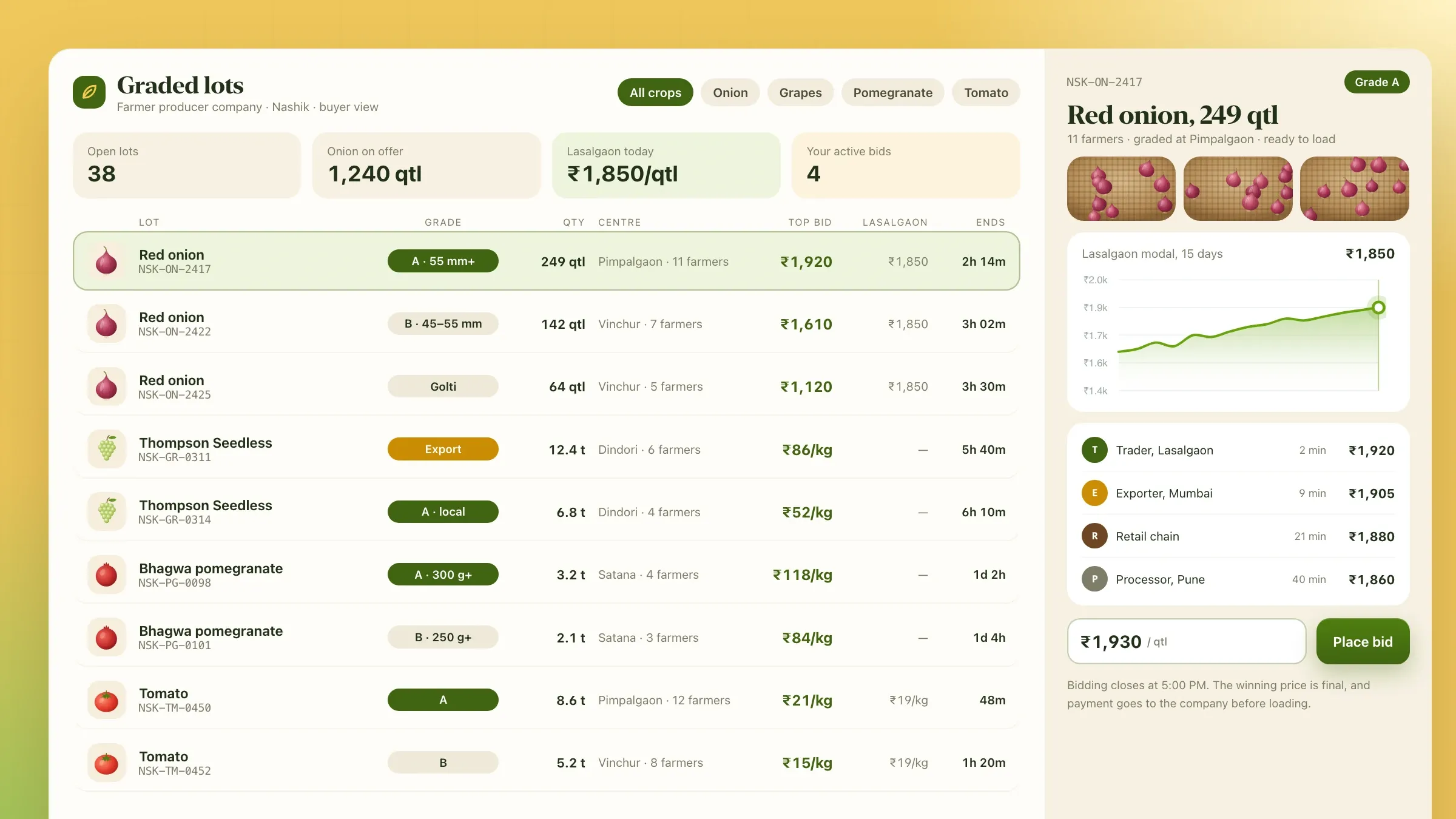
Buyers, including traders, exporters, processors and retail chains, see graded lots by crop, grade, quantity and location in their own app. They bid on lots within a set time or buy at a fixed price set by the farmer producer company.
At the collection centre, staff combine many small farmers’ lots of the same grade into the truckloads large buyers want. Every farmer’s share of a combined lot is recorded by weight and grade, so the scale belongs to the group but the payment stays individual.
Prices in the open
Today’s prices at the nearby mandis, including Lasalgaon, appear beside every lot, so farmers can judge each offer against the market. Farmers see every bid on their produce, and the winning price is final once the bidding closes.
Payments farmers can see
When a buyer pays through the platform, each farmer’s share is worked out from the weight and grade of their produce. Every deduction, such as handling, transport and the company’s fee, is listed. The rest is paid straight to the farmer’s own bank account, with a receipt by SMS in Marathi. Farmers see every payment and deduction in the app.
Built for the field
Farmers join through the company’s field staff, who register them, verify their bank accounts and help with their first listing. The app runs on basic smartphones and saves listings and photos on the phone until a signal returns, so fields with patchy coverage are not a barrier.
How it’s built
The farmer and buyer apps are built in Flutter, on a FastAPI backend in Python with PostgreSQL. Bhashini and Google Gemini turn Marathi speech into structured listings, Gemini estimates grades from photos, Razorpay handles buyer payments and payouts to farmers, and everything runs on Google Cloud in India.
The pilot started with onion growers at two collection centres. Grapes, pomegranates and tomatoes followed once the first season’s grades, bids and payments had been checked with the farmers.
The outcome
Farmers now list their produce in their own language without typing, and sell to buyers they could not reach before. Buyers get graded lots and full truckloads, prices are set by open bids with the mandi rate in view, and payments reach farmers’ bank accounts directly, with every deduction visible in the app.
How the project ran
6 months in 6 phases
- Month 1
Field visits
Days in villages, at collection centres and at the Lasalgaon market with farmers, quality staff and buyers, watching how produce was graded, sold and paid for.
- Months 2–3
Farmer app and voice
The Marathi farmer app with voice listing, photo capture and mandi prices, tested with farmers on basic smartphones.
- Months 3–5
Grading, bids and lots
AI grading from photos, grading at the collection centre, the buyer app, bidding, and building truckloads from small lots.
- Month 5
Payments
Buyer payments, each farmer's share by weight and grade, direct bank payouts and receipts in Marathi.
- Month 6
Pilot and launch
A pilot with onion growers at two collection centres, then grapes, pomegranates and tomatoes.
- 2026 onwards
Support
More crops, collection centres and buyers, and continued tuning of AI grading from confirmed grades.
What we delivered
- Field research
- Product design
- Mobile app
- Web app
- AI agents and automation
- Payments
- Cloud
- Maintenance and support
Inside the project
7 pictures
Questions and answers
10 answered
What did FIRELIFE Ventures build for a farmer producer company in Nashik?
FIRELIFE Ventures built a farm-to-buyer agritech app for a farmer producer company in Nashik. Farmers list produce by voice in Marathi, AI estimates its grade from photos, buyers bid on graded lots with the mandi rate in view, and each farmer's share is paid straight to their bank account.
What is a farm-to-buyer agritech app?
A farm-to-buyer agritech app lets farmers sell produce directly to traders, exporters, processors and retail chains, without depending on commission agents. Buyers see graded lots, farmers see the offers, and payment goes straight to the farmer.
What is a farmer producer company?
A farmer producer company is a company owned by farmers, who are its members and shareholders. It collects, grades and sells its members' produce together, so small farmers get the scale and prices that large growers get.
How does voice listing in Marathi work?
The farmer presses a button and says the crop, variety, quantity and harvest date in Marathi. The app turns the speech into a listing and reads it back for the farmer to confirm, so nobody needs to type.
How does AI quality grading from photos work?
The farmer photographs the produce, and AI estimates its grade from size, colour and visible damage. This first estimate helps buyers plan, and the farmer producer company's quality staff confirm the final grade and weight at the collection centre.
How are prices set?
Buyers bid on graded lots within a set time, or buy at a fixed price the farmer producer company sets. The day's prices at the nearby mandis, including Lasalgaon, are shown beside every lot, so farmers can judge each offer.
How do farmers get paid?
The buyer pays through the platform. Each farmer's share is worked out from the weight and grade of their produce, with every deduction shown, and paid straight to their own bank account, with a receipt by SMS in Marathi.
Does the app work with a weak network?
Yes. The app runs on basic smartphones and saves listings and photos on the phone until a signal returns, so farmers in fields with patchy coverage can still list their produce.
How long does it take to build an agritech trading app?
The app took six months, including field visits, the Marathi voice app, AI grading, buyer bidding, lot building and direct payments, ending with a pilot at two collection centres.
Can FIRELIFE Ventures build an agritech app for my organisation?
Yes. FIRELIFE Ventures builds agritech apps for farmer producer companies, agri traders and food businesses, in Indian languages and with AI where it helps. Start a project through the contact page.
More from the portfolio
All portfolio-
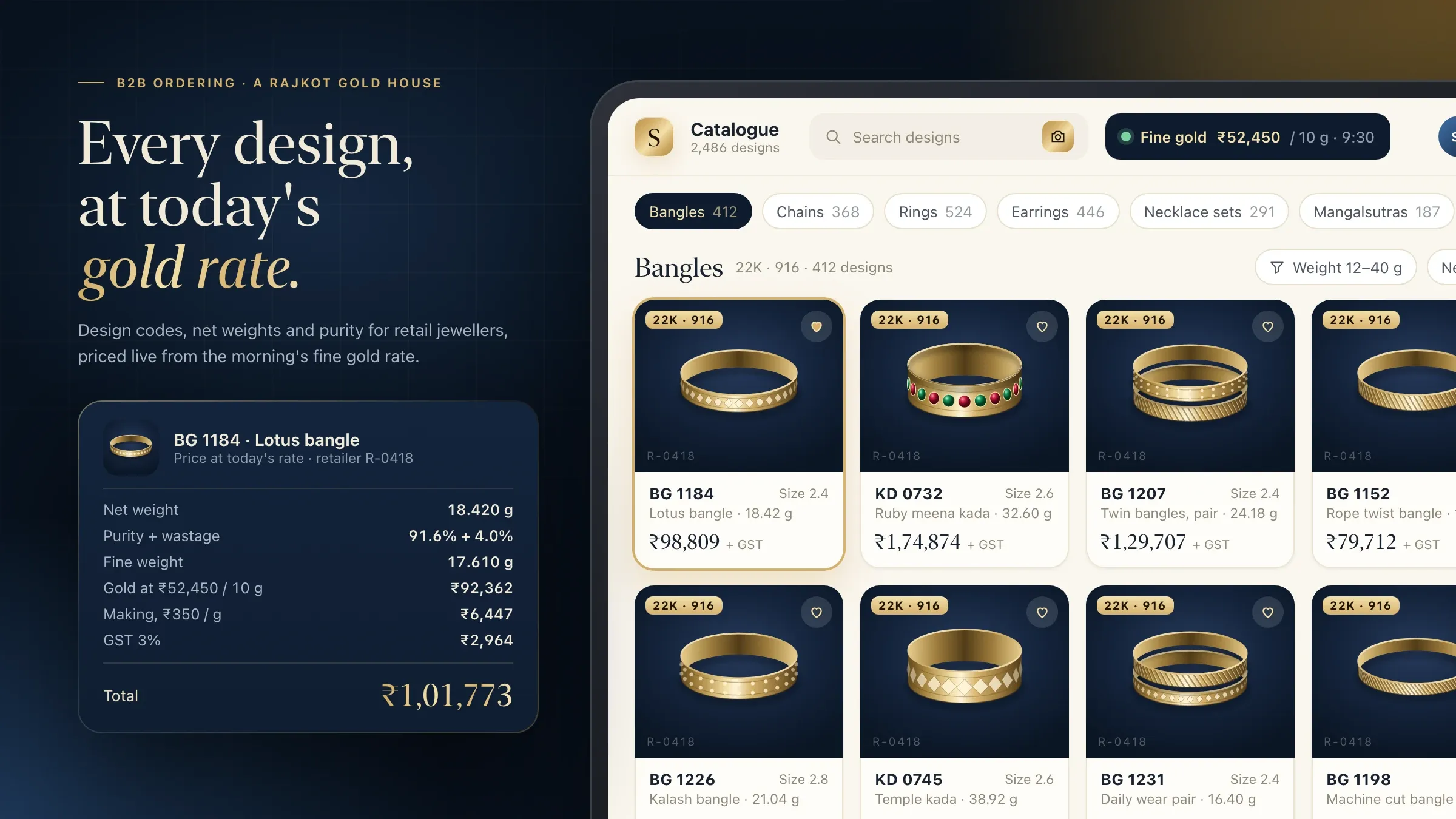 Jewellery Catalogue and Ordering App A B2B jewellery ordering app for a gold jewellery wholesaler in Rajkot: a live catalogue, gold-rate pricing, search by photo, and every order tracked from karigar to hallmark to dispatch.
-
 Fitness Studio Membership App A gym membership app and management software for a chain of fitness studios in Bengaluru: memberships on UPI AutoPay, class booking with waitlists, QR check-in, trainer workout plans, a front-desk console and one view across every studio.
-
 Supermarket Loyalty App A loyalty and rewards app for a supermarket chain in Ireland: a digital loyalty card scanned at the existing tills, household points, personalised offers, supplier-funded deals and digital receipts, built for the GDPR.
Need something like this built?
Tell us what you want to build and where you are with it, and we'll get back to you.
Start a project