Overview
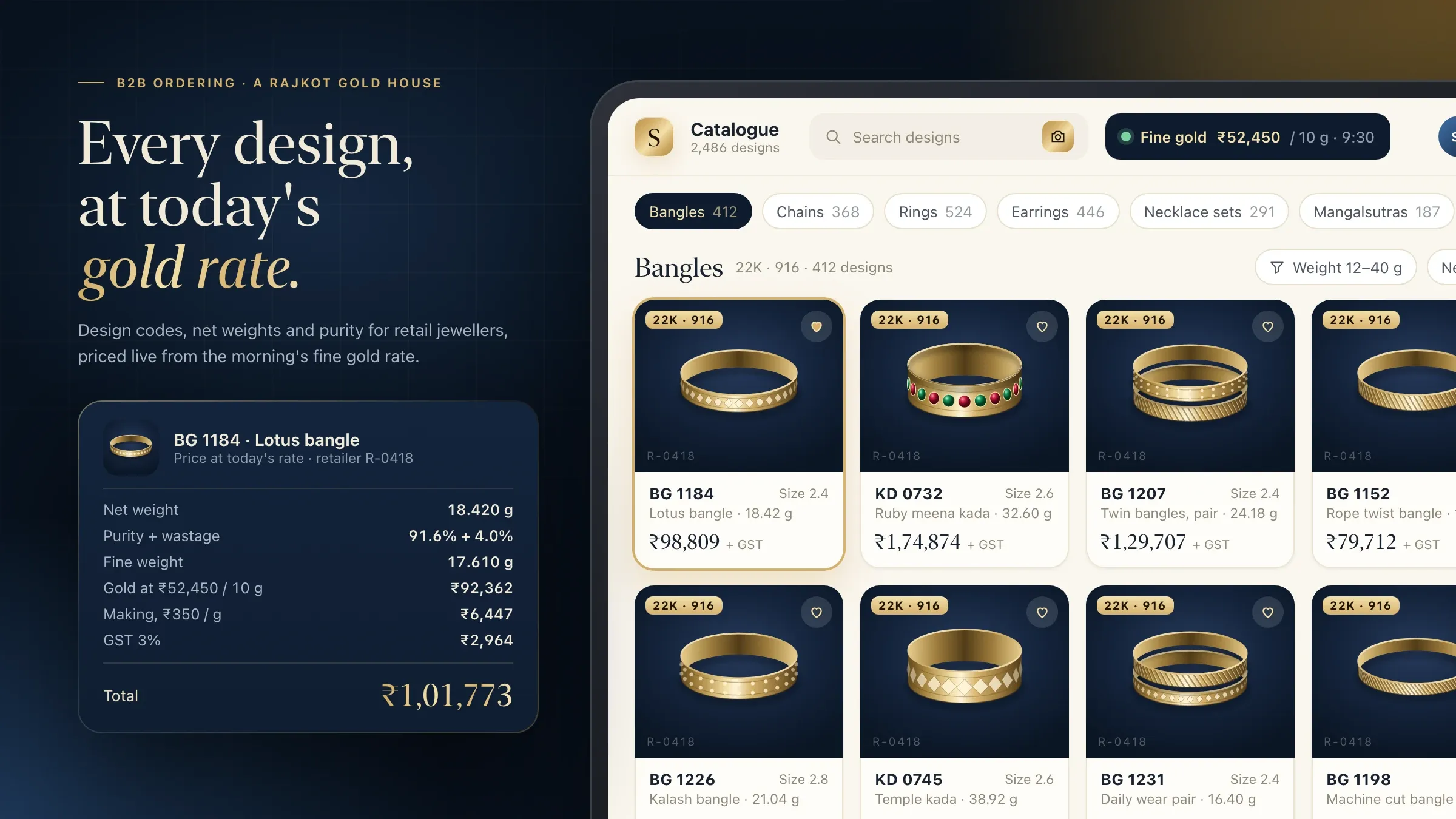
B2B jewellery ordering app for a gold wholesaler: a digital catalogue, live gold-rate pricing, search by photo and order tracking for retailers.
- Client
- A gold jewellery manufacturer and wholesaler in Rajkot
- Industry
- Jewellery manufacturing and wholesale
- Location
- Rajkot, Gujarat, India
- Year
- 2022
- Duration
- 4 months
At a glance
- The challenge
Retailers ordered through WhatsApp photos, phone calls and printed albums, and every price went stale by the next morning.
- What we found on the ground
We spent two weeks in the workshops and in retailers' shops before designing anything.
- A catalogue built for the jewellery trade
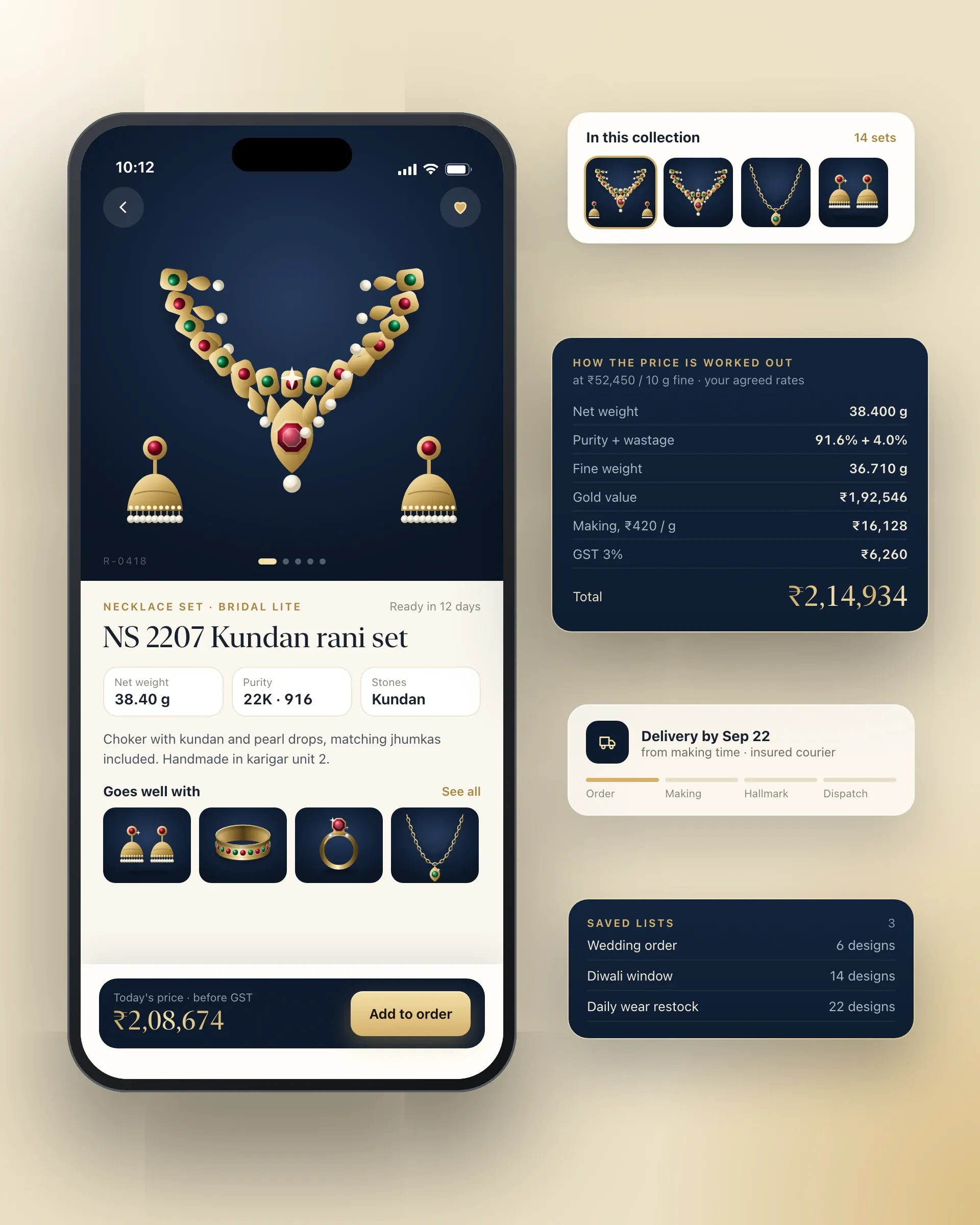
Every live design sits in one digital catalogue, with everything a retailer needs to decide.
- Pricing that follows the gold rate
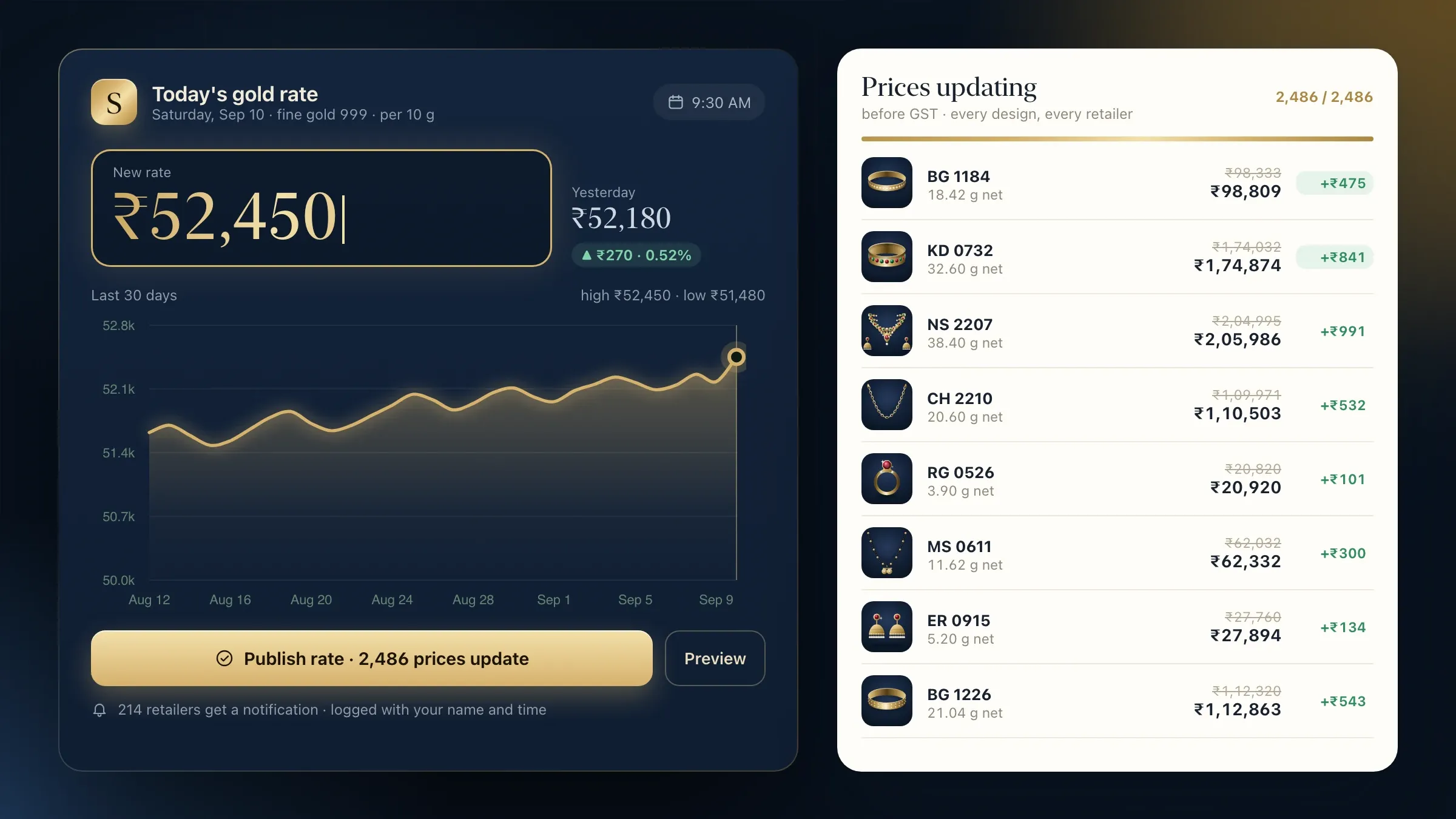
Every price follows the gold rate the owner sets each morning.
- Search by photo
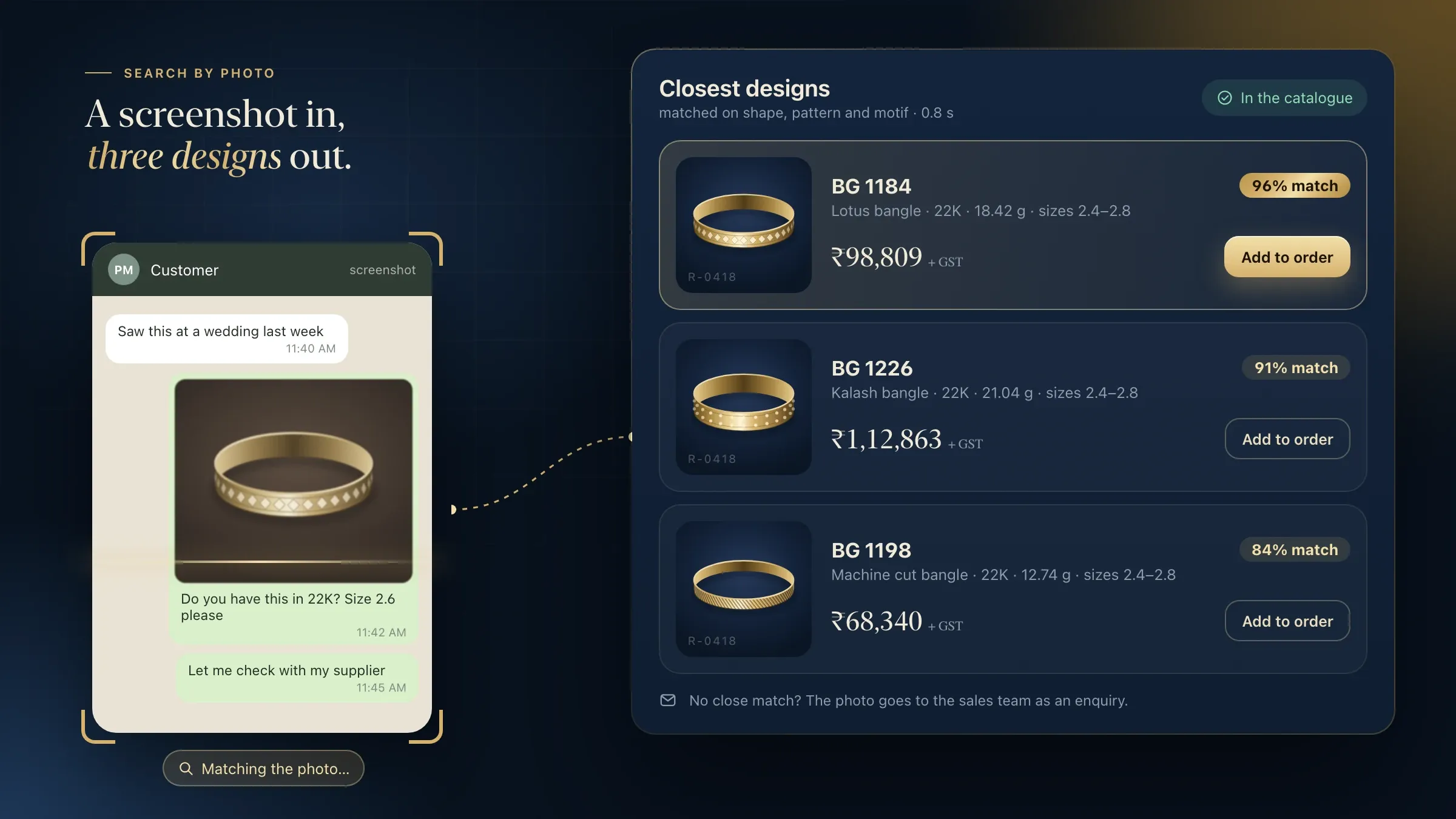
Retailers upload a photo and see the closest designs in the catalogue.
- From order to hallmark to dispatch
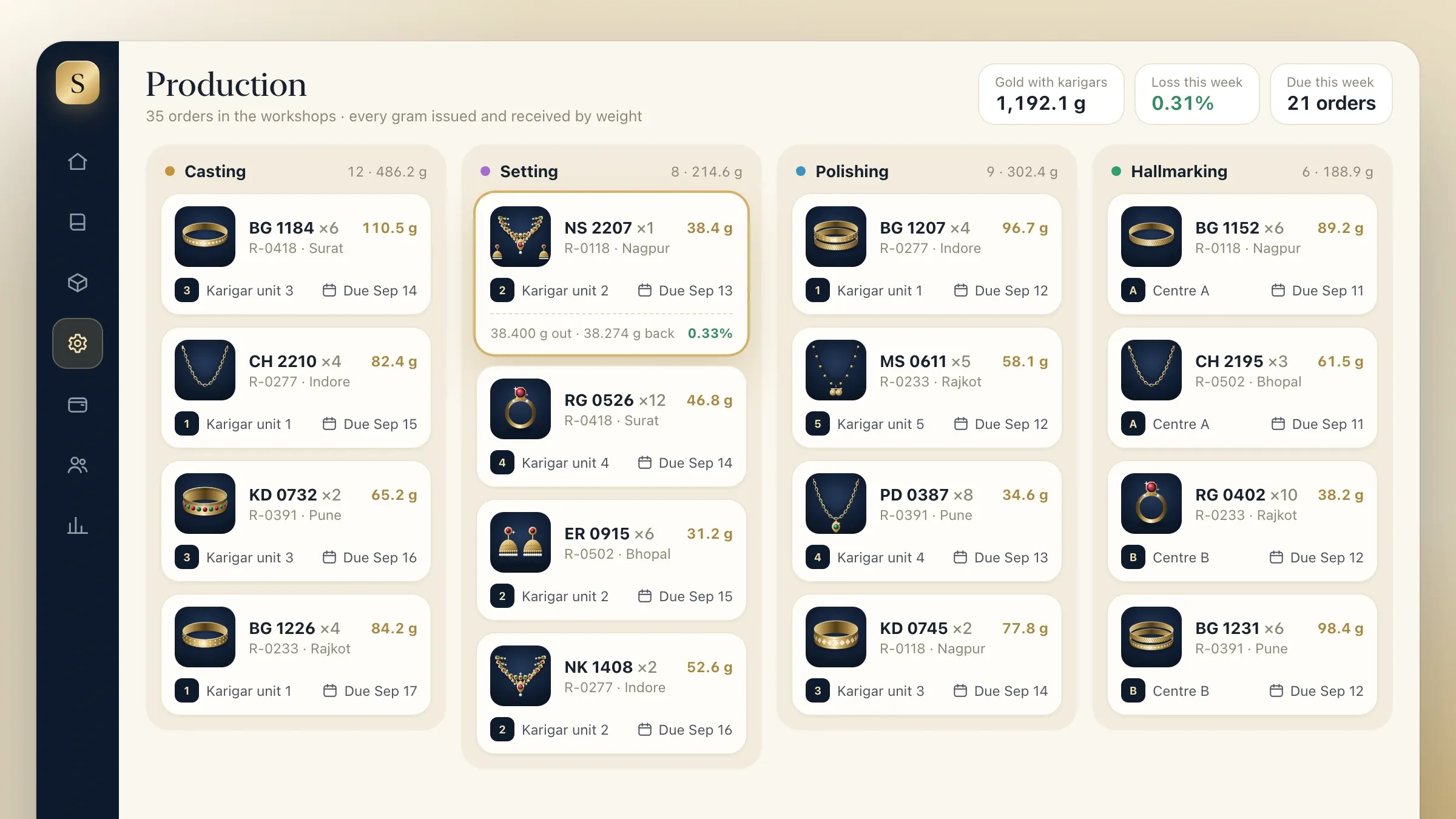
Every order moves through the same stages the workshop uses, and the retailer sees each one.
- How it's built
One Flutter app for phones and tablets, a web panel for the team, and one API behind both.
- Launch and adoption
The catalogue went in first, then a pilot with regular retailers, then everyone.
- The outcome
Retailers order at any hour, with the right design and today's price.
The challenge
Retailers ordered through WhatsApp photos, phone calls and printed albums, and every price went stale by the next morning.
Rajkot is one of India’s great gold jewellery centres, and this manufacturer and wholesaler supplies retail jewellers across Gujarat, Maharashtra and Madhya Pradesh with chains, bangles, rings, mangalsutras and lightweight bridal sets. Its designs were strong. The way retailers ordered them was not.
Orders arrived as WhatsApp photos, phone calls and visits from the sales team carrying heavy printed albums. Thousands of design photos circulated loosely, so a retailer would forward a screenshot and ask whether that design was still made, and in which weight. Design codes were read out over the phone and written down by hand, and the wrong piece was made often enough to hurt.
Prices moved with the gold rate every day, so any quote older than a morning was out of date. Each retailer had its own wastage and making charges, kept in the owner’s memory and a notebook. Retailers called repeatedly to ask whether their order had reached casting, setting, polishing or hallmarking. And with hallmarking and the six-digit HUID newly mandatory, every piece’s HUID now had to be recorded and passed on correctly.
What we found on the ground
We spent two weeks in the workshops and in retailers’ shops before designing anything. We sat at the wholesaler’s counter, followed orders through the karigar workshops and visited retailers in three states, and four findings shaped the whole product.
- Retailers think in designs, not names. Nobody remembers a design code. They remember a shape, a motif or a photo a customer showed them, so finding a design had to start from a picture.
- The trade runs on fine gold. Wholesale prices are worked out in grams of fine gold plus labour, and many retailers settle partly in gold. A rupee-only shopping cart would have been useless.
- Trust lives in the ledger. Retailers and the wholesaler each keep their own account of what is owed in gold and in cash. If the app’s numbers didn’t match the wholesaler’s books to the milligram, nobody would use it.
- The catalogue is the business’s most valuable asset. Designs copied by competitors are a constant worry, so open access was out of the question.
A catalogue built for the jewellery trade
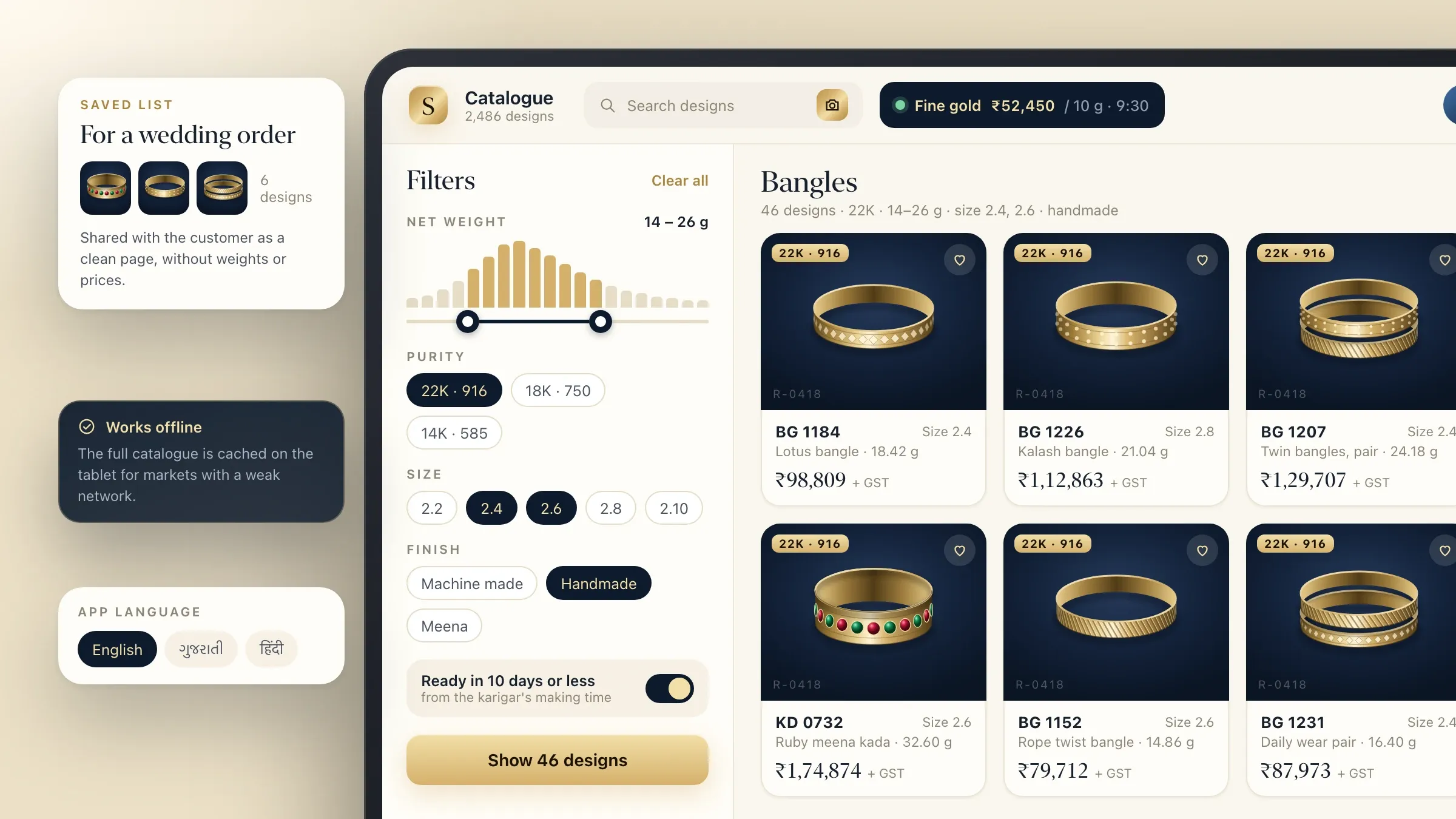
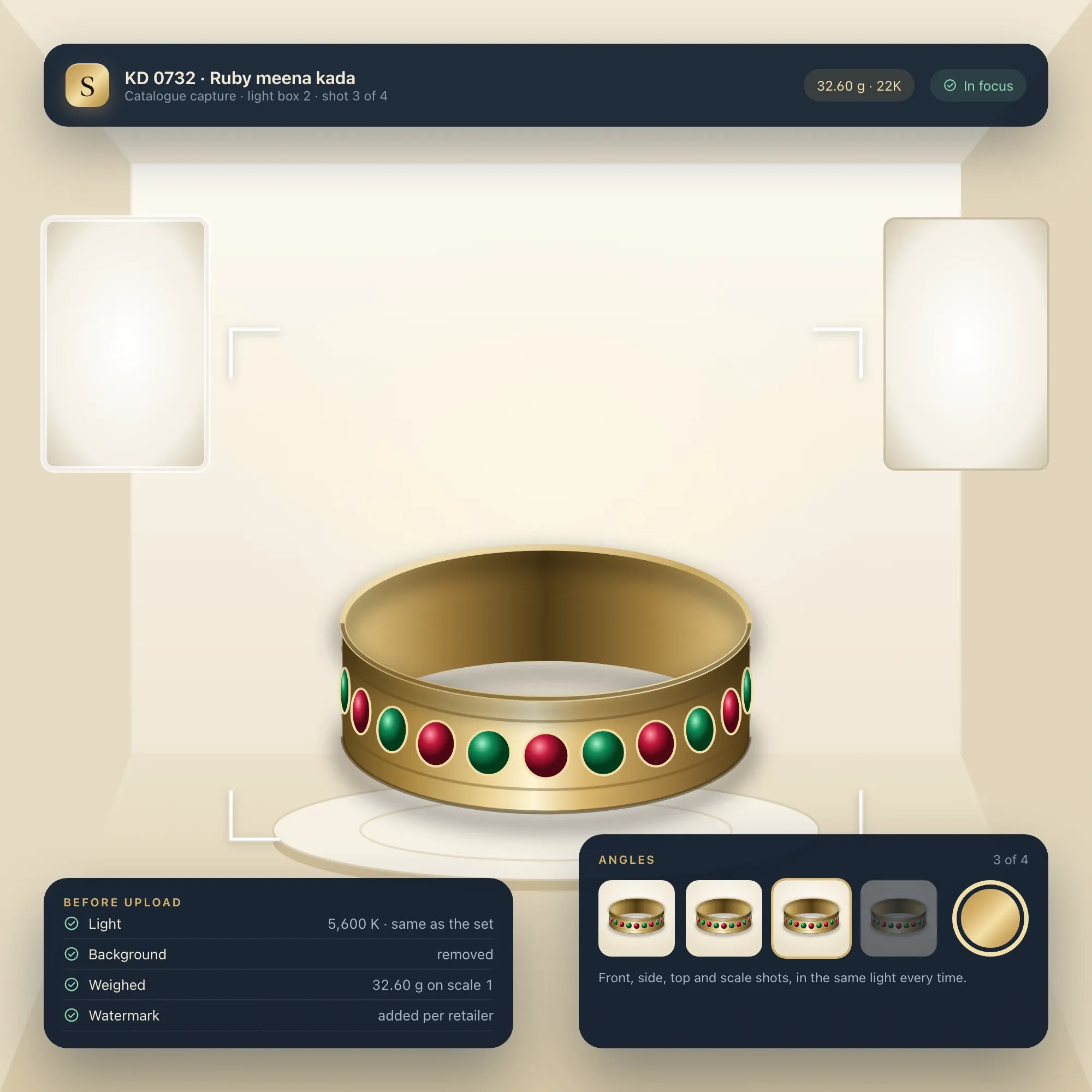
Every live design sits in one digital catalogue, with everything a retailer needs to decide. Each design is photographed in consistent light and stored with:
- design code, collection and category: chains, bangles, kadas, rings, earrings, pendants, mangalsutras and sets;
- purity (22K/916, 18K/750 and 14K), net weight range and the sizes it is made in;
- stone details, finish and whether it is machine-made or handmade;
- the karigar workshop and making time, so delivery dates are realistic.
Retailers browse by collection or filter by category, purity, weight range and size, and save designs into lists for their own customers. The catalogue is cached on the device, so the sales team can open the full collection on a tablet in markets where the network is weak. The app speaks English, Gujarati and Hindi.
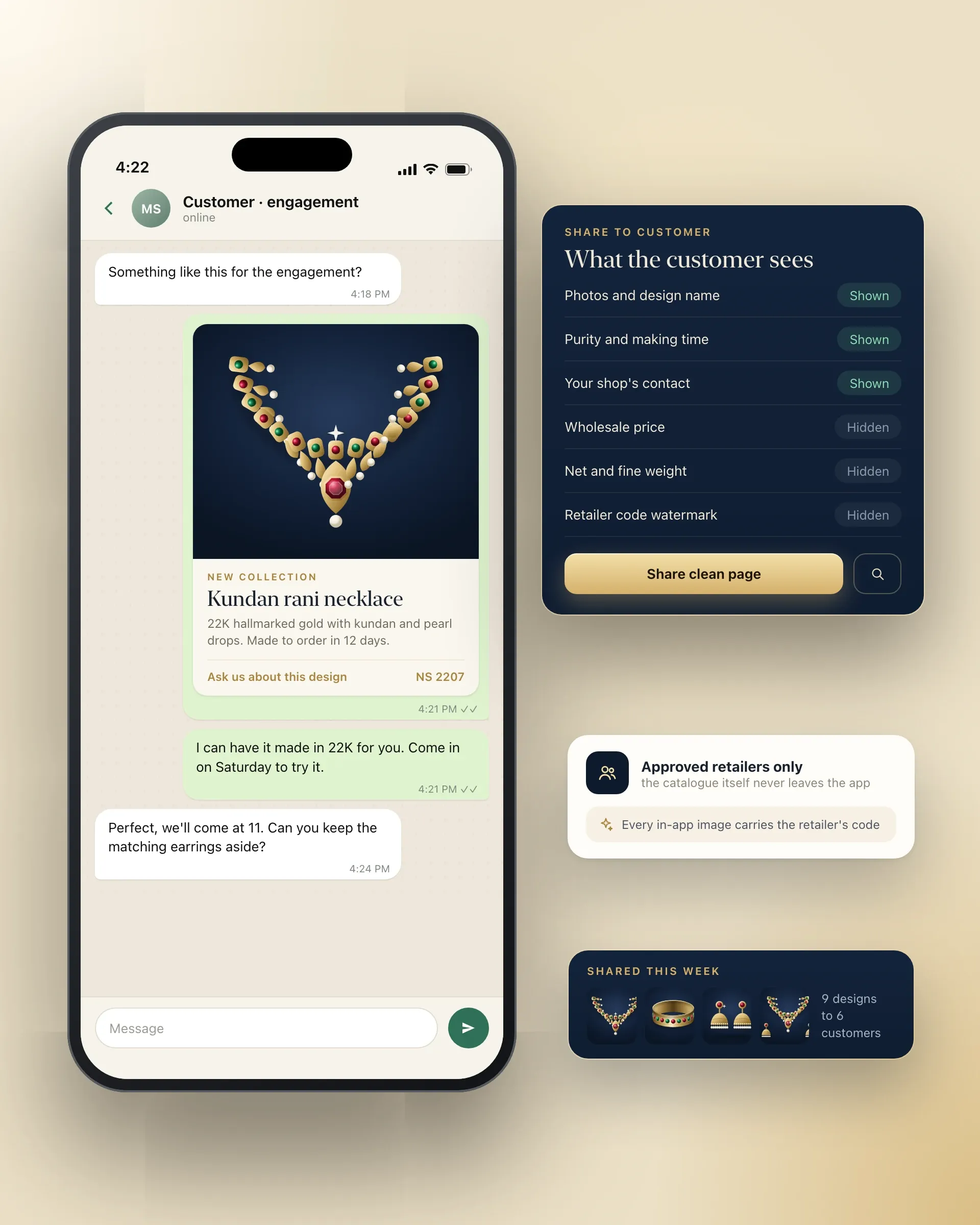
Only retailers the wholesaler has approved can sign in. Every image is watermarked with that retailer’s code, and when a retailer shares a design with a customer on WhatsApp, it goes out as a clean page without wholesale prices or weights.
Pricing that follows the gold rate
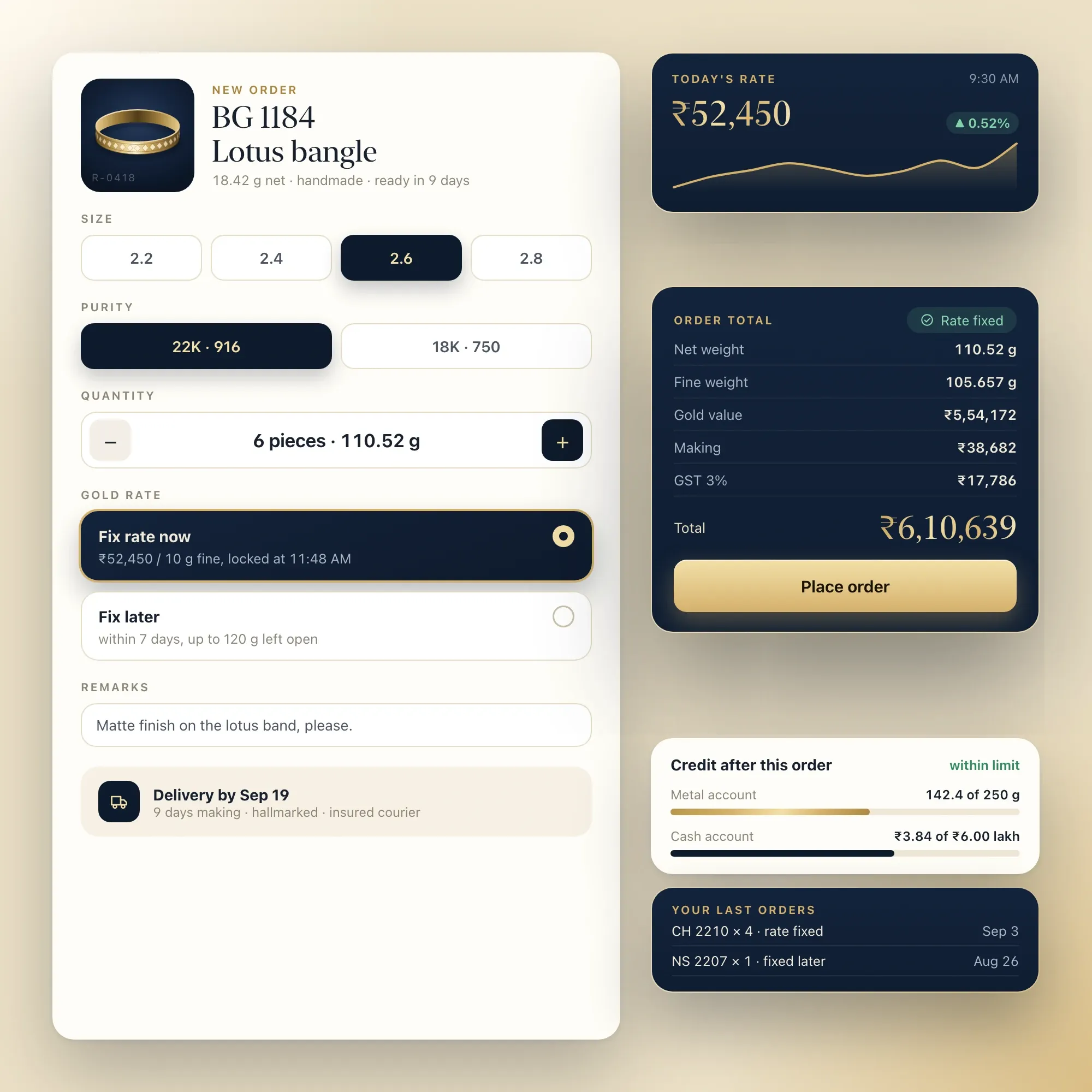
Every price follows the gold rate the owner sets each morning. The owner enters the day’s rate once, and a design’s price is worked out the way the trade works it out:
- Fine weight: the net weight multiplied by the purity and the retailer’s agreed wastage.
- Gold value: the fine weight at today’s rate.
- Making charges: per gram or as a percentage, at that retailer’s own agreed rate.
- GST: 3% on the jewellery, shown separately.
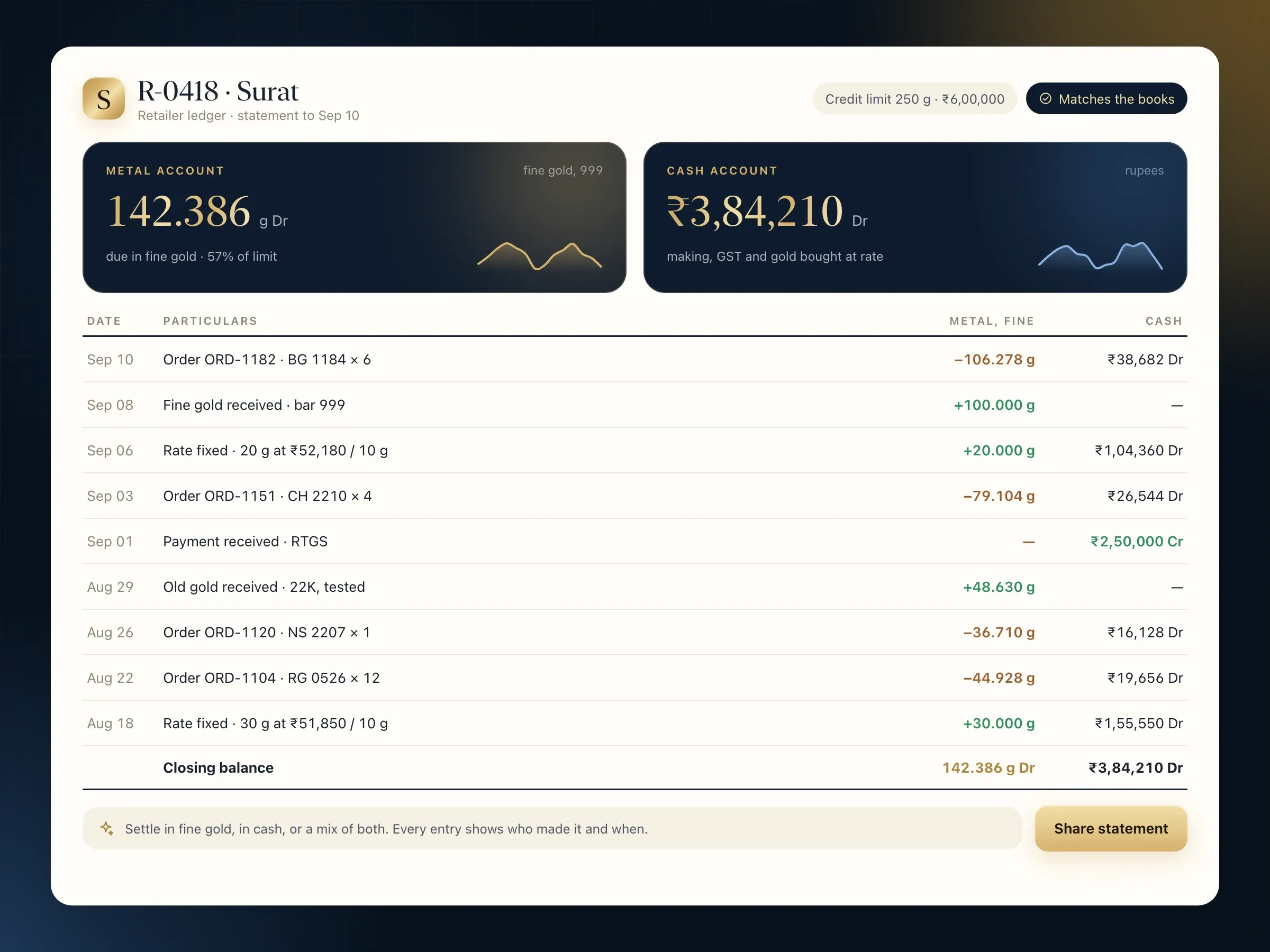
Each retailer has a metal account in grams of fine gold and a cash account in rupees, both visible in the app. When placing an order, a retailer can fix the rate there and then, or leave the order unfixed and fix it later within the limits the wholesaler sets. Credit limits apply to both accounts, and an order that would cross a limit waits for the owner’s approval instead of being refused outright.
Search by photo
Retailers upload a photo and see the closest designs in the catalogue. It is the feature they use most, and the simplest to explain.
Behind it, an AI image model turns every catalogue photo into a numeric fingerprint of its shape, pattern and motif, stored in the database alongside the design. A retailer’s photo, often a compressed screenshot from WhatsApp or Instagram, gets the same treatment, and the app returns the nearest designs with their codes, weights and today’s prices. When there is no close match, the photo goes to the sales team as an enquiry, which tells the wholesaler which designs customers are asking for.
From order to hallmark to dispatch
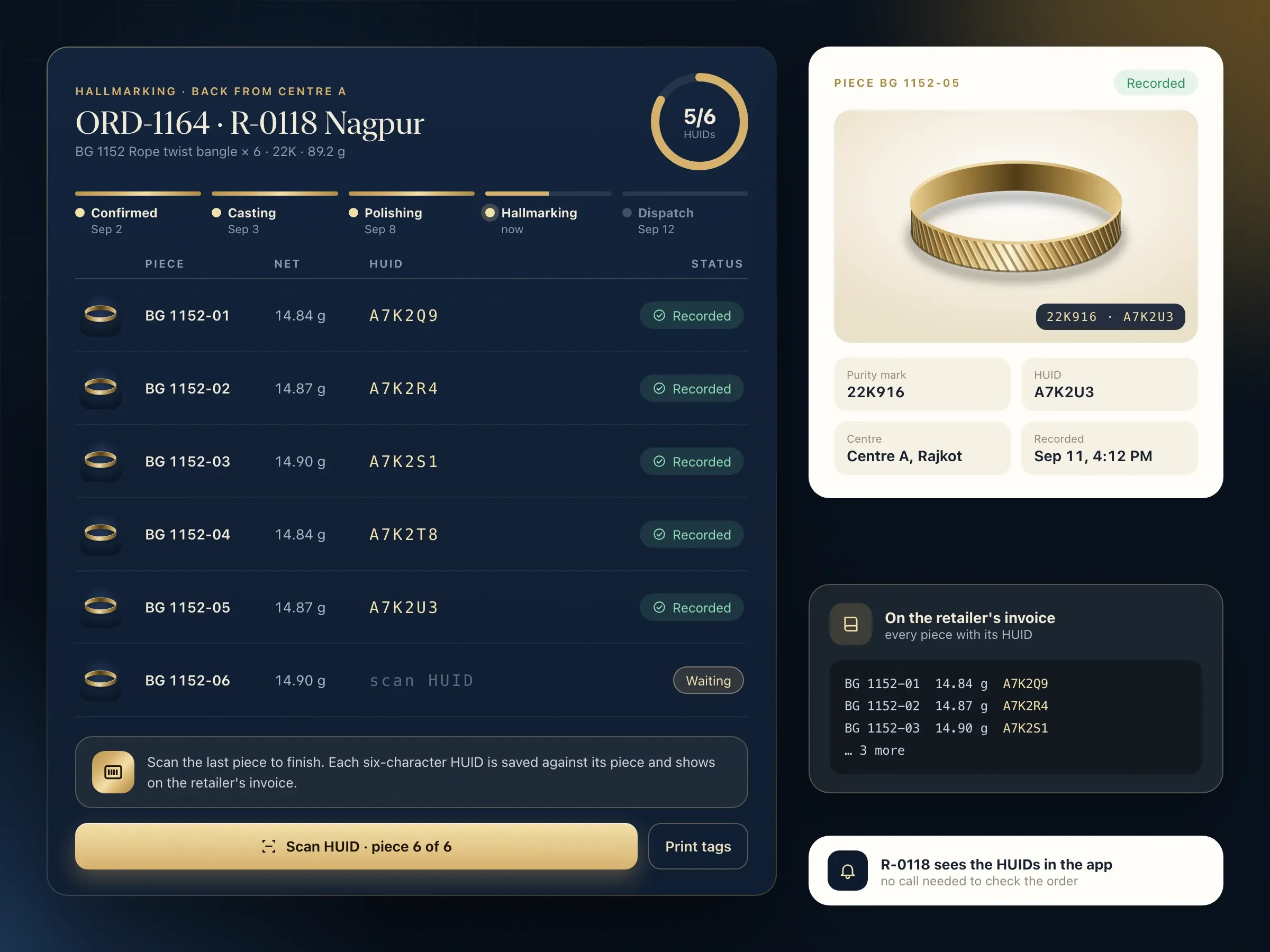
Every order moves through the same stages the workshop uses, and the retailer sees each one. An order records the design, size, purity, quantity, rate status and remarks, and then moves through the stages the workshop actually uses:
- Confirmed: checked against credit, with the delivery date set from the design’s making time.
- Casting and making: gold issued to the karigar by weight and received back by weight, with the allowed loss for each process tracked, so every gram is accounted for.
- Setting and polishing: each step recorded as the piece moves between workshops.
- Hallmarking: pieces sent to the assaying and hallmarking centre, with each piece’s HUID recorded when they return.
- Ready and dispatched: packed, invoiced and sent by angadia or insured courier, with the dispatch details on the retailer’s phone.
Retailers see where every order stands without calling. The owner sees what each workshop is holding, in pieces and in grams.
How it’s built
One Flutter app for phones and tablets, a web panel for the team, and one API behind both. The app runs on Android, iPhone and tablets, and the web panel serves the owner, sales, production and accounts teams. A NestJS API sits on PostgreSQL, which also stores the image fingerprints for search by photo through pgvector. A separate Python service runs the image model.
Catalogue images are stored in Amazon S3 and served through CloudFront in several sizes, so the app stays quick on mobile data. Rate changes and order updates reach phones as push notifications. Every user has a role with its own permissions, and every rate change, rate fix and ledger entry is logged with who made it and when.
Launch and adoption
The catalogue went in first, then a pilot with regular retailers, then everyone. First came the catalogue: every live design photographed, coded, weighed and checked by the wholesaler’s own team. We then piloted the app with a group of regular retailers, matched their ledgers in the app against the wholesaler’s books until both agreed exactly, and fixed what they asked for.
For the full launch, the sales team switched from printed albums to tablets and helped each retailer sign in and place a first order in the shop. New collections now go live the day they are photographed, with a notification to every retailer.
The outcome
Retailers order at any hour, with the right design and today’s price. They browse the full collection on their phone, always with the correct design code. Search by photo turns a customer’s screenshot into an order in seconds, and order status is visible without a phone call.
For the wholesaler, prices, ledgers and production now run from one system that matches the books exactly. Every gram issued to a karigar is accounted for, every piece arrives with its HUID on record, and the catalogue reaches only the retailers it should.
How the project ran
4 months in 6 phases
- Weeks 1–2
Discovery in the bazaar
Days at the wholesaler's counter and in the workshops, visits to retailers in three states, and every order, ledger and design album in use mapped end to end.
- Weeks 3–6
Catalogue and design
Every live design photographed, coded and weighed, the catalogue structure agreed, and the app designed and tested on paper with retailers and the sales team.
- Weeks 7–10
Pricing, ledgers and orders
Live gold-rate pricing, metal and cash accounts, credit limits, rate fixing and the order flow, checked line by line against the wholesaler's own books.
- Weeks 11–14
Search by photo and production
AI search by photo, karigar issue and receipt by weight, production stages, HUID recording and dispatch.
- Weeks 15–17
Pilot and launch
A pilot with a group of regular retailers, fixes from their feedback, then the launch to every retailer with the sales team trained on tablets.
- Week 18 onwards
Support and new collections
New collections loaded each season, monthly improvements, and the rate and ledger rules kept in step with the trade.
What we delivered
- Discovery and product strategy
- Product design
- Mobile app
- Web app
- AI search
- Cloud
- Maintenance and support
Inside the project
7 pictures
Questions and answers
10 answered
What did FIRELIFE Ventures build for a Rajkot jewellery wholesaler?
FIRELIFE Ventures built a B2B jewellery ordering app for a gold jewellery manufacturer and wholesaler in Rajkot. Retail jewellers use it to browse the full catalogue, see prices at the day's gold rate, search by photo, place orders and follow each order through production, hallmarking and dispatch.
What is a B2B jewellery ordering app?
A B2B jewellery ordering app lets retail jewellers order from a manufacturer or wholesaler on their phone or tablet instead of through calls, WhatsApp photos and printed albums. The wholesaler manages designs, gold rates, retailer accounts, credit and production from one system.
How is jewellery priced in a B2B ordering app?
Wholesale gold jewellery is usually priced in fine gold plus labour. The app works out each design's fine weight from its net weight, purity and the retailer's agreed wastage, adds making charges, and converts it to rupees at the day's gold rate set by the wholesaler, plus 3% GST on the jewellery.
What is a metal account in the jewellery trade?
Many wholesalers keep two ledgers for each retailer: a metal account in grams of fine gold, and a cash account in rupees for making charges, GST and gold bought at the day's rate. Retailers can settle in fine gold, in cash, or a mix of both, and the app shows both balances at any time.
Can retailers fix the gold rate when they order?
Yes. A retailer can fix the rate when placing an order, so the price is settled at that moment, or leave it unfixed and fix it later within the wholesaler's limits. Every rate fix is recorded with the time and the rate used.
How does search by photo work for jewellery?
A retailer uploads a photo, often a screenshot a customer sent on WhatsApp or Instagram, and the app shows the closest matching designs in the catalogue with their design codes. An AI image model compares shape, pattern and motif rather than names, so it finds a match even when nobody knows what a design is called.
How does the app handle hallmarking and HUID?
Hallmarking is one of the production stages. When pieces come back from the assaying and hallmarking centre, each piece's six-digit HUID is recorded against its order, so the retailer receives jewellery with HUIDs already on record.
How are the wholesaler's designs protected from copying?
Only retailers approved by the wholesaler can open the catalogue. Every image shown in the app carries a watermark with that retailer's code, and designs shared with end customers on WhatsApp go out without wholesale prices or weights.
How long did it take to build the jewellery ordering app?
Four months, from the first days of discovery in the bazaar to the launch for every retailer, including photographing and coding the full catalogue, live pricing, metal and cash accounts, search by photo and production tracking.
Can FIRELIFE Ventures build an ordering app for my jewellery business?
Yes. FIRELIFE Ventures builds catalogue, ordering, ledger and production software for jewellery manufacturers and wholesalers, shaped around how the trade actually prices, settles and makes jewellery. Start a project through the contact page.
More from the portfolio
All portfolio-
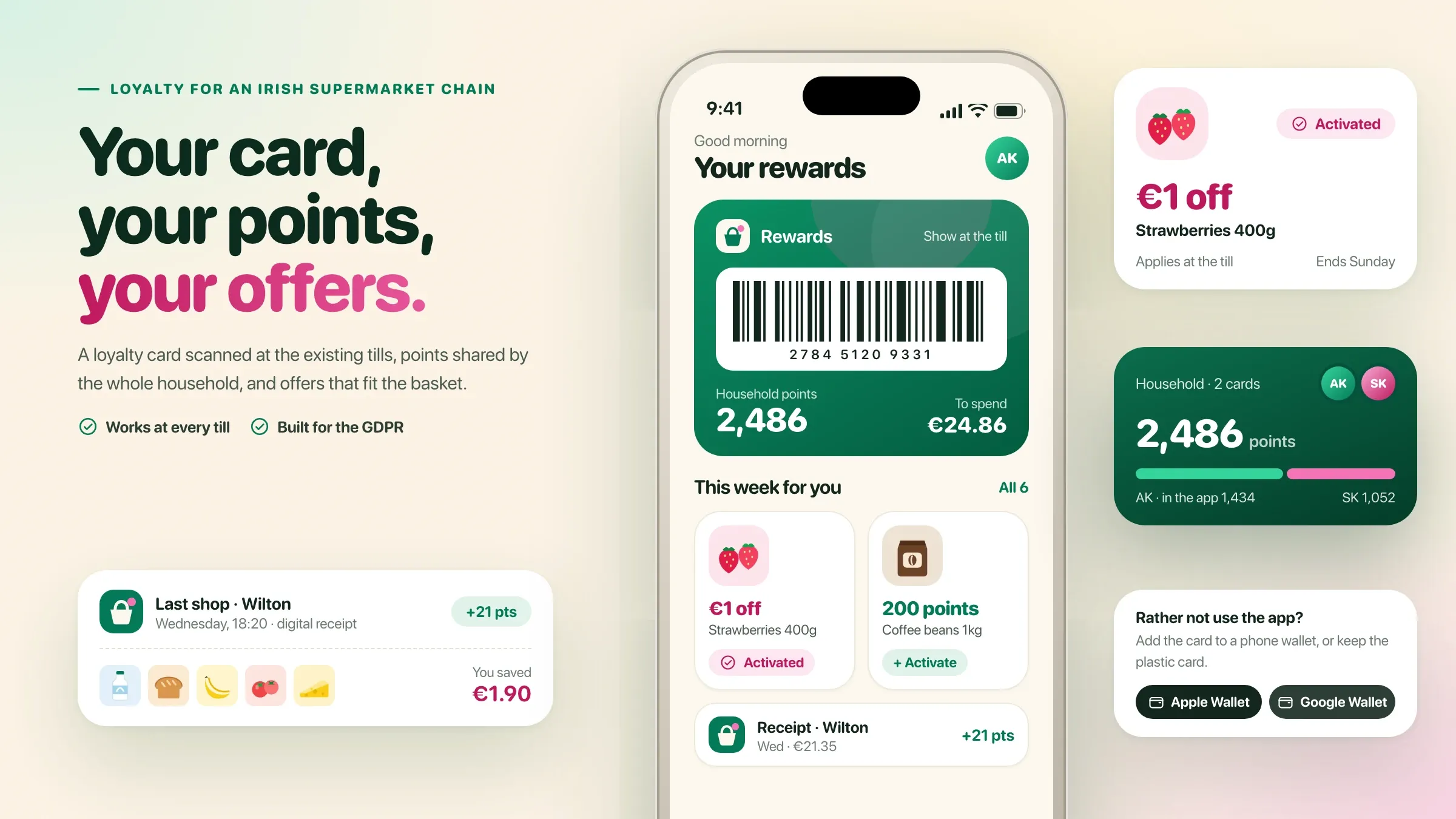 Supermarket Loyalty App A loyalty and rewards app for a supermarket chain in Ireland: a digital loyalty card scanned at the existing tills, household points, personalised offers, supplier-funded deals and digital receipts, built for the GDPR.
-
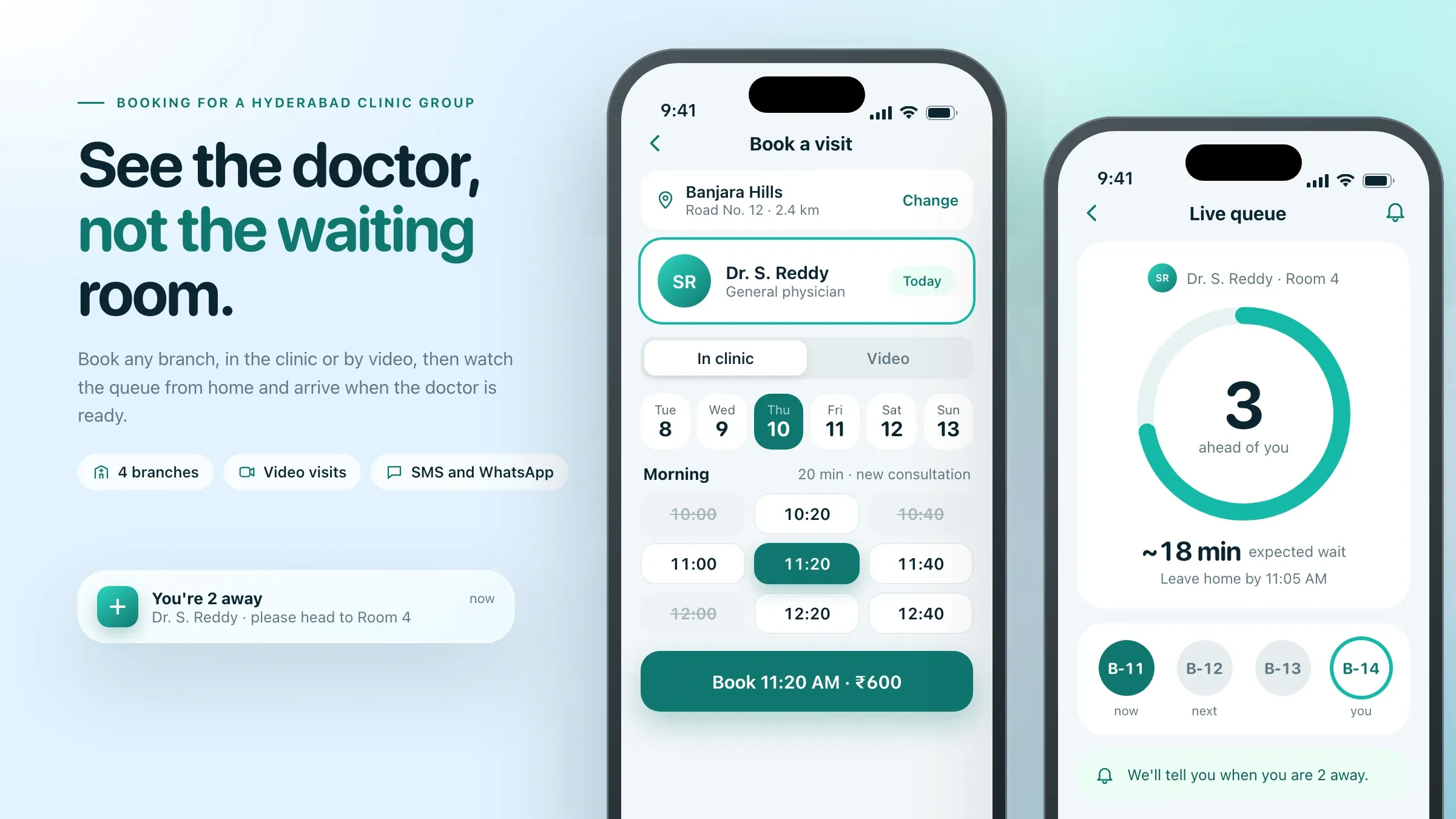 Clinic Booking and Live Queue A clinic appointment booking system for a multi-speciality clinic group in Hyderabad: online booking for every branch, a live patient queue, video consultations and reminders on SMS and WhatsApp.
-
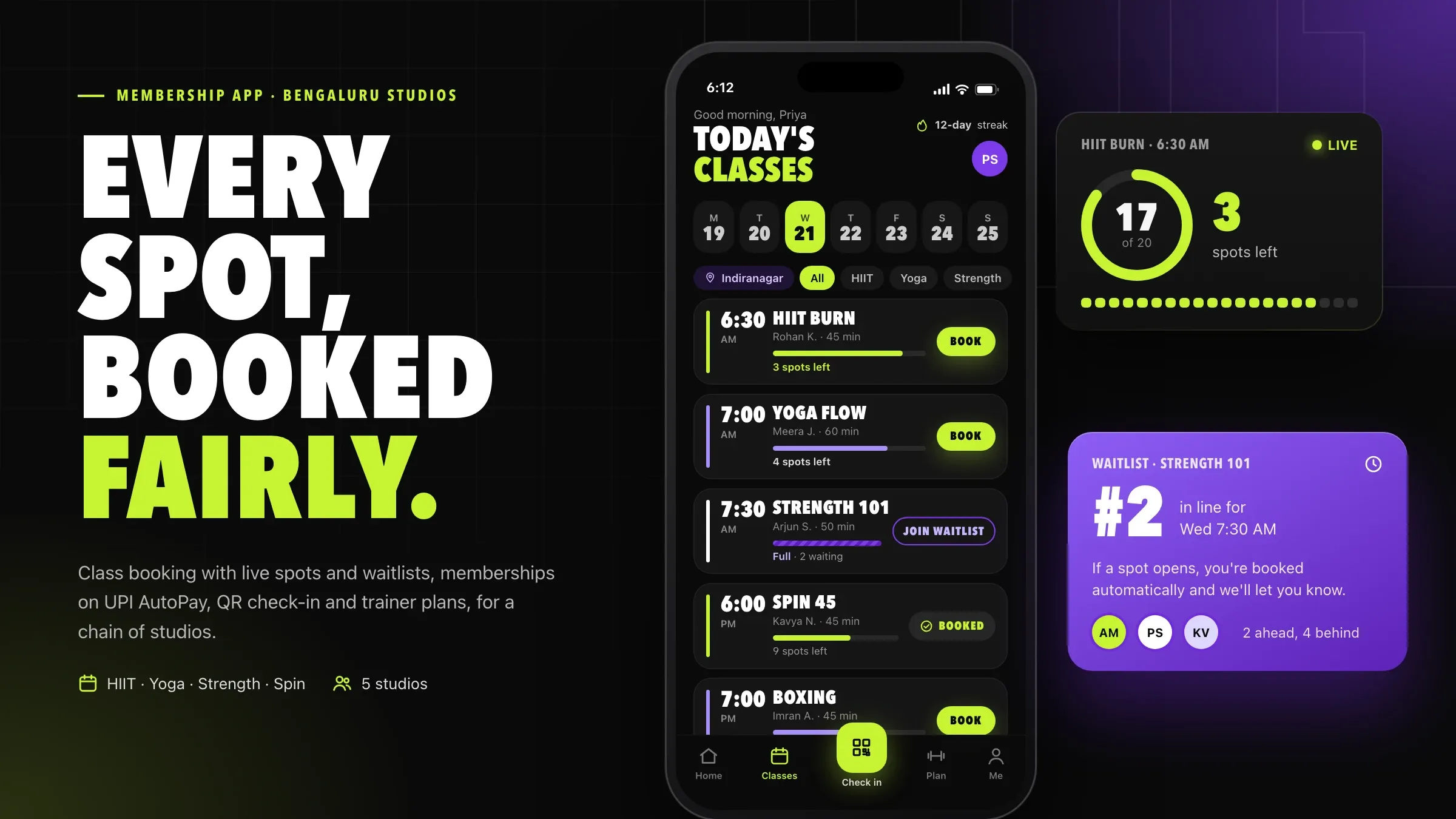 Fitness Studio Membership App A gym membership app and management software for a chain of fitness studios in Bengaluru: memberships on UPI AutoPay, class booking with waitlists, QR check-in, trainer workout plans, a front-desk console and one view across every studio.
Need something like this built?
Tell us what you want to build and where you are with it, and we'll get back to you.
Start a project