Overview
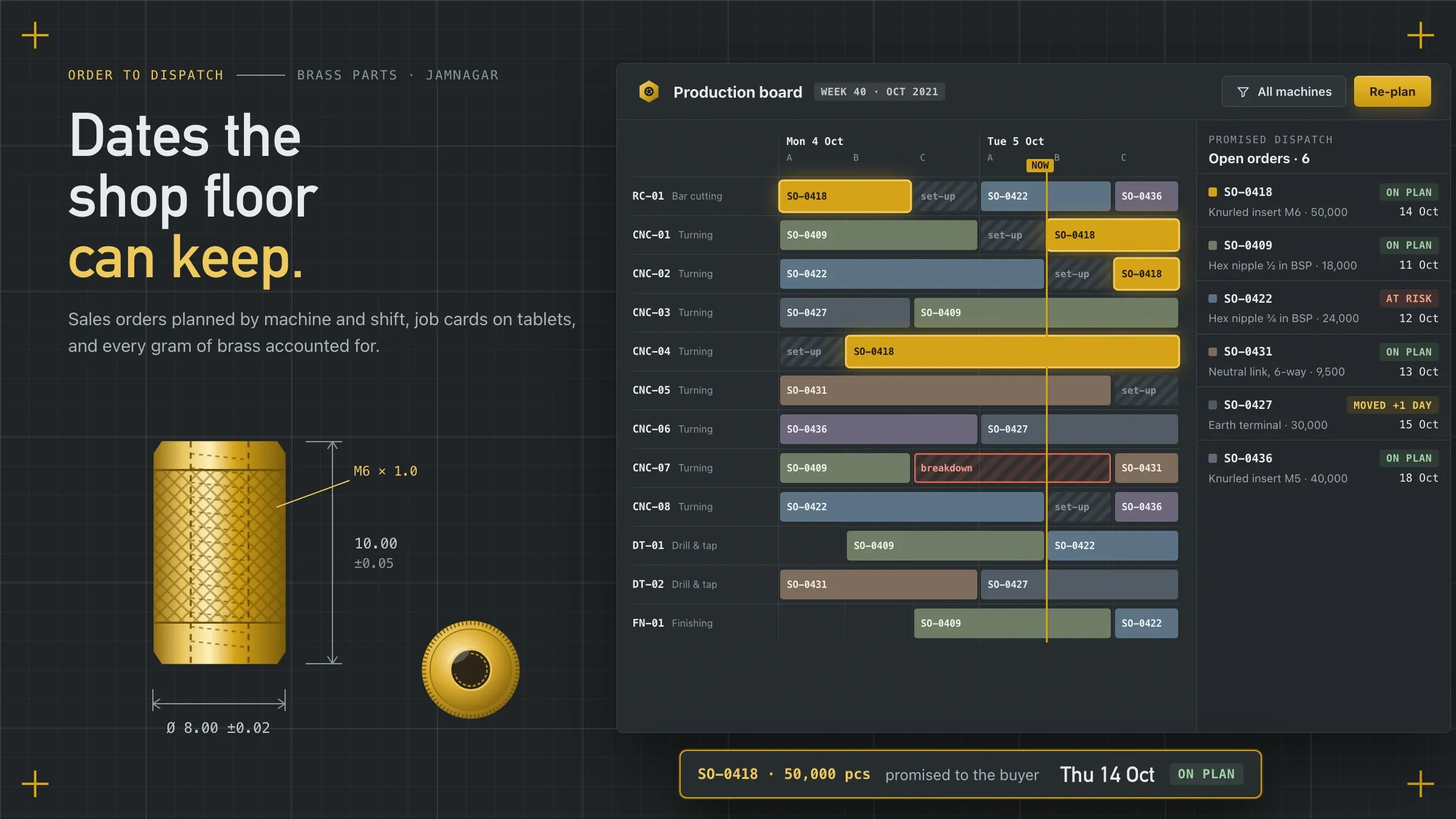
Manufacturing order management software: sales orders, production planning, job cards on the shop floor, quality checks and dispatch with e-invoices.
- Client
- A brass precision components manufacturer in Jamnagar
- Industry
- Manufacturing
- Location
- Jamnagar, Gujarat, India
- Year
- 2021
- Duration
- 7 months
At a glance
- The challenge
The plant made thousands of precision brass parts a day and managed them on spreadsheets and a whiteboard.
- What we learned on the shop floor
We spent the first month following real orders from purchase order to truck, through sales, planning, stores, the machines, quality and dispatch.
- Orders and delivery dates that hold
Every order starts as a sales order entered once, from the buyer's purchase order: part number, drawing revision, quantity, finish and requested date.
- Production planning by machine and shift
Planners schedule work by machine and shift on one production board.
- Job cards and quality on the shop floor
Supervisors work from tablets.
- Brass, yield and job work
Brass is the plant's biggest cost, so the system tracks it to the gram:
- Dispatch, e-invoices and e-way bills
At dispatch, the system prepares the packing list from the batches that passed final inspection, with each box labelled by part, quantity and batch.
- How it's built
The system is a Laravel and MySQL application with a Vue.js interface for planners, sales, stores and accounts, and a Flutter app on rugged tablets for the shop floor.
- Roll-out
The plant moved over department by department.
- The outcome
The plant now runs from one live view, from purchase order to truck.
The challenge
The plant made thousands of precision brass parts a day and managed them on spreadsheets and a whiteboard. Jamnagar is India’s brass parts capital, and this manufacturer turns brass rod into inserts, fittings and terminals for electrical and plumbing companies in India and abroad.
Orders arrived by email and phone and were tracked in spreadsheets. Production was planned on a whiteboard, supervisors walked the floor to find out where an order had reached, and dispatch dates were promised without knowing whether the machines were free. Brass is expensive, but nobody could say how much rod had gone into an order or how many turnings had come back. Quality reports were on paper, and every invoice was typed again into the accounting software, just as GST e-invoicing made those invoices harder to get wrong.
What we learned on the shop floor
We spent the first month following real orders from purchase order to truck, through sales, planning, stores, the machines, quality and dispatch.
- Delivery dates were guesses. Sales couldn’t see machine loads, so promises and capacity rarely matched.
- Brass was counted by the tonne, not by the batch. Losses only showed up at stock counts, too late to know where they happened.
- The real bottleneck moved every week, from one set of CNC machines to plating to inspection, and nobody could see it coming.
- Supervisors were the plant’s memory. When one was absent, the status of half the floor went with them.
Orders and delivery dates that hold
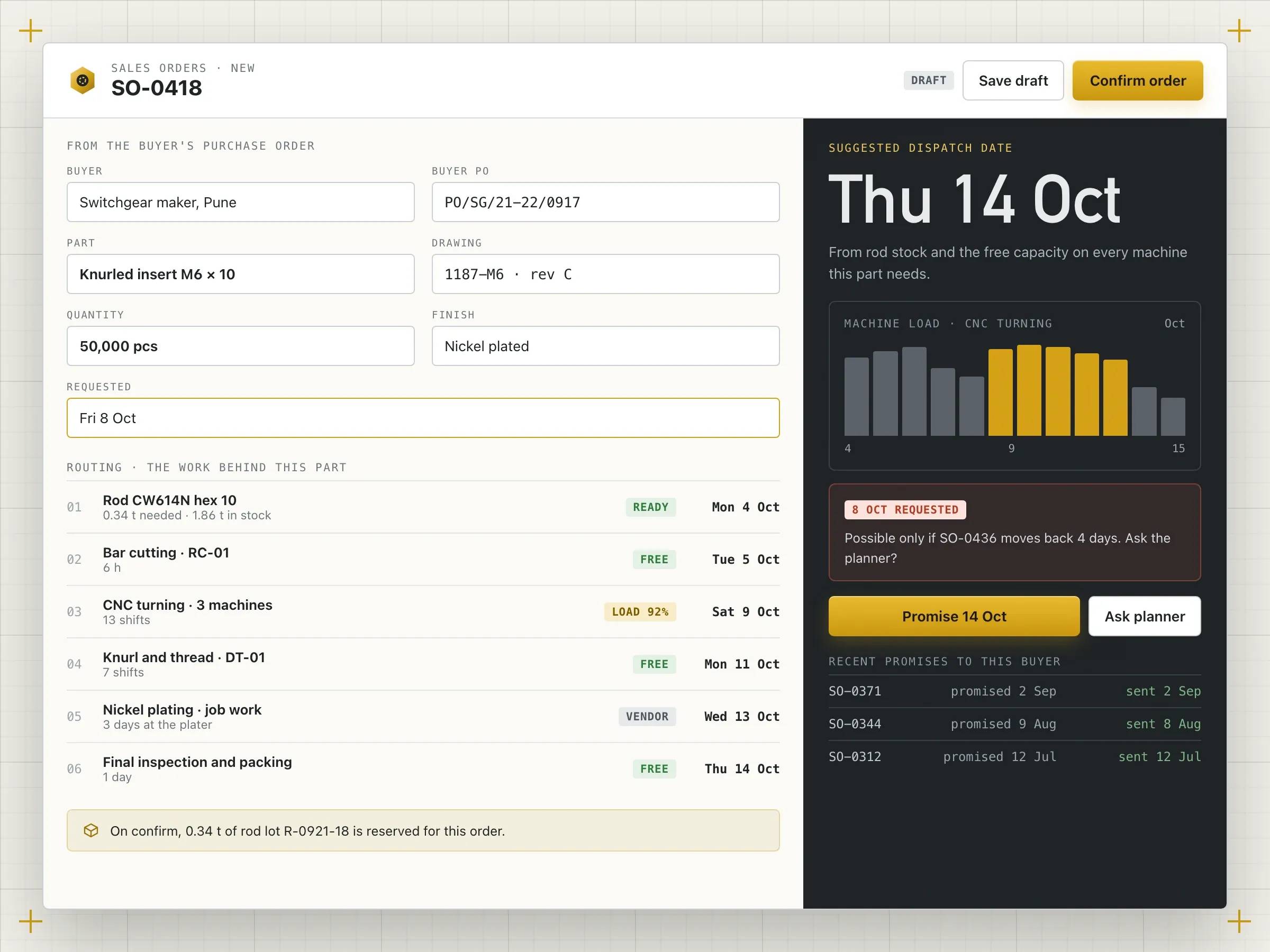
Every order starts as a sales order entered once, from the buyer’s purchase order: part number, drawing revision, quantity, finish and requested date. Repeat parts carry their routing, the list of operations and machines each part needs, so the system knows the work behind every order.
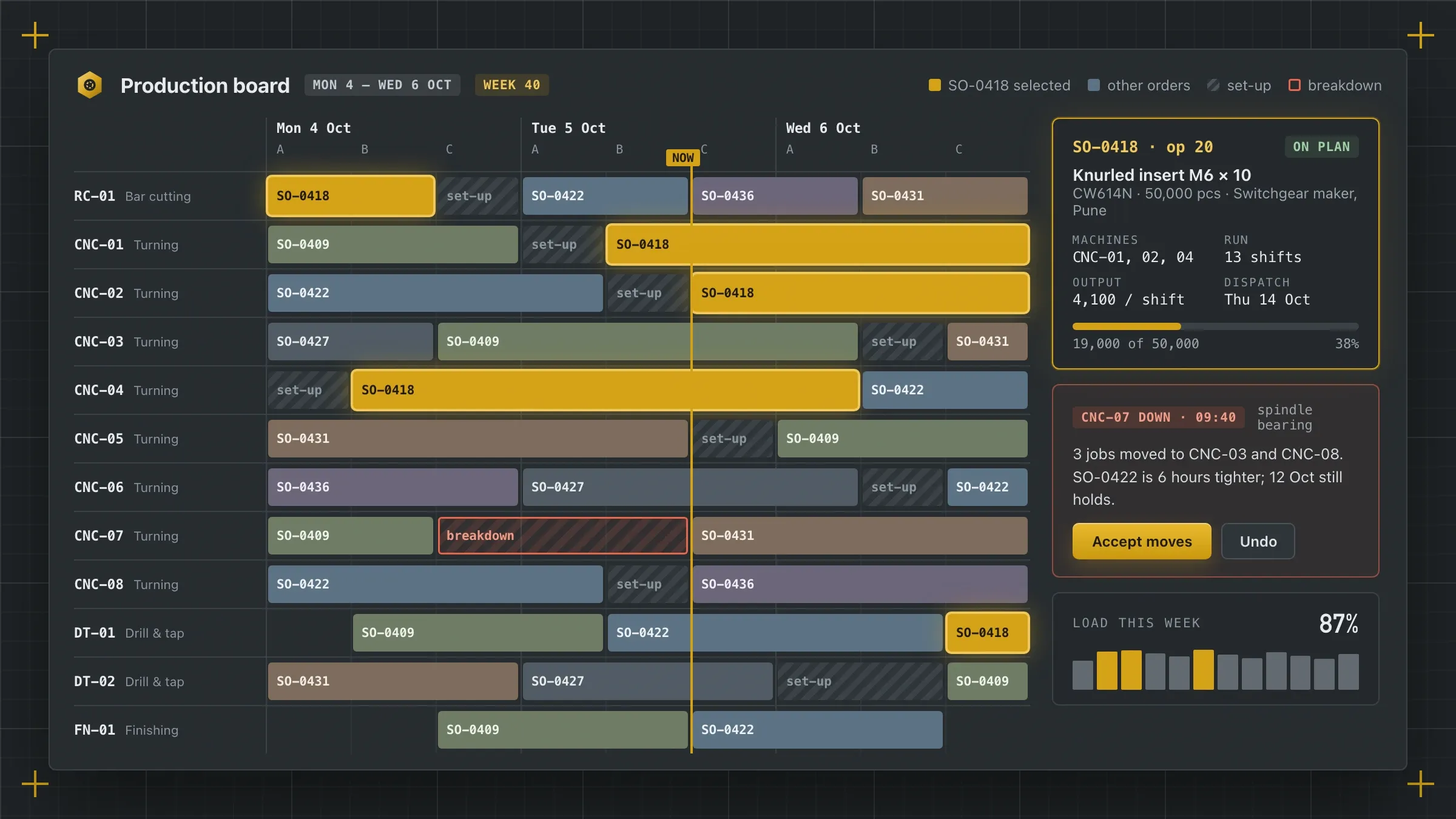
As the order is entered, the system checks brass rod stock for the right alloy and size, and the free capacity on every machine the part needs. It then suggests a dispatch date. Sales promises dates the plant can keep, and when a buyer asks to pull an order forward, the planner sees exactly what moves to make room.
Production planning by machine and shift
Planners schedule work by machine and shift on one production board. Each machine shows its load for the coming days, changeovers are planned to group similar parts, and the board warns when an order is at risk of missing its date.
When a machine breaks down or an urgent order arrives, the planner moves jobs on the board and every affected date updates. The bottleneck of the week is visible on Monday, not on Friday.
Job cards and quality on the shop floor
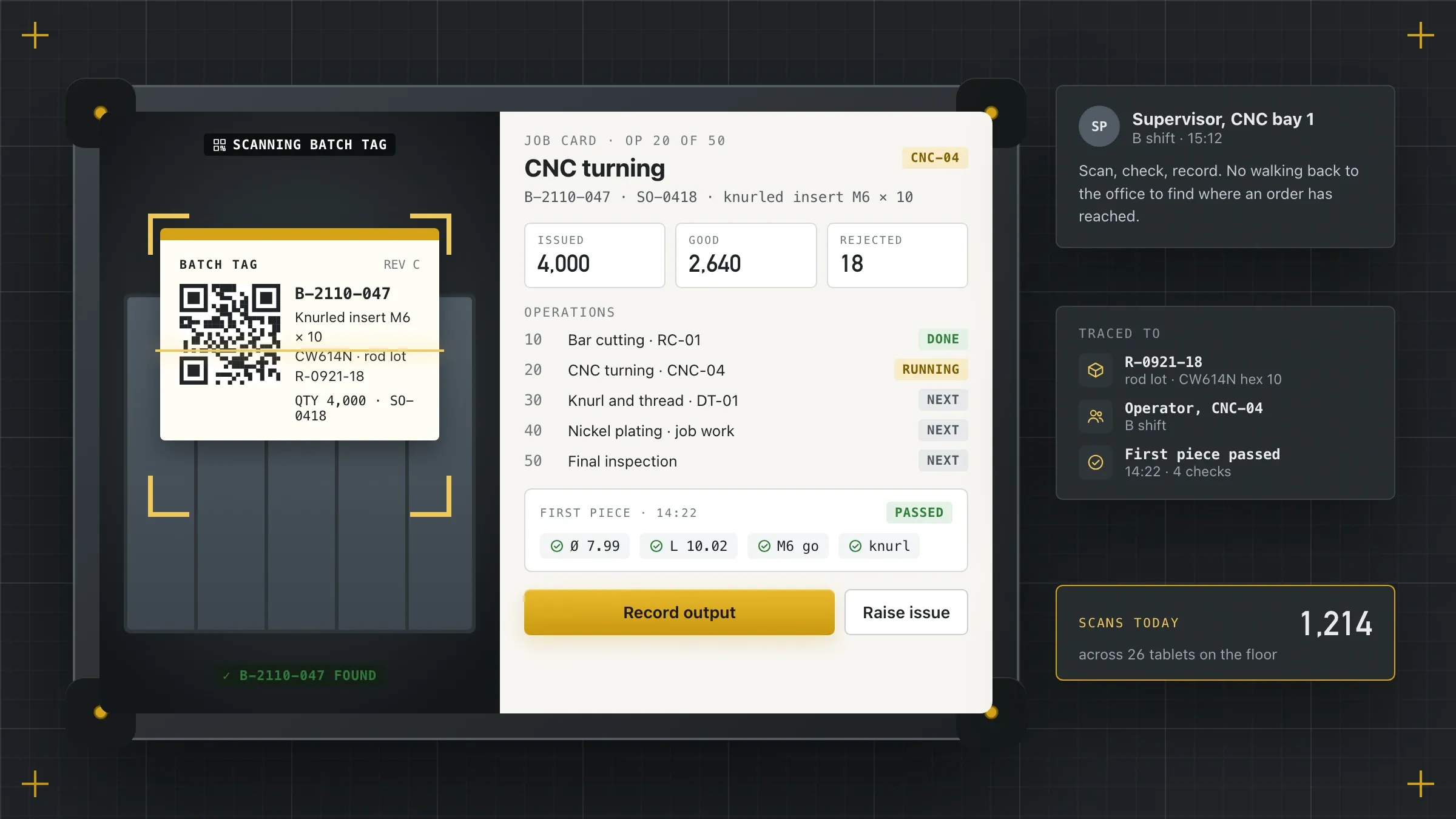
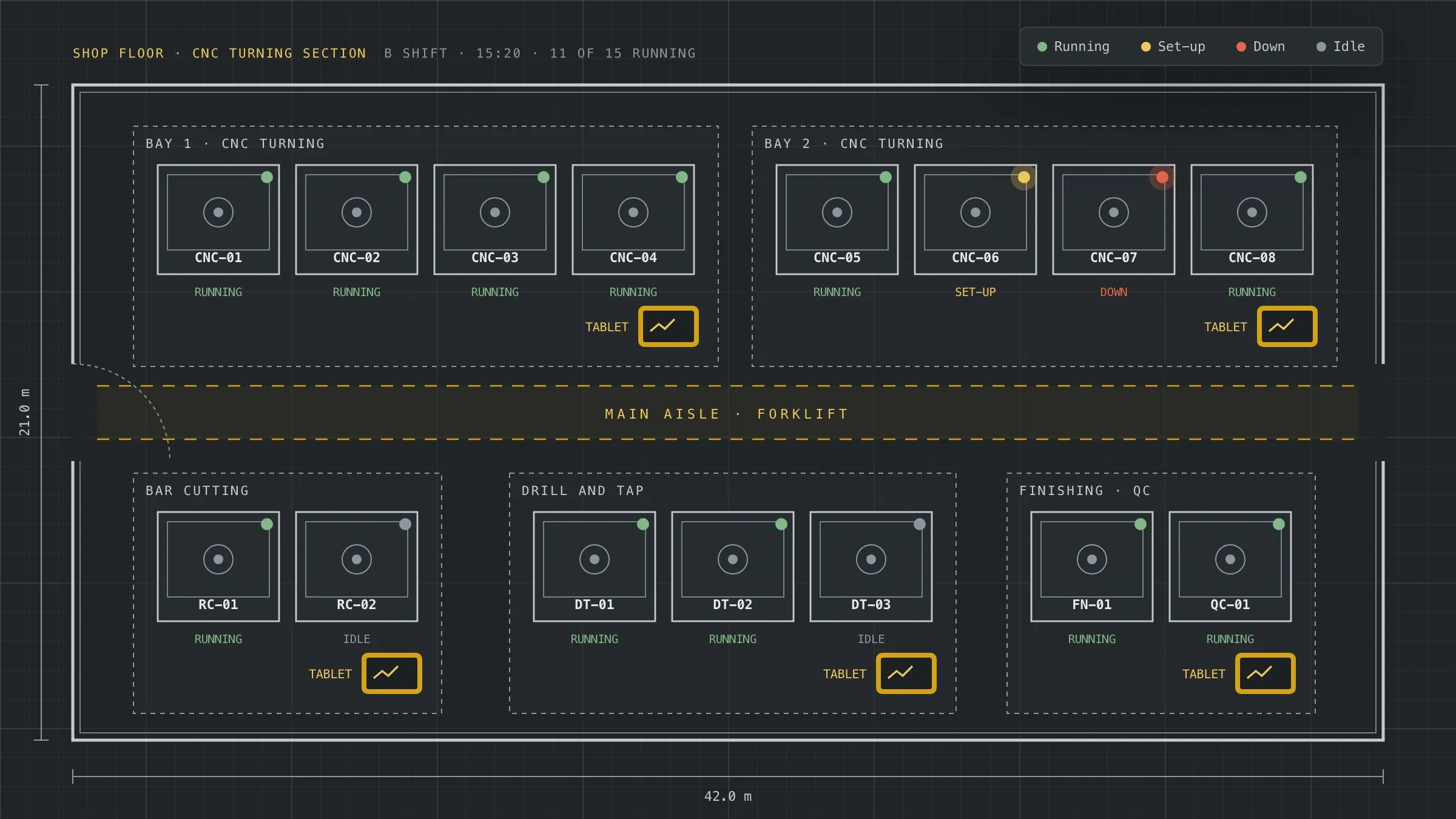
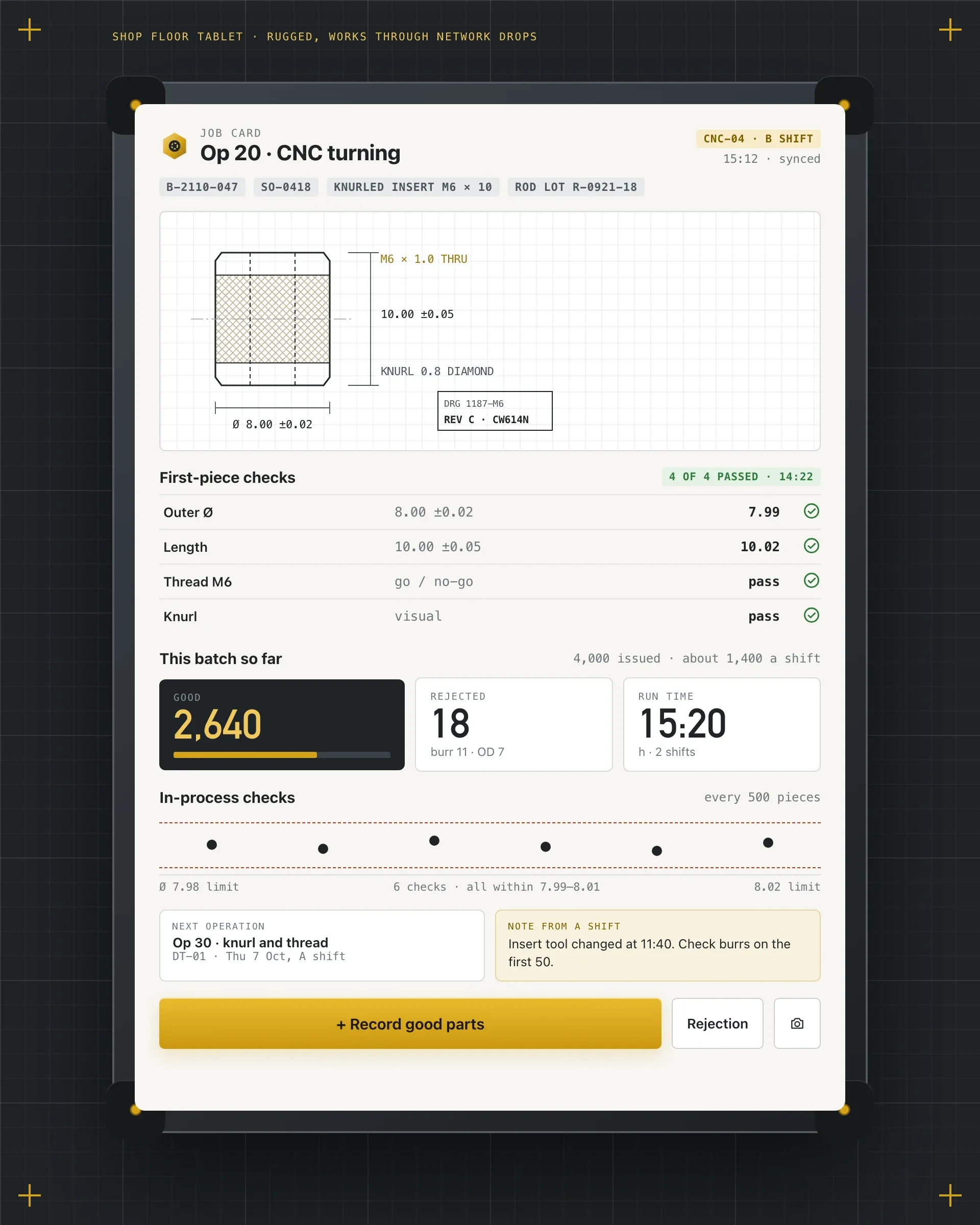
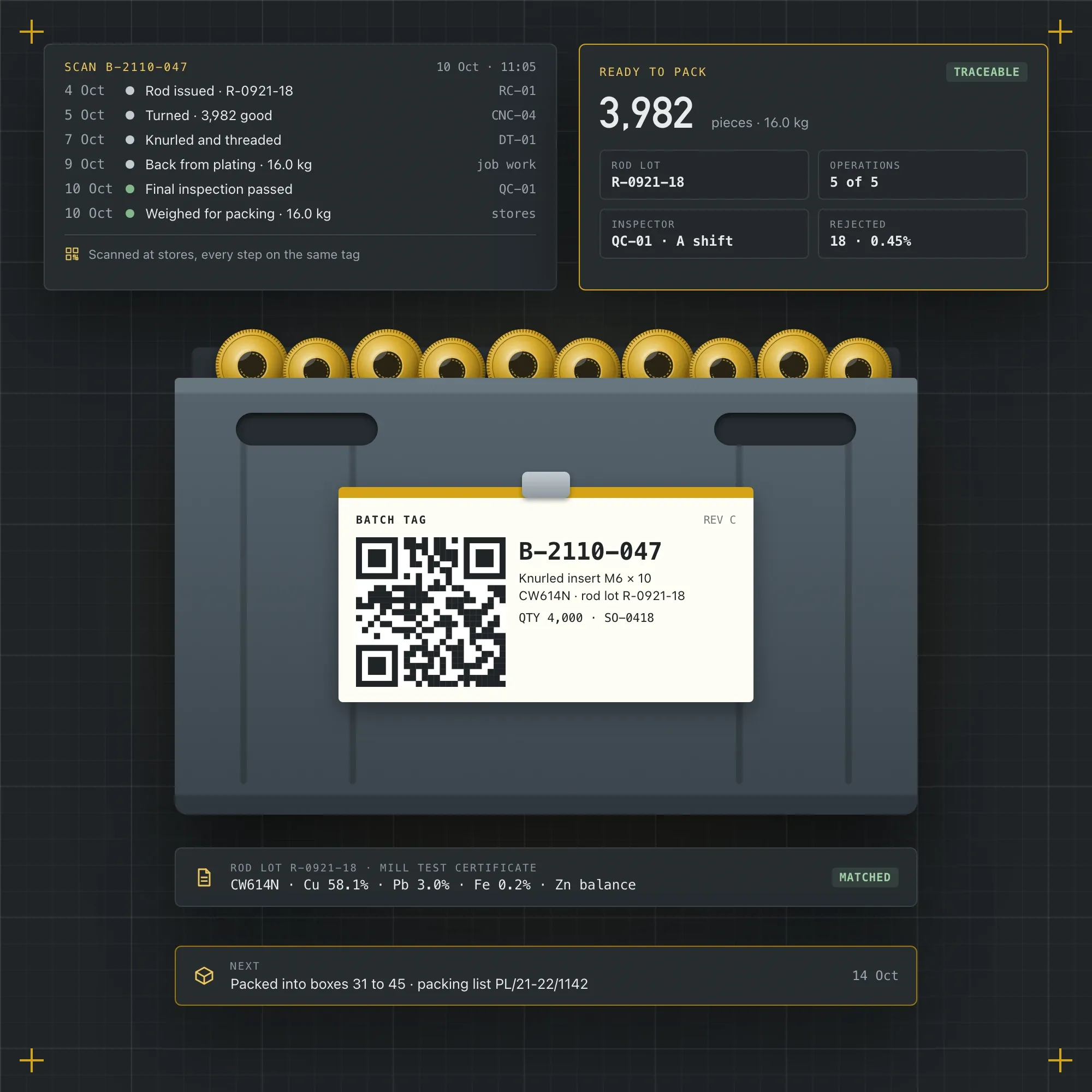
Supervisors work from tablets. Every batch carries a QR code from the moment rod is issued, and scanning it opens the digital job card for the next operation: bar cutting, CNC turning, drilling and threading, and finishing.
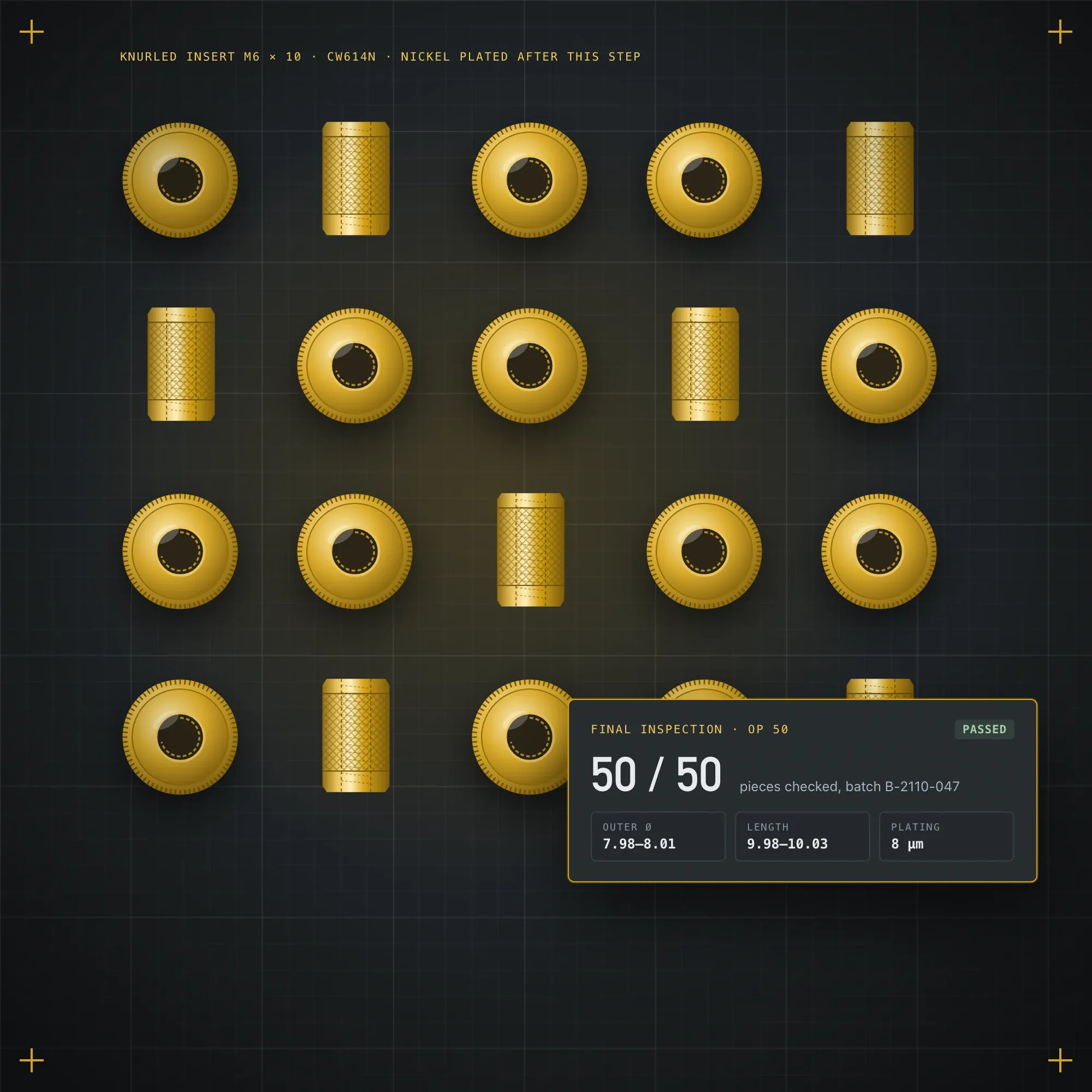
The job card shows the drawing, the machine and the checks for that operation. Supervisors record good output, rejections with their reasons, and time. Inspectors record dimensional checks at first-piece, in-process and final inspection, with measurements and photos, and a batch can’t move on until its inspection is passed.
Brass, yield and job work
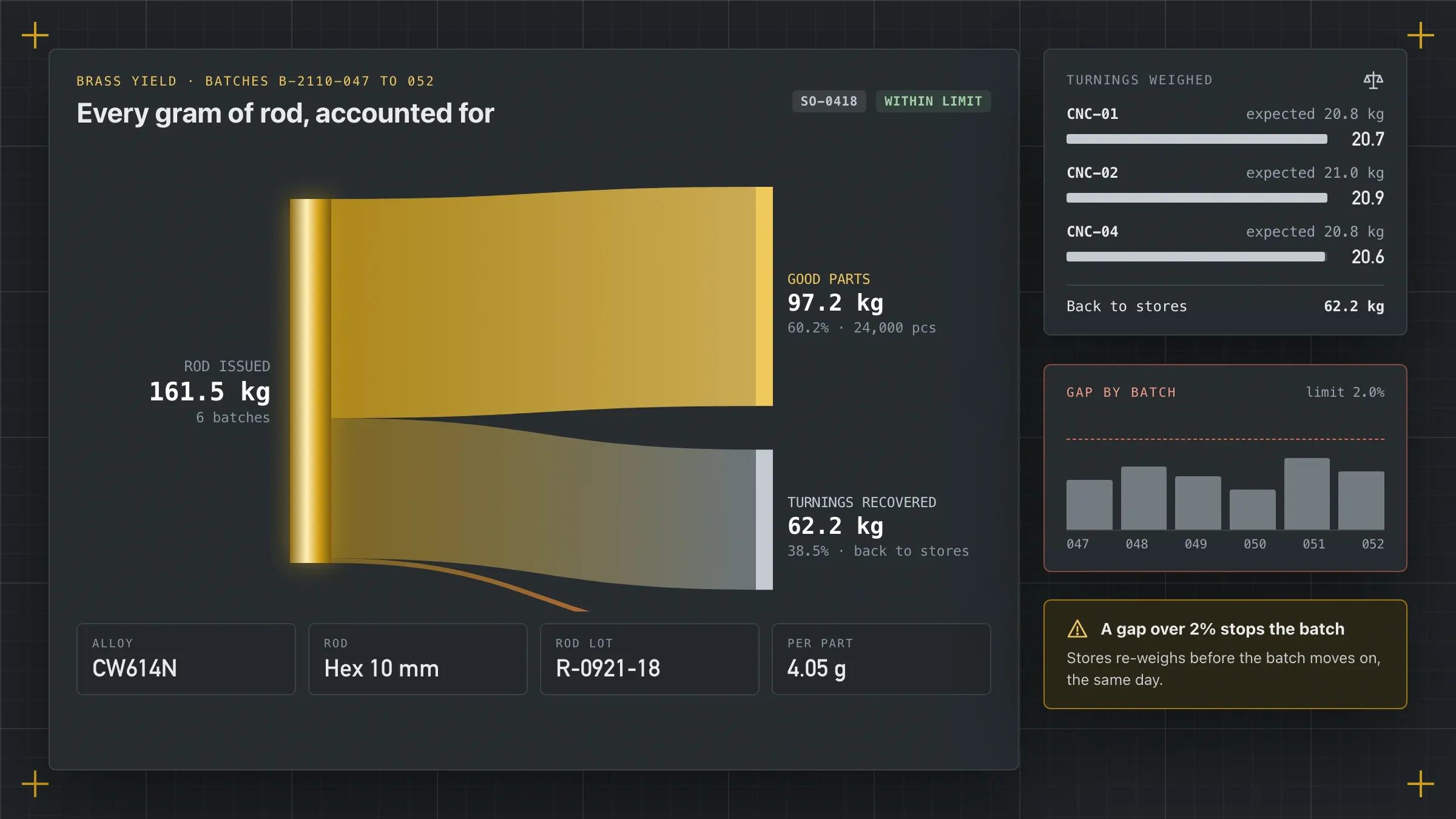
Brass is the plant’s biggest cost, so the system tracks it to the gram:
- rod issued to each batch, by alloy, size and lot;
- good parts produced, by count and weight;
- turnings recovered from each machine, weighed and returned to stores;
- the gap, shown for every batch, so a loss is found the day it happens.
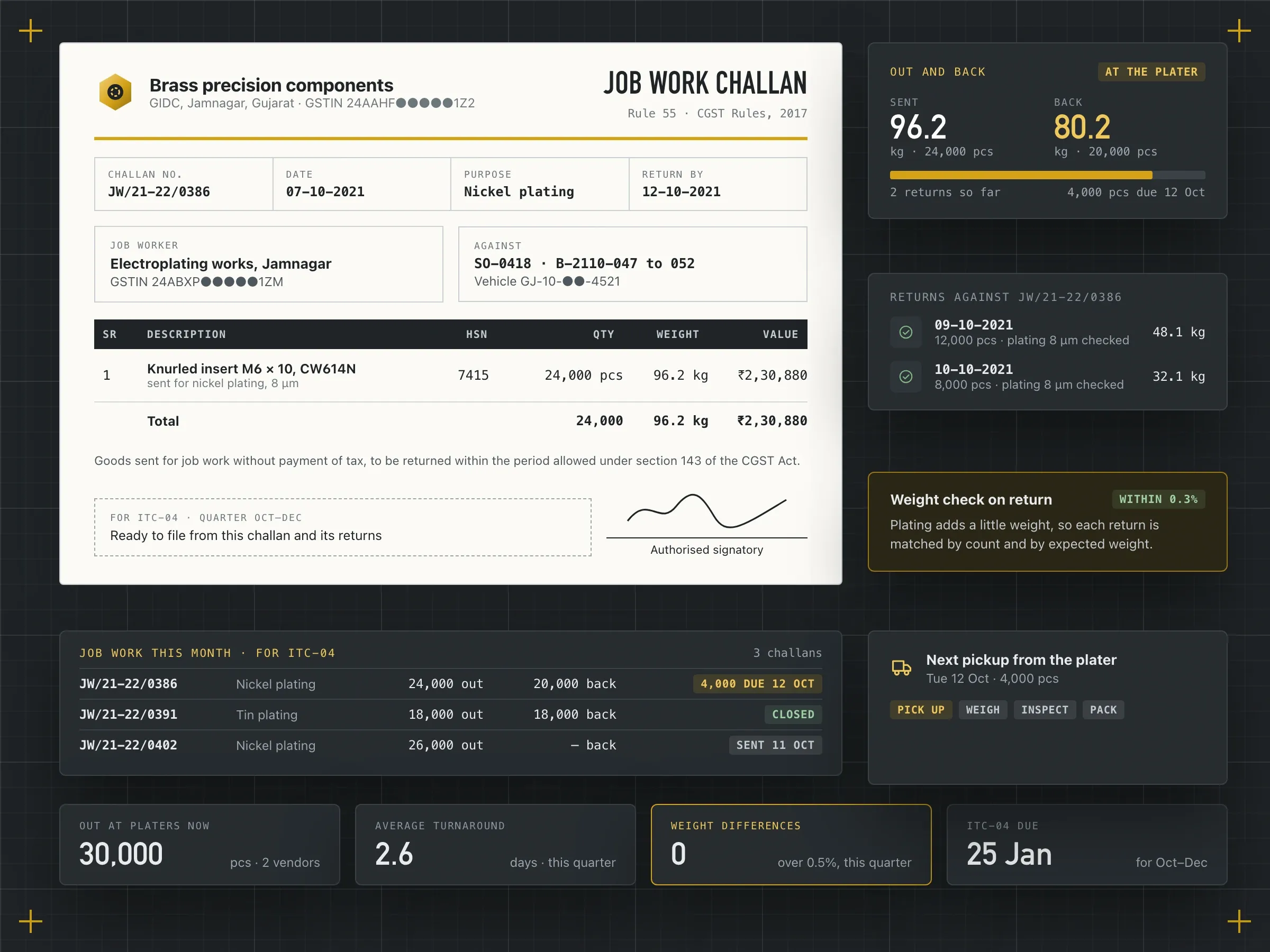
Parts that go out for nickel or tin plating travel with a GST job work challan generated by the system. Quantities and weights are tracked out to the plater and back, and the details for the ITC-04 job work return are ready when it is due.
Dispatch, e-invoices and e-way bills
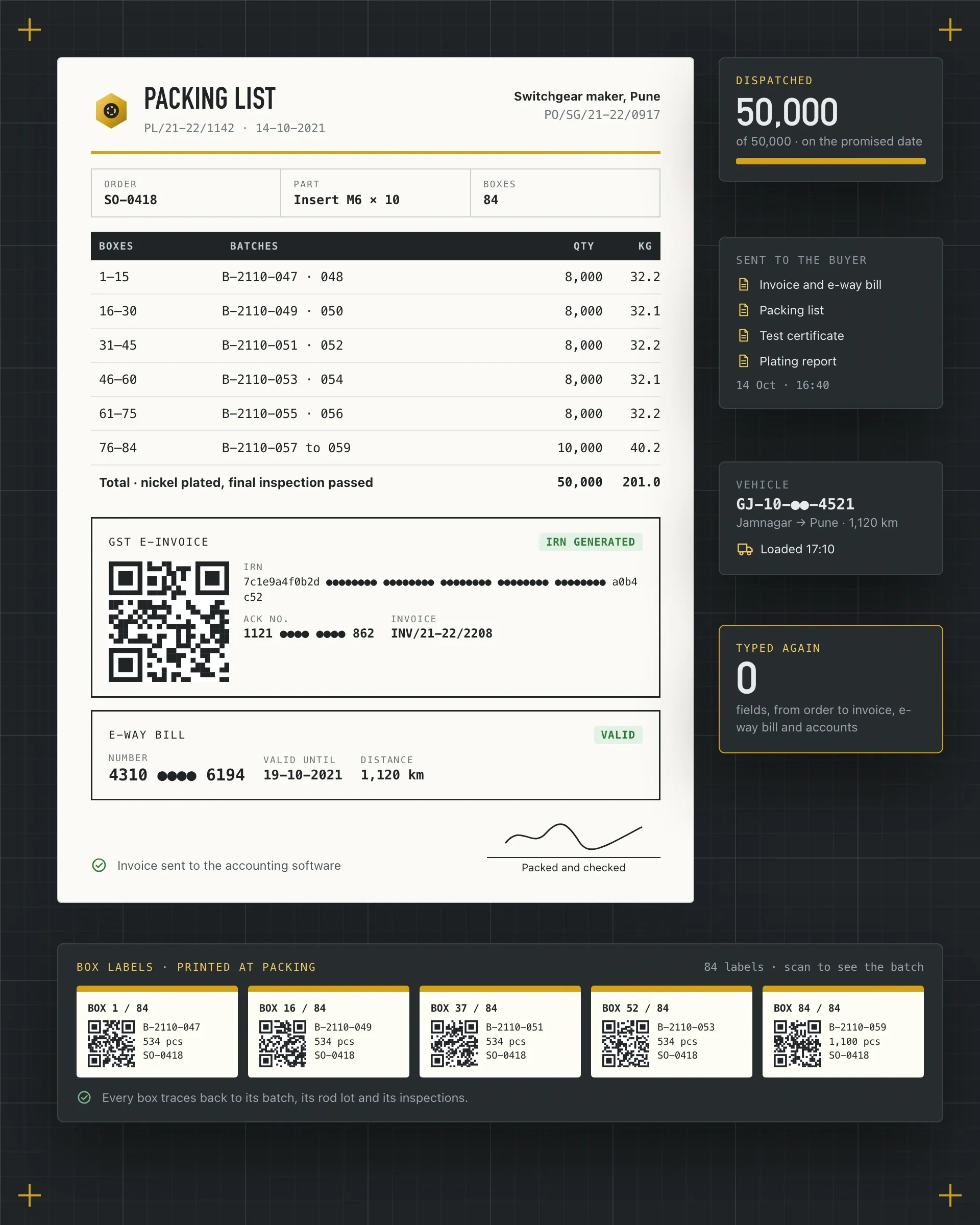
At dispatch, the system prepares the packing list from the batches that passed final inspection, with each box labelled by part, quantity and batch. It generates the GST e-invoice and the e-way bill through an authorised GST API provider, and sends the invoice to the accounting software, Tally, so nothing is typed twice. Buyers receive dispatch details, with test certificates where they need them, the same day.
How it’s built
The system is a Laravel and MySQL application with a Vue.js interface for planners, sales, stores and accounts, and a Flutter app on rugged tablets for the shop floor. Redis keeps the production board live across screens, and a Python service calculates capacity and suggested dates. GST e-invoices and e-way bills are generated through an authorised provider’s API, invoices flow to Tally, and everything runs on AWS, with the shop-floor tablets working through short network drops.
Roll-out
The plant moved over department by department. Orders and planning ran alongside the old spreadsheets for a month until planners trusted the board. The shop floor followed, one machine group at a time, with supervisors trained on the tablets beside their machines. Dispatch and accounts switched last, once the first e-invoices had been checked line by line.
The outcome
The plant now runs from one live view, from purchase order to truck. Dispatch dates are based on real capacity, supervisors update progress from the floor instead of chasing it, and every gram of brass issued to a batch is accounted for. Every part can be traced to its rod lot and inspections, and invoices, challans and e-way bills come straight from the records, without retyping.
How the project ran
7 months in 6 phases
- Month 1
Map the shop floor
Days with sales, planning, the shop floor, quality, stores and dispatch, following real orders from purchase order to truck.
- Months 2–3
Orders and planning
Sales orders, rod stock by alloy and size, machine capacity and the production board, run alongside the old spreadsheets for a month.
- Months 4–5
Shop floor and quality
Job cards on tablets, QR-coded batches, brass yield and scrap by weight, and inspections recorded at every stage.
- Month 6
Job work and dispatch
Job work challans for plating, packing lists, e-invoices, e-way bills and invoices sent to the accounting software.
- Month 7
Roll-out
The whole plant moved over department by department, with supervisors trained on the floor.
- 2022 onwards
Support
New machines, customers and reports added, with the plan tuned as the plant grew.
What we delivered
- IT consulting
- Process mapping
- Product design
- Web app
- Mobile app
- Cloud
- Maintenance and support
Inside the project
7 pictures
Questions and answers
10 answered
What did FIRELIFE Ventures build for a brass components manufacturer in Jamnagar?
FIRELIFE Ventures built manufacturing order management software for a brass precision components manufacturer in Jamnagar. It follows every order from the buyer's purchase order through planning, the shop floor, plating and inspection to dispatch, with e-invoices and e-way bills generated from dispatch records.
What is order-to-dispatch software for manufacturers?
Order-to-dispatch software follows every order from the customer's purchase order through production planning, the shop floor and quality checks to packing, invoicing and dispatch. Everyone works from the same live record instead of separate spreadsheets.
How does the system set realistic delivery dates?
When an order is entered, the system checks brass rod stock for the right alloy and size, and the free capacity of each machine the part needs, then suggests a dispatch date. Sales promises dates the plant can actually meet.
What is a digital job card?
A digital job card is the shop-floor instruction for one operation on one batch: the part, drawing, machine, quantity and checks. Supervisors open it on a tablet by scanning the batch's QR code, and record output, rejections and time as the work happens.
Why track brass yield and scrap?
Brass is expensive, and turning bar into precision parts produces a lot of turnings. The system records the rod weight issued, the weight of good parts and the turnings recovered for each batch, so any gap shows up straight away instead of at the stock count.
How does the system handle job work such as plating?
Parts sent out for plating go with a GST job work challan generated by the system. Quantities and weights are tracked out and back, and the details needed for the ITC-04 job work return are ready when it is due.
Can the system create GST e-invoices and e-way bills?
Yes. When a dispatch is packed, the system generates the GST e-invoice and e-way bill through an authorised GST API provider and sends the invoice to the accounting software, so nothing is typed twice.
How does batch traceability work?
Each batch carries a QR code from the moment brass rod is issued. Every operation, machine, operator and inspection is recorded against it, so any part can be traced back to its rod lot and its quality checks.
How long does it take to build manufacturing software like this?
The system took seven months, delivered in stages: orders and planning first, then the shop floor and quality, then job work and dispatch, with each stage in use before the next began.
Can FIRELIFE Ventures build order management software for my factory?
Yes. FIRELIFE Ventures builds order, production, inventory and dispatch software for manufacturers, shaped around how each plant actually works, and supports it after launch. Start a project through the contact page.
More from the portfolio
All portfolio-
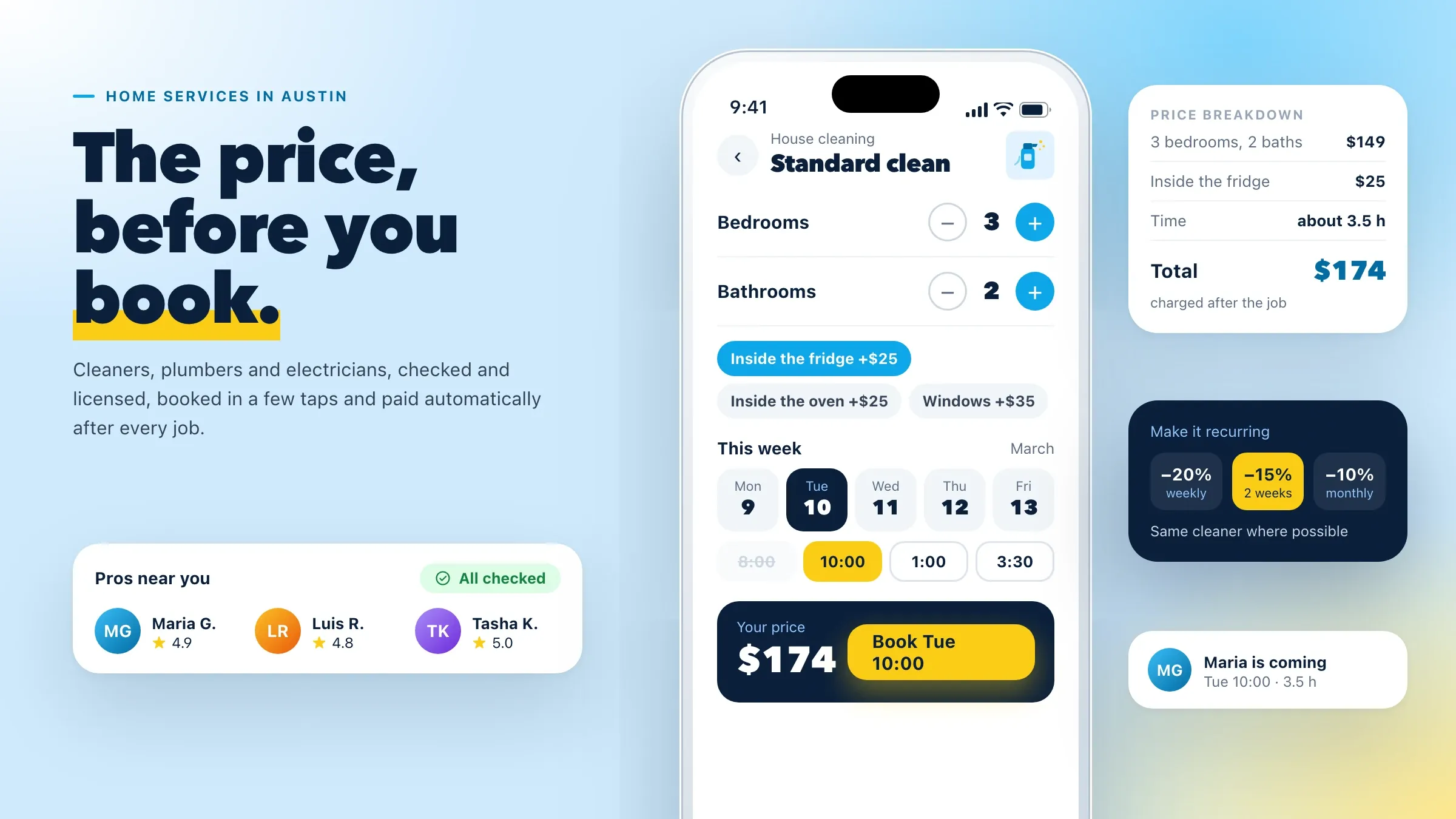 Home Services Booking App An on-demand home services marketplace for a company in Austin: homeowners book cleaners, plumbers and electricians with upfront prices, jobs go to checked and licensed pros nearby, and pros are paid automatically after every job.
-
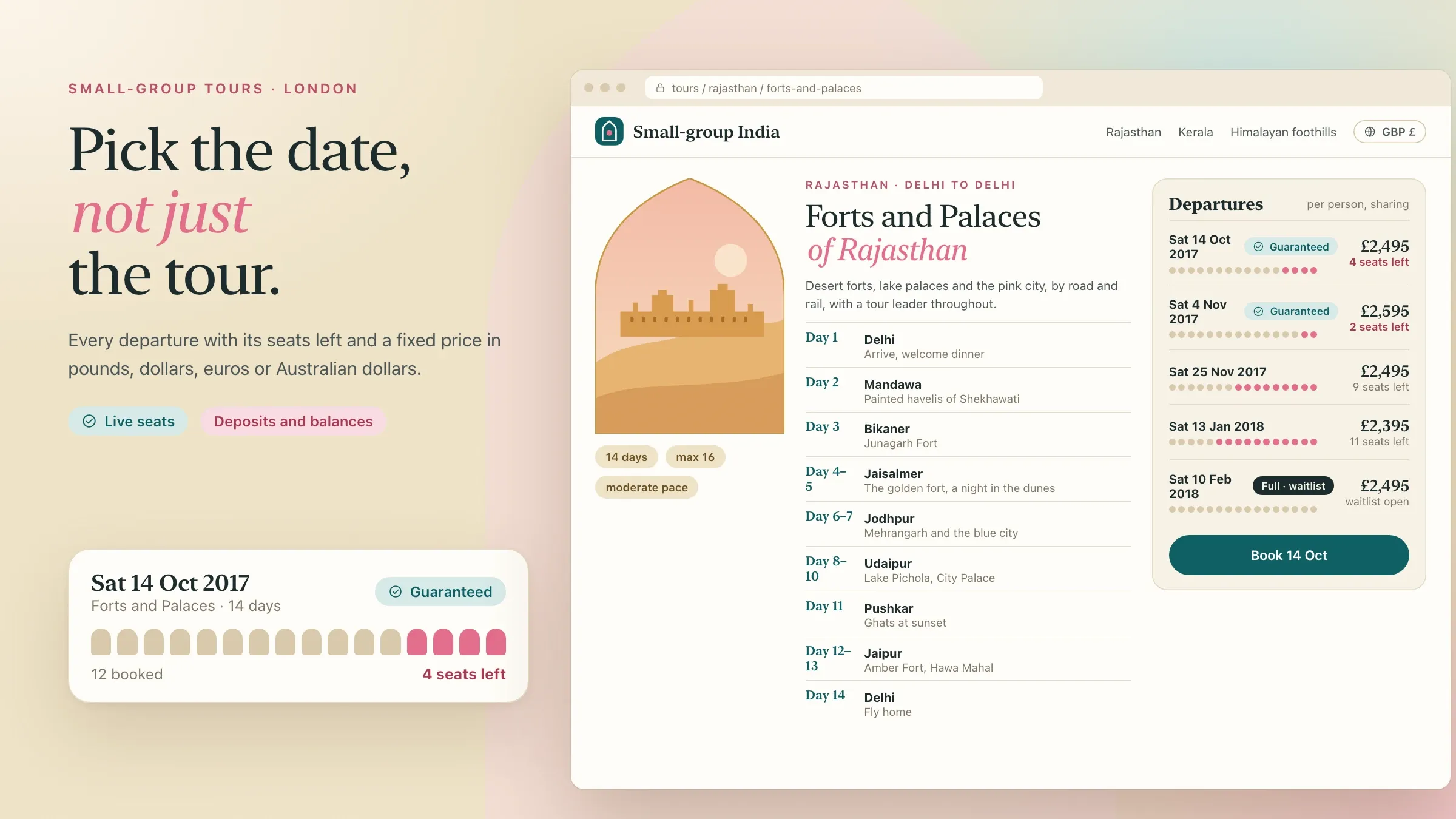 Small-Group Tour Booking A tour booking platform for a London tour operator running small-group tours in India: live seats for every departure, deposits and balances in four currencies, room sharing for solo travellers, a travel agent portal and rooming lists for the ground team.
-
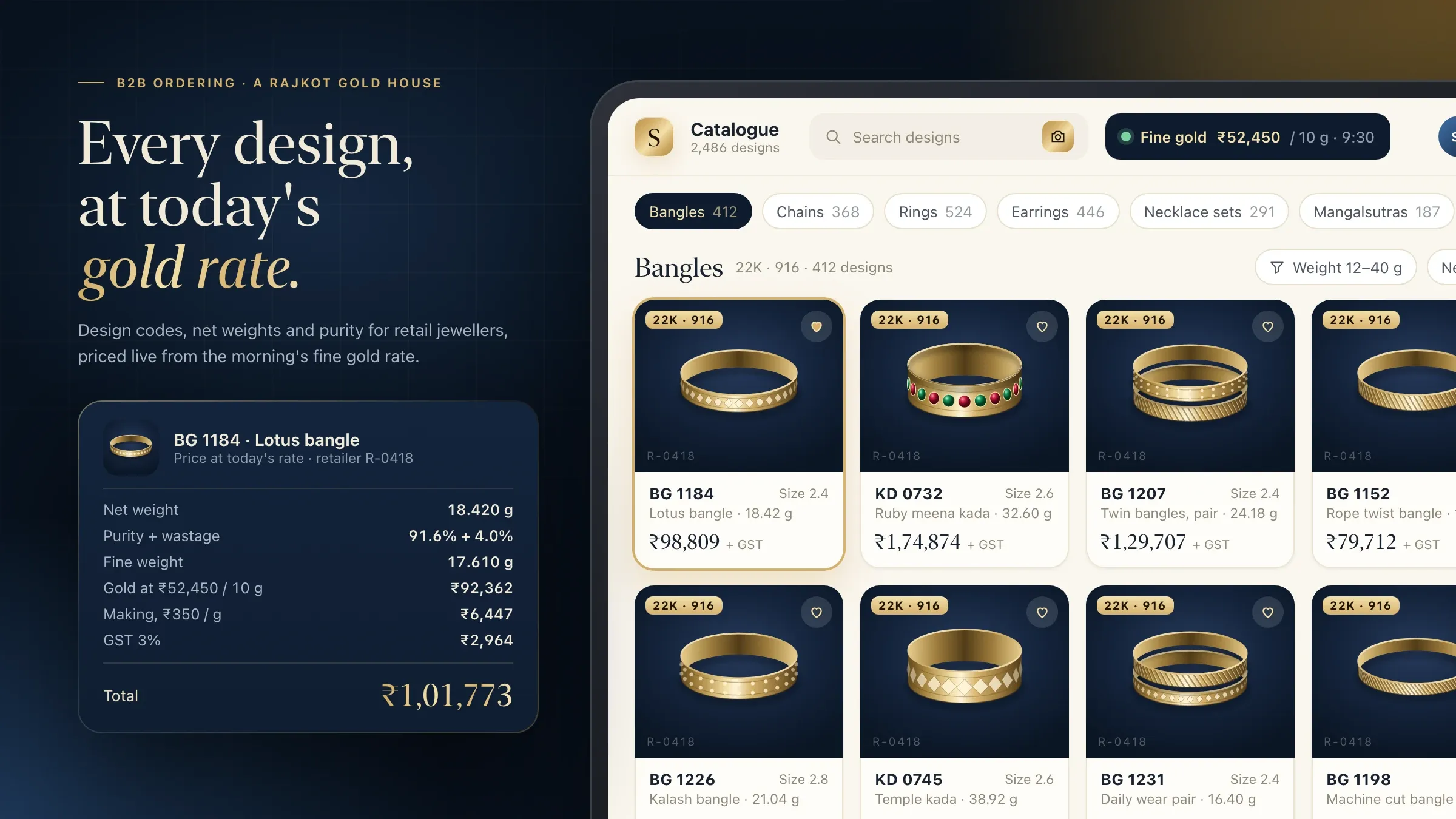 Jewellery Catalogue and Ordering App A B2B jewellery ordering app for a gold jewellery wholesaler in Rajkot: a live catalogue, gold-rate pricing, search by photo, and every order tracked from karigar to hallmark to dispatch.
Need something like this built?
Tell us what you want to build and where you are with it, and we'll get back to you.
Start a project