Overview
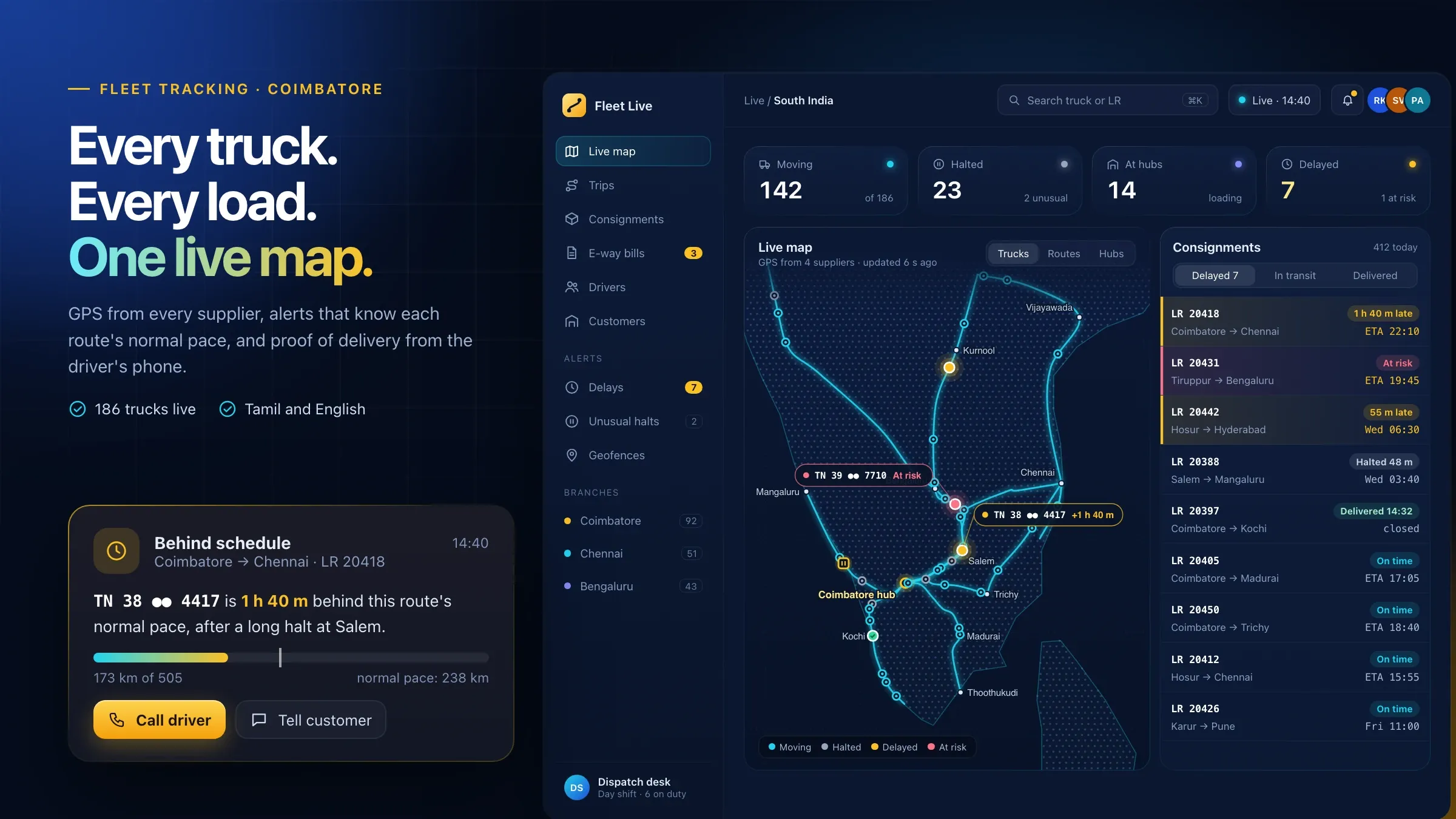
Logistics tracking dashboard for a transport company: live GPS for every vehicle, delay alerts, a driver app with proof of delivery and customer tracking links.
- Client
- A regional logistics and transport company in Coimbatore
- Industry
- Logistics and transport
- Location
- Coimbatore, Tamil Nadu, India
- Year
- 2018
- Duration
- 6 months
At a glance
- The challenge
Dispatchers needed five tools and their phones to answer one question: where is this consignment?
- Mapping the dispatch room
We spent the first month in the dispatch room and at two hubs, sitting beside dispatchers through full shifts.
- One live map
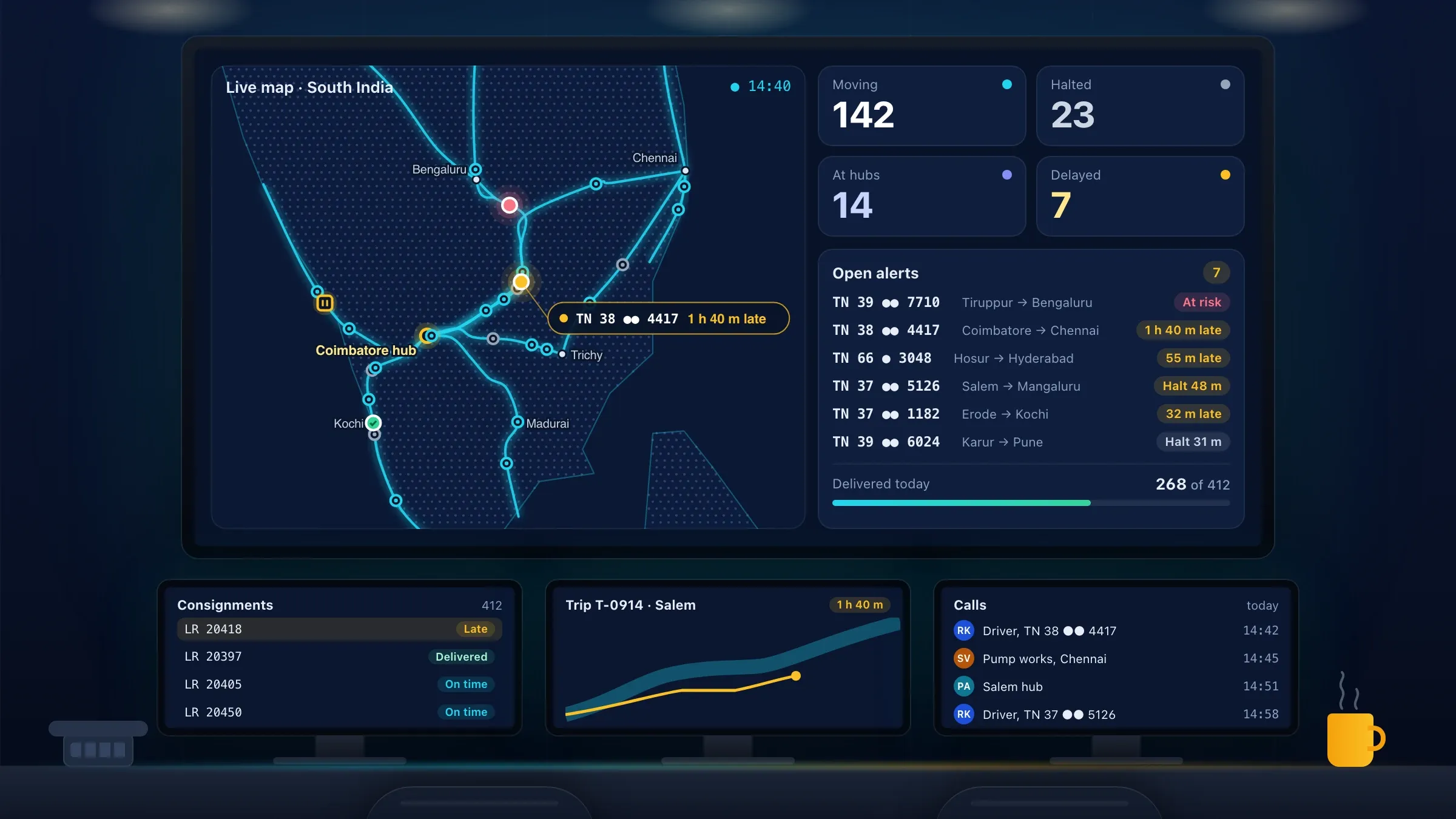
The dashboard brings every truck, trip and consignment onto one live map.
- Delay alerts that learn each route
A delay alert is only useful if it knows what normal is.
- The driver app
Drivers got a simple Android app with large buttons, in Tamil and English.
- E-way bills and paperwork
The national e-way bill system arrived in April 2018, in the middle of the project, and we built it in.
- Customer tracking links
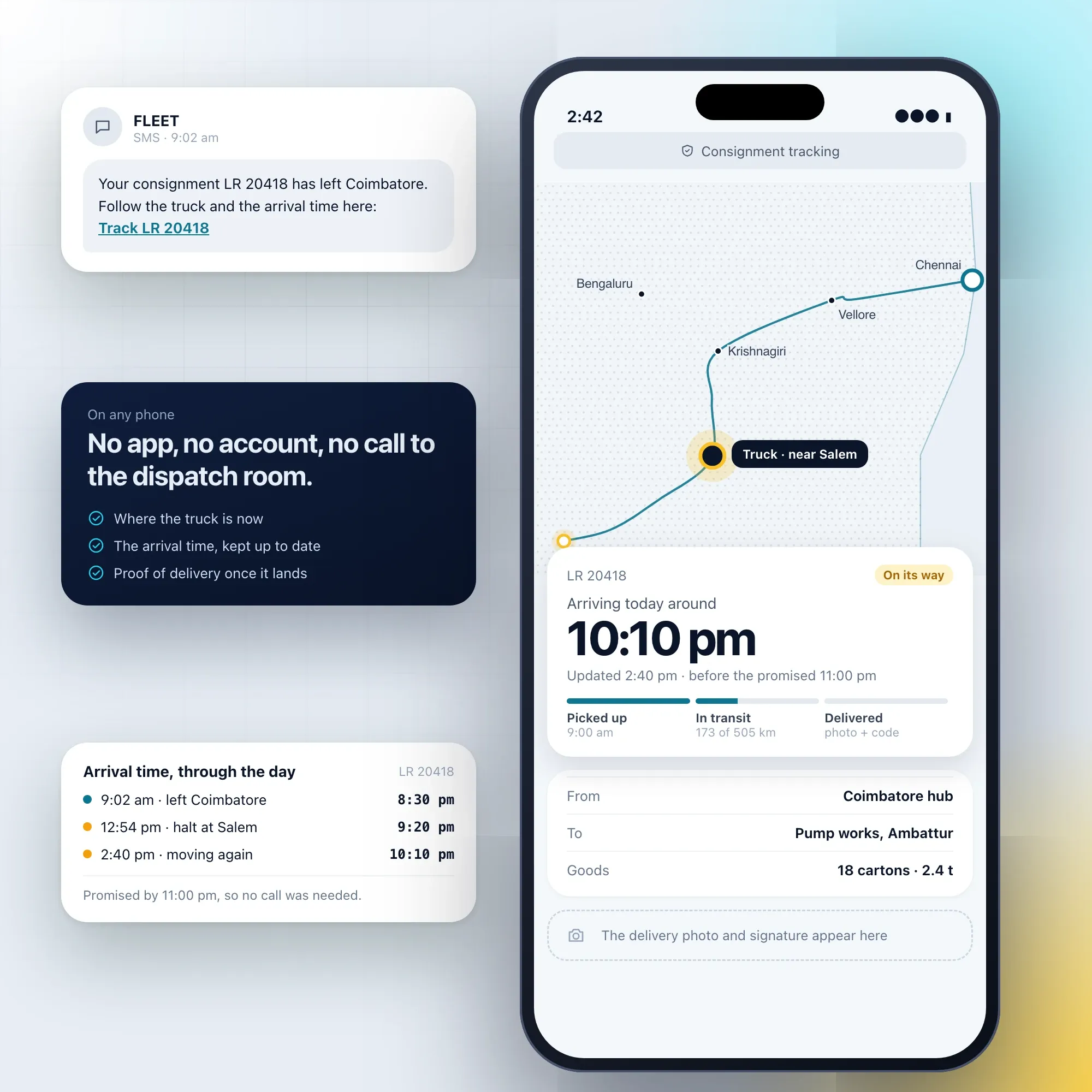
Every consignment has a tracking link that the company shares with its customer by SMS or email.
- How it's built
The dashboard is React, on a Node.js and Express backend with MongoDB for trips and positions and Redis for live state.
- Roll-out
Two dispatchers used the first live view alongside their old tools for a month, and their feedback shaped the alerts.
- The outcome
The dispatch team now runs the whole fleet from one screen, sees delays early enough to act, and closes deliveries the moment they happen.
The challenge
Dispatchers needed five tools and their phones to answer one question: where is this consignment? The company runs trucks across South India for manufacturers and distributors, and its operation had outgrown the way it was managed.
Trucks carried GPS devices from different suppliers, each with its own website. Trips and consignments lived in spreadsheets. Drivers reported progress by phone, proof of delivery was a paper slip that came back days later, and delays were usually discovered when the customer rang to ask. From April 2018, every consignment also needed a valid e-way bill, and an expired one on the road meant a stopped truck and a penalty.
Mapping the dispatch room
We spent the first month in the dispatch room and at two hubs, sitting beside dispatchers through full shifts.
- Dispatchers spent their day on the phone, calling drivers for positions they could have seen on a screen.
- Every GPS supplier had its own website, so no one ever saw the whole fleet at once.
- Delays were only noticed when they were already late. Nobody knew what “normal” looked like for each route.
- Paperwork lagged behind the trucks. Lorry receipts, proof of delivery and e-way bills were chased separately from the trips they belonged to.
One live map
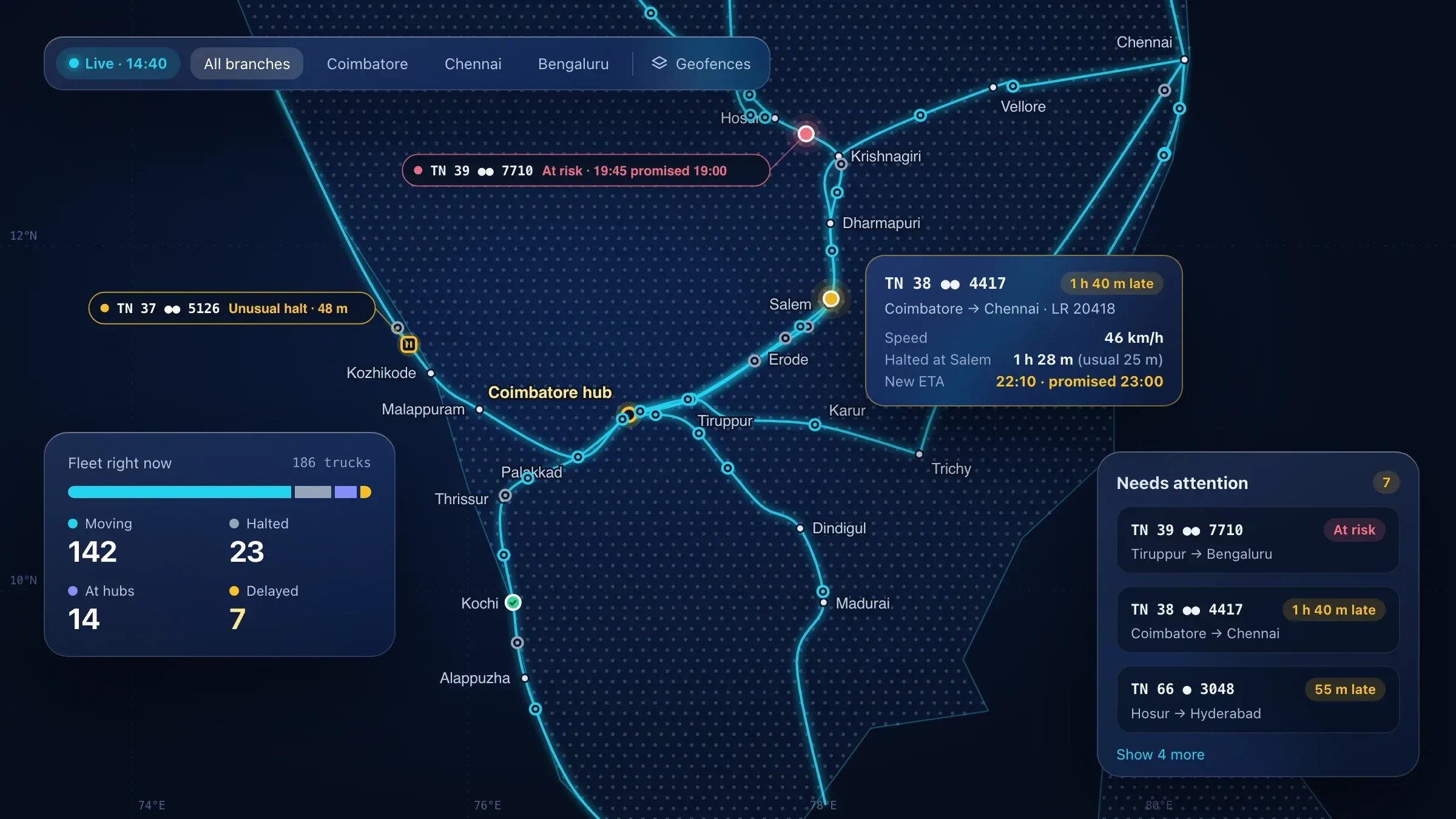
The dashboard brings every truck, trip and consignment onto one live map. The dashboard reads the GPS devices already fitted in the trucks, whatever their supplier, and shows each truck’s position, speed and status in real time.
Each trip carries its consignments and their lorry receipt numbers, with geofences around hubs, customer sites and common halt points. The dashboard knows when a truck reaches a hub, leaves a customer’s gate or stops somewhere it shouldn’t. Dispatchers filter the map by route, customer, branch or status, and see each truck’s whole day in one place.
Delay alerts that learn each route
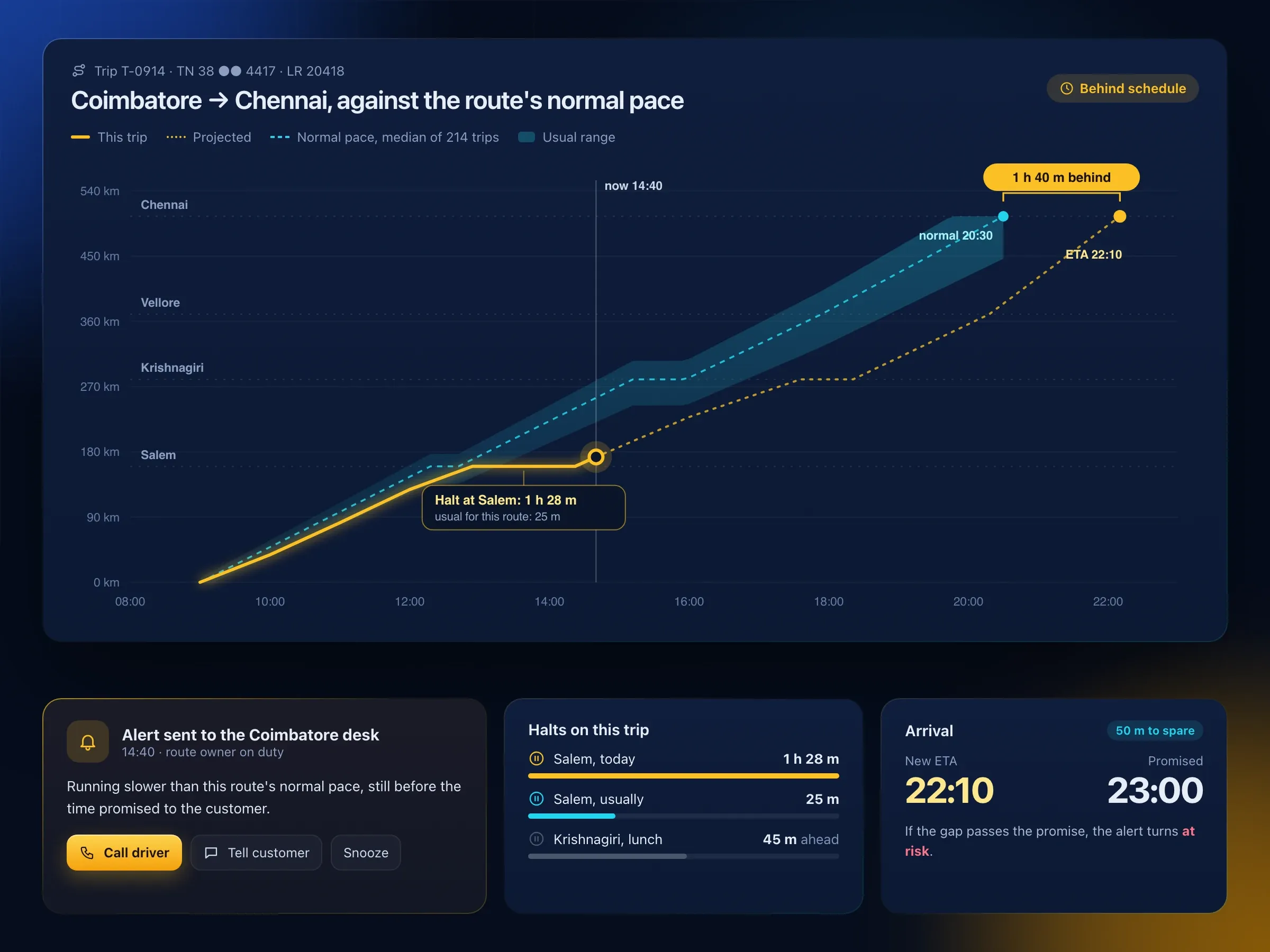
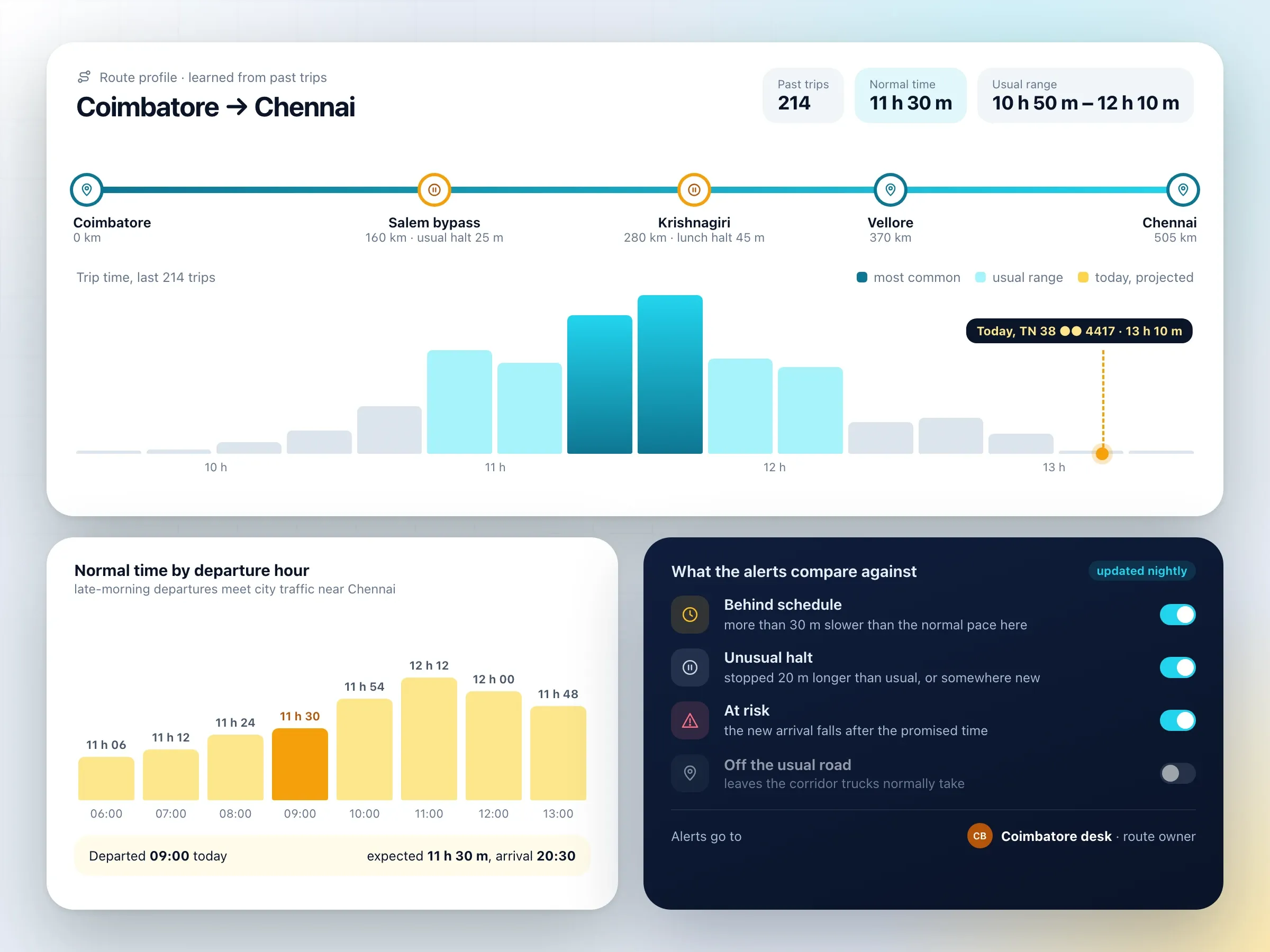
A delay alert is only useful if it knows what normal is. The dashboard learns how long each route usually takes from past trips, including the usual night halts and loading times.
Every live trip is compared against that baseline, and the dashboard raises alerts in order of urgency:
- behind schedule: the truck is running slower than the route’s normal pace;
- unusual halt: the truck has stopped longer than usual, or somewhere unusual;
- at risk: the arrival time now falls after the time promised to the customer.
Alerts go to the dispatcher responsible for that route, so the team can act, by calling the driver, informing the customer or planning a handover, before anyone has to ask.
The driver app
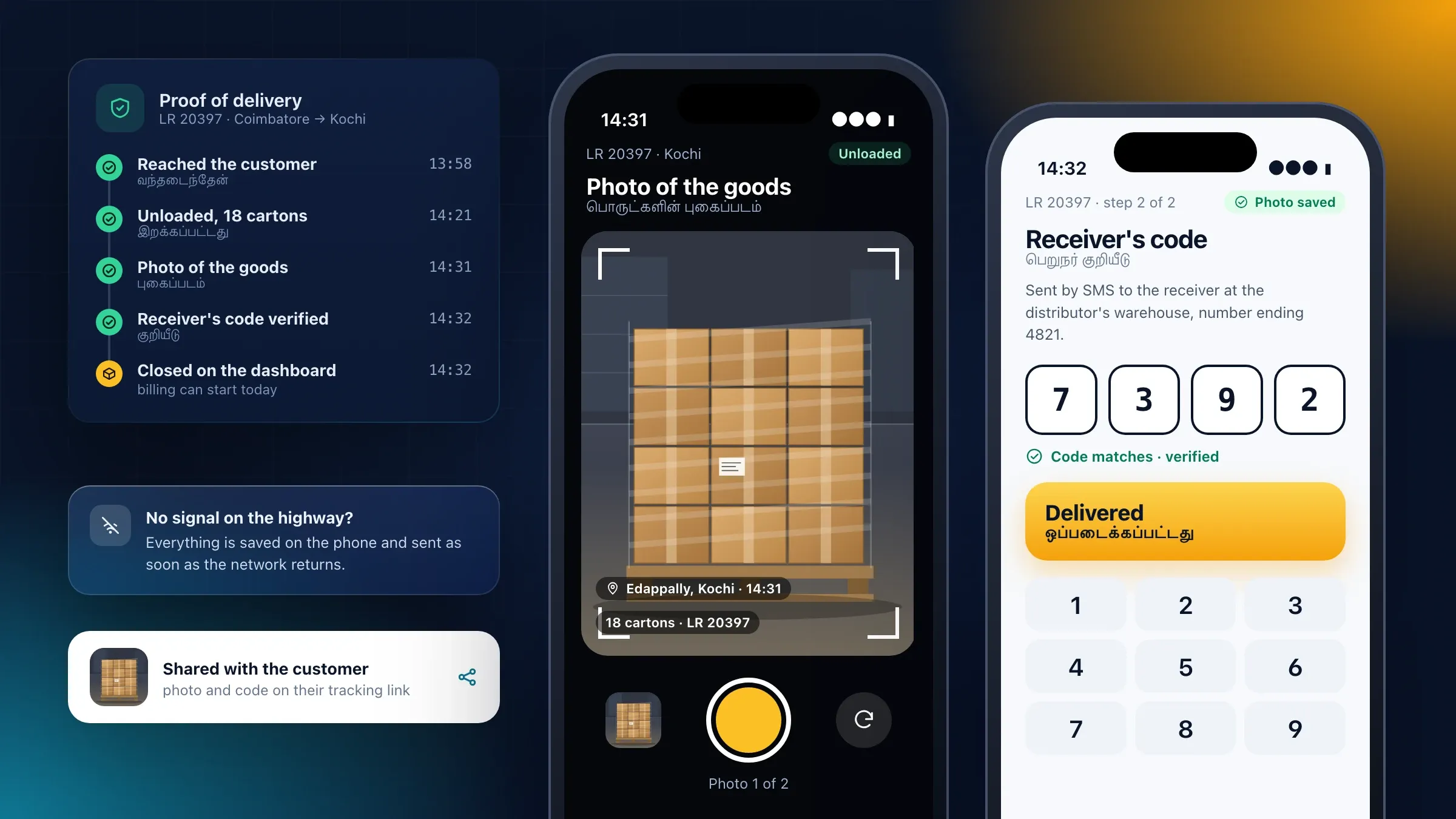
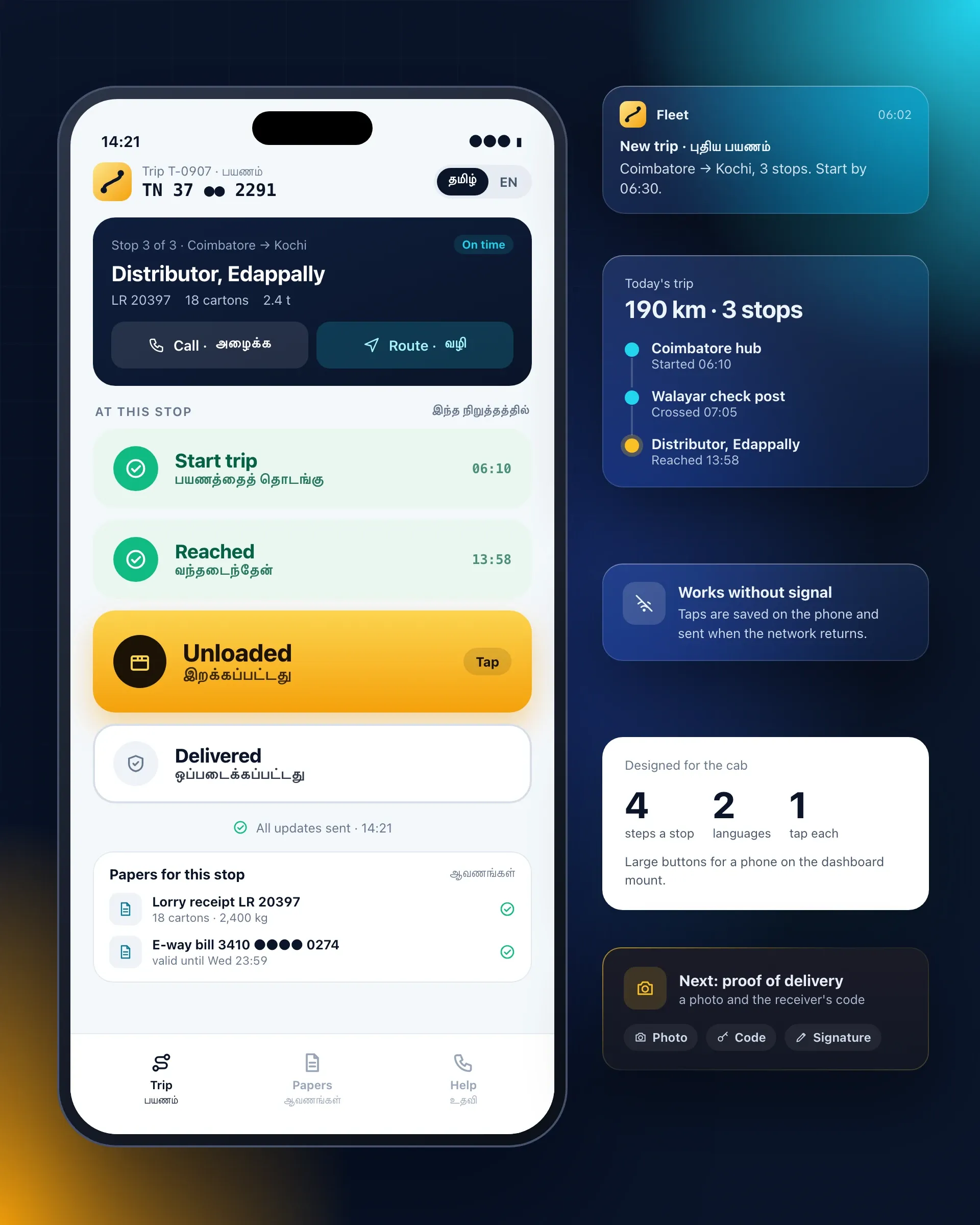
Drivers got a simple Android app with large buttons, in Tamil and English. It shows each trip’s consignments, addresses and contacts, and asks for only what matters: start trip, reached, unloaded, delivered.
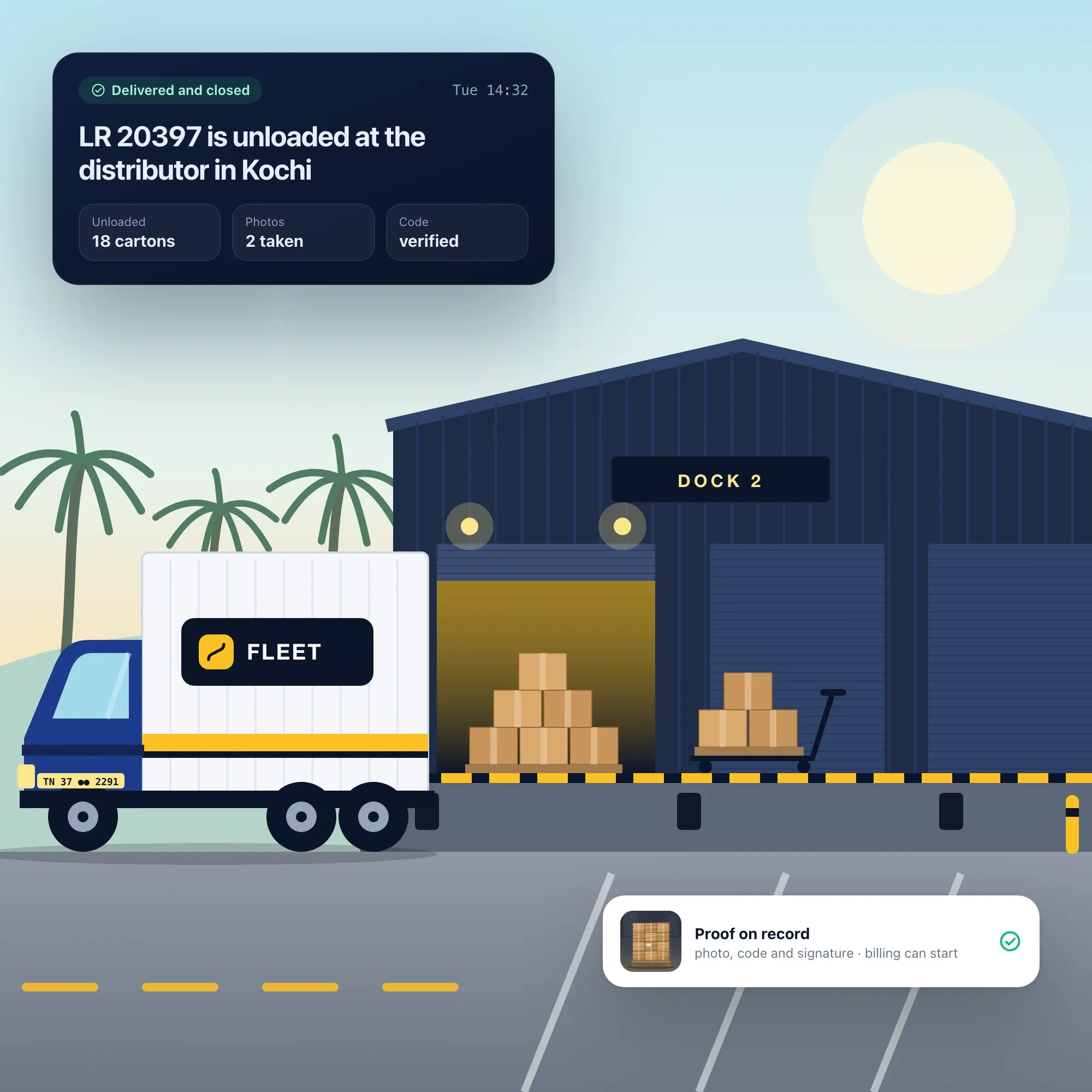
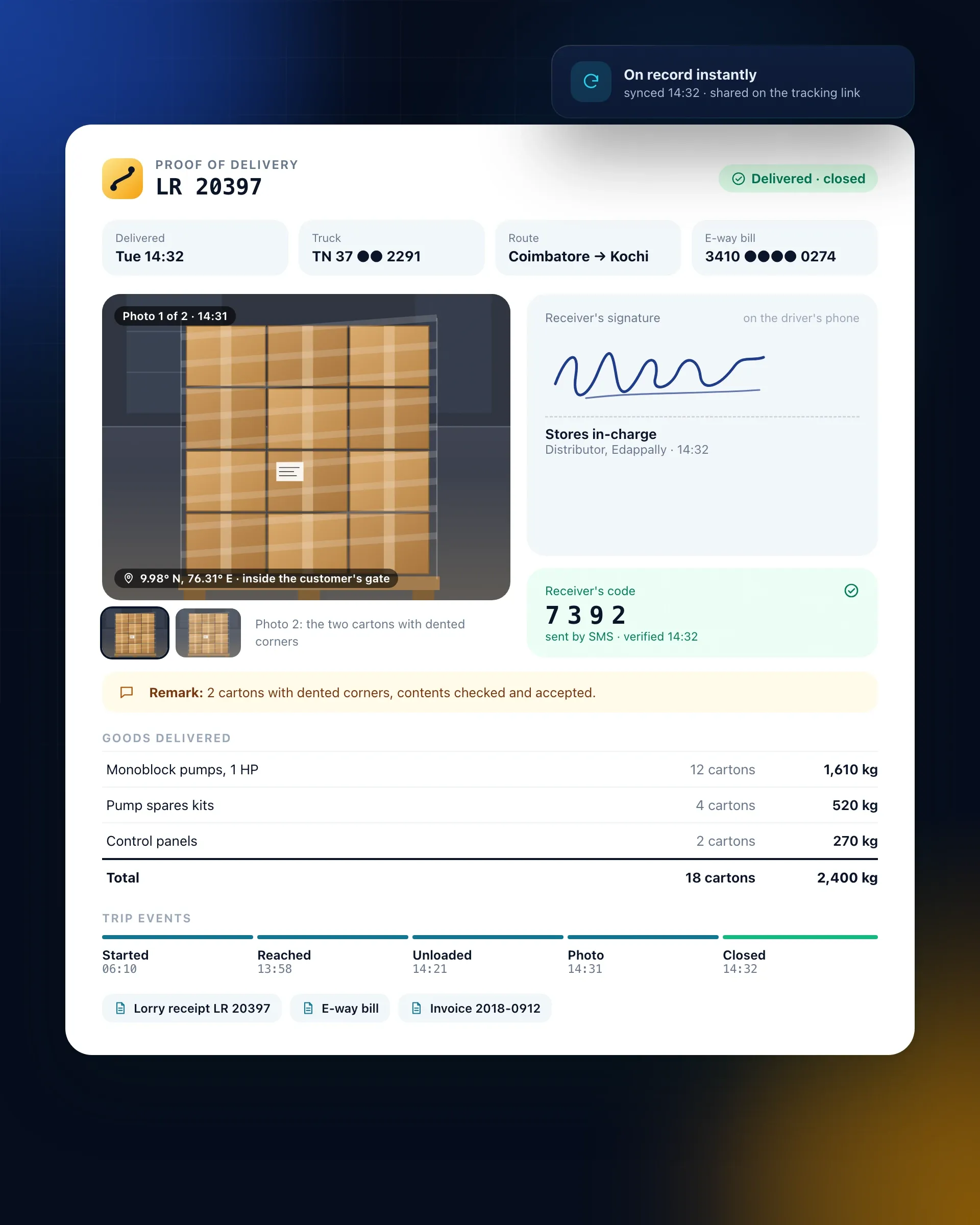
At delivery, the driver takes a photo of the goods and records the receiver’s signature or a one-time code sent to the receiver’s phone. The consignment closes on the dashboard instantly. Highways often have no signal, so the app saves everything on the phone and sends it as soon as the network returns.
E-way bills and paperwork
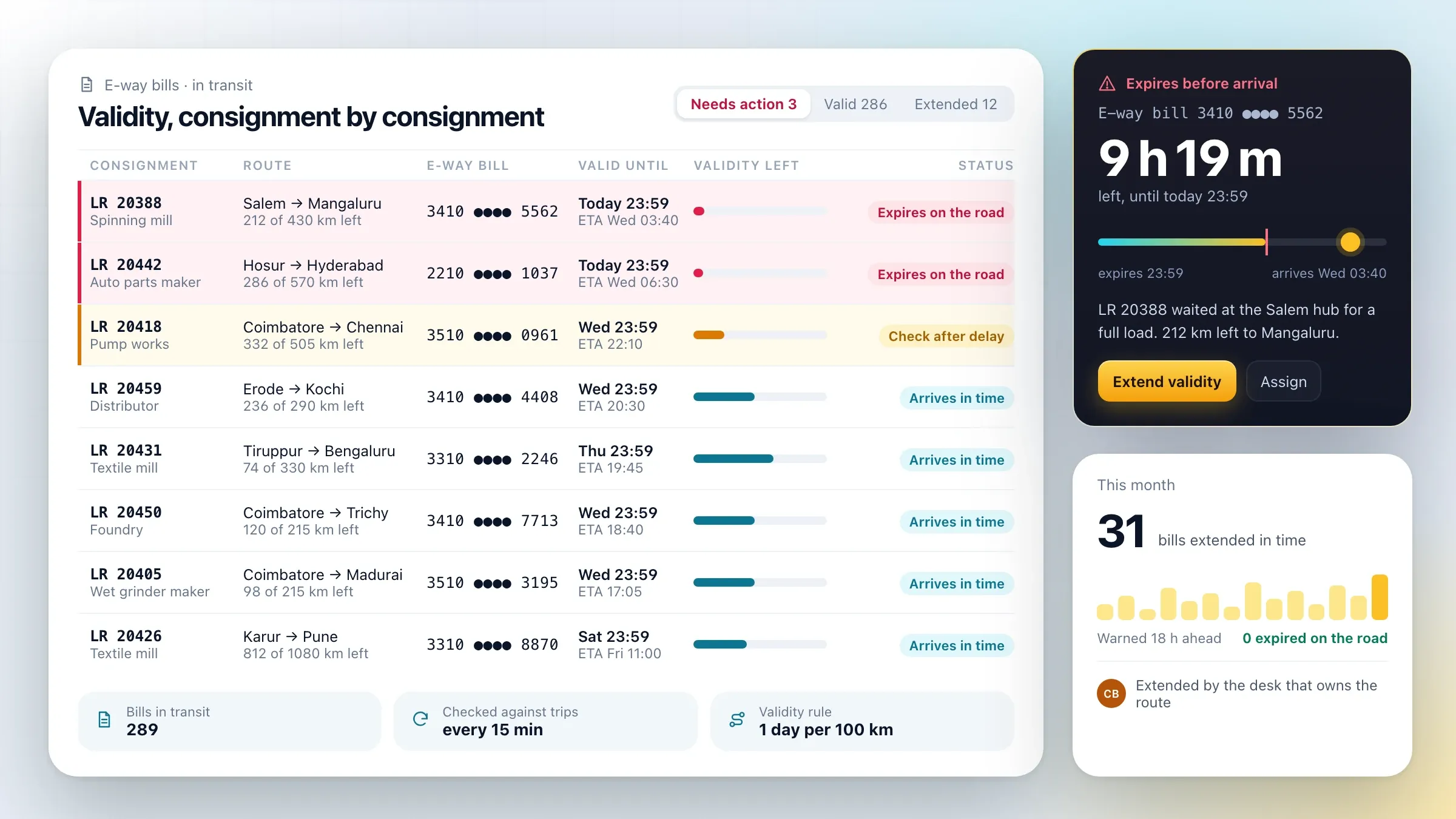
The national e-way bill system arrived in April 2018, in the middle of the project, and we built it in. Every consignment records its e-way bill number and validity, which depends on the distance travelled.
The dashboard warns the team before any e-way bill expires on the road, so it can be extended in time. Lorry receipts, e-way bills and proof of delivery are attached to the consignment they belong to, and month-end billing starts from complete delivery records instead of paper slips.
Customer tracking links
Every consignment has a tracking link that the company shares with its customer by SMS or email. The customer sees where the truck is, the expected arrival time and, once delivered, the proof of delivery, on any phone and without an account. Customers check for themselves instead of calling the dispatch room.
How it’s built
The dashboard is React, on a Node.js and Express backend with MongoDB for trips and positions and Redis for live state. A device gateway reads the different GPS suppliers’ data formats, and Socket.IO pushes positions and alerts to every dispatcher’s screen as they happen. Route timings are learned by Python models trained on past trips. The driver app is built in Kotlin for Android, Google Maps provides the maps, and everything runs on AWS.
Roll-out
Two dispatchers used the first live view alongside their old tools for a month, and their feedback shaped the alerts. The whole dispatch team then moved over, drivers were trained at the hubs as they came in, and the old spreadsheets were retired. In the years after, we added new routes and customers, and brought in FASTag toll records once FASTag became mandatory.
The outcome
The dispatch team now runs the whole fleet from one screen, sees delays early enough to act, and closes deliveries the moment they happen. No e-way bill expires unnoticed on the road, customers follow their own consignments, and month-end billing starts from complete records.
How the project ran
6 months in 6 phases
- Month 1
Map the operation
Days in the dispatch room and at two hubs, every tool and spreadsheet in use listed, and the questions customers called about most written down.
- Months 2–3
First live view
GPS from every truck, trips and consignments on one live map, used by two dispatchers alongside their old tools.
- Month 4
Delay alerts and e-way bills
Route timings learned from past trips, delay and halt alerts, and e-way bill validity watched for every consignment.
- Month 5
Driver app and customer tracking
The driver app with proof of delivery, and a tracking link for every consignment.
- Month 6
Roll-out
The whole dispatch team moved to the dashboard, drivers trained at the hubs, and the old spreadsheets retired.
- 2019 onwards
Support
New routes, customers and reports added, and FASTag toll records brought in once FASTag became mandatory.
What we delivered
- IT consulting
- Product design
- Web app
- Mobile app
- Data and machine learning
- Cloud
- Maintenance and support
Inside the project
7 pictures
Questions and answers
10 answered
What did FIRELIFE Ventures build for a transport company in Coimbatore?
FIRELIFE Ventures built a logistics tracking dashboard for a regional transport company in Coimbatore. It shows every truck and consignment on one live map, raises delay alerts based on each route's normal timing, watches e-way bill validity, and gives drivers an app for proof of delivery.
What is a logistics tracking dashboard?
A logistics tracking dashboard shows every vehicle, trip and consignment on one live screen, with GPS positions, delivery status and alerts. Dispatchers manage the whole fleet from one place instead of phoning drivers.
How does the dashboard know a delivery will be late?
It learns how long each route normally takes from past trips, including usual halts, and compares every live trip against it. When a truck falls behind or stops for longer than usual, the dashboard raises an alert so the team can act before the customer calls.
Can the dashboard work with different GPS devices?
Yes. Trucks fitted with different GPS devices send their data in their own formats, and the dashboard reads each one, so the company didn't have to replace devices that already worked.
What is an e-way bill, and why track its validity?
An e-way bill is the electronic document required under GST to move goods above a set value, introduced across India in April 2018. Each one is valid for a distance-based period, and the dashboard warns the team before a consignment's e-way bill expires on the road.
What is proof of delivery in a driver app?
Proof of delivery is the record that a consignment reached its destination. In the driver app, the driver captures a photo of the delivered goods and the receiver's signature or one-time code, and the consignment closes on the dashboard instantly.
Can customers track their own consignments?
Yes. Each consignment has a tracking link that the customer can open on any phone to see where the truck is, the expected arrival time and, once delivered, the proof of delivery.
Does the driver app work without a network?
Yes. Drivers on highways often lose signal, so the app saves trip updates and proof of delivery on the phone and sends them as soon as the network returns.
How long does it take to build logistics tracking software?
The project took six months, delivered in stages: a first live view in month three, then delay alerts and e-way bills, then the driver app and customer tracking, then the full roll-out.
Can FIRELIFE Ventures build tracking software for my fleet?
Yes. FIRELIFE Ventures builds fleet tracking dashboards, driver apps and customer tracking for logistics and transport companies, and supports them after launch. Start a project through the contact page.
More from the portfolio
All portfolio-
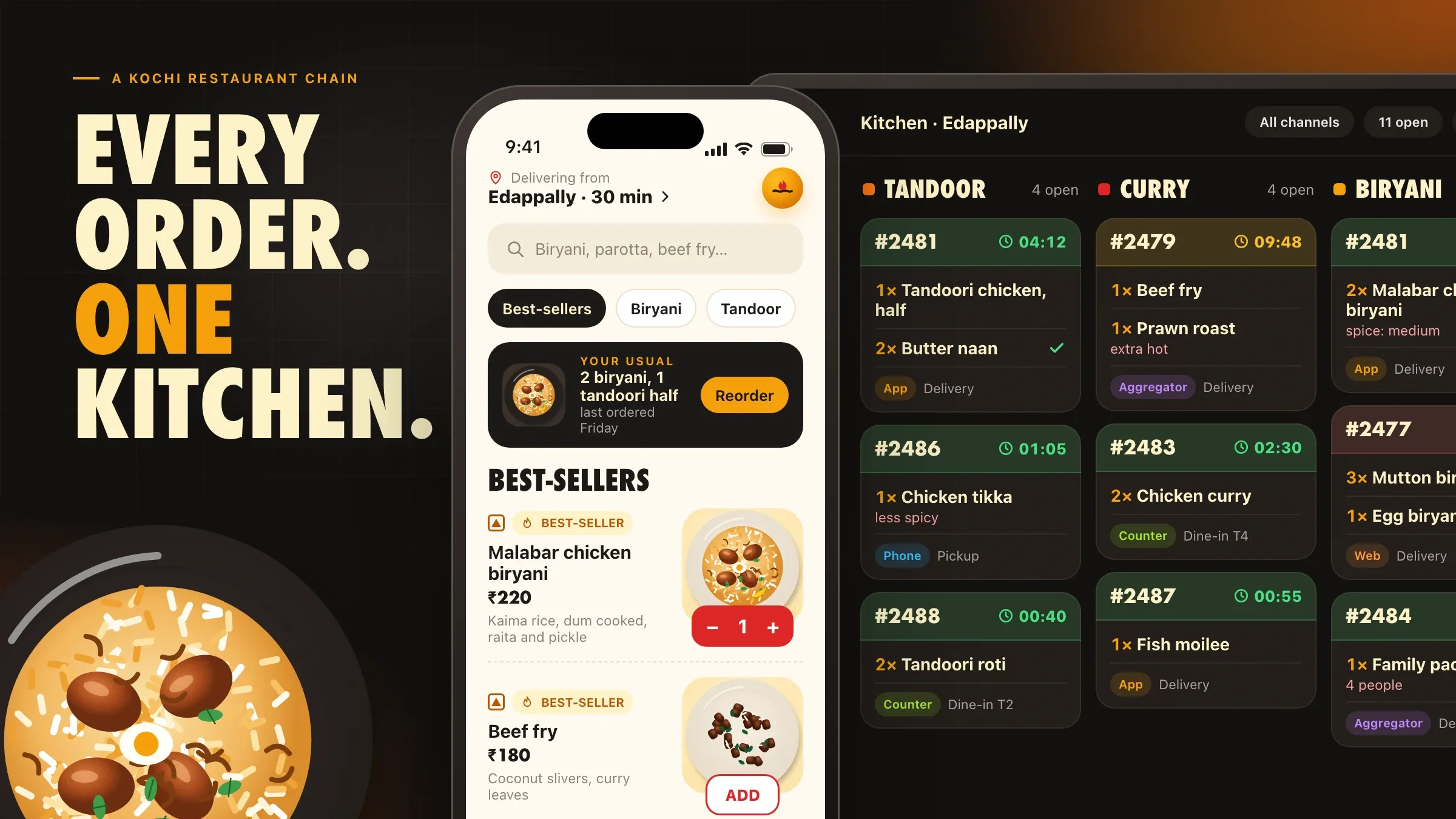 Restaurant Ordering App A branded food ordering app for a restaurant chain in Kochi: ordering on web and mobile, one kitchen display for every channel, a rider app with live tracking, and loyalty points that bring regulars back.
-
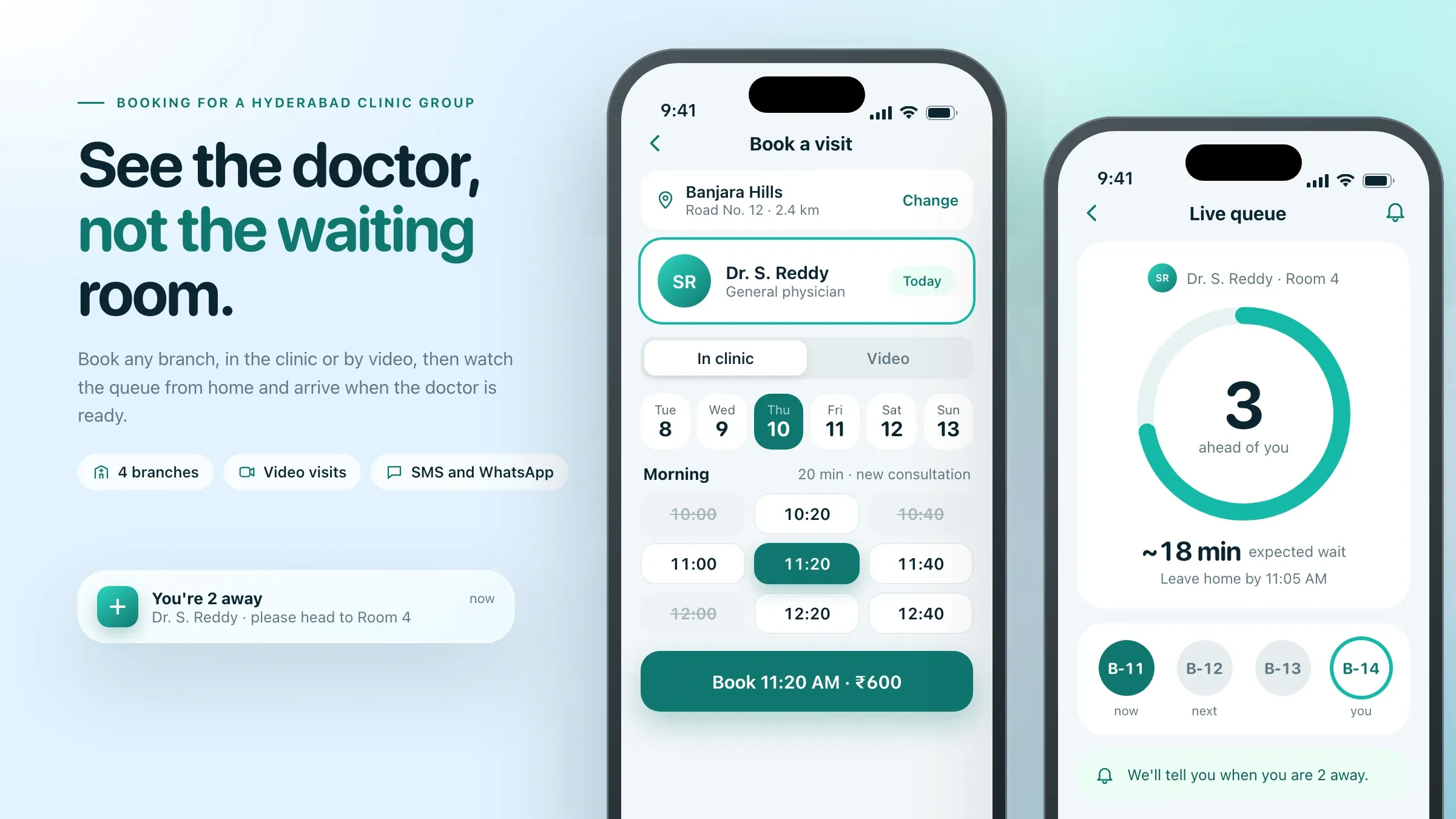 Clinic Booking and Live Queue A clinic appointment booking system for a multi-speciality clinic group in Hyderabad: online booking for every branch, a live patient queue, video consultations and reminders on SMS and WhatsApp.
-
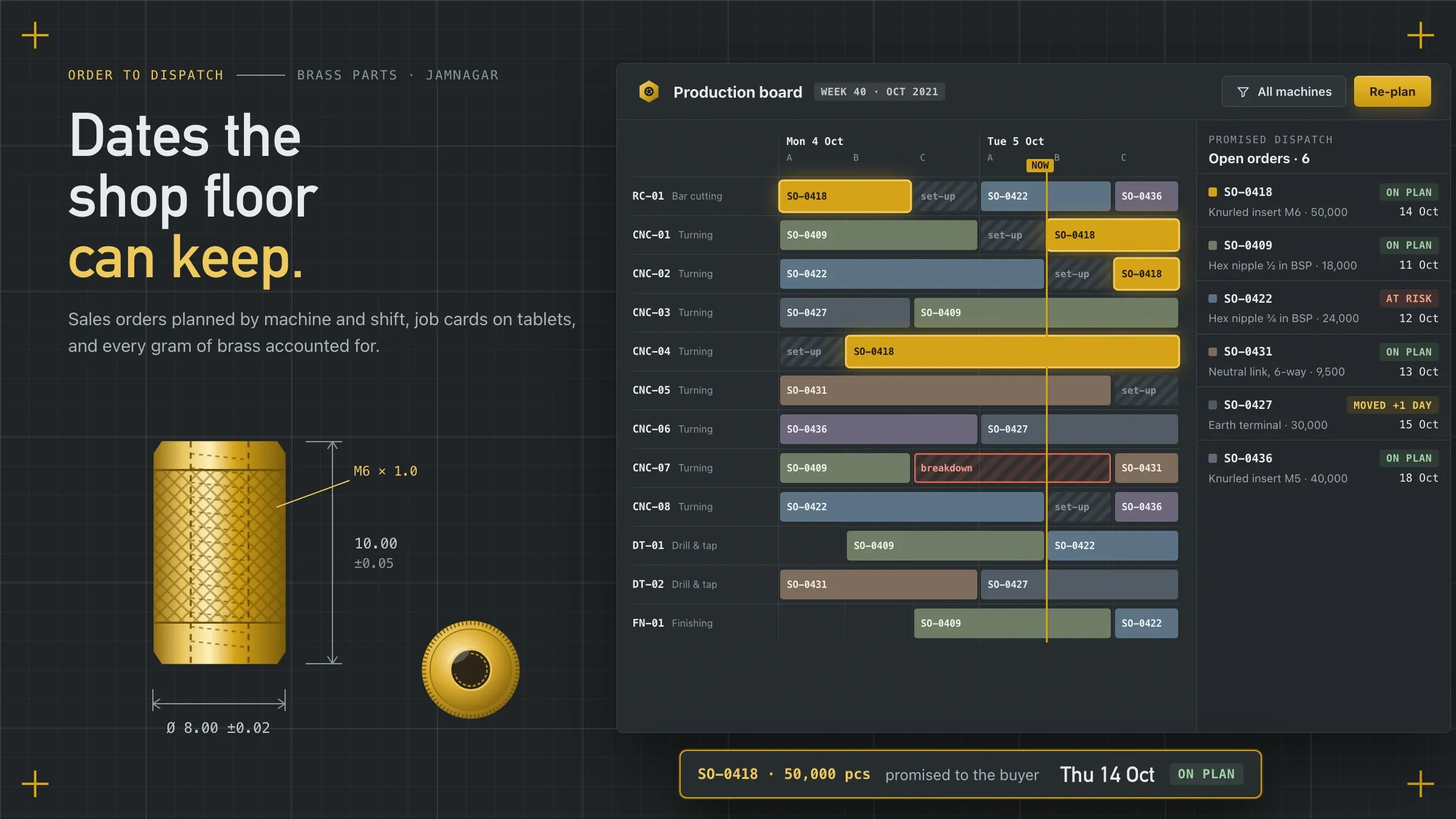 Order-to-Dispatch System Order-to-dispatch software for a brass precision components manufacturer in Jamnagar: delivery dates based on real capacity, shop-floor job cards, brass yield and scrap tracked to the gram, job work challans, and e-invoices straight from dispatch.
Need something like this built?
Tell us what you want to build and where you are with it, and we'll get back to you.
Start a project