Overview
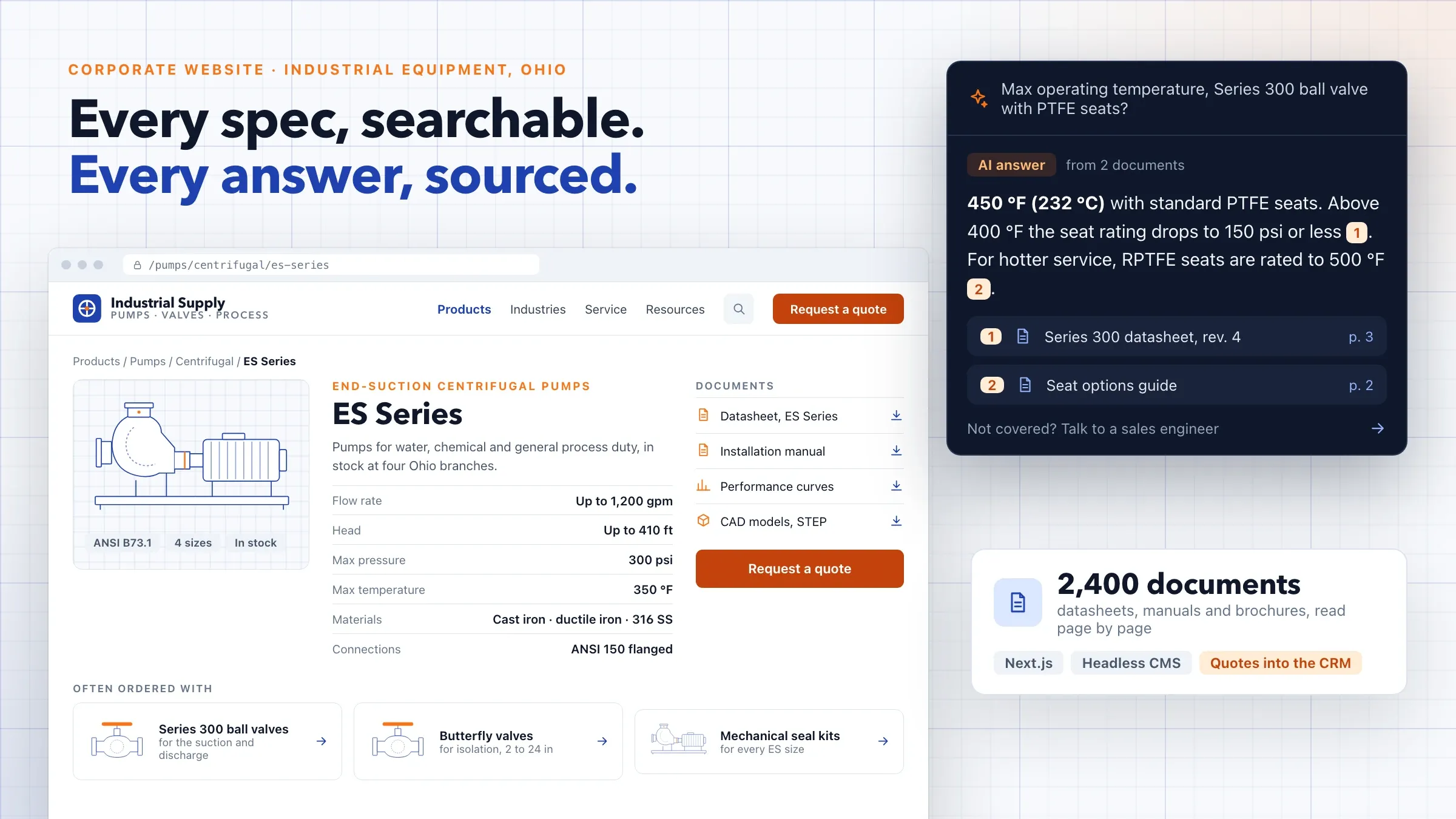
Corporate website on a headless CMS for a US industrial equipment company: fast pages, AI search across product documents and a careful SEO migration.
- Client
- An industrial pumps, valves and process equipment distributor in Ohio
- Industry
- Industrial equipment
- Location
- Cleveland, Ohio, United States
- Year
- 2024
- Duration
- 3 months
At a glance
- The challenge
Customers couldn't find answers that were already on the website.
- The audit
Before designing anything, we audited the whole site: every page, the search terms each one ranked for, the links pointing in from other sites, and every PDF.
- A content model and a CMS the team runs
We rebuilt the content in Sanity, a headless CMS, with a proper content model: product lines, series and models with their specifications; industries served; services and repair; resources such as datasheets, manuals and CAD drawings; news; and branch locations.
- The product catalogue and documents
Products are now structured data rather than typed pages.
- AI search that answers from datasheets
AI search reads every datasheet, manual and brochure.
- Quotes straight into HubSpot
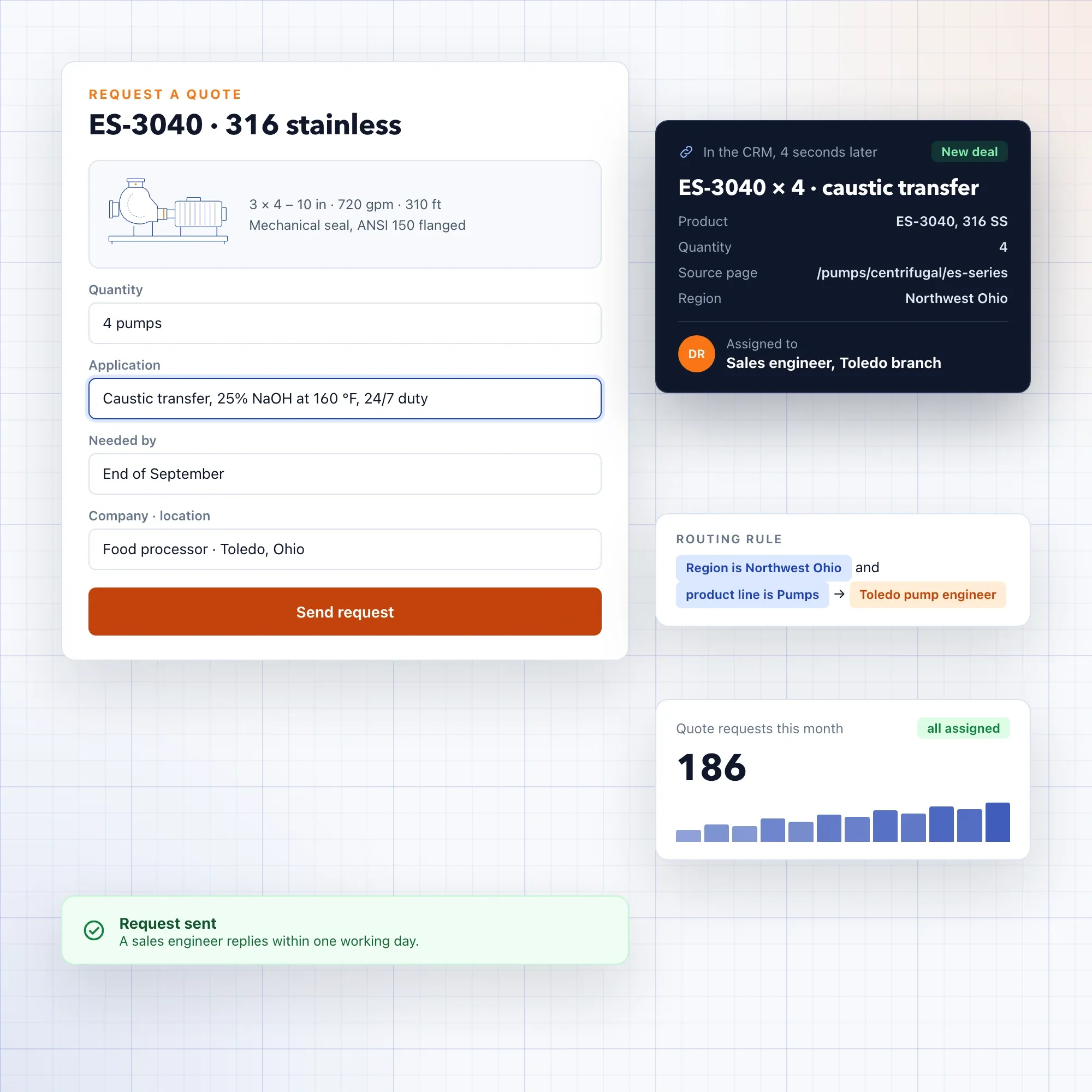
Every product page has a quote request.
- Speed and accessibility
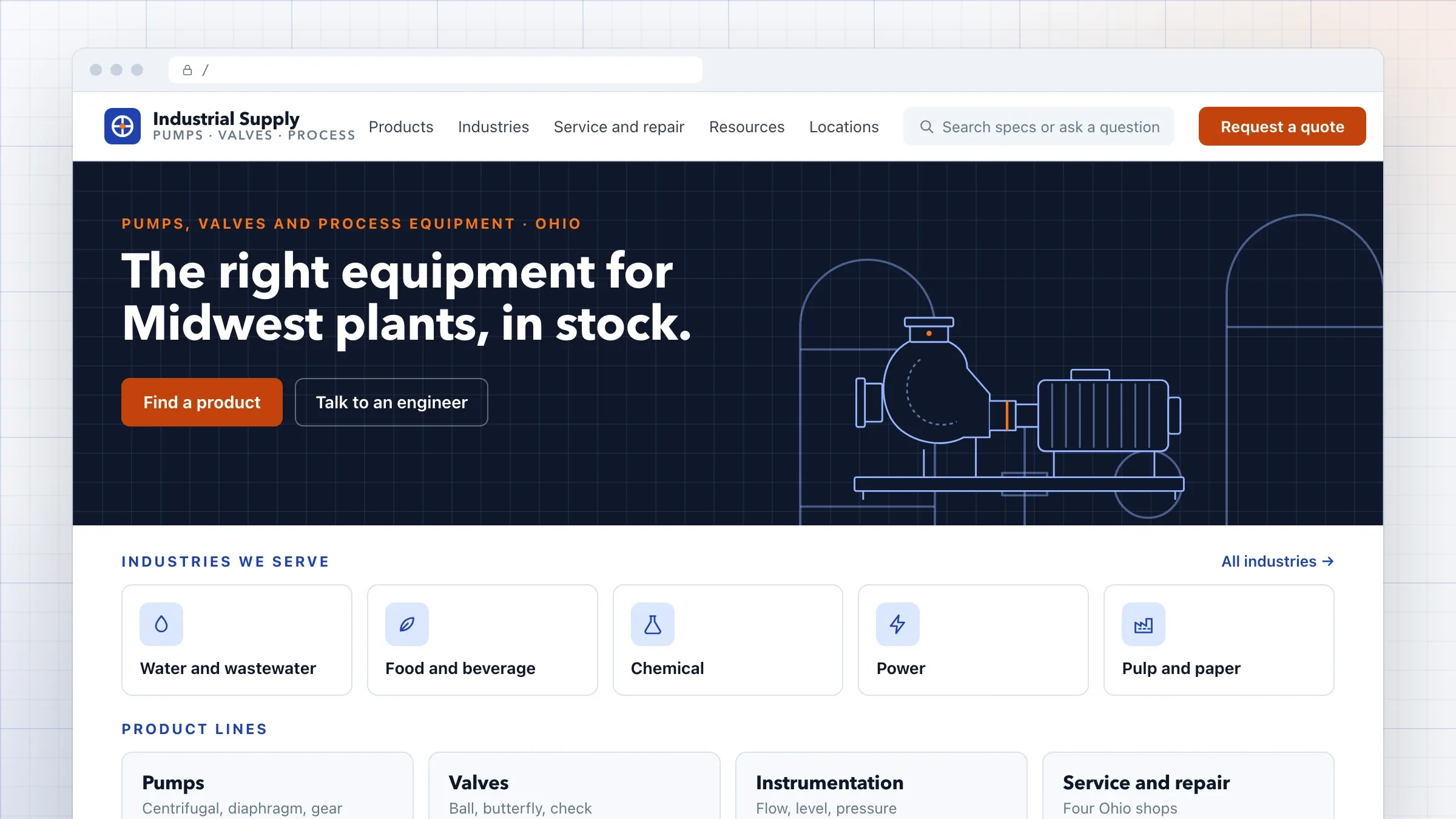
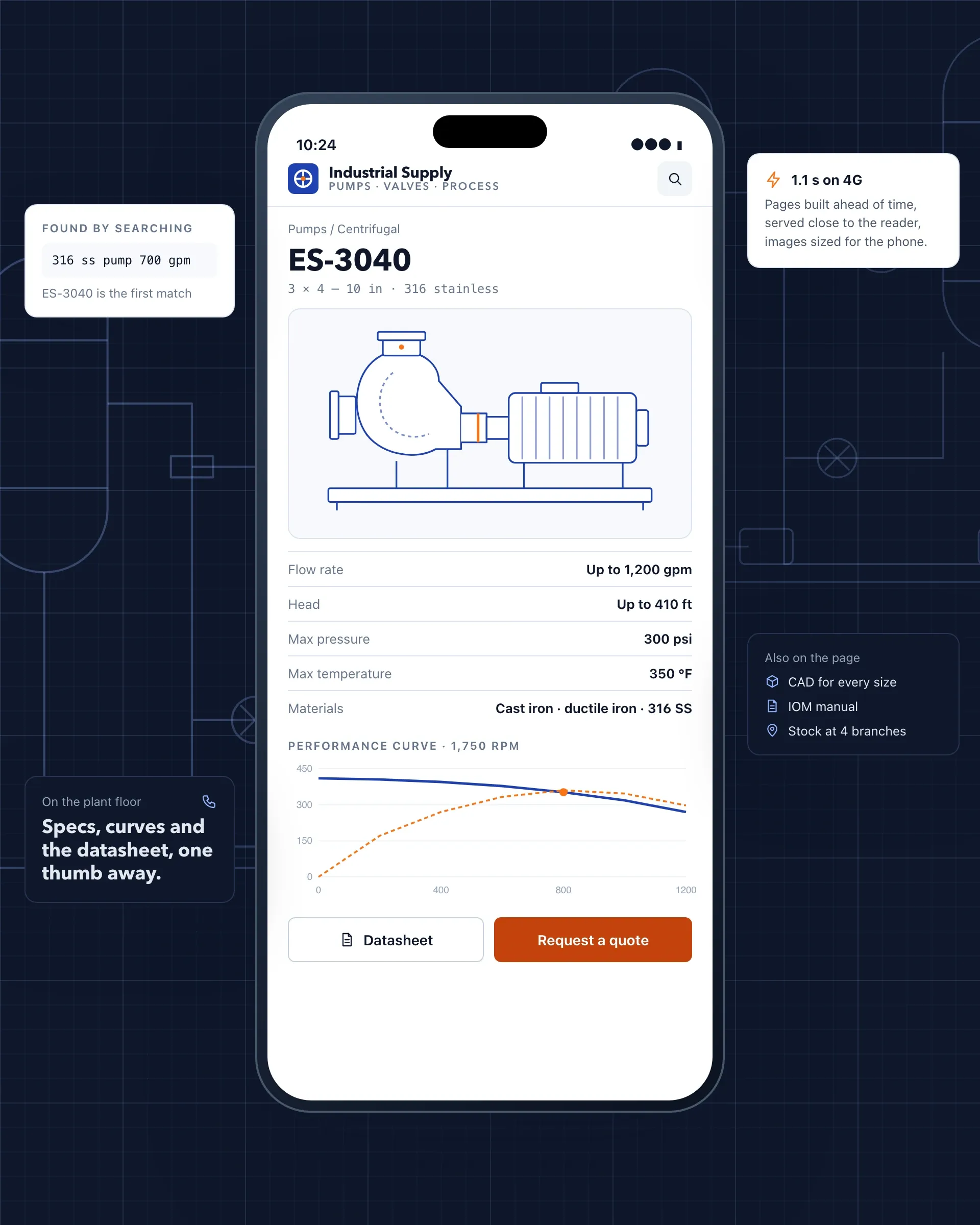
The site is built on Next.js, with pages generated ahead of time and served from the edge, and images resized for every screen, so it loads fast on mobile at a plant or on the road.
- Moving without losing search
The migration was planned page by page.
- How it's built
The front end is Next.js in TypeScript, deployed on Vercel, with content from Sanity.
- The outcome
The new website loads fast on mobile, and the marketing team launches pages and campaigns without waiting for developers.
The challenge
Customers couldn’t find answers that were already on the website. The company distributes pumps, valves and process equipment to plants across the Midwest, and its website had grown over many years on a WordPress theme with layers of page-builder plugins.
It was slow on mobile, and the marketing team needed a developer for every new landing page. Thousands of datasheets, manuals and brochures sat in PDFs that customers couldn’t search, so sales engineers spent hours answering questions about specifications that were already published. And after years online, the site ranked well for many valuable searches. A rebuild could not afford to lose them.
The audit
Before designing anything, we audited the whole site: every page, the search terms each one ranked for, the links pointing in from other sites, and every PDF. We also read the questions customers sent to the sales team.
- A small set of pages carried most of the search traffic, and every one of them needed a safe new home.
- Customers searched by specification, such as flow rate, pressure, material and connection size, not by product name.
- The most-asked questions were answered in the PDFs, on pages nobody could find.
- The content had no structure. Product information was typed into pages, so nothing could be filtered or reused.
A content model and a CMS the team runs
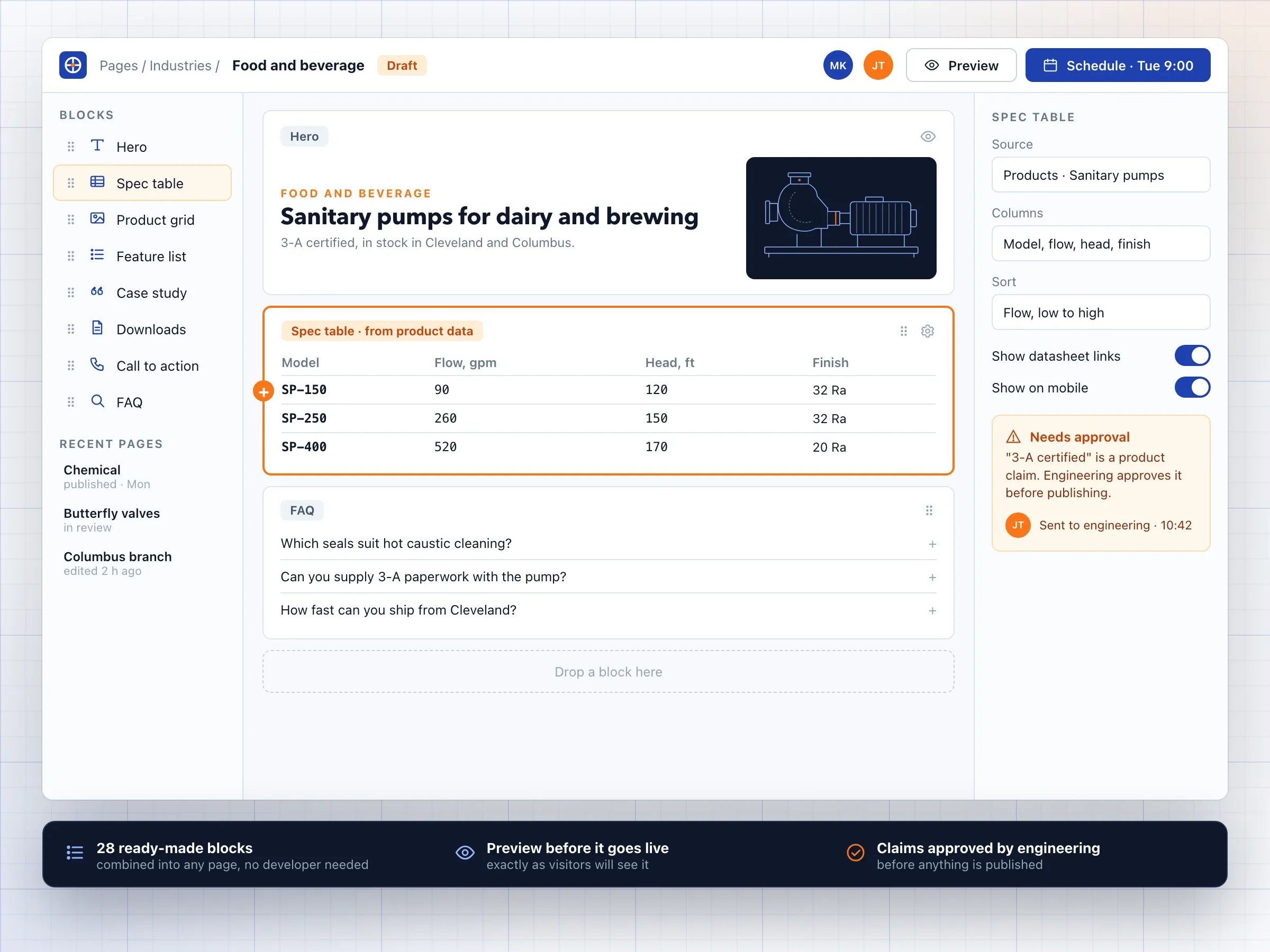
We rebuilt the content in Sanity, a headless CMS, with a proper content model: product lines, series and models with their specifications; industries served; services and repair; resources such as datasheets, manuals and CAD drawings; news; and branch locations.
The marketing team builds pages from a library of ready-made blocks, previews every change before it goes live and schedules publishing. Product claims pass through an approval step before they go live.
The product catalogue and documents
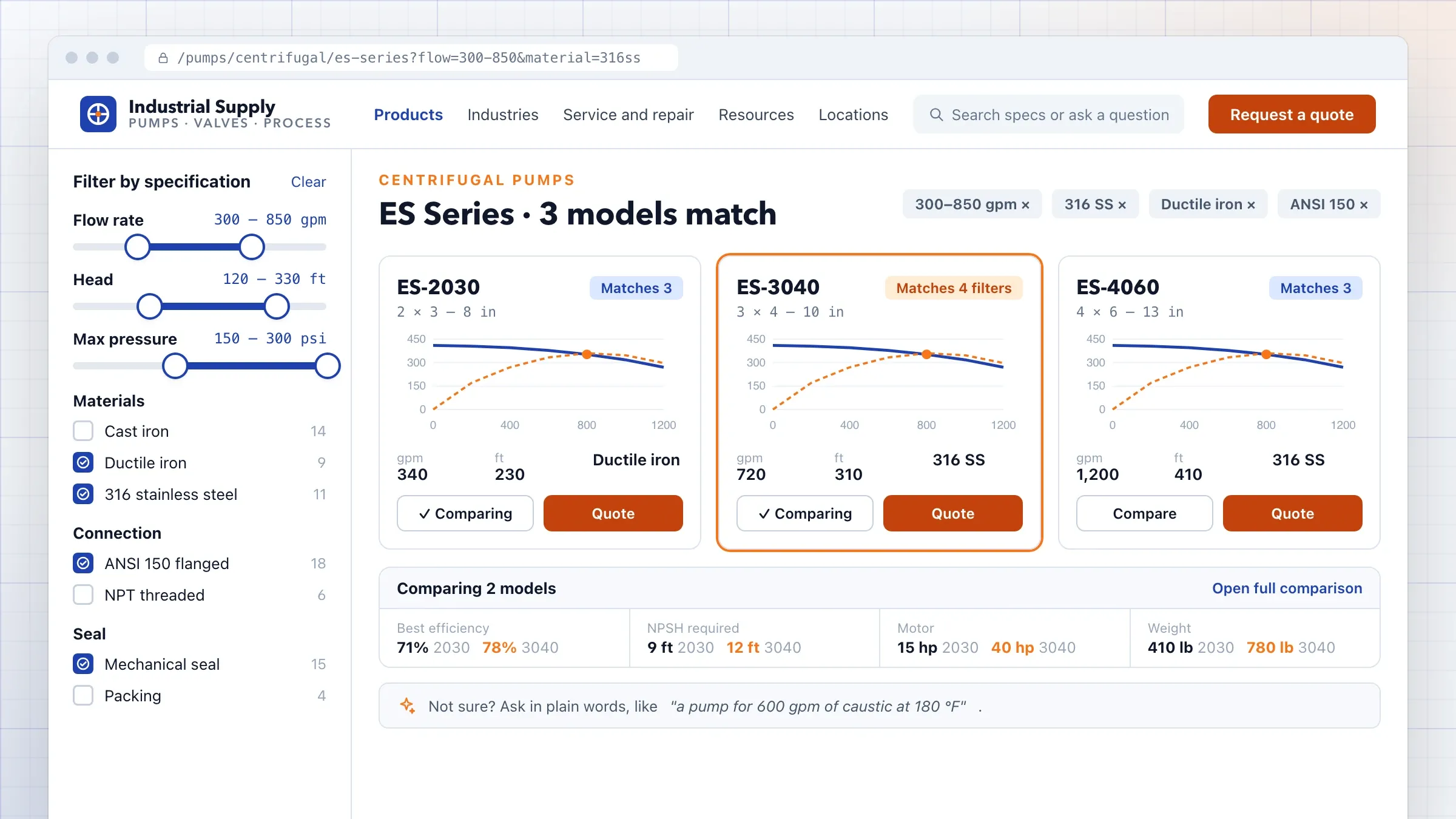
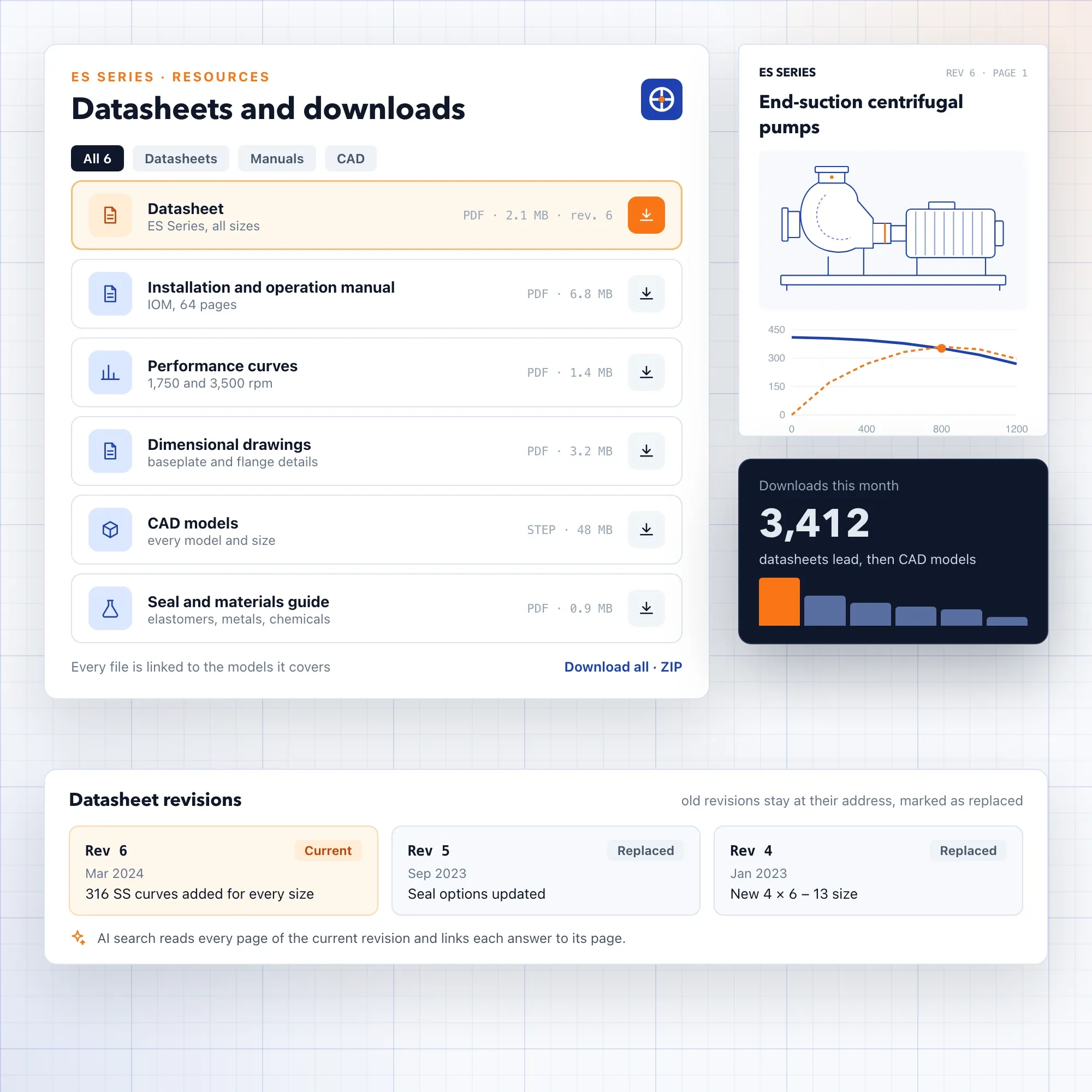
Products are now structured data rather than typed pages. Customers filter series by flow rate, pressure, materials and connection type, compare models side by side, and download the right datasheet, manual or CAD drawing from each model’s page. Each industry page shows the equipment that suits it, built from the same data.
AI search that answers from datasheets
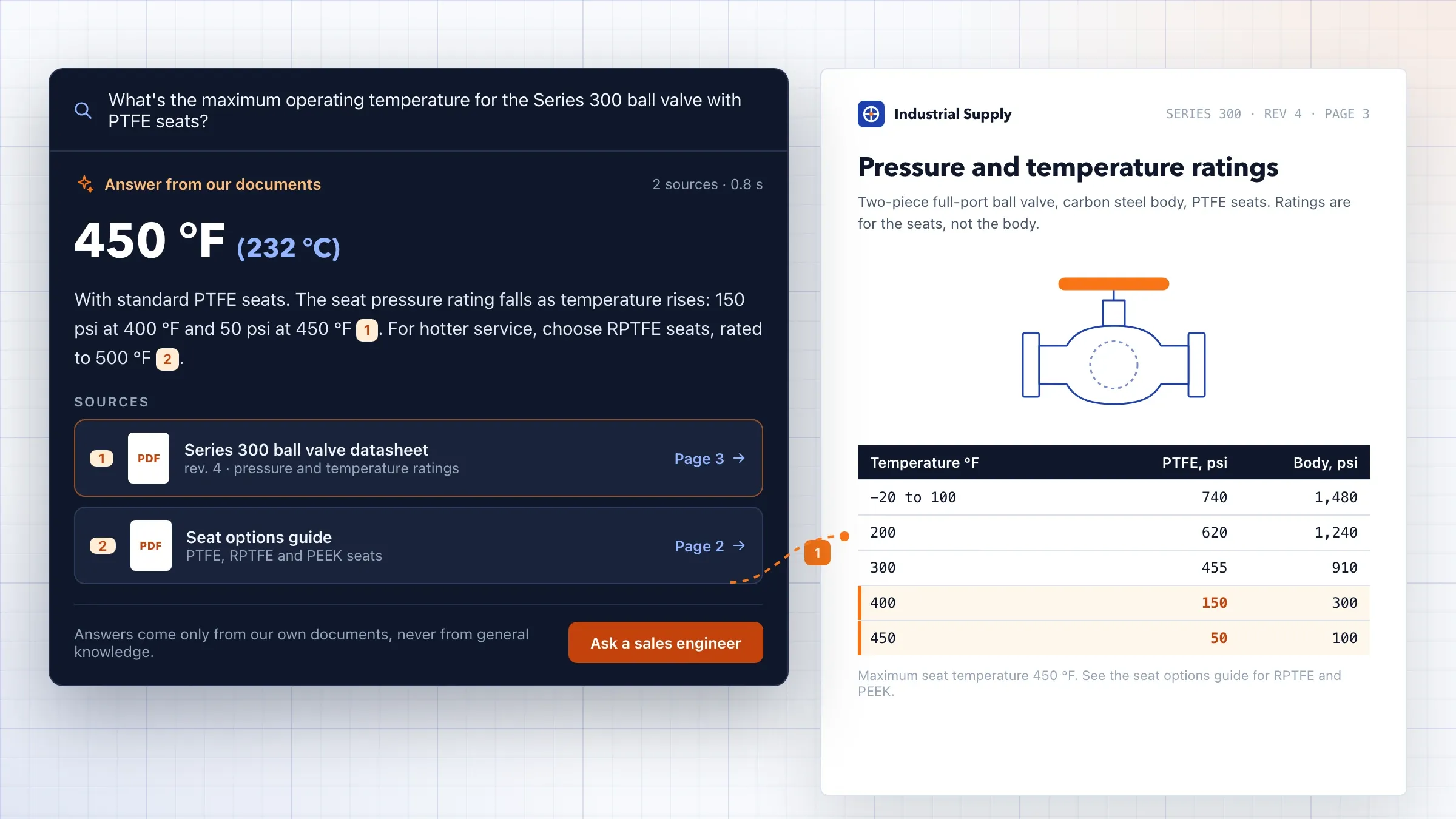
AI search reads every datasheet, manual and brochure. Customers ask questions in plain words, such as the maximum operating temperature of a valve series or the seal options for a pump, and get an answer drawn from the company’s own documents, with a link to the exact page it came from.
It is built to be trusted:
- it answers only from the company’s documents, never from general knowledge;
- every answer shows its source, so customers can check it;
- when the documents don’t cover a question, it says so and offers to connect the customer with a sales engineer.
What customers ask also shows the marketing team which content is missing.
Quotes straight into HubSpot
Every product page has a quote request. Each request goes straight into HubSpot with the product, quantity and application attached, and is assigned to the right sales engineer by region and product line. Sales engineers start each conversation knowing exactly what the customer is looking at.
Speed and accessibility
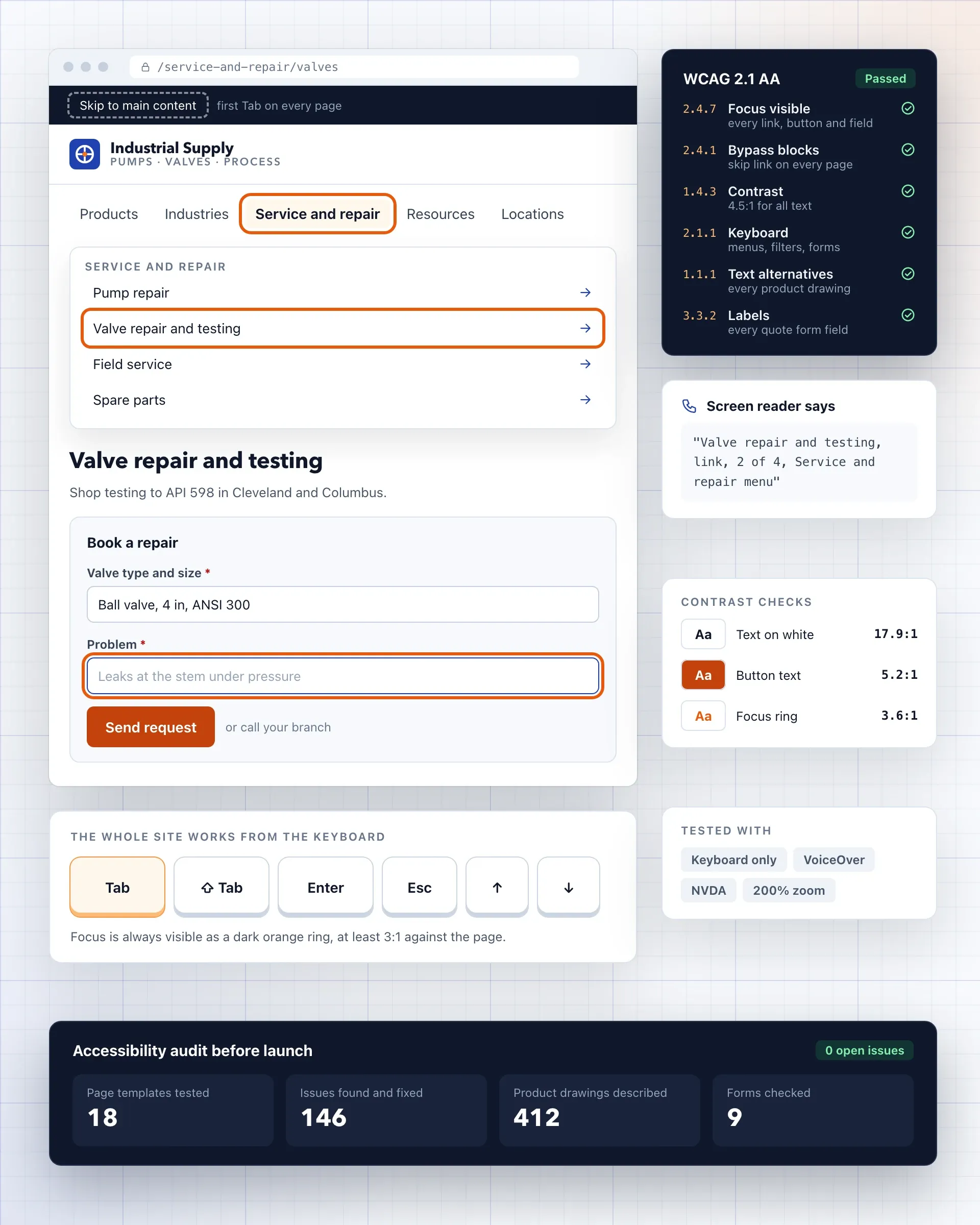
The site is built on Next.js, with pages generated ahead of time and served from the edge, and images resized for every screen, so it loads fast on mobile at a plant or on the road. Every page was designed and tested against WCAG 2.1 AA, so it works with screen readers and keyboards and meets the accessibility expectations of US buyers.
Moving without losing search
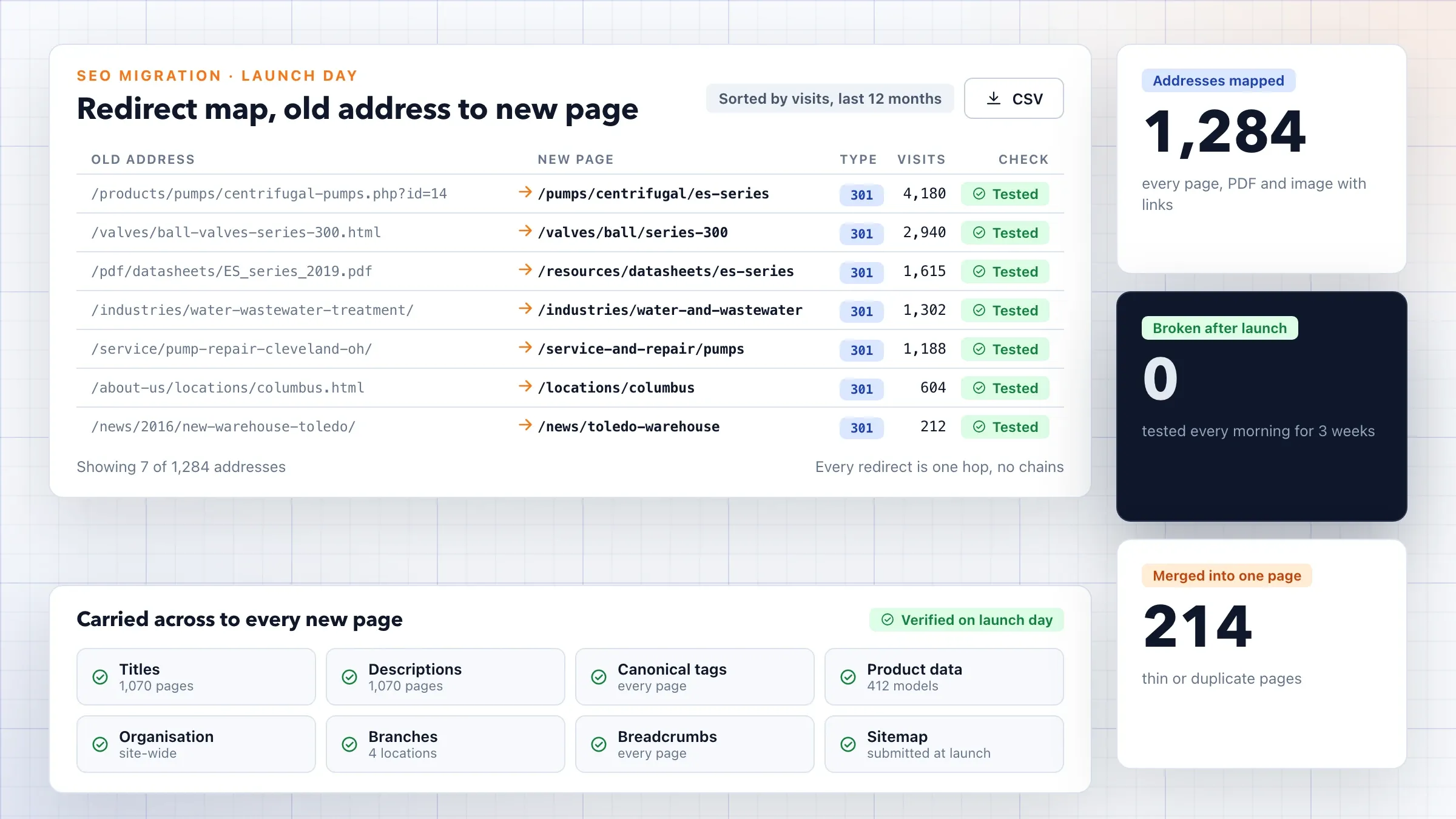
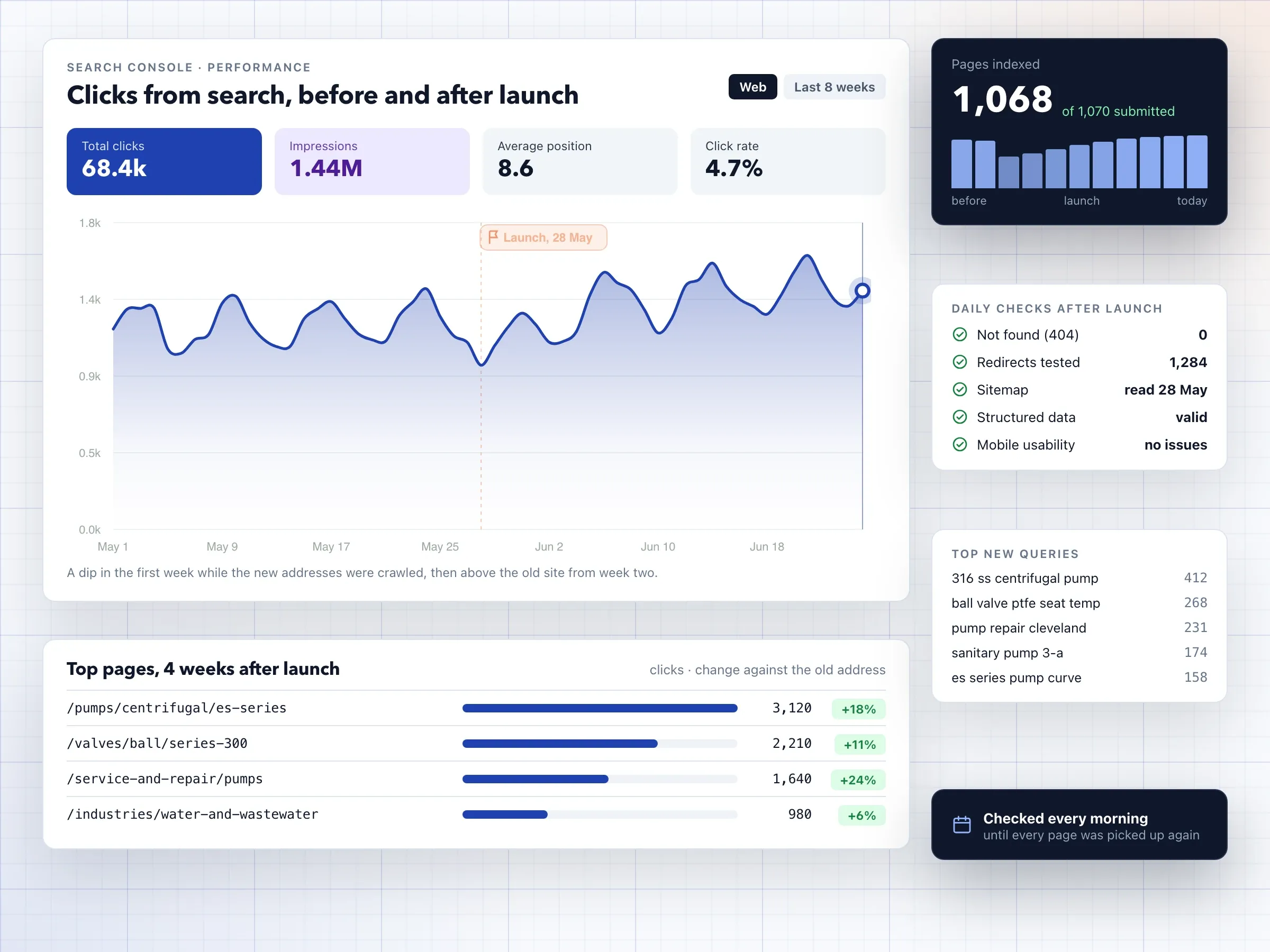
The migration was planned page by page. Every old address was mapped to its new page with a permanent redirect, and titles, descriptions and structured data were carried across. Product, organisation and branch details were added as structured data, and the new sitemap was submitted on launch day.
After launch, we watched Search Console daily, tested every redirect and fixed any page that dropped out, until the whole site had been picked up again.
How it’s built
The front end is Next.js in TypeScript, deployed on Vercel, with content from Sanity. Algolia powers catalogue search and filters, and the AI search uses OpenAI models over an index of the company’s documents stored with pgvector. HubSpot receives every quote request and form, and visitors choose which tracking they accept.
The outcome
The new website loads fast on mobile, and the marketing team launches pages and campaigns without waiting for developers. Customers find specifications themselves, with the source document one click away, and sales engineers spend their time on real projects instead of looking up datasheets. The company’s search presence moved across to the new site with its addresses intact.
How the project ran
3 months in 6 phases
- Weeks 1–3
Audit and content model
A full audit of the old site: every page, ranking search term, backlink and PDF, then a content model for products, industries, services and resources.
- Weeks 4–6
Design
A design system and a library of page blocks the marketing team can combine into any page, tested for accessibility.
- Weeks 7–10
Build
The new site, the product catalogue, AI document search and the HubSpot link for quotes.
- Weeks 10–12
Migration
Content moved, every old address mapped to its new page, and titles, descriptions and structured data carried across.
- Week 13
Launch and checks
Launch, redirects tested, Search Console watched daily, and the marketing team trained on the CMS.
- Week 14 onwards
Support
Monthly improvements, new product lines and continued tuning of AI search from what customers ask.
What we delivered
- SEO audit and migration
- Content modelling
- Product design
- Web app
- AI agents and automation
- Cloud
- Maintenance and support
Inside the project
7 pictures
Questions and answers
10 answered
What did FIRELIFE Ventures build for an industrial equipment distributor in Ohio?
FIRELIFE Ventures built a corporate website on a headless CMS for an industrial pumps, valves and process equipment distributor in Ohio. It includes a product catalogue the marketing team runs, AI search that answers technical questions from datasheets with links to the source, quote requests into HubSpot and a full SEO migration.
What is a headless CMS?
A headless CMS is a content management system that stores and manages content without controlling how the website looks. The website fetches content from it, so the design can be fast and custom while editors work in a simple interface.
Why move a corporate website to a headless CMS?
A headless CMS gives faster pages, stronger security and freedom in design, and editors can build new pages from ready-made blocks without a developer. The same content can also feed other channels, such as a customer portal or sales tools.
How does AI search across product documents work?
Every datasheet, manual and brochure is read and indexed. A customer asks a question in plain words, such as a model's maximum operating pressure, and the search answers from those documents with a link to the exact page it came from. If the documents don't hold the answer, it says so and offers to connect the customer with a sales engineer.
Can AI search give wrong technical answers?
It is built to answer only from the company's own documents and to show its source every time, so customers can check the answer. When a question isn't covered by the documents, the search says so instead of guessing.
How do you keep search rankings when rebuilding a website?
Every old address is mapped to its new page with a permanent redirect, titles, descriptions and structured data are carried over, and the new sitemap is submitted. After launch, Search Console is checked daily for errors until every page has been picked up.
Why does website accessibility matter for a B2B company?
An accessible website works for everyone, including people using screen readers or keyboards, and reduces legal risk in the United States. The website was designed and tested against WCAG 2.1 AA, the widely used accessibility standard.
How do quote requests reach the sales team?
Each quote request is sent straight into HubSpot with the product, quantity and application attached, and assigned to the right sales engineer by region and product line.
How long does it take to build a corporate website on a headless CMS?
The website took three months, including the content audit, design, the product catalogue, AI document search and a full SEO migration. Larger sites with more languages or integrations take longer.
Can FIRELIFE Ventures rebuild my company website on a headless CMS?
Yes. FIRELIFE Ventures builds fast corporate websites on headless CMS platforms, moves existing content and search rankings across carefully, and supports the site after launch. Start a project through the contact page.
More from the portfolio
All portfolio-
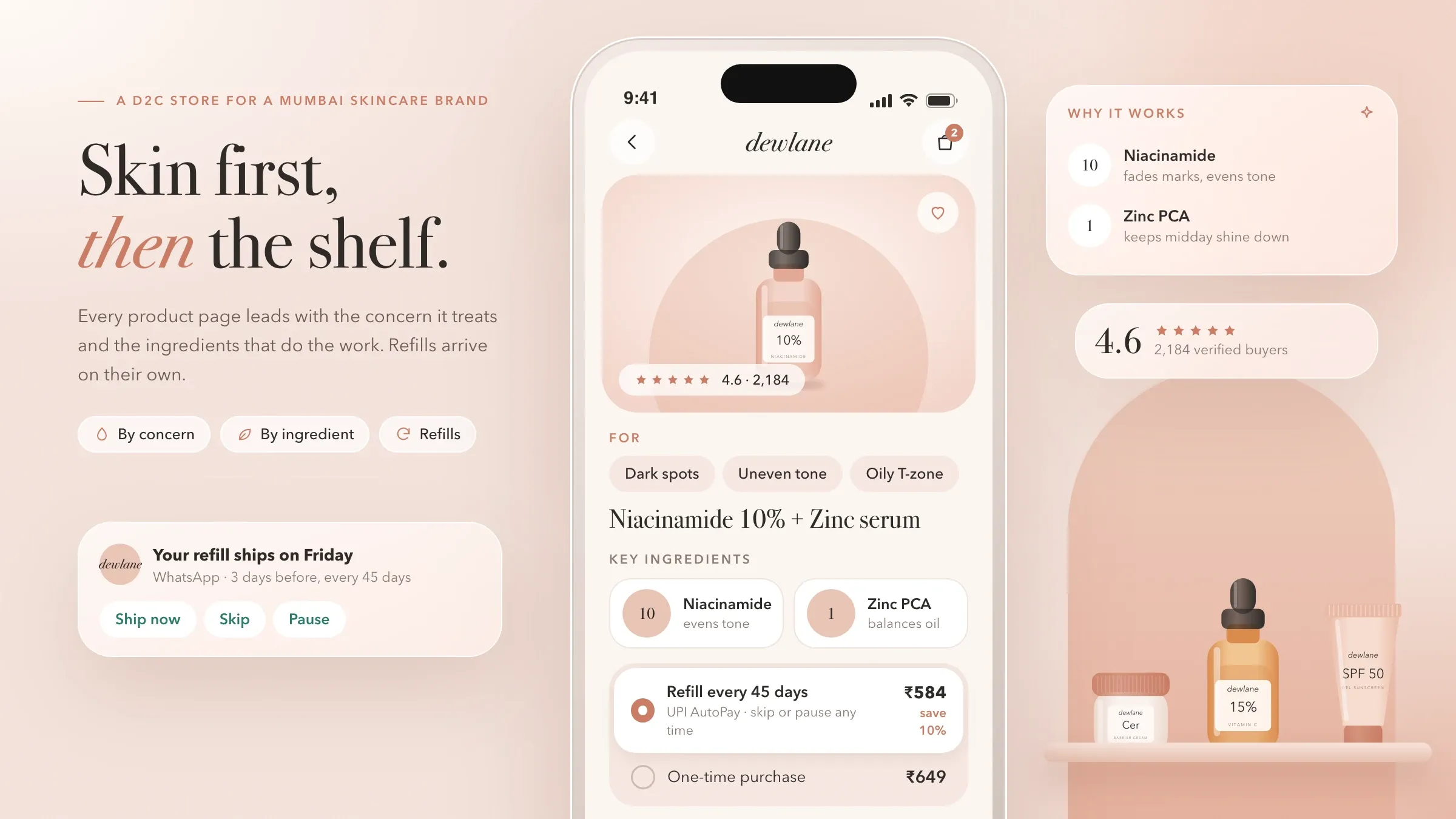 D2C Skincare Store A headless D2C e-commerce platform for a skincare brand in Mumbai: a fast mobile storefront, a skin quiz with AI recommendations, refill subscriptions on UPI AutoPay and delivery updates on WhatsApp.
-
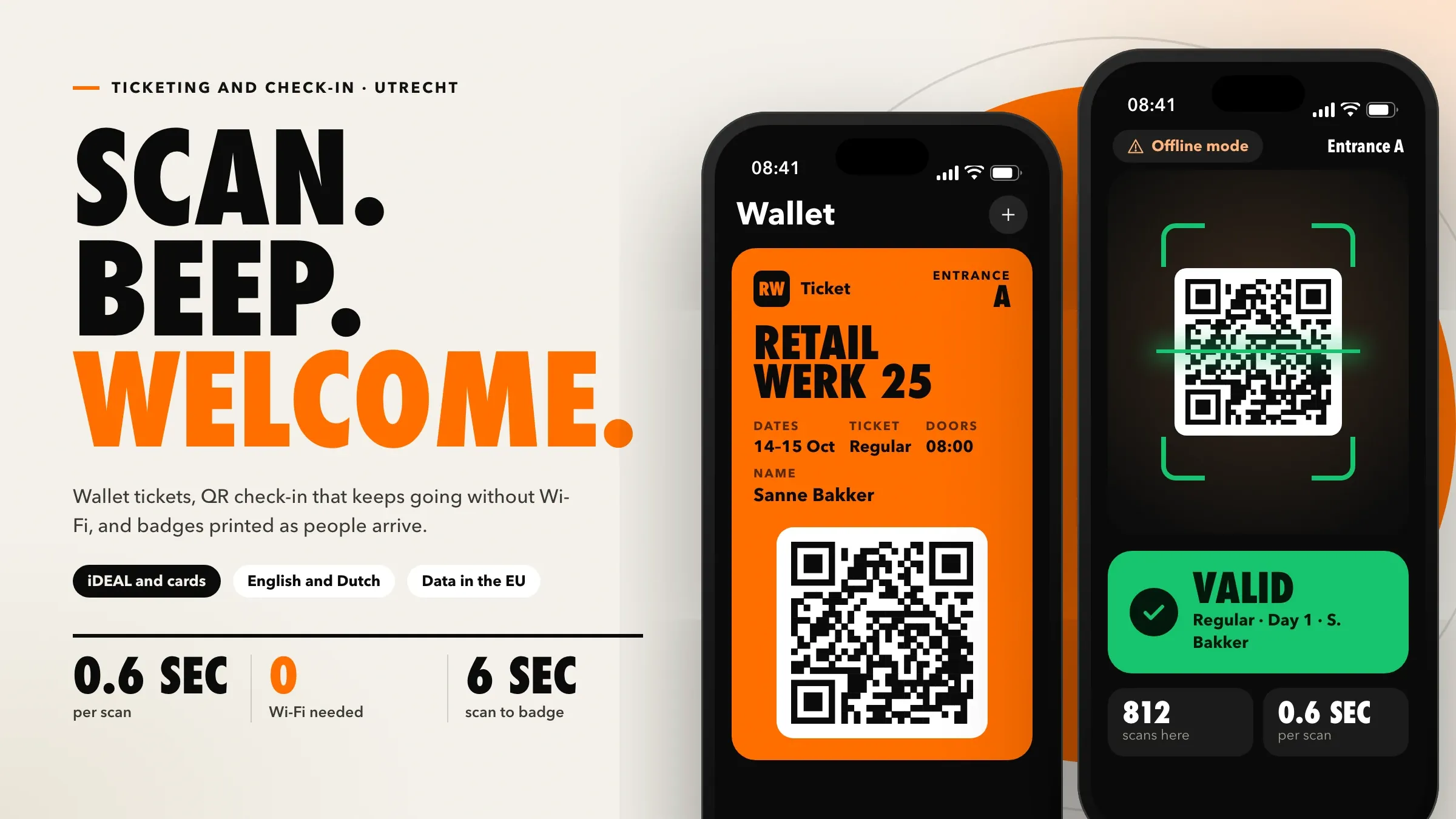 Conference Ticketing and Check-in An event ticketing platform for a conference and trade show organiser in Utrecht: tickets the organiser designs, VAT invoices for companies, wallet tickets, QR check-in that works without Wi-Fi, badges printed on arrival and an AI assistant for attendees.
-
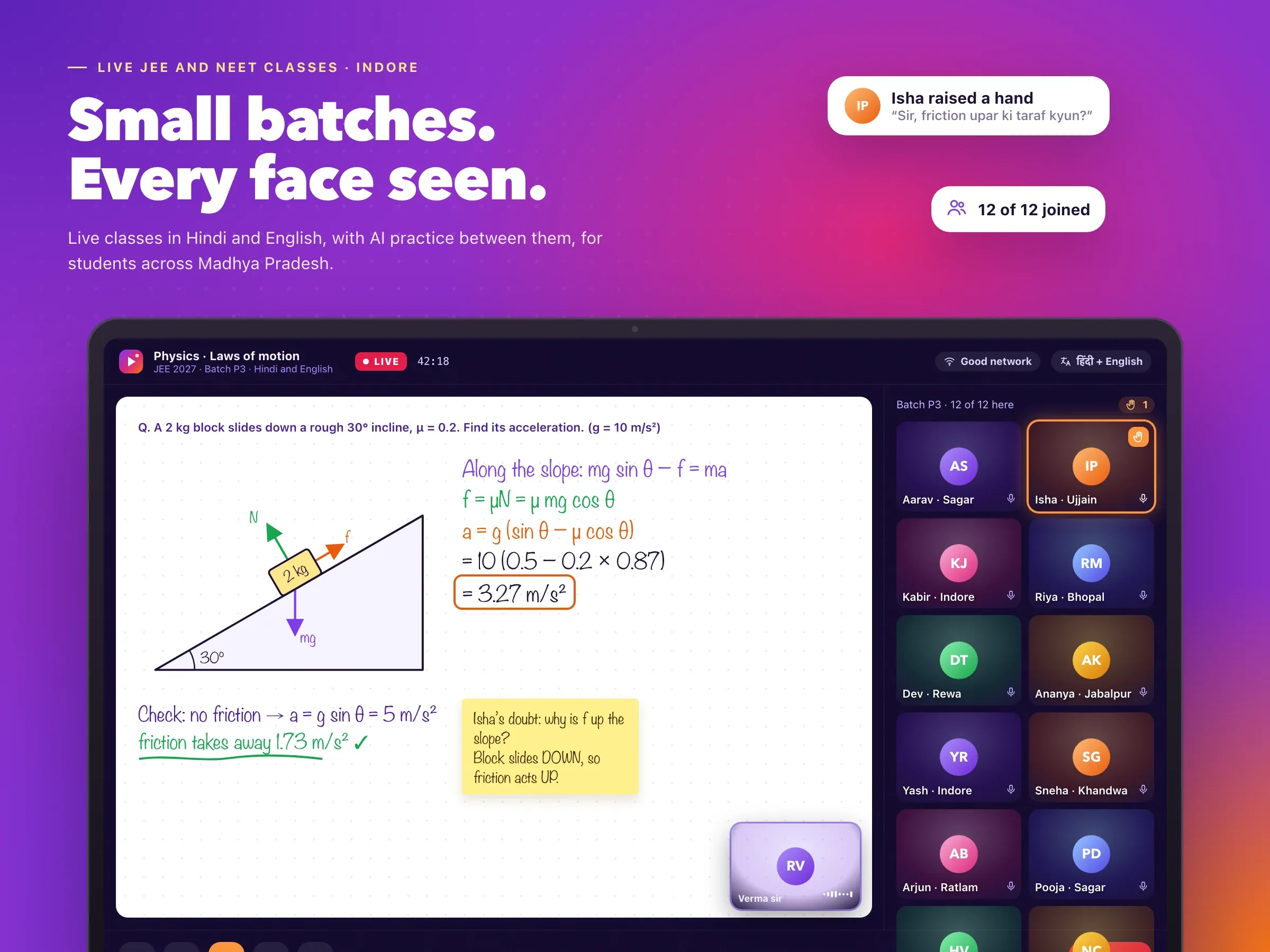 Live JEE and NEET Classes Small-batch live classes and AI practice for JEE, NEET and board exams, taught in Hindi and English, built for students in Madhya Pradesh's smaller cities.
Need something like this built?
Tell us what you want to build and where you are with it, and we'll get back to you.
Start a project