Make it work better security testing
Find the gaps before attackers do
We test your web app, mobile app, APIs and cloud set-up for security gaps, with your written permission and an agreed scope. Then we explain each finding in plain words, help you fix it and test again to confirm it is closed.
- Nothing is tested without written permission
- Every finding explained in plain words
- A retest after every fix
Sound familiar?
What we hear before we start
- Your software holds customer data, payments or health records, and nobody has tested it since launch.
- A large customer has sent a security questionnaire and you are not sure what to answer.
- Your developers ship quickly, and security checks happen only when someone remembers.
- Old staff accounts, test servers and forgotten integrations are still switched on somewhere.
- An investor, auditor or regulator has asked for proof that your software was tested.
- You once got a security report full of jargon, and nobody knew which items mattered.
What changes
-
Today: Security is a guess based on what the developers remember.
After: You have a written record of what was tested, what was found and what was fixed.
-
Today: Gaps are found by a customer, or by someone with worse intentions.
After: Gaps are found by testers you authorised, inside a scope you agreed.
-
Today: A long report sits unread because nobody knows where to start.
After: Each finding says what it means for your business and how to fix it, most serious first.
-
Today: Fixes are assumed to work.
After: Every fix is retested and marked closed only when it holds.
-
Today: Security is checked once, just before a big launch.
After: Basic checks run with every release, with a deeper test when something big changes.
What it does for you
-
Web application testing
Logins, sessions, forms, file uploads, payments and, above all, what each kind of user is allowed to see and change.
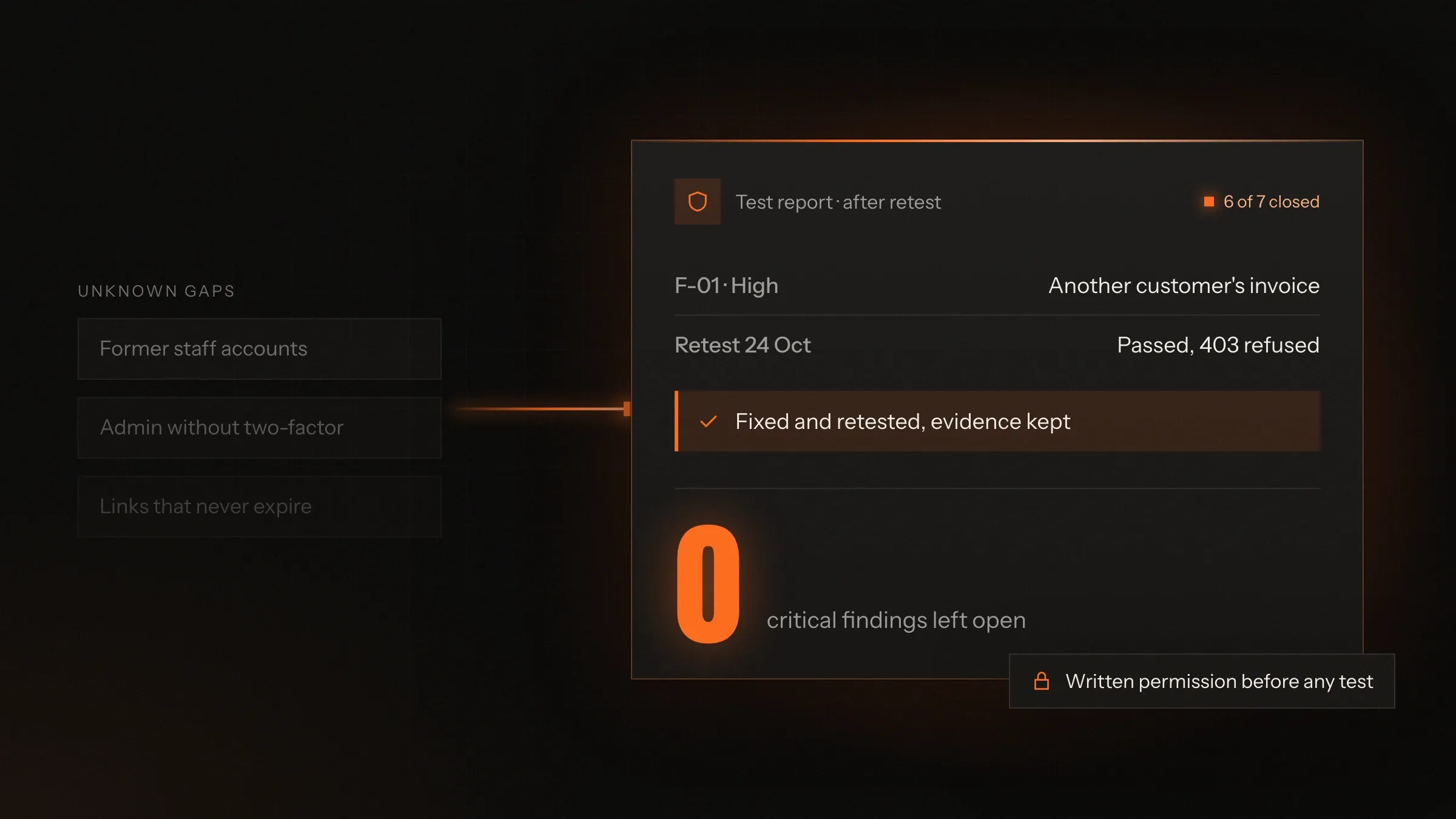
For exampleWe confirm that a customer can open only their own invoices, never another customer's.
-
API testing
The APIs behind your apps and integrations: who can call each one, what they can change and what data comes back.
For exampleA mobile app's API is found returning a customer's full record when the screen needs only a name, so it is trimmed.
-
Mobile app testing
Android and iPhone apps: what they keep on the phone, how they talk to your servers and what happens on a lost or shared phone.
For exampleLogin tokens are moved into the phone's secure storage instead of an ordinary file.
-
Cloud and server review
Your AWS, Google Cloud or server set-up: what is open to the internet, storage, backups, admin panels and who holds the keys.
For exampleA forgotten test server with a copy of real data is found, the data removed and the server switched off.
-
Code and library review
Your code and the open-source libraries it depends on, checked for known weaknesses and for passwords or keys left in the code.
For exampleAn outdated library with a published weakness is flagged, upgraded and retested.
-
Accounts and access review
Staff accounts, admin roles, password and two-factor settings, and people who left but still have access.
For exampleTwo former employees still have admin access to the dashboard. Both accounts are closed the same day.
-
Checks in every release
Automatic scans in your build pipeline, so common mistakes are caught before they reach your customers.
For exampleA change that would publish a secret key is stopped before it is merged.
How it works
-
Agree the scope
We agree in writing what will be tested, what will not, when, and who to call.
-
Map what is there
We list the apps, APIs, servers, user roles and data inside the scope.
-
Test
Automated scans cover the ground; people then check the logic and access by hand.
-
Confirm and rate
Each finding is confirmed, so you don't chase false alarms, and rated by its risk to your business.
-
Report
You get a plain-language report and a call to walk through it, most serious first.
-
Fix and retest
We help your developers fix each finding, then test again until it is closed.
Where we've built it
1 from our portfolio
What security testing is, and what it is not
Security testing checks your software for weaknesses before someone with bad intentions finds them. With your written permission, testers look at your apps, APIs and servers from the outside, as a customer and as a member of staff, and ask one question again and again: can this person see or change something they shouldn’t?
There are two common kinds of test. A vulnerability assessment looks broadly for known weaknesses, mostly with automated tools, and lists them. A penetration test goes deeper by hand and confirms whether a weakness can really be used and what it would expose. In India the pair is often called VAPT, and most businesses need a bit of both.
Security testing is not a promise that software can never be broken. It is a careful look within an agreed scope and time, which removes the gaps that are most likely to hurt you and shows you where the remaining risk sits.
When a security test pays off
The best time to test is before something important depends on the software. That might be a launch, a big customer who will put their own data in it, a funding round, an audit, or a move to new servers.
Testing also pays off after big changes, such as a new payment flow, a new mobile app, a new integration with a partner or a rewrite of how logins work. These are the places where new gaps usually appear.
Some businesses carry more risk by the nature of their work: anyone handling payments, loans, health records, children’s data, identity documents or other people’s money. For them, a yearly deeper test and checks with every release are a sensible baseline, and their customers and regulators increasingly expect to see both.
Permission and scope come first
We test nothing until the owner of each system has agreed in writing. Testing someone’s software without permission is illegal in most countries, including India, and a professional test starts with paperwork for that reason.
The scope lists what may be tested (the web addresses, apps, APIs and cloud accounts), what may not, the test window, the user roles we will use, and the contacts on both sides. Services run by others, such as your cloud provider, payment gateway or email service, are tested only within the rules those providers publish, and their own systems stay out of scope.
We also agree how we will behave on live systems. Where possible we test a copy; on live systems we avoid anything that could slow customers down or change real data, and we stop and call if anything looks wrong.
What we check in a web app and its APIs
Most serious gaps in modern software are about access: one customer seeing another’s orders, a staff member reaching an admin screen, or an API that hands back more data than the app shows. We check every user role against every important screen and API.
We also check how logins, passwords, two-factor and sessions work; how forms and file uploads handle unexpected input; what error messages give away; and whether the business rules hold, such as a discount that can only be used once or a refund that needs approval. The OWASP Top 10 and the OWASP Application Security Verification Standard (ASVS) give us a shared checklist, and your own workflows show us where to look hardest.
Mobile apps and what they keep on the phone
A mobile app is two things to test: the app on the phone and the APIs it talks to. On the phone, we check what the app stores, whether login tokens and personal data are kept in the phone’s secure storage, and what someone could learn from a lost or shared device.
Between the phone and your servers, we check that every connection is encrypted and that the servers do not trust the app blindly. Anyone can copy an app and change how it behaves, so every important rule, such as who may see an order or how much a customer pays, must be checked on the server too. We test Android and iPhone versions separately, because they store data differently.
Cloud, servers and the things people forget
Many incidents start with something nobody remembered was switched on. We list what is open to the internet and look for forgotten test servers, storage that anyone with the link can read, admin panels without two-factor, old backups and accounts of people who have left.
We also review the code and its open-source libraries for known weaknesses, and search for passwords and keys left in the code or its history. In your cloud accounts on AWS or Google Cloud, we check who holds which permissions, whether logging is switched on, and whether backups can be restored by the right people and not by the wrong ones.
Findings you can act on
A report is only useful if your team acts on it. Ours opens with a short summary in plain words for the owner or manager: what was tested, what was found, and what to fix first.
Each finding then gives what we found and where, how serious it is and why (rated Critical, High, Medium or Low against your business, not a generic score alone), the evidence with any personal data masked, and the fix in terms your developers can follow. We confirm every finding before reporting it, so your team doesn’t spend days chasing false alarms. Then we walk through the report together on a call.
Fixing and retesting
A finding is closed only when a retest shows the fix holds. We help your developers understand each fix, review their changes if they wish, or make the fixes ourselves.
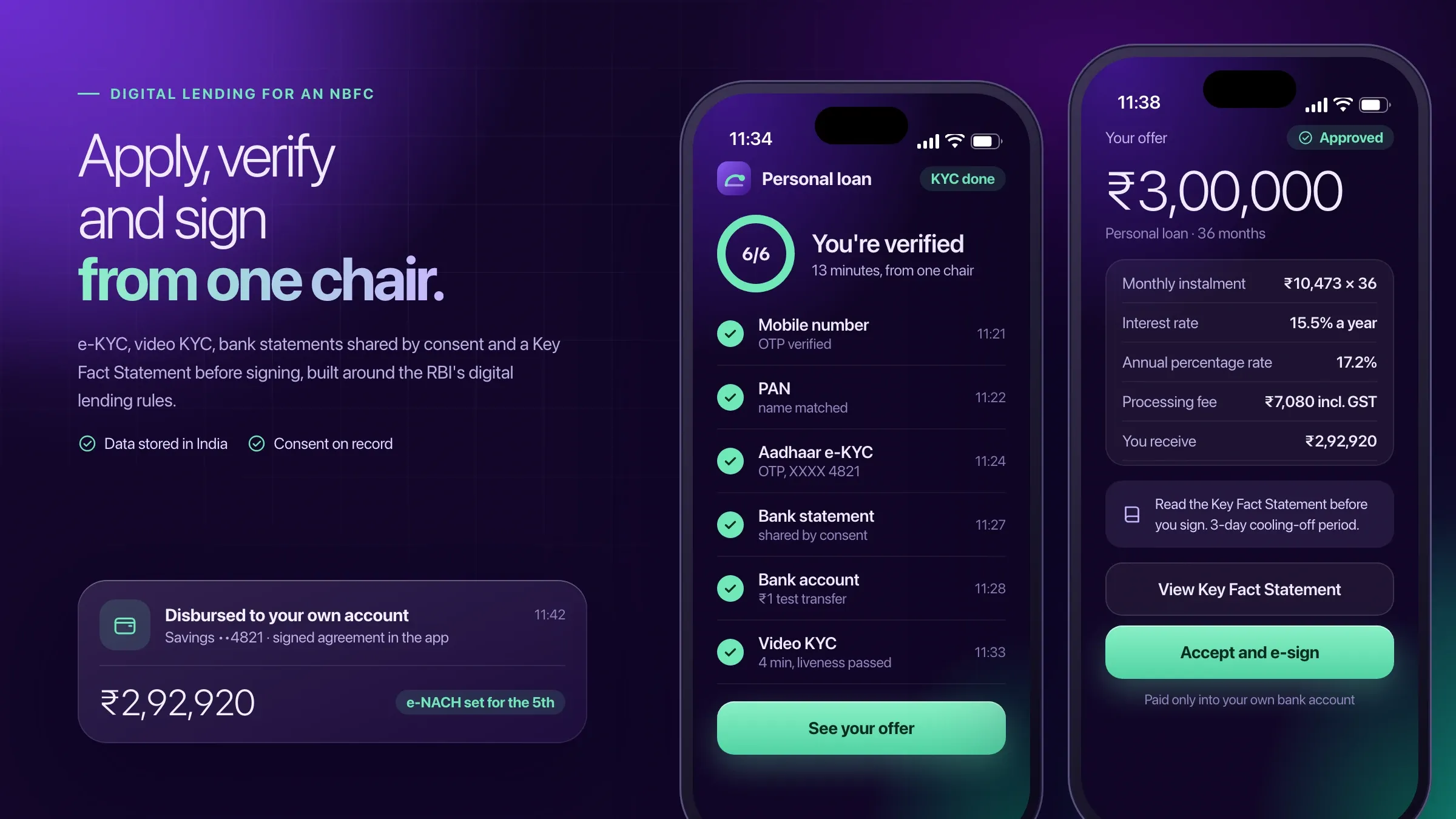
After the retest you receive a summary of what was tested, what was found and what was closed. You can share it with customers, partners or auditors who ask how your software is tested. Where a regulator or customer needs a report from an empanelled or accredited auditor, our test and fixes prepare you for that audit, and we fix what the auditor finds. The lending platform we built for an NBFC in Kolkata went through independent vulnerability assessment and penetration testing before launch, and every finding was fixed.
Rules you may need to meet
Security testing often has a reason beyond good practice. In India, the Digital Personal Data Protection Act 2023 expects businesses to protect personal data with reasonable safeguards, CERT-In’s directions require certain incidents to be reported quickly and logs to be kept, and the RBI expects regulated lenders and payment businesses to test their systems.
Abroad, GDPR applies to data about people in Europe, health software is held to HIPAA-style privacy expectations in the United States, and card payments follow PCI DSS. We plan the scope around what you need to show and map our findings to it, so your evidence is ready when someone asks. We don’t issue certificates; we make sure the software behind your answers holds up.
Security in every release
One test a year does not keep up with weekly releases. We add automatic checks to your build pipeline in GitLab or GitHub: scans of your code and libraries, a search for secrets, and a scan of the running test site, so common mistakes are stopped before they reach customers.
Around that, a few habits do most of the work: libraries kept up to date, two-factor on every admin account, access removed on the day someone leaves, logs that are kept and read, and a deeper test before big launches or after major changes. We can look after all of this as part of ongoing support, so security stays part of the routine rather than a yearly scramble.
How we work with you
From the first call to running it
- Start
Agree what to test
On a call we list your apps, APIs and cloud accounts, pick what matters most and agree what is out of scope.
- Permission
Put it in writing
You sign a short authorisation with the scope, the test window and the contacts on both sides. You create test accounts for us.
- Test
Test within the scope
We test in the agreed window, on a test copy where possible, and call you at once if we find something urgent.
- Report
Walk through the findings
You get the report and a call to go through it, with each finding's risk, evidence and fix.
- Retest
Confirm the fixes
Once you or we have fixed the findings, we test each one again and give you a summary of what was tested and closed.
- Every release
Keep it that way
Automatic checks run in your build pipeline, with a deeper test after big changes or before big launches.
Safe and in your control
Written permission, always
Nothing is tested until the owner of each system has signed the scope. Services run by others, such as cloud providers and payment gateways, are tested only within their own published rules.
A test window and a named contact
Testing happens at agreed times. If anything looks wrong on your side, we stop and call your contact straight away.
Test copies before live systems
We prefer a test copy of your software. On live systems we avoid anything that could slow customers down or change real data.
Test accounts, not customers
We use accounts you create for us. Real customer data we come across is not downloaded or kept, and the report masks it.
Findings kept private
The report goes only to the people you name, through a private channel. Our test notes and evidence are deleted after the retest.
Nothing left behind
Test accounts, files and data created during testing are listed and removed when we finish.
Honest about limits
A test covers the scope and the time agreed. It lowers your risk a great deal, but no test can promise that software is unbreakable.
Time and cost
The cost depends on what is in scope and how deep the test goes, not on a package. Many businesses start with their main customer-facing app and its APIs, then add the rest. After the first call we send a written scope and a quote.
What is in scope
One web app is a contained test. Several apps, APIs, mobile apps and cloud accounts take longer.
User roles and workflows
Every kind of user (customer, staff, admin, partner) adds access to check, and complex workflows such as payments and approvals take the most care.
Depth of the test
An automated scan with checks is quicker; a manual test of logic and access goes deeper and takes longer.
What you need to show
A report mapped to a customer's questionnaire or a standard such as the OWASP checklists adds work to the write-up.
Fixing and retesting
Retesting is part of every test. If you want us to make the fixes too, that is planned and quoted separately.
Built with
Chosen for each project, never by habit
Questions and answers
14 answered
What is security testing?
Security testing checks your software for weaknesses that someone could use to see data, change it or stop the service, before they do. With your written permission, testers look at your apps, APIs and servers the way an outsider would, then report what they found and how to fix it.
What is the difference between a vulnerability assessment and a penetration test?
A vulnerability assessment looks broadly for known weaknesses, mostly with automated tools, and lists them. A penetration test goes deeper by hand and confirms whether a weakness can really be used, and what it would expose. Together they are often called VAPT in India.
What do you test?
Web applications, mobile apps for Android and iPhone, APIs, cloud and server set-ups, code and its open-source libraries, and staff accounts and access. We agree the exact scope with you in writing before we start.
How much does security testing cost?
It depends on how many apps, APIs and user roles are in scope, how deep the test goes and what you need the report to show. We send a written scope and a quote after the first call, with the retest included.
How long does a security test take?
A single web app with a few user roles is usually a matter of days, plus time for the report and the retest. Several apps, mobile apps and cloud accounts take longer. The written scope sets out the timeline before we start.
Will security testing disrupt our live system?
It shouldn't. We prefer a test copy of your software, test in an agreed window and avoid anything that could slow customers down or change real data. If anything looks wrong, we stop and call your contact.
Do you need our source code?
No, but it helps. We can test from the outside like a stranger, with test accounts like a customer, or with the code as well, which finds more in the same time. We agree the approach in the scope.
What do we get at the end?
A report with a short summary in plain words and, for each finding, what it is, where, how serious it is for your business, the evidence and how to fix it. After the retest you get a summary of what was tested and closed, which you can share with customers or auditors.
Do you help fix what you find?
Yes. We walk your developers through each finding and the fix. If you prefer, our team makes the fixes, and every fix is retested before it is marked closed.
Do we need an empanelled or accredited auditor?
Some regulators and large customers ask for a report from a CERT-In empanelled or otherwise accredited auditor. Where that applies, we prepare your software for that audit and fix what the auditor finds, as we did for a lending platform that passed independent penetration testing before launch.
How often should we test our software?
Run basic automatic checks with every release, and a deeper test before a big launch, after major changes, and at least once a year for software that handles money, health or personal data.
Can you help us answer customers' security questionnaires?
Yes. A recent test, its retest summary and a clear description of how your software handles data, access and logs answer most questions. We help you write accurate answers, never ones the software can't back up.
Do you test software for businesses outside India?
Yes. FIRELIFE Ventures works with small and mid-size businesses worldwide from Rajkot, India, on India time. We plan tests around your time zone and the rules you work under, such as GDPR in Europe.
What happens after the test?
Findings are fixed and retested, and checks are added to your build pipeline so the same mistakes don't come back. We recommend a deeper test after big changes, and we can look after this as part of ongoing support.
Tell us what should work better
Write a few lines about what slows you down today. We reply with our questions, a first plan and how we would start.
Write to us