Make it work better IT consulting
Get a straight answer on your tech
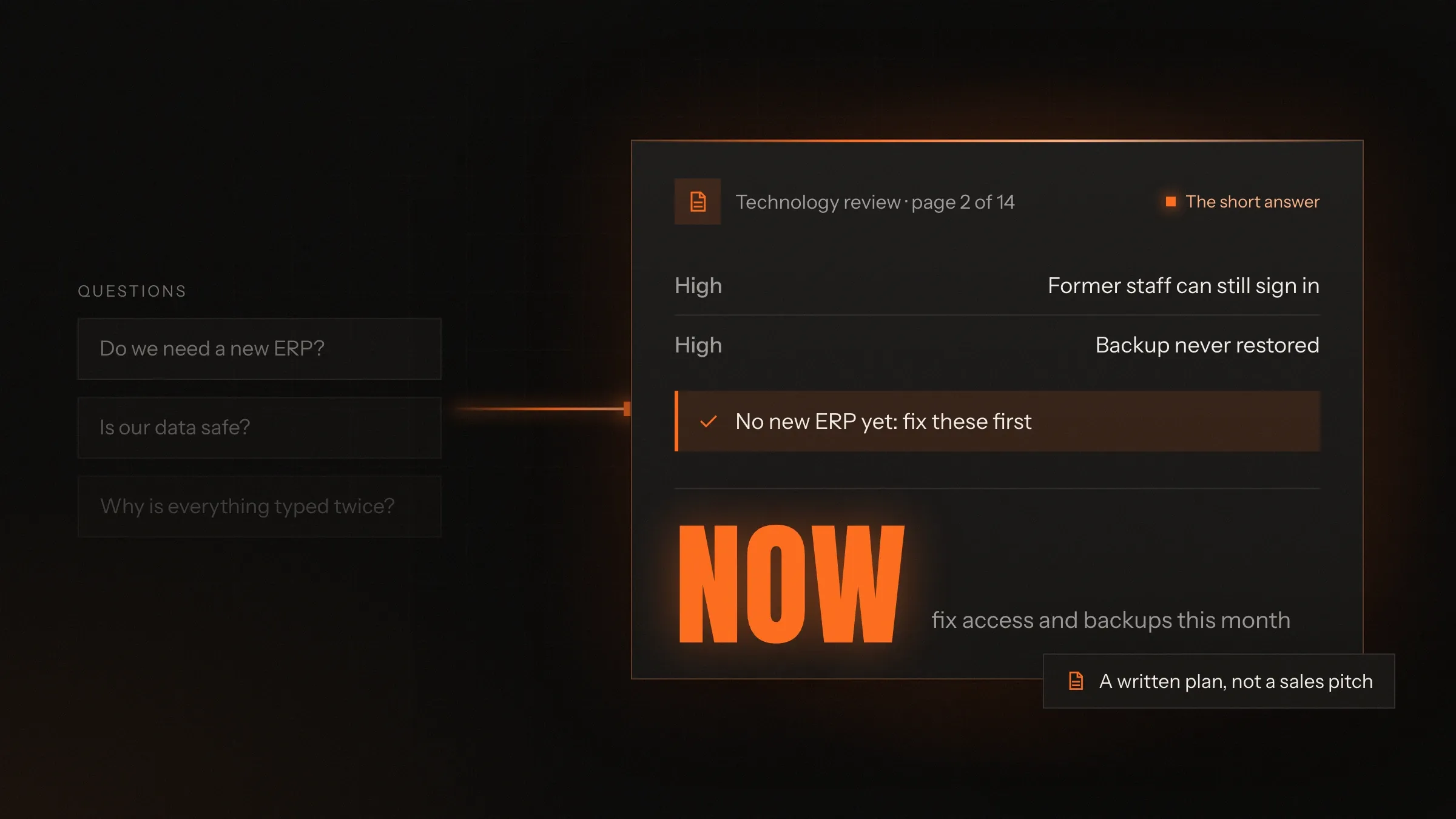
We look at the software, systems and suppliers your business runs on, tell you plainly what works, what doesn't and what it costs you, and give you a written plan you can act on with us or with anyone else.
- We look before we advise
- Plain answers, in writing
- A plan you can use with anyone
Sound familiar?
What we hear before we start
- Three suppliers have told you three different things, and each one wants to sell you something.
- You pay for software nobody uses, and you can't tell which.
- A developer has quoted for a rebuild, and you don't know whether you need one.
- Your team works around the system instead of with it.
- AI comes up in every meeting, and nobody can say where it fits.
- If your one IT person left tomorrow, nobody would know the passwords.
What changes
-
Today: Advice from whoever is selling.
After: A written review from someone who looked first.
-
Today: Software bills that only ever go up.
After: A list of what to keep, cut and combine, with what each one costs.
-
Today: Big decisions made on gut feel.
After: Options laid out side by side, with their cost, risk and time.
-
Today: Passwords and know-how in one person's head.
After: Systems, access and suppliers written down and owned by the business.
-
Today: AI ideas with no starting point.
After: One or two places where AI would pay off, and what each would take.
-
Today: Big projects started before the problem is clear.
After: Small steps in a sensible order, each worth doing on its own.
What it does for you
-
Review what you run
Your software, data, cloud, devices and suppliers, seen in use and written up in plain words.
For exampleA distributor learns its three tools hold three different customer lists, and which one to keep.
-
Cut what you don't need
Licences, hosting and subscriptions checked against what is really used, before the next renewal.
For examplePaid seats for people who left last year are found a month before the annual renewal.
-
Build, buy or adapt
Ready-made products and custom builds compared on fit, cost over the years and risk, with a clear recommendation.
For exampleA clinic tries three systems on its own busiest day of appointments before choosing one.
-
Fix the security basics
Two-step sign-in, leavers' access, shared passwords, backups and the obvious open doors, checked and put in order.
For exampleA former employee's email account still works. It is closed the same day.
-
Brief a project before you spend
Scope, risks, a sensible order of work and the questions to ask suppliers, so their quotes can be compared.
For exampleThree quotes for an app finally line up, because each supplier answered the same written brief.
-
Find where AI fits
Where AI would save real time in your business, what data it needs, and what it should not touch.
For exampleReading supplier invoices is picked as the first job for AI; setting customer prices is not.
-
Map the rules that apply
What GST, India's DPDP Act, RBI directions or the GDPR mean for your systems, worked out with your own advisers.
For exampleA lender maps every step of its loan journey against the RBI's digital lending rules before a screen is designed.
-
Someone to ask
A regular call and a second opinion before you sign, hire or buy.
For exampleBefore signing a three-year software contract, the owner sends it over and gets a plain answer that week.
How it works
-
You tell us the question
What worries you, what you are about to decide, or simply whether your tech is in good shape.
-
We look
We see your systems in use, read the contracts and bills, and talk to the people who use them.
-
We map it
Every tool, what it does, who owns it, what it costs and how it connects to the rest.
-
We answer plainly
What works, what doesn't, what's risky and what's wasted, in words anyone in the business can follow.
-
We lay out the options
For each problem: what to do, what it costs, how long it takes and what happens if you leave it.
-
You decide
A written plan in order. Act on it with us, with your own team or with another supplier.
Where we've built it
5 from our portfolio
-
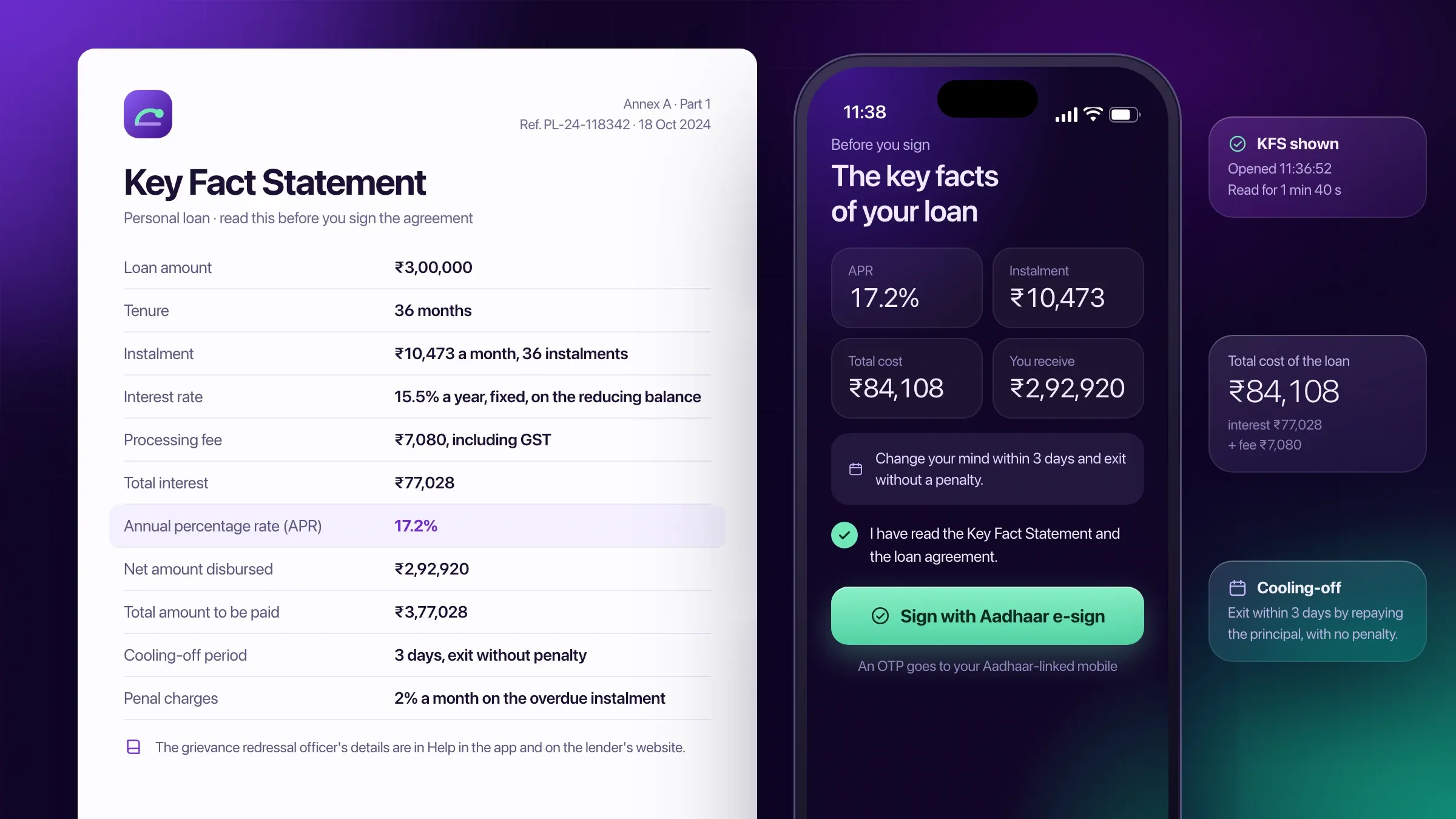 Rules mapped before anything was designed For an NBFC in Kolkata, we mapped every step of the loan journey against the RBI's digital lending rules with its compliance team before designing anything. Read the case study
-
 A month in the dispatch room first For a transport company in Coimbatore, we spent the first month in the dispatch room and at two hubs, listing every tool and spreadsheet in use. Read the case study
-
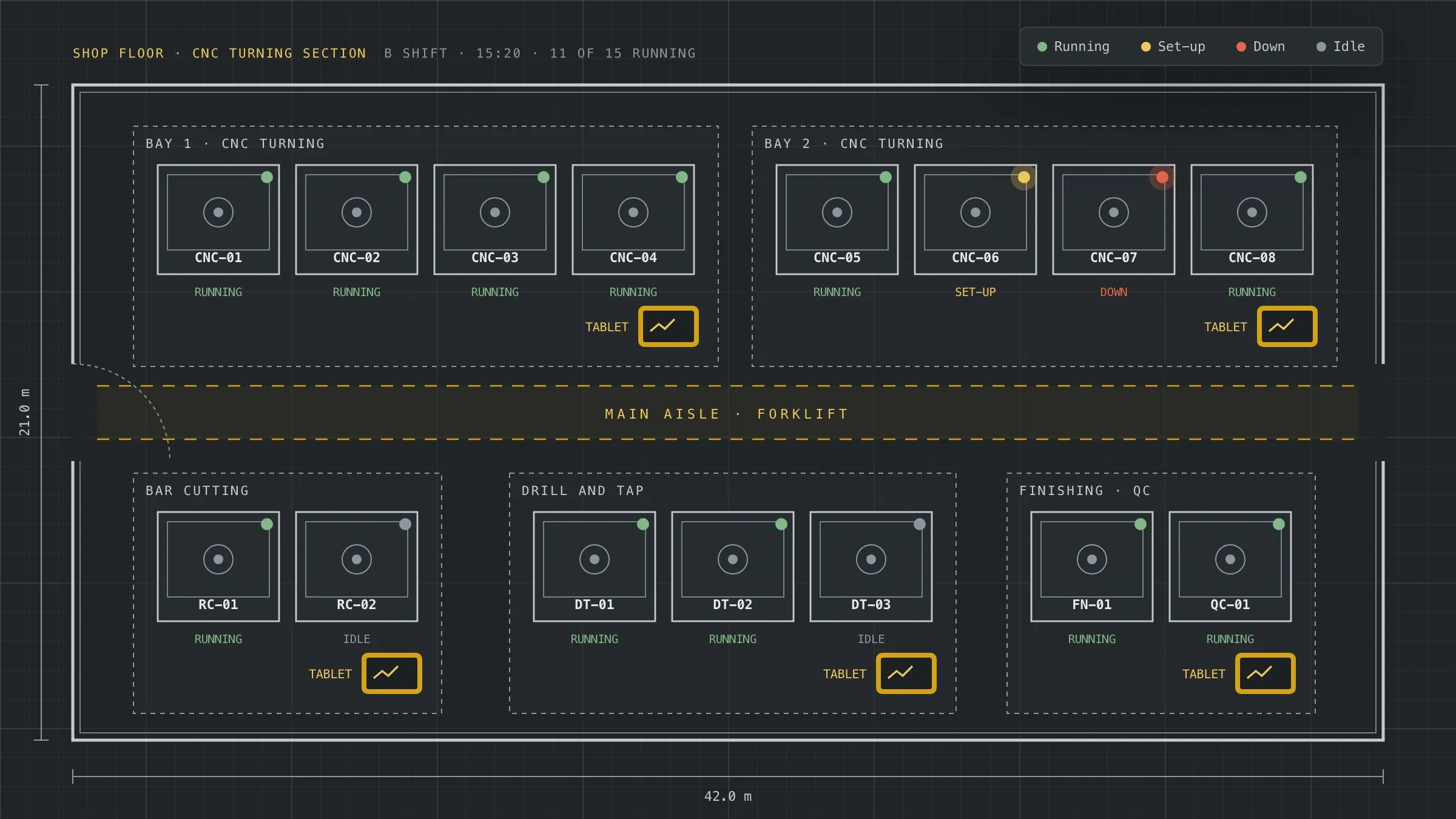 Real orders followed from purchase order to truck For a brass parts manufacturer in Jamnagar, we spent the first month following real orders from purchase order to truck, through every department, before building anything. Read the case study
-
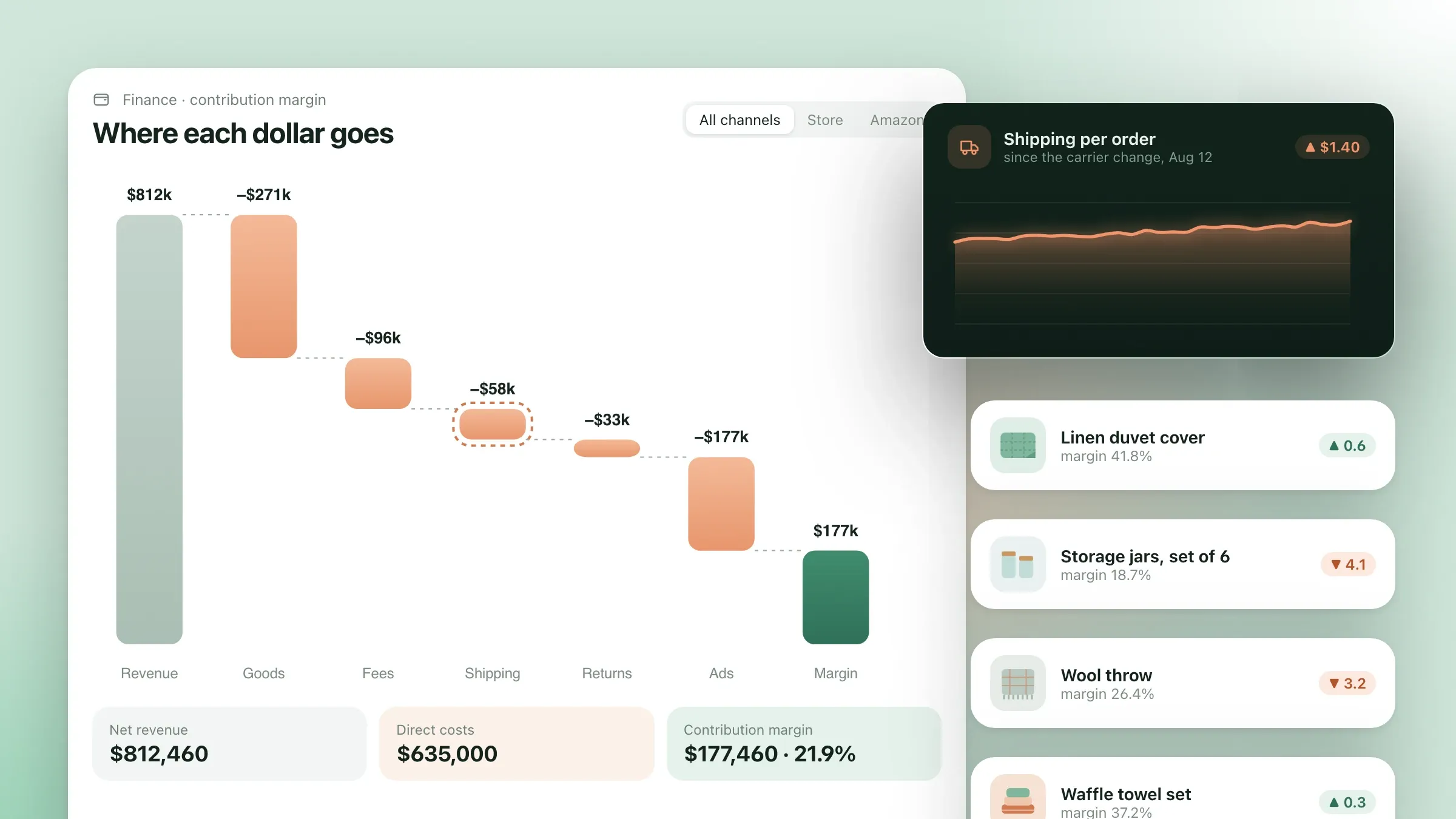 One agreed meaning for every number For a home goods brand in Denver, interviews with leadership, marketing, operations and finance produced one written definition for every metric before a single source was connected. Read the case study
-
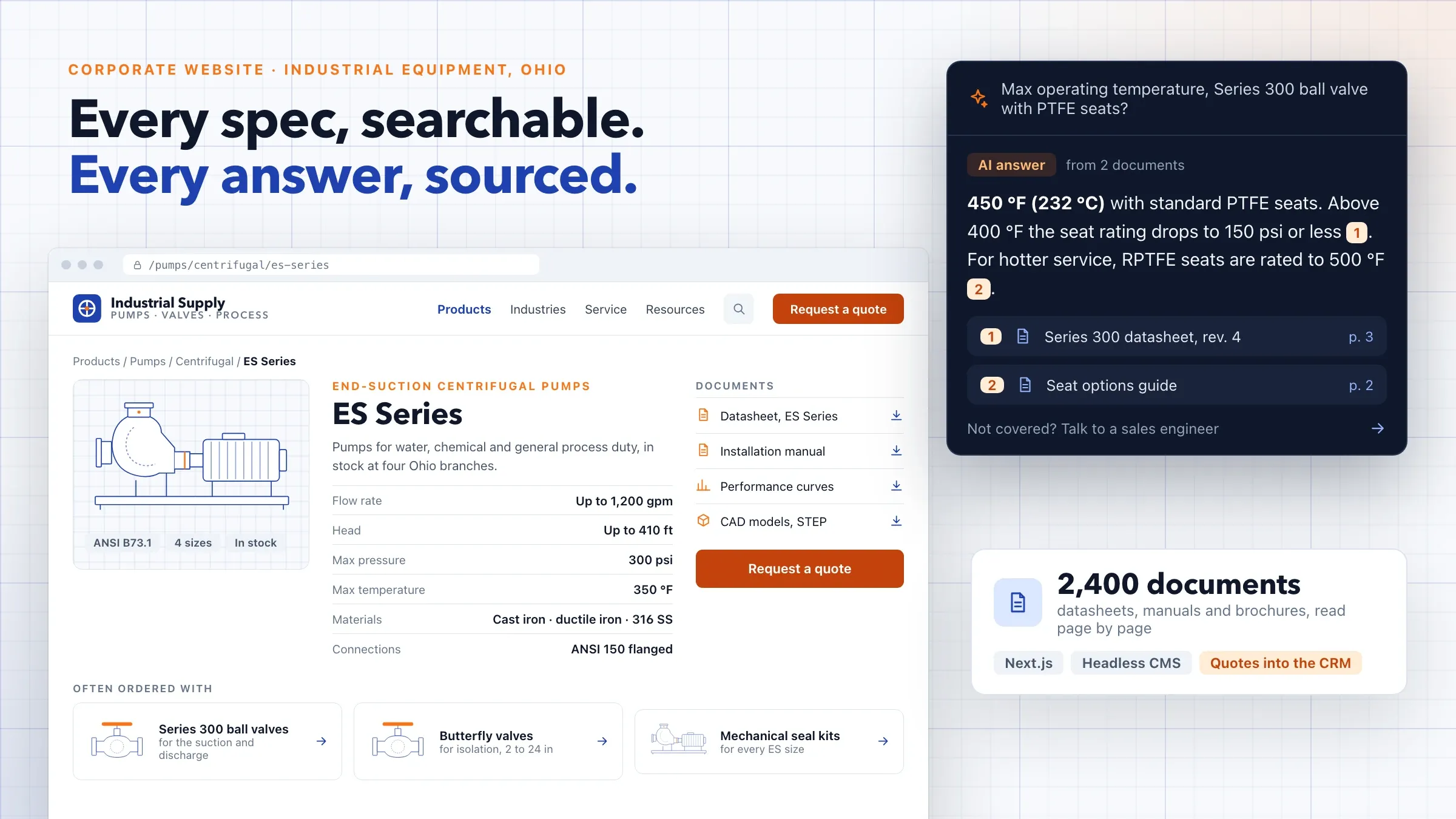 A full audit before the rebuild For an industrial equipment distributor in Ohio, we audited every page, search term, backlink and PDF, and read customers' questions, before designing the new site. Read the case study
What IT consulting is, and what it isn’t
IT consulting is advice on your technology from someone who looks before speaking. You bring a question, large or small; we look at how your business actually works and give you a plain, written answer you can act on.
It is not a sales visit dressed up as advice, where every problem happens to need the product being sold. It is not a thick report full of words nobody in the business uses. And it is not day-to-day IT support, such as fixing laptops or setting up printers, although we will tell you whether yours is working.
We have been building software since 2008, for businesses from shops to lenders and manufacturers. That matters for advice: we know what software takes to build, run and change, so we can tell a sensible quote from a wild one and a real risk from a theoretical one.
When a straight answer saves the most
Advice pays off most just before a big decision. The moments we hear about most often are these: before buying an ERP or a CRM, before accepting a quote to rebuild an app, before hiring a first developer or a tech lead, and before signing a long software contract.
Other moments are warnings. Software and cloud bills climbing with no clear reason. A security scare, such as a hacked email account or a ransom note on a shared drive. The one person who knows how everything works handing in their notice. Investors or a buyer asking about your technology before a deal.
A short review at any of these points costs little next to a wrong choice that runs for years. And sometimes the answer is reassuring: what you have is fine, and here are the three small things to fix.
What we look at
We look at five things: the software you use, your data, where it all runs, who has access, and what it costs. Software means everything from your accounting package and Tally to your website, CRM, spreadsheets with macros and the apps your team installed themselves.
For data, we ask where your customer, sales and stock records live, how many copies exist, which one is right and whether it is backed up. For where it runs, we look at office servers, hosting, cloud accounts and domains, and who pays for each. For access, we check who can sign in to what, whether leavers still can, and whether two-step sign-in is switched on.
For cost, we list every subscription, licence and hosting bill with its renewal date. The result is a map of your technology on one page, which many businesses have never seen.
How the review works without disrupting your team
Most of the review happens on screen-share and in short conversations, so your team keeps working. We ask for view-only access where we need it, and we never change anything during a review without asking.
We talk to the people who use the systems every day, not only to managers, because they know the workarounds: the spreadsheet kept on the side, the report that is always wrong, the step that is done twice. Conversations happen in English, Hindi or Gujarati, whichever people are comfortable with.
We work on India time, which overlaps with the working morning in Europe, and we set calls at the edges of our day for the Americas. A review of a single decision needs a few conversations; a full review spreads them over the agreed period.
Build, buy or fix: making the call
The right answer is the cheapest one that solves the real problem for the next few years. Many businesses arrive with a quote to rebuild when a ready-made product would do, and others try to bend a product into something it will never be.
We compare the options on the things that matter: how well each fits the way you work, what it costs to buy or build and then to run over several years, how hard it is to leave, who owns your data, and whether your team can live with it. Where a ready-made product fits, we say so, including our own, such as Flare CRM for sales teams or Ember POS for billing and stock, and including other companies’ products when they fit better.
Sometimes the honest answer is neither: fix what you have, connect two tools that don’t talk, or stop doing a task nobody needs.
Security: the basics first
Most small-business security problems are basic, and fixing them costs little. Shared passwords, accounts belonging to people who left, two-step sign-in switched off, backups that have never been restored, a domain registered on a former employee’s personal card: these cause far more damage than clever attacks.
We check each of these and put them in order of risk. Many are fixed in an afternoon: a password manager for the team, two-step sign-in on email and banking, leavers removed, backups tested once. The plan names who owns each fix.
Where you hold sensitive data, such as payments, health records or children’s information, or where a customer or regulator asks for proof, we recommend deeper checks, such as penetration testing, as a separate step.
Costs: what you pay for and what you use
Most businesses pay for more software than they use. Subscriptions are added one at a time by different people, renew automatically and are rarely reviewed together.
We list every subscription, licence, hosting and domain bill with its renewal date and owner, then compare it with real use. The usual findings are seats for people who left, two tools doing the same job, plans larger than needed, and cloud servers left running after a project ended.
The result is a renewal calendar and a list of what to cut, combine or renegotiate, so the next renewal becomes a decision rather than a surprise.
Rules your systems must follow
Rules about tax and data shape what your systems must do, so we check them early. In India that can mean GST e-invoicing and e-way bills, the Digital Personal Data Protection Act 2023, CERT-In’s rules on reporting incidents and keeping logs, and RBI directions for lenders and payment businesses.
For customers abroad, the GDPR covers personal data of people in Europe and the UK, and health businesses often adopt HIPAA-style privacy controls. We map what each rule means in practice: which data you hold, where it lives, who can see it and what must be logged.
We work alongside your lawyers, chartered accountants and auditors. We explain the technology side clearly; they give the legal and tax advice, and nobody claims a certificate that wasn’t earned.
The written plan
At the end you get a written plan in plain words, ordered by what matters most. It opens with a one-page summary any owner can read over a cup of tea, followed by the map of your systems and suppliers.
Each finding comes with a decision: keep, fix, replace or stop. Each decision comes with options, what each costs, how long it takes, what could go wrong and what happens if you leave it. Steps are sorted into now, next and later, with quick wins first.
Where a step needs a supplier, the plan includes the brief to send them and the questions to ask, so quotes can be compared fairly, whether one of them is ours or not.
Ongoing advice, or a part-time tech lead
Some businesses want a review once; others want someone to ask every month. As a part-time technology advisor, sometimes called a fractional CTO, we join a regular call, review plans and quotes, read contracts before they are signed, and help you hire or brief developers and suppliers.
It suits companies that have outgrown guesswork but are not ready for a full-time technology lead. When you are, we help you write the role, interview candidates and hand over everything we know.
How we work with you
From the first call to running it
- Start
Agree the question
A first call to understand what you need answered, by when, and who should be involved.
- Review
Look at what matters
Time with your team, your systems, your bills and your contracts, on screen-share and in short conversations.
- Report
A written answer
A plain report: what we found, what we recommend, in what order, and the cost and risk of each step.
- Decide
Walk through it together
We go through the report with you and your team, answer every question and adjust the plan where needed.
- Every month
Advice when you need it
If you want it, a regular call and a second opinion before you sign, buy or hire. Or we build the first step with you.
Safe and in your control
We look, we don't touch
We use view-only access wherever we can, and change nothing without your say.
Confidential by default
Contracts, bills and data you share stay private, under a non-disclosure agreement if you want one.
Advice, not a sales pitch
We say when our own products or services fit, and when someone else's would serve you better.
Everything in writing
Findings, reasons and options are written down, so you can check them or take them to anyone.
Access handed back
Any access you give us is listed, and removed when the review ends.
Yours to keep
The report, the system map and the plan belong to you, to use and share as you like.
Time and cost
The cost depends on how much we need to look at and how deep, not on a package. After a first call we send a written scope and a quote for the review, so you know what you will get before we start.
How big the question is
One decision, such as which software to buy, is quick. A review of everything you run takes longer.
How many systems and suppliers
Each system, contract and supplier is another thing to look at, understand and write up.
How much is written down
If passwords, contracts and diagrams exist, the review is quicker. If they live in people's heads, we gather them first.
How many people we talk to
The real answers come from the people who use the systems, across teams, branches and offices.
One review or regular advice
A single review is one piece of work. A regular advisor is a monthly arrangement.
Built with
Chosen for each project, never by habit
Questions and answers
13 answered
What is IT consulting?
IT consulting is getting independent advice on the technology your business uses: what to keep, fix, replace or buy, how to keep it safe and what it should cost. A good consultant looks at how you work first and gives you a written plan.
Do small businesses need IT consulting?
Often more than large ones, because there is no IT department to ask. A review before a big purchase, a rebuild or a new hire costs little next to a wrong choice that runs for years.
How much does IT consulting cost?
It depends on how big the question is, how many systems and suppliers are involved, how much is already written down, how many people we need to talk to, and whether you want one review or regular advice. After a first call we send a written scope and a quote.
How long does an IT review take?
A single question, such as which software to buy, can be answered within days. A review of everything a mid-size business runs is a matter of weeks. The scope we agree after the first call sets the date for the report.
Will you just recommend your own services?
No. We recommend what fits and say so when another product, another supplier or your own team is the better choice. The plan is written so anyone can carry it out, and building any step with us is a separate decision.
What do we get at the end?
A written report in plain words: what we found, a map of your systems and suppliers, what we recommend and in what order, with the cost, risk and time of each step. We walk you through it and answer every question.
Can you help us decide whether to build or buy software?
Yes. We compare ready-made products and a custom build on fit, cost over several years, risk and how much you would have to change the way you work. Sometimes the answer is a product, sometimes a build, and sometimes fixing what you have.
Can you advise us on using AI?
Yes. We look for tasks that come up often, follow clear rules and are easy to check, and tell you plainly where AI would help, what data it needs, what it would cost to run and where it should not be used.
Can you review our software and cloud costs?
Yes. We go through hosting, cloud and subscription bills against what is really used, and list what to cut, combine or renegotiate before each renewal.
Do you help with data protection and compliance?
We work out what rules such as India's DPDP Act, GST e-invoicing, RBI directions or the GDPR mean for your systems, and work with your lawyers and auditors on the legal side. We don't give legal advice or certify compliance.
Can you be our part-time technology advisor?
Yes. Some businesses keep us on a regular call to review plans, read contracts and quotes, and help hire or brief suppliers. It suits companies that need a technology lead's judgement but not a full-time one.
Do you work with businesses outside India?
Yes. FIRELIFE Ventures works with small and mid-size businesses worldwide from Rajkot, India, on India time. Reviews happen over video calls and screen-share, in English, Hindi or Gujarati, and our portfolio includes clients in the United States, the United Kingdom, Ireland, the Netherlands and India.
What happens after the review?
You decide. Act on the plan with your own team, another supplier or us. We can build or run any step, or simply stay available for questions as you go.
Tell us what should work better
Write a few lines about what slows you down today. We reply with our questions, a first plan and how we would start.
Write to us