Build something new product discovery
Know what to build before you spend
Before you spend on building, we find out what your users actually need: we watch the work where it happens, test the idea with a clickable prototype and hand you a clear first release, a plan and an estimate you can decide on.
- We go where the work happens
- You see a prototype before any code
- Research in English, Hindi and Gujarati
Sound familiar?
What we hear before we start
- You have an idea and a budget, and three quotes describe three different products.
- Everyone on your team pictures a different app.
- You're not sure which feature matters first, so the list keeps growing.
- A past project was built to a spec, launched, and hardly anyone used it.
- Your users are shopkeepers, farmers or doctors, and nobody has asked them yet.
- Your board or investors want a number, and every estimate feels like a guess.
What changes
-
Today: Features come from a meeting room.
After: Features come from watching the people who will use them.
-
Today: The scope grows every week.
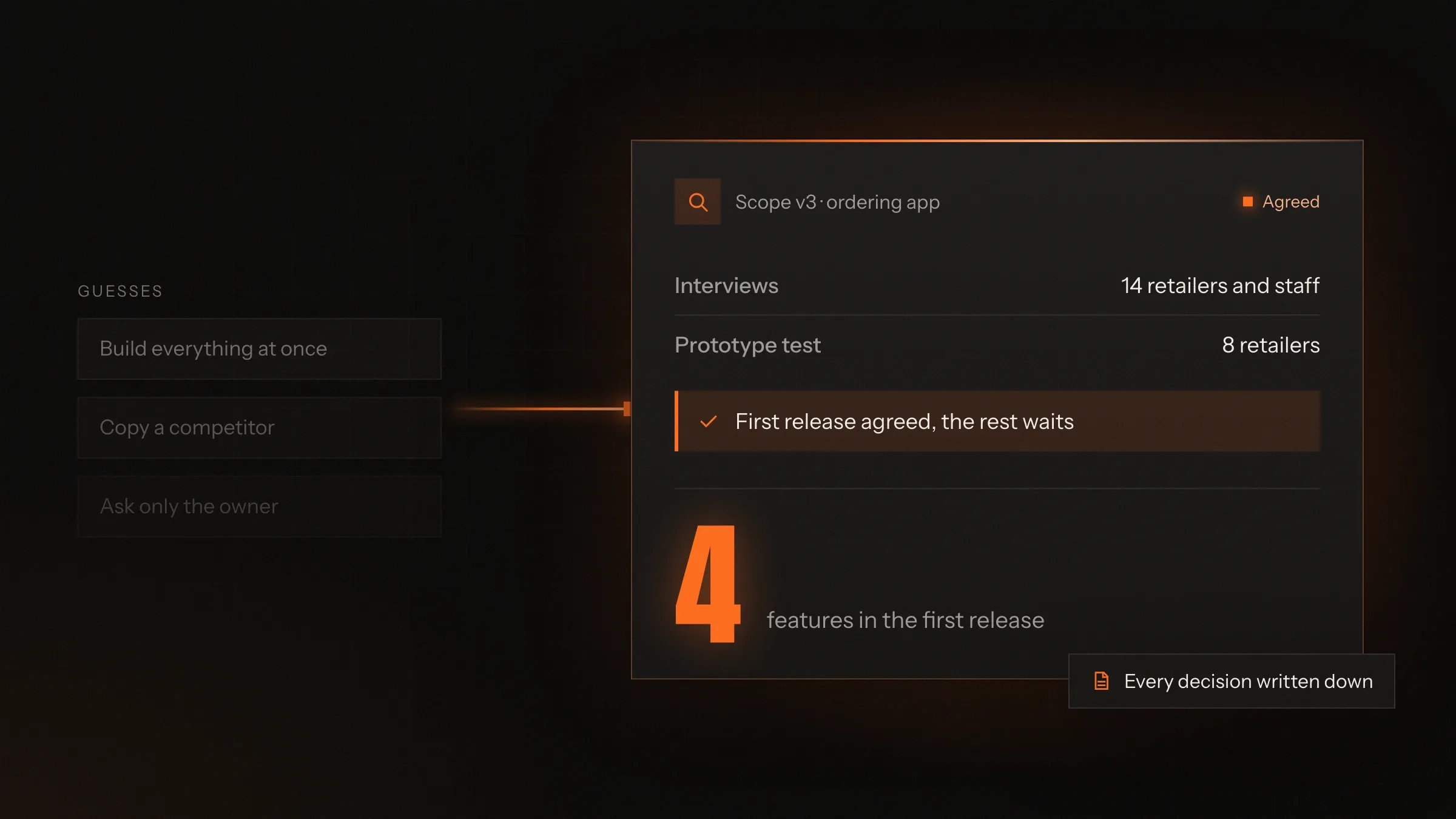
After: One first release, agreed in writing, with a list of what waits.
-
Today: The first real feedback arrives after launch.
After: Users try a clickable prototype before any code is written.
-
Today: Estimates are guesses on a vague list.
After: The estimate rests on screens, data and integrations that are known.
-
Today: Risks surface halfway through the build.
After: The riskiest questions are tested first: payments, data, integrations, rules.
What it does for you
-
Go and see
Interviews and time spent where the work happens: shops, clinics, warehouses, farms, offices and on the road.
For exampleMornings at a clinic's front desk show that paper tokens hide how long patients really wait.
-
Map how the work runs today
Every step, hand-over, tool, spreadsheet and workaround, written up as one map everyone can read.
For exampleThe map shows each order is typed three times: from WhatsApp, into the ledger, onto the warehouse slip.
-
Define the first release
What the first version must do, what can wait and what shouldn't be built, agreed in writing.
For exampleReordering and live prices go in the first release; a loyalty scheme waits for the second.
-
Build a clickable prototype
The key screens designed and linked, so real users can try them on a phone before any code exists.
For exampleEight retailers try to reorder on the prototype. One gets stuck, and the screen is changed that evening.
-
Test the technical risks
Integrations, data, payments, rules and AI ideas checked early, with a small proof where the risk is real.
For exampleA quick test shows the accounting software can return each retailer's credit limit, so the plan can rely on it.
-
Map the rules
Regulations, data protection and industry rules that shape the product, each with what it means on screen.
For exampleA loan journey is mapped against the RBI's digital lending rules before any screen is drawn.
-
Agree how success is measured
What the first release should change for users and the business, and how it will be measured.
For exampleSuccess means retailers reorder in the app without calling, not the number of downloads.
-
Plan and estimate
Releases, team, timeline, risks and a cost estimate built on what is now known.
For exampleThe board gets a plan and an estimate for the first release that it can approve or trim.
How it works
-
Agree the question
What decision discovery should help you make, and by when.
-
Go and see
Interviews and visits with users, staff and partners, in their language.
-
Find the patterns
How the work runs today, and the few findings that matter most.
-
Shape the first release
What to build first, what waits and what to leave out.
-
Prototype and test
Clickable screens tried by real users, then changed.
-
Plan and estimate
Releases, timeline, team, risks and cost, written down for you to decide.
Where we've built it
5 from our portfolio
-
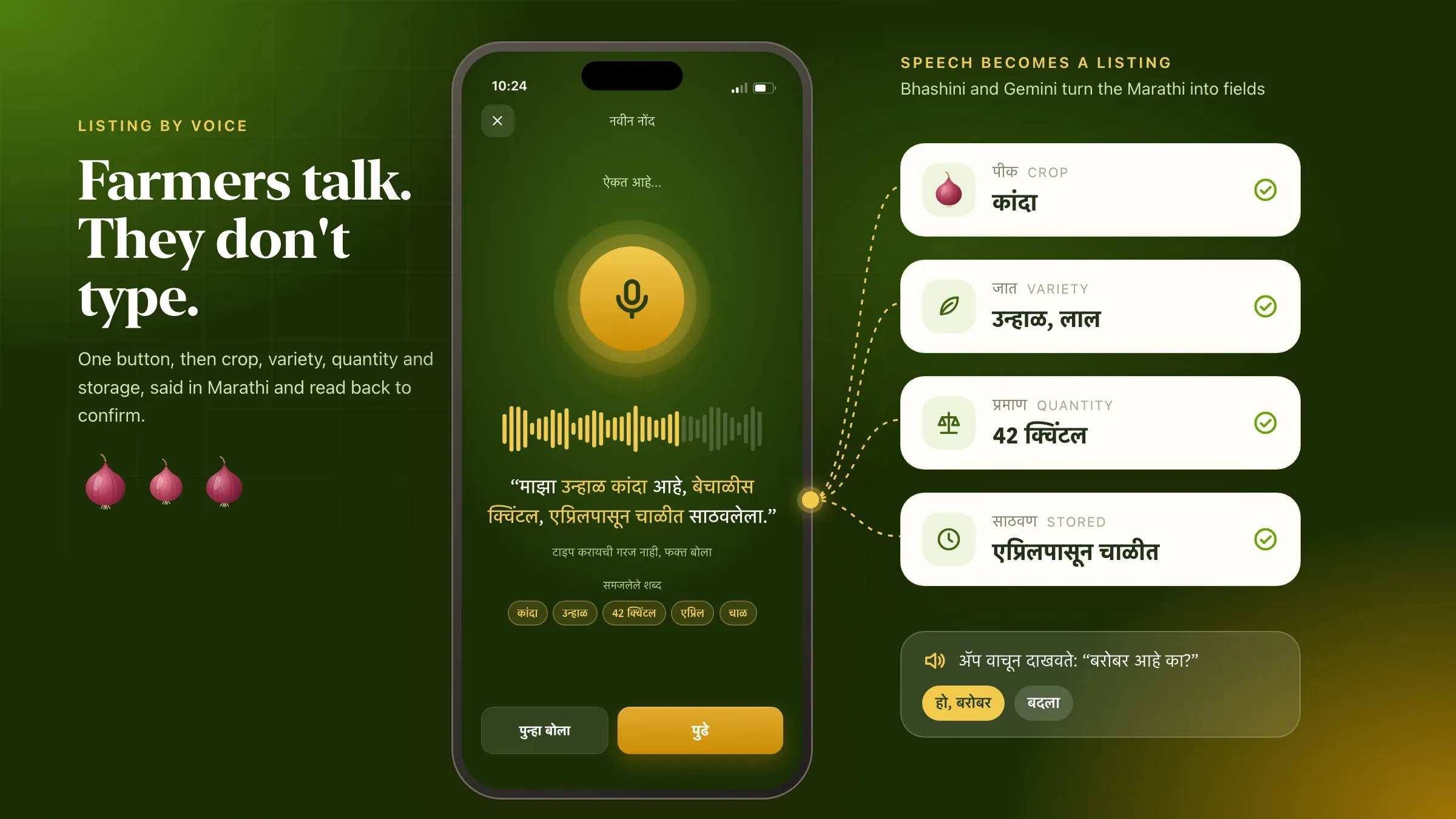 Field visits that led to voice listing For a farmer producer company in Nashik, we spent time in villages, at collection centres and at the Lasalgaon market. Farmers talk rather than type, so produce is listed by voice in Marathi. Read the case study
-
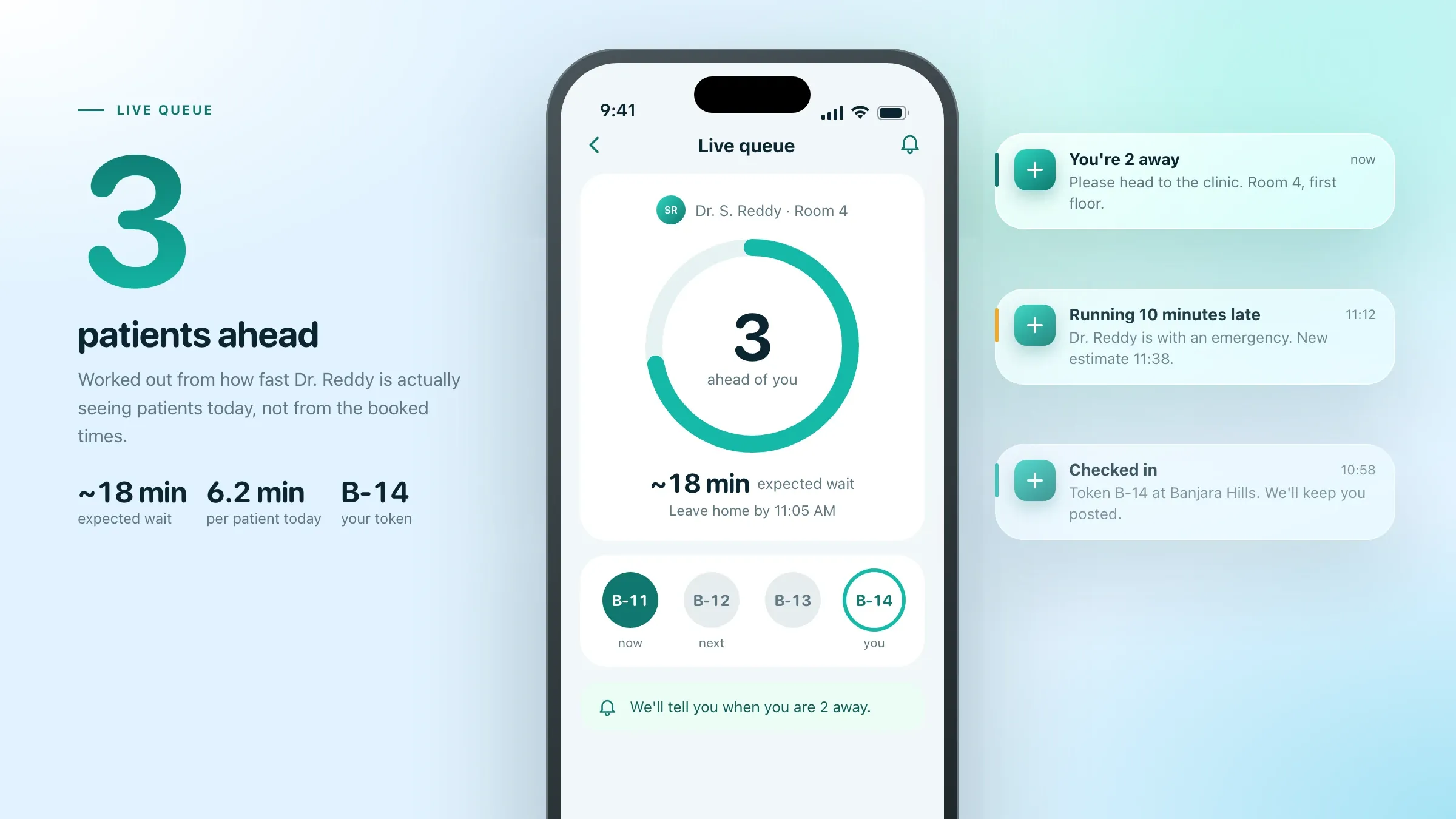 Mornings at the front desk For a clinic group in Hyderabad, mornings at the front desks of two branches showed that paper tokens hid the real wait. The answer was a live queue on patients' phones. Read the case study
-
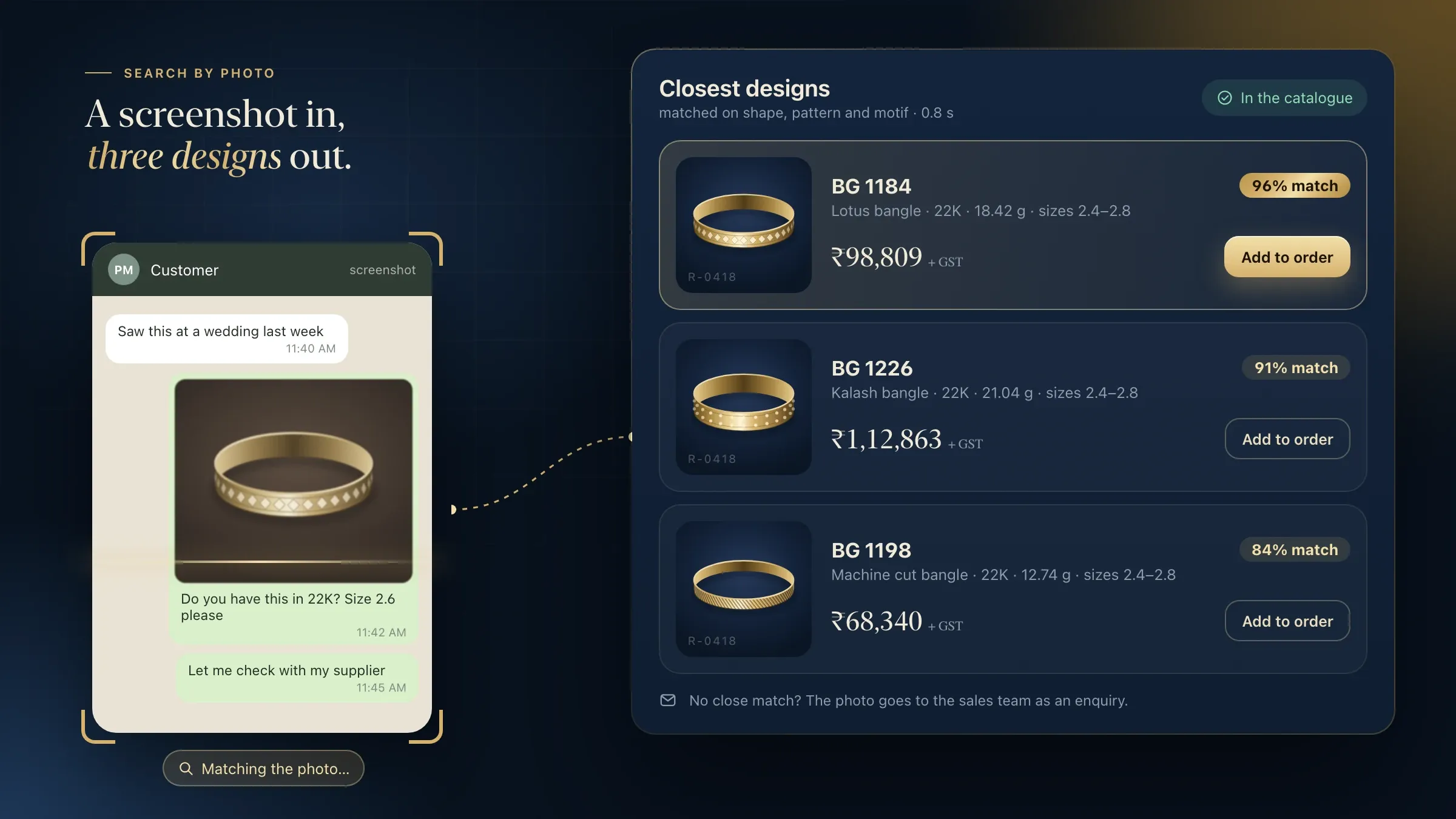 Discovery in the bazaar For a gold jewellery wholesaler in Rajkot, time in the workshops and in retailers' shops showed that retailers remember designs, not codes. So the catalogue lets them search by photo. Read the case study
-
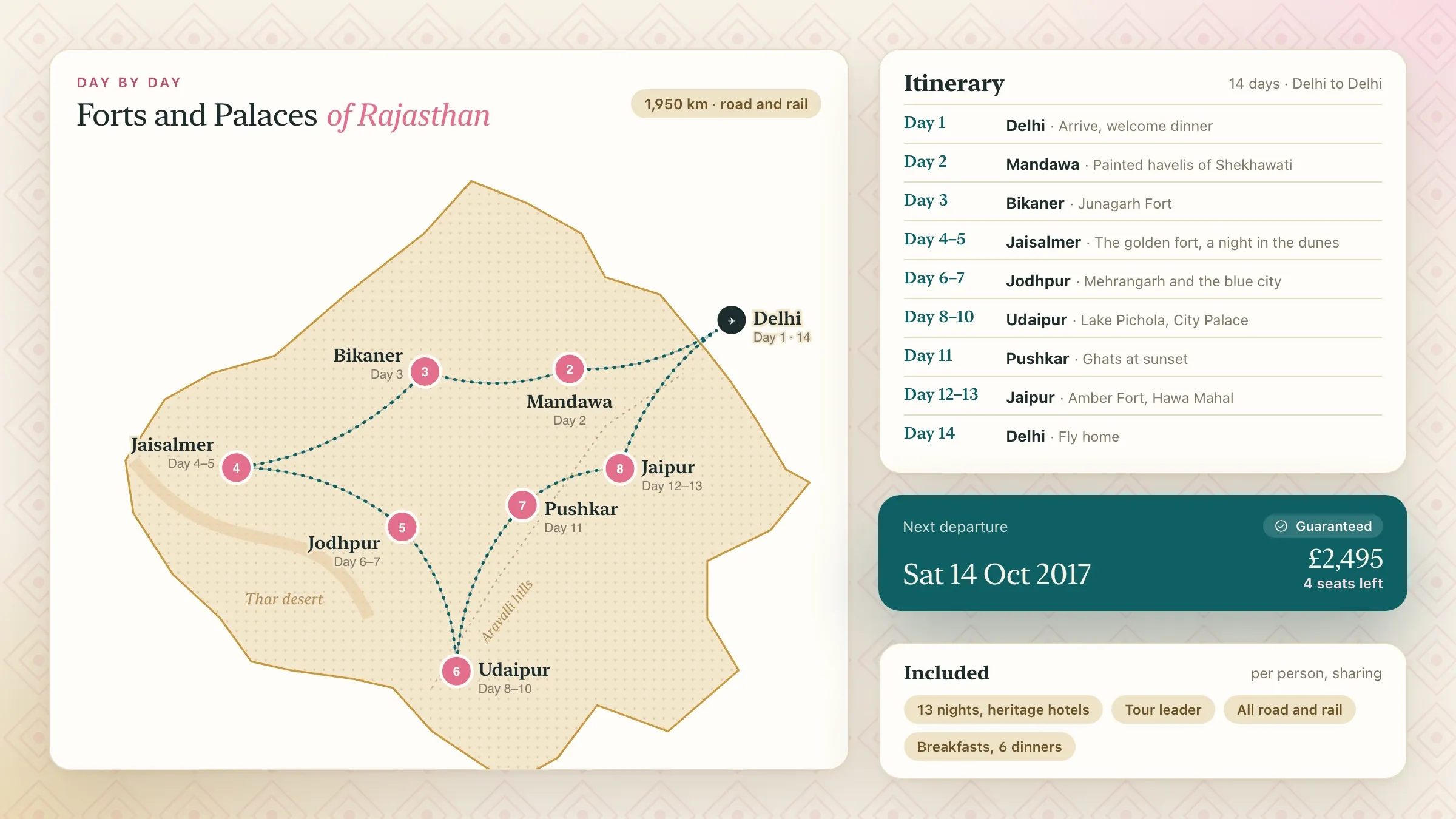 Listening before designing For a tour operator in London, talks with the office, the ground team in India, past travellers and partner agents showed that travellers compare departures, not tours. Read the case study
-
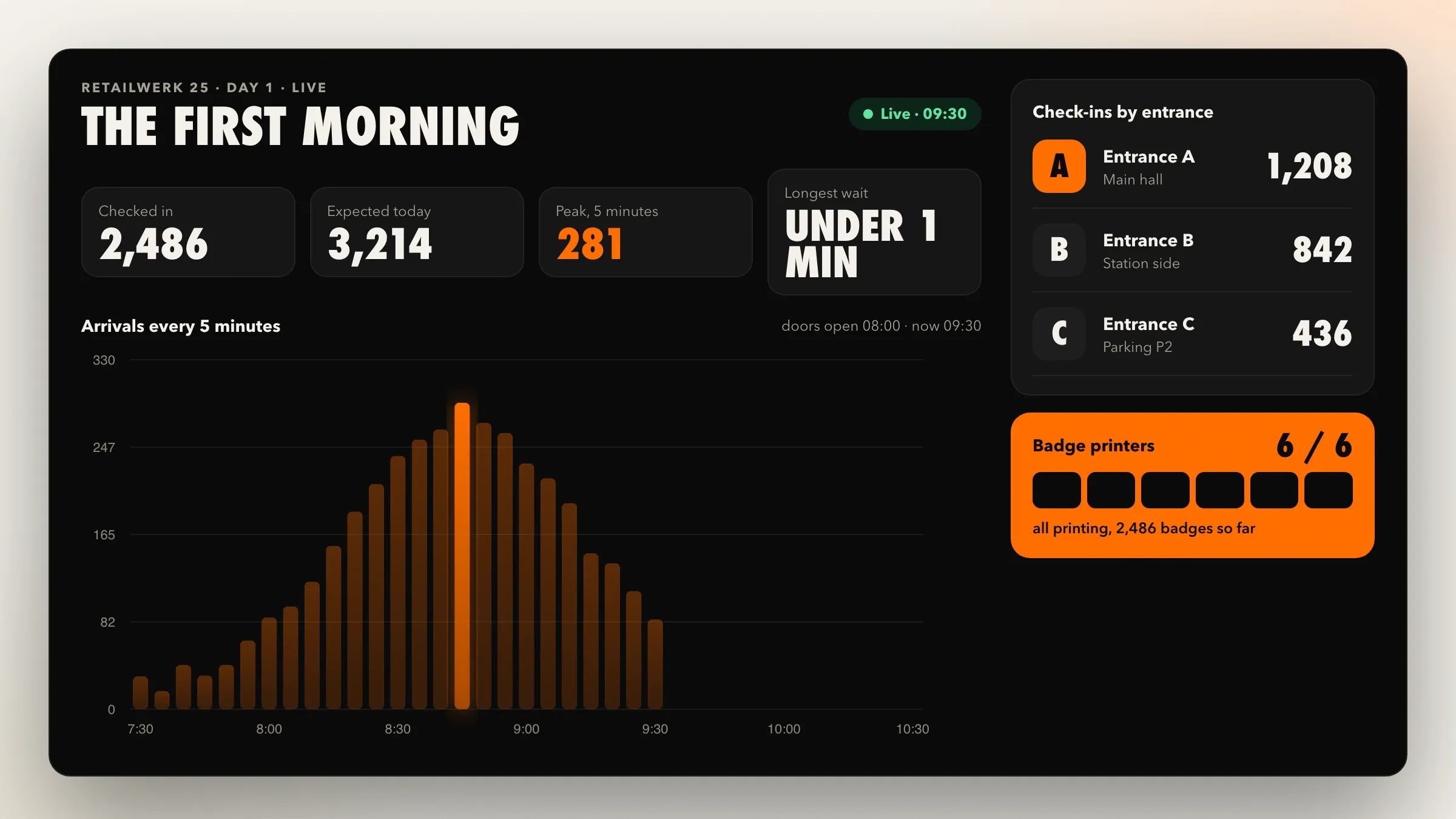 A walk through the last event For a conference organiser in Utrecht, walking through its last event showed that the first hour decides the day and venue Wi-Fi can't be trusted, so check-in works offline. Read the case study
What product discovery is
Product discovery is the work that decides what to build before anyone builds it. It answers four questions: who will use the product, what they need from it, what the first release must do, and what it will take to build.
It is not a long requirements document. It is time spent with the people who will use the software, a map of how their work runs today, a prototype they can try, and a plan built on what was learned. The result is a first release small enough to build with confidence and specific enough to estimate properly.
Discovery is where most of the expensive mistakes in software are cheapest to fix. A wrong assumption costs an afternoon to change in a prototype and far more once it is built into screens, databases and integrations.
When discovery pays off
Discovery pays off whenever the cost of building the wrong thing is high. That includes a new product for users you don’t know well, software that replaces how a business has worked for years, an idea that has to convince a board or investors, and any product with payments, regulations or other systems at its centre.
It matters most when the users are far from the people paying for the software. A wholesaler’s retailers, a clinic’s patients, a farmer producer company’s members and a lender’s borrowers all work in ways that are hard to guess from an office.
It is less useful for a small, well-understood change to software you already run. There, a short conversation and a sketch are usually enough, and we will say so.
Going where the work happens
The most useful findings come from watching, not asking. People describe their work as it should be; watching shows the workarounds, the paper notes and the moments where things go wrong.
So we go where the work happens. In our own projects that has meant time in villages, at collection centres and at the Lasalgaon market with farmers near Nashik, who talk rather than type; mornings at a Hyderabad clinic group’s front desks, where paper tokens hid how long patients really waited; and days in a Rajkot gold jewellery wholesaler’s workshops and in retailers’ shops, where nobody remembered a design code but everyone remembered a picture.
Where travel isn’t practical, we interview by video and ask people to show us their screens. Interviews run in English, Hindi or Gujarati, or with people who speak the user’s language, because people explain their work most clearly in their own words.
Mapping how the work runs today
After the visits, we write up how the work runs today on one map: every step, who does it, which tool or spreadsheet they use, where information is retyped and where it waits. Nobody in the business usually sees the whole of it until it is drawn.
The map turns opinions into facts everyone can point at. It shows where time is lost, where errors come from and which changes would help most. It also becomes the starting point for design, because each screen in the new product replaces a step on the map.
From the map and the interviews we pull out the few findings that matter most, written as plain statements with the evidence behind them, such as “Retailers order on WhatsApp because it is quick, so the app has to be quicker.”
Choosing the first release
The first release should be the smallest product that makes a real difference to its users. We agree it in writing, together with what can wait for later releases and what shouldn’t be built at all.
Choosing is the hard part. Every feature sounds useful in a meeting; the research shows which ones users will reach for every day. We weigh each candidate by how much it helps users, how much it matters to the business and how hard it is to build, and keep the first release tight enough to launch and learn from.
We also agree how success will be measured, such as orders placed without a phone call or appointments booked online, so that after launch you can see whether the product is doing its job.
Prototypes people can try
A clickable prototype shows the product before any code exists. The key screens are designed and linked so that a user can tap through the main tasks on a phone or a laptop, as if the product were real.
We put the prototype in front of the people who will use it and watch them try. Where they hesitate, misread or get stuck, the design changes, often the same day. A few rounds of this find most of the confusing screens, and they are far cheaper to fix in a prototype than after launch.
The prototype also helps everyone else. Your team, your board and your investors see the same product, instead of each picturing their own.
Testing the technical risks
Some questions can’t be answered with a prototype. Can the accounting software return a retailer’s credit limit? Will an AI model read handwritten slips well enough? Does the payment provider support the mandate the business needs? What do the rules require before a borrower signs?
We list these risks early and test the ones that could change the plan, with a small technical proof where needed. Regulations and data protection rules are mapped against the journey, so they shape the design from the start instead of being patched in afterwards.
The same goes for the choice of technology. Whether the product should be a mobile app, a web app or both, which systems it must connect to, where its data should live and which parts could use a ready-made service instead of new code are decided here, with the reasons written down.
The plan and the estimate
Discovery ends with a written plan you can decide on: the first release and what follows, the team it needs, the order of work, the risks and how they will be handled, and a cost estimate.
The plan also says what would change it. If a technical proof is still open or a partner’s system is unknown, the estimate shows which part depends on it and by how much the work could move, so nobody is surprised later.
Because the estimate rests on known screens, data, integrations and rules, it is far firmer than a quote on a feature list. It is a document you can take to your board or investors, or use to compare teams, and it stays yours whatever you decide next.
What we need from you
We need a person who can decide, a few people who know the work, and access to real users. The decision-maker agrees the question at the start and the first release at the end. The people who know the work explain how things run today and where it hurts.
Access to users is the part only you can open. Introductions to customers, retailers, patients, partners or field staff, and permission to visit them where they work, make the research real. We arrange the schedule and bring the questions.
Anything you already have helps too: sales data, support tickets, past research, spreadsheets the team relies on and screenshots of the tools in use today. They show where to look first and save interview time for the questions only users can answer.
From discovery to building
When discovery ends, the next step is yours to choose. If you build with us, the same team carries everything it learned straight into design and development, so nothing is lost in a hand-over and the first sprint starts on known ground.
Discovery doesn’t stop at launch either. The questions from the first release, such as what users try that the product can’t do yet, become the research for the next one.
How we work with you
From the first call to running it
- Start
Agree the question
We agree what you need to decide when discovery ends, who we should meet and how we will work together.
- Research
Go where the work happens
Interviews and visits with your users, staff and partners, in their language and at their place of work.
- Shape
Find the first release
We map how the work runs today, pick out what matters most and agree what the first release must do.
- Test
Prototype and test
Clickable screens tried by real users and changed until the main tasks feel easy.
- Decide
Plan, estimate and decide
A written plan, a cost estimate and the risks, ready for you, your board or your investors.
Safe and in your control
You own the results
Research notes, maps, the prototype and the plan are yours, in formats any team can pick up.
People's privacy respected
Interviewees agree before they are recorded, and their names stay out of the findings.
Your idea kept confidential
Your plans are shared only with the people working on them, under a confidentiality agreement if you want one.
Honest findings
If the research says part of the idea won't work as planned, we tell you, with the evidence.
A clear end
Discovery has an agreed question and an agreed end, so it can't drift into an open-ended project.
Decisions written down
Every decision, assumption and open question is recorded, so nothing depends on anyone's memory.
Time and cost
The cost of discovery depends on how much there is to learn, not on the size of the final product. A focused question with one kind of user is a short piece of work; a product for several kinds of users across cities takes longer. After the first call we send a written plan and a quote for the discovery itself.
Kinds of users
Each group, such as buyers, sellers and your own staff, needs its own interviews and visits.
Where they are
Visits in one city are quicker than research across several cities or countries; video interviews fill the gaps.
Languages
Interviews in Hindi, Gujarati or other languages are run by people who speak them, and notes are translated for everyone.
How much to prototype
A few key screens are quick. A prototype of the whole journey takes longer and answers more.
Technical unknowns
Integrations, data or AI ideas that need a small proof before the plan can rely on them.
Built with
Chosen for each project, never by habit
Questions and answers
12 answered
What is product discovery?
Product discovery is the work done before building software to find out what to build: who will use it, what they need, what the first release must do and what it will take. It ends with a tested prototype, a plan and an estimate.
Why do discovery instead of going straight to building?
Because changing a sketch costs far less than changing finished software. Discovery tests the riskiest assumptions with real users first, so the build starts with a clear scope and fewer surprises.
What do we get at the end of product discovery?
Research findings, a map of how the work runs today, a defined first release, a clickable prototype tested with users, notes on the technical risks, and a written plan with a cost estimate.
How long does product discovery take?
It depends on how much there is to learn. A focused question with one kind of user is a matter of weeks; a product for several kinds of users across cities takes longer. We agree the end date at the start.
How much does product discovery cost?
It depends on how many kinds of users we need to meet, where they are, the languages involved, how much to prototype and how many technical questions need a proof. After the first call we send a written plan and a quote.
Who from our side needs to be involved?
A decision-maker who can agree the scope, a few people who know the work today, and access to real users: customers, staff or partners. We arrange the interviews and visits with your help.
Can you interview our users in Hindi or Gujarati?
Yes. Our team works in English, Hindi and Gujarati, and research in other languages is done with people who speak them, because users explain their work most clearly in their own words.
Is discovery worth it before an MVP?
Yes. Discovery decides what the MVP has to prove and what it can leave out, so the MVP is smaller, launches sooner and tests the right thing.
Can you do discovery for a product we already have?
Yes. For a product already in use, discovery starts from its data and its users: where people drop out, what support hears most often, and what the next release should change.
Can AI speed up product discovery?
It helps with the slow parts: transcribing and translating interviews, sorting notes into themes and drafting prototype text. The listening, the judgement and the decisions stay with people.
Do you do product discovery for businesses outside India?
Yes. FIRELIFE Ventures works with businesses worldwide from Rajkot, India. Research with a London tour operator's office, ground team and partner agents, and with a conference organiser's team in Utrecht, shaped the platforms we built for them.
What happens after discovery?
You decide. The findings, prototype, plan and estimate are yours to use, and if you build with us, the same team carries what it learned straight into design and development.
Tell us what you want to build
Write a few lines about the idea and who it is for. We reply with our questions, a first plan and how we would start.
Write to us