Build something new travel booking software
Sell tours with seats, deposits and balances
We build travel booking software for tour operators: every departure shows its live seats, travellers book and pay a deposit online, balances arrive without chasing, and your agents and ground team work from the same bookings.
- We start with how you sell today
- Your existing bookings move across before launch
- English, Hindi, Gujarati and more
Sound familiar?
What we hear before we start
- Seats are tracked in a spreadsheet, and now and then a departure is double-booked.
- Every enquiry means an itinerary PDF, a bank transfer and a string of emails.
- Balance payments are chased one email at a time, and some still arrive late.
- Agents email to ask what's available, then wait for a reply.
- Passport copies, visa details and dietary needs are scattered across inboxes.
- Before every departure, someone rebuilds the rooming lists by hand.
What changes
-
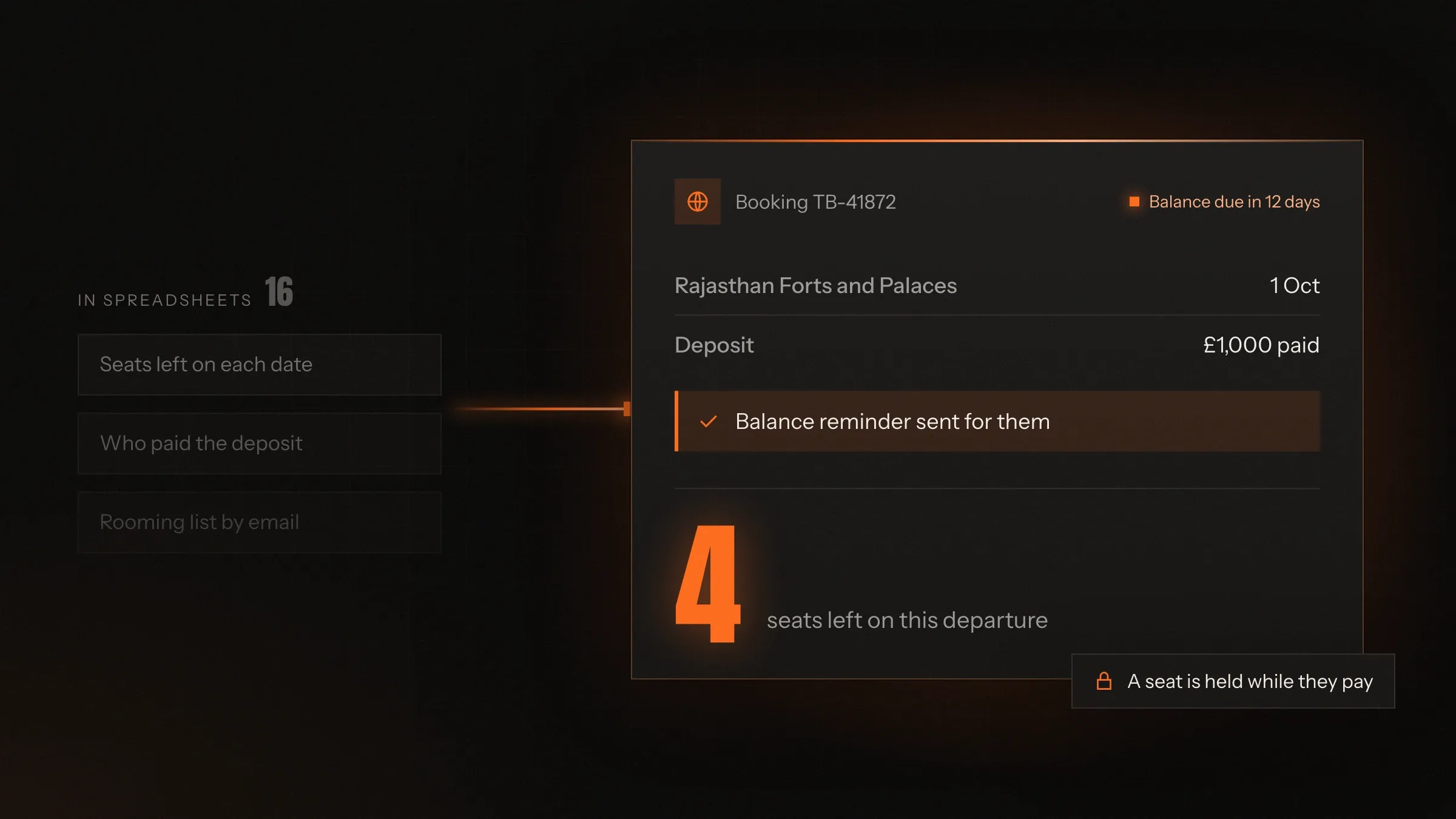
Today: Seats live in a spreadsheet that someone has to remember to update.
After: Every departure shows its seats left, updated the moment anyone books.
-
Today: Deposits arrive by bank transfer and are matched to bookings by hand.
After: Travellers pay the deposit online, in a currency they know, and the booking confirms itself.
-
Today: Balances are chased one traveller at a time.
After: Reminders go out before the due date, and travellers pay the balance from a link.
-
Today: Agents ask by email whether there is space.
After: Agents check live seats and book at their own rates in a portal.
-
Today: Rooming lists are typed up from forwarded emails.
After: Rooming lists and manifests are ready for every departure and update as bookings change.
What it does for you
-
Show live seats for every departure
Each tour lists its departures with dates, price, seats left and whether it has enough travellers to run. Full departures take a waitlist.
For exampleThe 1 October departure shows four seats left. When the 6 October one fills, the next person joins its waitlist.
-
Take deposits and balances
A deposit at booking, the balance on the date your terms set, reminders in between and online payment from a link.
For exampleA traveller pays the deposit by card in February. In July a reminder arrives, and she pays the balance from her phone.
-
Sell in more than one currency
A price list per currency, so travellers see a firm price in rupees, pounds, dollars or euros, not a conversion that moves.
For exampleA traveller in Sydney sees the tour in Australian dollars and pays exactly that amount.
-
Handle rooms, solo travellers and extras
Room types, single supplements, room shares, extra nights, child prices and optional excursions, all priced and counted.
For exampleA solo traveller chooses to share a room and is matched with another solo traveller on the same departure.
-
Give agents their own portal
Partner agents check live seats, book at their agreed rates, see the commission on each booking and download itineraries and invoices.
For exampleAn agent in Toronto books two seats for her clients, and the seat count drops for everyone at once.
-
Collect traveller details once
Passport, visa, insurance, emergency contacts, dietary and medical notes, completed by each traveller in their own account.
For exampleThe account warns a traveller that his passport expires too soon for the trip.
-
Prepare the paperwork for each departure
Rooming lists for every hotel, passenger manifests for guides and drivers, and a summary of diets and medical notes.
For exampleA late booking is added, and the hotel in Jaipur gets an updated rooming list the same day.
-
Keep travellers informed
Confirmations, payment reminders, joining instructions and last-minute changes, by email and WhatsApp.
For exampleThe week before departure, joining instructions arrive on WhatsApp with the hotel and the meeting time.
How it works
-
A traveller finds a tour
Searching by region, month or style, then comparing departures and seats left.
-
They book and pay a deposit
Choosing a room and extras and paying online. The seat is held while they pay.
-
The seat count updates
For everyone at once: your website, your agents and your team.
-
They complete their details
Passport, visa, insurance and diet in their own account, with reminders for anything missing.
-
The balance is collected
Reminders before the due date, payment online, and late balances flagged to your team.
-
The departure is prepared
Rooming lists, manifests and joining instructions go to the ground team and the travellers.
Where we've built it
3 from our portfolio
-
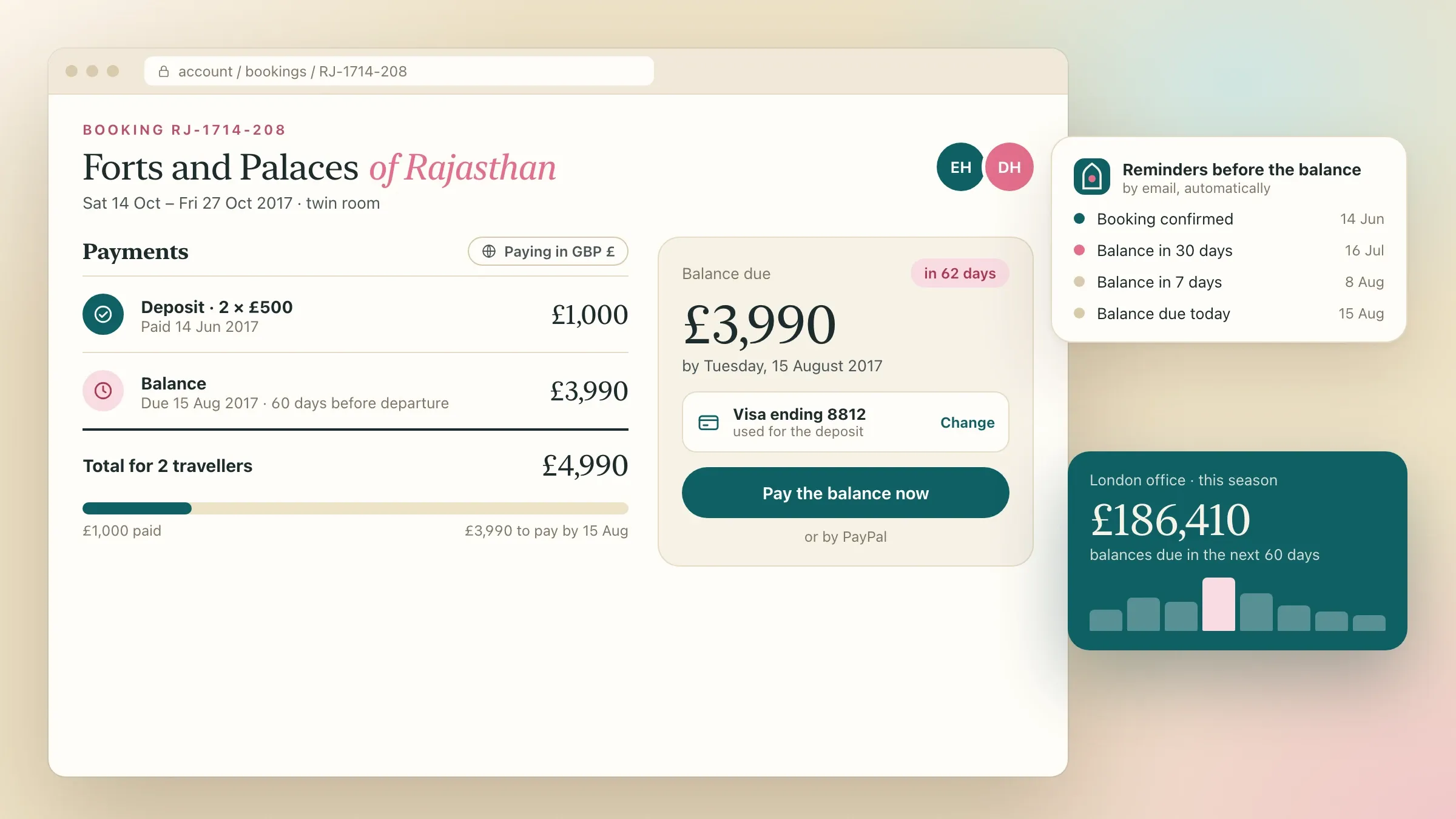 Small-group tours, deposits in four currencies For a tour operator in London running small-group tours in India, we built live seats for every departure, deposits and balances in four currencies, room shares for solo travellers, an agent portal and rooming lists. Read the case study
-
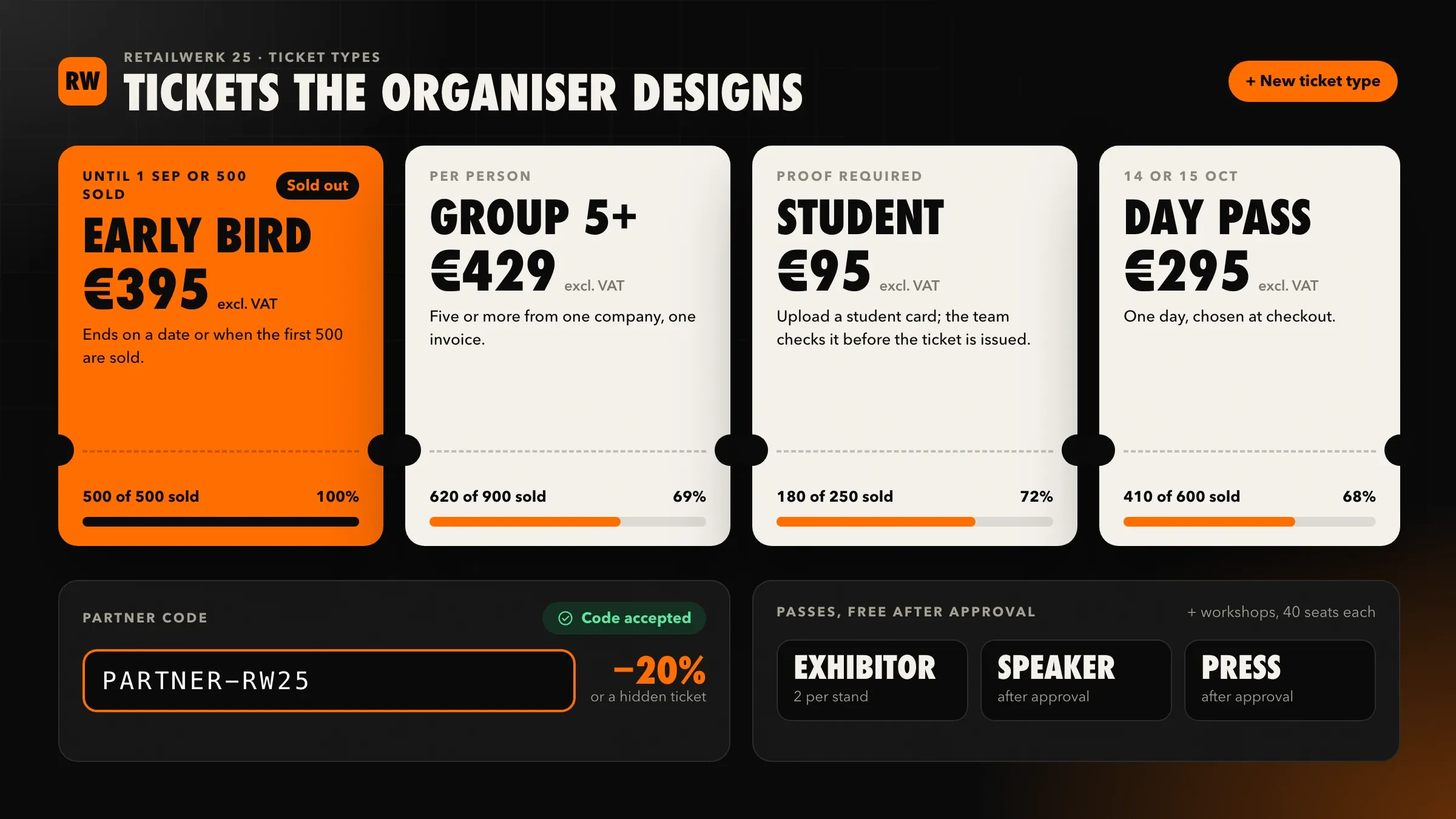 Prices with rules: early bird, group and codes For a conference organiser in Utrecht, ticket types each with their own rules: early bird prices, group rates, student tickets and partner codes, with VAT invoices for companies. Read the case study
-
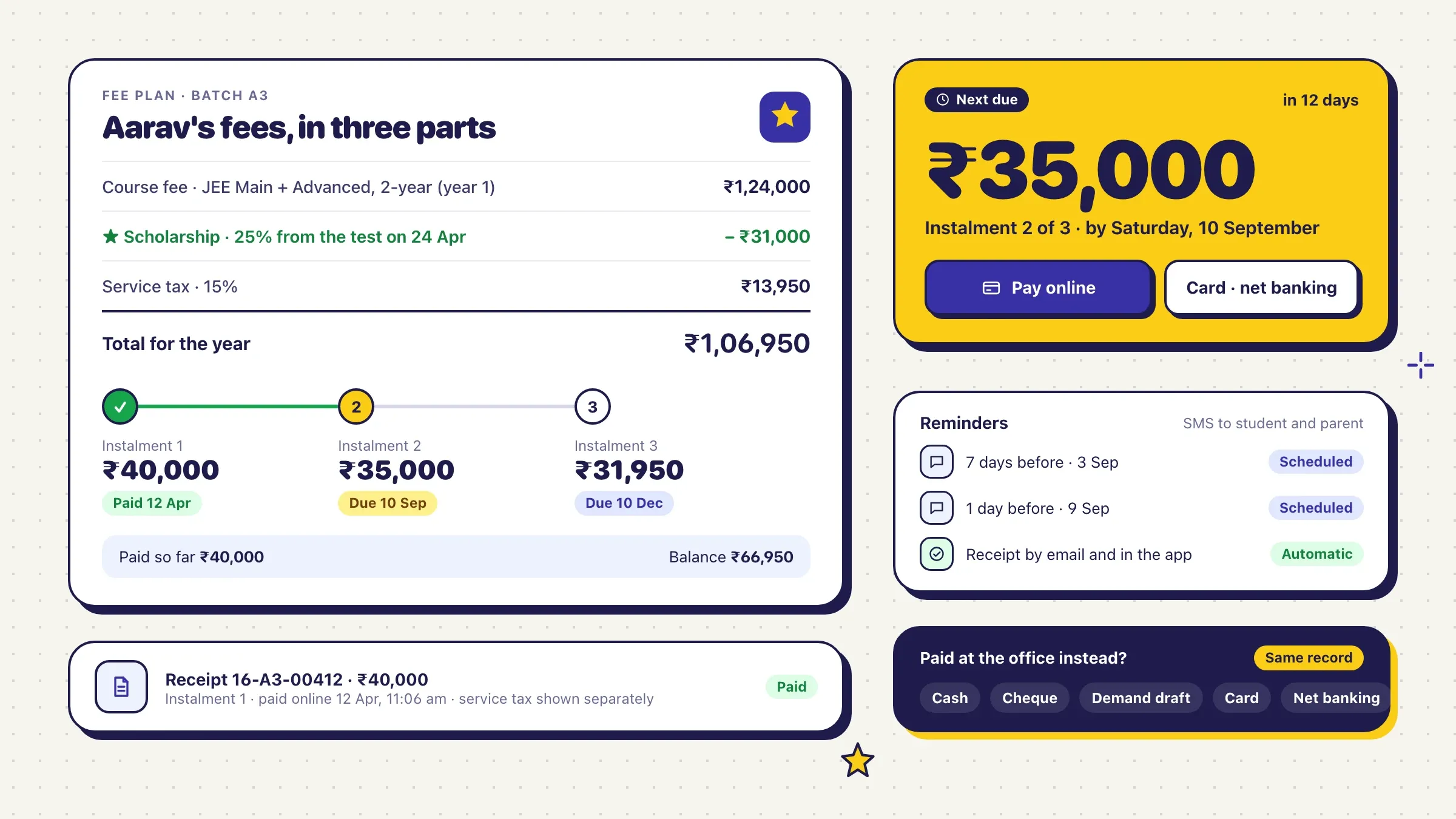 Payments in instalments, with reminders For a coaching institute in Kota, fee plans with instalments on set dates, online payment, automatic receipts and SMS reminders before each instalment falls due. Read the case study
What travel booking software does
Travel booking software lets travellers choose a tour and a departure, book and pay online, and then keeps everything about that booking in one place. Your team sees every seat, every payment and every traveller’s details, and the documents each departure needs come out of the same system.
For a tour operator, the hard part isn’t the booking button. It is everything around it: a seat count that has to be right across your website, your agents and your office; deposits and balances on different dates; rooms that depend on who is travelling with whom; and a ground team that needs names, passports and diets in good time to confirm hotels.
We build that as one system, around how your tours are actually sold. It suits small-group tours, fixed departures, pilgrimages, school and college trips, adventure treks and holiday packages: any trip with limited places, a price per person and money that arrives in stages.
Departures and live seats
Travellers compare departures, not just tours. Once they like a tour, the question is which date, and how full it is. So every tour page lists its upcoming departures with the price, the seats left and whether the departure has enough travellers to run.
Each departure has one seat count. When a traveller books online, an agent books through the portal or your team takes a phone booking, the same count goes down at the same moment, so the last seat can’t be sold twice. A seat is held while the traveller pays and released if they don’t finish.
Departures are marked as confirmed once they reach the minimum number of travellers you need to run them, which is often what turns a hesitant traveller into a booking. Departures that are still short show how many more travellers they need, so your sales team knows where to push. A full departure offers a waitlist, and if a seat opens, the next person on it is told straight away.
Deposits, balances and cancellations
Most tours are paid in stages: a deposit to secure the seat and the balance a set time before departure. The system follows your booking terms. The deposit is taken online at booking; the balance date is worked out from the departure date; reminders go out as it approaches; and travellers pay from a link on their phone.
Your team sees who has paid, who is due and who is late, without opening a spreadsheet. Late balances are flagged before they become a problem, and your terms decide what happens next.
Payment plans can be more flexible where your terms allow. A pilgrimage or a long trip can be split into several instalments, each with its own date and reminder. Travellers in India can pay a reminder by UPI in a few taps, and a family booking can be paid by more than one person, with each payment recorded against the same booking.
Cancellations follow the same terms. The system works out what is refundable on the day a traveller cancels, records the reason and returns the money through the same payment provider. Changes such as a different room or an extra night are priced and charged in the same way.
Prices, currencies and taxes
Travellers want a firm price in a currency they know. Each tour can have its own price list in rupees, pounds, US dollars, euros or Australian dollars, so a traveller sees and pays a fixed amount, not a conversion that might change between the deposit and the balance.
Prices carry their own rules: early booking offers, child prices, single supplements, seasonal rates and group discounts. Payments go through providers such as Razorpay for UPI, cards and net banking in India, and Stripe or PayPal for cards abroad.
Invoices follow the tax rules that apply to you, such as GST in India or VAT in the UK and Europe, set up with your accountant. Indian operators selling overseas tour packages must also collect TCS, and the invoice works it out and shows it.
Rooms, solo travellers and extras
Rooms decide more bookings than most operators expect. Travellers choose a twin, a double or a single room, and the single supplement is added where it applies. Solo travellers are a large share of many small-group tours, and the cost of a room alone is often what decides whether they book.
Solo travellers can choose to share instead. They are matched with another solo traveller on the same departure, and the rooming list updates on its own. Extra nights before or after the tour, airport transfers, optional excursions and travel insurance can be added at booking or later, each with its own price and limit.
The traveller’s account
Each traveller gets a secure account for everything the trip needs. Before departure they add their passport details, with a check that the passport is valid long enough for the trip; follow the visa guidance and record the visa once it is granted; and add insurance, emergency contacts, dietary needs, medical notes and room preferences.
The account shows each traveller what is still missing, and reminders go out until it is done. Your team sees the same list for the whole departure, so a missing visa is spotted weeks ahead, not at the airport. The final itinerary and joining instructions arrive in the same place, so nothing is chased by email.
Selling through agents
Many operators sell through partner travel agents in other cities and countries. Agents get their own portal: they check live availability, book seats for their clients at their agreed net rates, see the commission on every booking and download itineraries and invoices under their own name.
Agents answer their own questions about dates and seats, and their bookings use the same live seat counts as everyone else’s. You decide which agents see which tours and at what rates, and every agent booking shows who made it. Commission statements are ready at the end of each month, so paying agents no longer means adding up emails.
Paperwork for the ground team
The ground team needs the same facts as the office, sooner. For each departure the system produces rooming lists for every hotel, passenger manifests for guides and drivers, and a summary of diets and medical notes.
These update as bookings change, so a late booking or a change of room reaches the hotel the same day. The ground team downloads them directly instead of rebuilding them from forwarded emails, and suppliers’ confirmations can be recorded against each departure.
What we need from you
We start with a season of your bookings. Your tours and price lists, your booking terms, a copy of your current seat spreadsheet and the documents you send to hotels and guides tell us how your business really runs.
We also talk to the people who use it every day: your sales team, a few partner agents, the ground team and, where possible, some past travellers. You will need accounts with the payment providers you choose, your tax details for invoices, and one person on your side who can decide on rules such as deposit amounts and cancellation terms.
Before launch we move your existing bookings across and check them against your records, so travellers and agents find their bookings waiting when they sign in.
Running it season after season
Travel runs in seasons, and so does the software. Between seasons we add new tours and pricing rules, adjust to changes from payment providers or tax rules, and build what your team asked for during the busy months.
We watch the system through each on-sale period and each departure month, and your team reports problems straight to the people who built it. Reports show which tours and departures sell, how early travellers book, which agents bring the most travellers and how many balances arrive late, which helps you plan the next season’s dates and prices. As sales grow, the same system takes on more departures, more agents and more currencies without starting again.
How we work with you
From the first call to running it
- Start
See how you sell today
We go through a season with your sales team, your agents and your ground team: enquiries, prices, payments, rooms and the documents each departure needs.
- Design
Design the booking and the back office
Tour pages, the booking flow, the traveller account, the agent portal and your team's view of every departure.
- Build
Build and connect
Tours, departures, pricing rules, payments and documents, connected to your website, your accounts and your email and WhatsApp.
- Move across
Bring your bookings over
Existing bookings and travellers are loaded and checked against your records, so travellers and agents find their bookings waiting.
- Launch
Open for sales
Travellers book online, and agents are invited to the portal one by one.
- Every season
Improve between seasons
New tours, new pricing rules and whatever your team asks for, added before the next season's sales.
Safe and in your control
Seats that can't be sold twice
A seat is held while the traveller pays, and the count updates for every channel at the same moment.
Card details stay with the payment provider
Cards, UPI and PayPal are handled by providers such as Stripe, Razorpay or PayPal, so your servers never hold card numbers.
Passports protected
Passport details and documents are encrypted, seen only by the staff who need them, and deleted after the tour.
Consent and data requests
Consent is recorded, and travellers can ask for a copy of their data or its deletion, under the GDPR or India's data protection law as your markets need.
Every change on record
Price changes, discounts, refunds and seat adjustments are logged with who made them and when.
Agents see only their own
Each agent sees their own clients, their own rates and their own commission, and nothing else.
Time and cost
The cost depends on how your tours are sold and run, not on how many tours you have. An operator with fixed departures and one currency needs less than one with agents, several currencies and tailor-made trips. After the first call we send a written plan and a quote.
Pricing rules
One price per departure is simplest. Room types, supplements, child prices, early booking offers and seasonal rates add rules to build and test.
Payments and currencies
Each currency, payment provider and deposit or instalment plan is set up and tested on its own.
Who sells
Direct sales are the quickest start. An agent portal with net rates and commission is a further build.
Operations
Rooming lists, manifests, supplier confirmations and guide schedules each add documents and rules.
Systems to connect
Your website, accounting software, CRM and email or WhatsApp tools each add work.
Existing bookings
Clean data moves quickly. Bookings spread across spreadsheets and inboxes take longer to bring across.
Built with
Chosen for each project, never by habit
Questions and answers
13 answered
What is travel booking software?
Travel booking software lets travellers find a tour, choose a departure, and book and pay online, while your team manages seats, payments, travellers' details and the paperwork for each departure. Built for you, it follows how your tours are actually sold and run.
Is it for tour operators or travel agencies?
It is built for businesses that run their own tours or packages: tour operators, destination companies and travel firms with fixed departures or group trips. Agencies that mainly resell flights and hotels need a different kind of system, built around suppliers' booking connections.
How do live seats stop double bookings?
Every departure has one seat count, shared by your website, your agents and your team. A seat is held while the traveller pays and taken the moment the booking is confirmed, so two people can't buy the last seat.
Can travellers pay a deposit now and the balance later?
Yes. Travellers pay a deposit when they book, and the balance falls due on the date your terms set. Reminders go out before the due date, travellers pay from a link, and your team sees who has paid, who is due and who is late.
Can we sell tours in more than one currency?
Yes. Each tour can have a price list in rupees, pounds, dollars, euros or other currencies, so travellers see a firm price in a currency they know instead of a conversion that changes.
Can travel agents book through it?
Yes. Partner agents get their own portal to check live seats, book at their agreed rates, see their commission and download itineraries and invoices. Their bookings use the same seat counts as everyone else's.
How are GST, TCS and VAT handled on tour invoices?
Invoices follow the tax rules that apply to your business, such as GST in India or VAT in the UK and Europe, set up with your accountant. Indian operators selling overseas tour packages must also collect TCS, and the invoice can work it out and show it.
Can you move our existing bookings into the new system?
Yes. We load your current season's bookings, travellers and payments before launch and check them against your records, so travellers and agents find their bookings waiting when they sign in.
How much does travel booking software cost?
It depends on your pricing rules, the currencies and payment plans you need, whether agents book through it, the documents each departure needs and the systems it connects to. After the first call we send a written plan and a quote.
How long does it take to build?
It depends on the scope. Tours, departures and online deposits for direct bookings are the quickest start; an agent portal, several currencies and operations documents take longer. We plan the launch ahead of your next season's sales.
Can the booking site work in Hindi and Gujarati?
Yes. Tour pages, the booking flow, emails and WhatsApp messages can be in English, Hindi, Gujarati or other languages, and each traveller chooses. Prices and dates show in the format their language expects.
Do you work with tour operators outside India?
Yes. FIRELIFE Ventures works with businesses worldwide from Rajkot, India, and has built a tour booking platform for a London tour operator whose travellers book from the UK, the United States, Europe and Australia.
What happens after launch?
We keep it running and improving with you: new tours and pricing rules before each season, changes when payment providers or tax rules change, and the features your team asks for as sales grow.
Tell us what you want to build
Write a few lines about the idea and who it is for. We reply with our questions, a first plan and how we would start.
Write to us