Build something new marketplace development
Bring buyers and sellers together
We build online marketplaces that bring buyers and sellers together: listings or services people can search and compare, payments split and paid out automatically, sellers checked before they sell, ratings both ways, and an admin to run it all.
- We help you win the harder side first
- Payments split and paid out automatically
- Trust built into every step
Sound familiar?
What we hear before we start
- Buyers and sellers find each other through calls, WhatsApp groups and middlemen.
- Every deal is matched by hand, by a few people with phones.
- Sellers wait weeks to be paid, and commissions are worked out in a spreadsheet.
- Nobody can tell a good seller from a bad one until something goes wrong.
- When a deal goes sour, there's no record of what was agreed.
- You have the idea for a marketplace, but not the first hundred sellers.
What changes
-
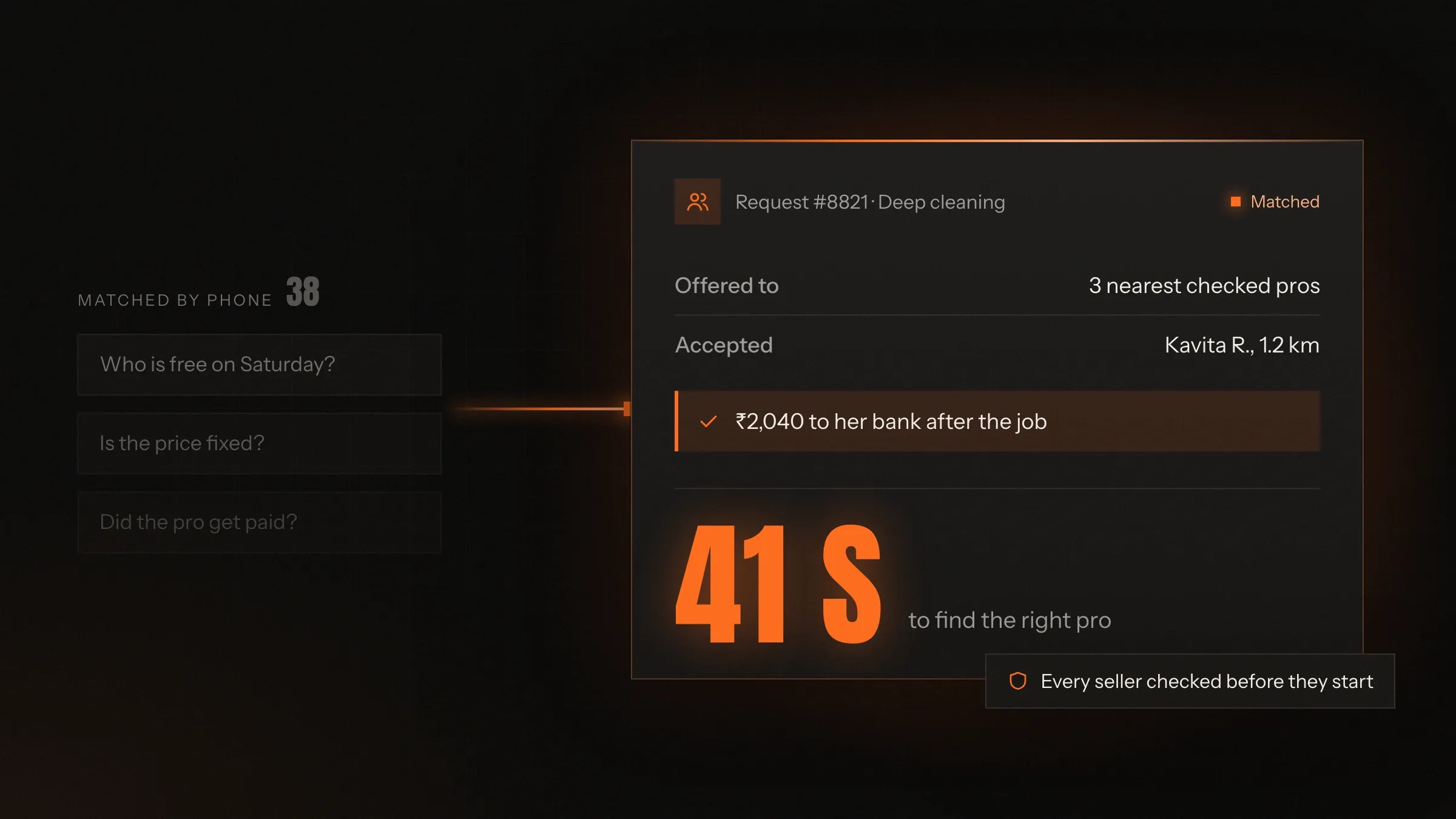
Today: Buyers ask around and wait a day for a quote.
After: Buyers search, compare and see the price before they commit.
-
Today: Requests are offered to sellers one call at a time.
After: Requests reach the right sellers at once, and the first to accept takes it.
-
Today: Sellers are paid by transfer, when someone gets round to it.
After: The platform keeps its fee and pays each seller automatically.
-
Today: Trust depends on who you happen to know.
After: Sellers are checked before their first sale, and ratings run both ways.
-
Today: Disputes are settled from memory and phone calls.
After: Every order carries its messages, photos and history, ready for a fair decision.
What it does for you
-
Listings people can search
Products, services or lots with photos, prices, filters and search by location, so buyers find the right seller quickly.
For exampleA trader filters onion lots by grade and collection centre and sees every bid so far.
-
Prices, quotes, bids or matching
Fixed prices, quotes, open bidding or automatic matching to available sellers nearby, whichever suits your market.
For exampleA plumbing visit is offered to checked pros who cover that area, highest-rated first.
-
Payments split automatically
The buyer pays once; the platform keeps its fee, holds the money until the work is done if needed, and pays each seller to their bank.
For exampleA cleaner is paid automatically when the job is marked complete.
-
Seller sign-up and checks
Sign-up, identity and bank checks, licences or GST details, and your team's approval before the first sale.
For exampleA new electrician uploads a trade licence and waits for approval before seeing any jobs.
-
Ratings, reviews and disputes
Ratings both ways, reviews only from real orders, and a dispute desk with the order's photos and messages.
For exampleA disputed job is settled from the before-and-after photos taken in the app.
-
Private contact
Masked calls and in-app chat, so buyers and sellers can talk about an order without sharing their numbers.
For exampleA customer calls the pro about the gate code; neither sees the other's number.
-
An admin to run the market
Approvals, categories, fees, payouts, refunds, disputes and reports, all in one place.
For exampleThe team switches on a new city and its categories from the admin, without a release.
-
Apps for each side
A buyer app, a seller app and a web admin, each built for the person who uses it.
For exampleFarmers list produce by voice in Marathi while traders bid from their own app.
How it works
-
Sellers join
They sign up, pass your checks and list what they offer, with their area and availability.
-
Buyers search
By need, location, price and rating, on the app or the website.
-
They agree a deal
At a fixed price, by quote, by bid or by an automatic match.
-
The buyer pays the platform
The payment is confirmed and, where the rules say so, held until the order or job is done.
-
The seller delivers
With tracking, a checklist or photos, depending on what is being sold.
-
Everyone is paid and rated
The platform keeps its fee, the seller is paid out, and both sides rate each other.
Where we've built it
3 from our portfolio
-
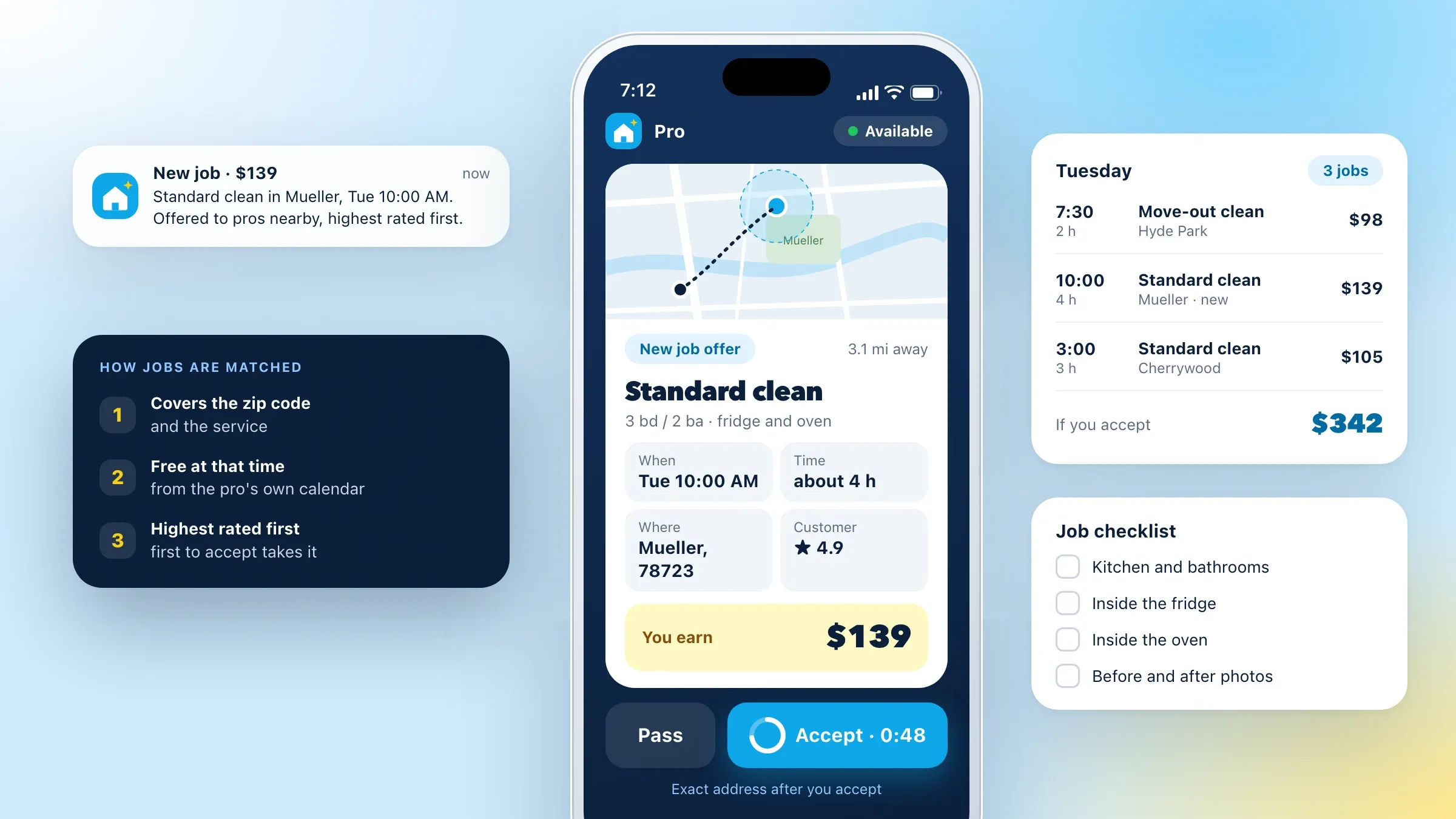 Home services, booked and paid in the app For a home services company in Austin, a marketplace where homeowners book checked cleaners, plumbers and electricians, and pros are paid automatically after every job. Read the case study
-
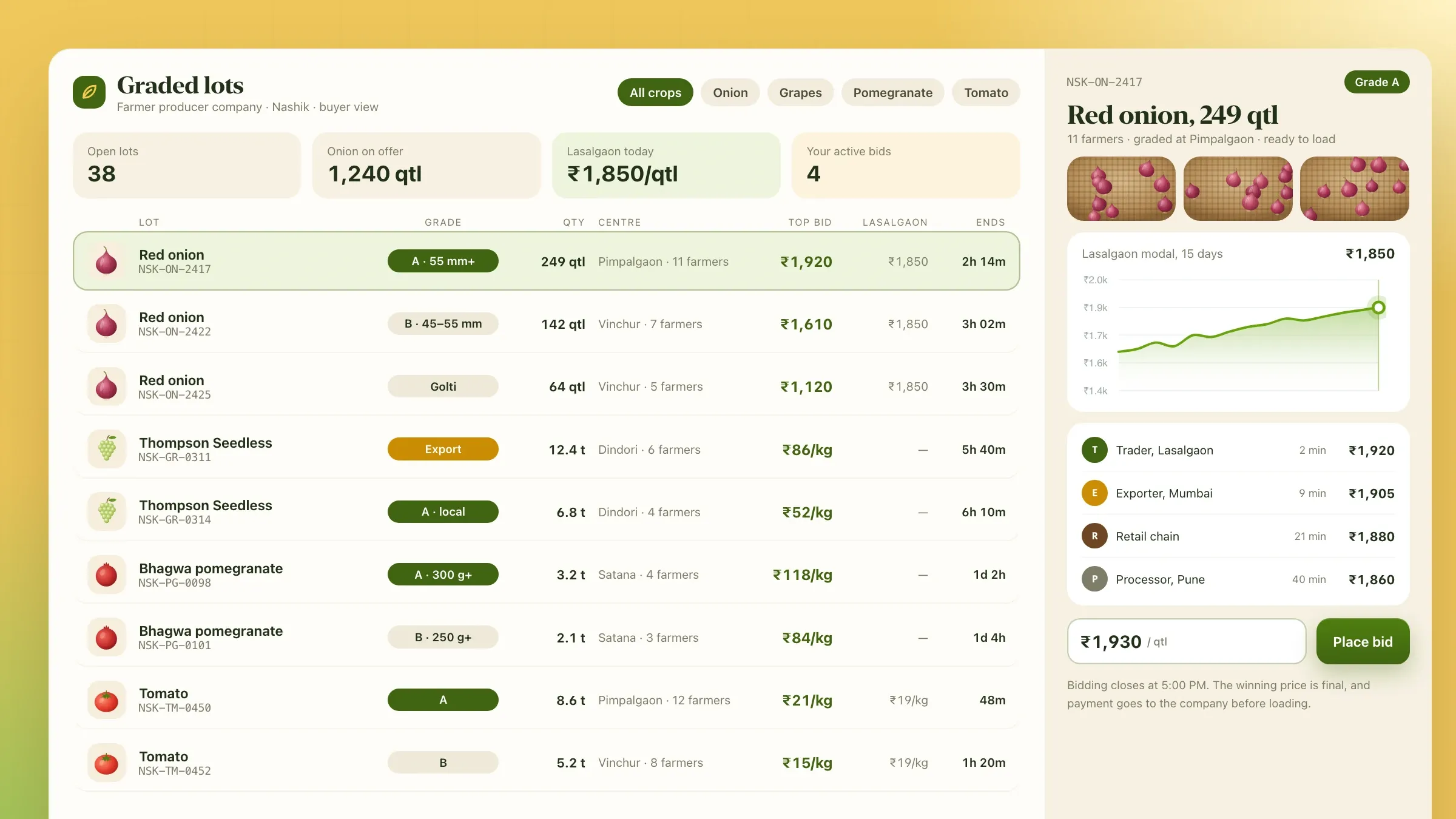 Farmers selling straight to buyers For a farmer producer company in Nashik, an app where farmers list produce by voice in Marathi, buyers bid on graded lots, and farmers are paid to their own bank accounts. Read the case study
-
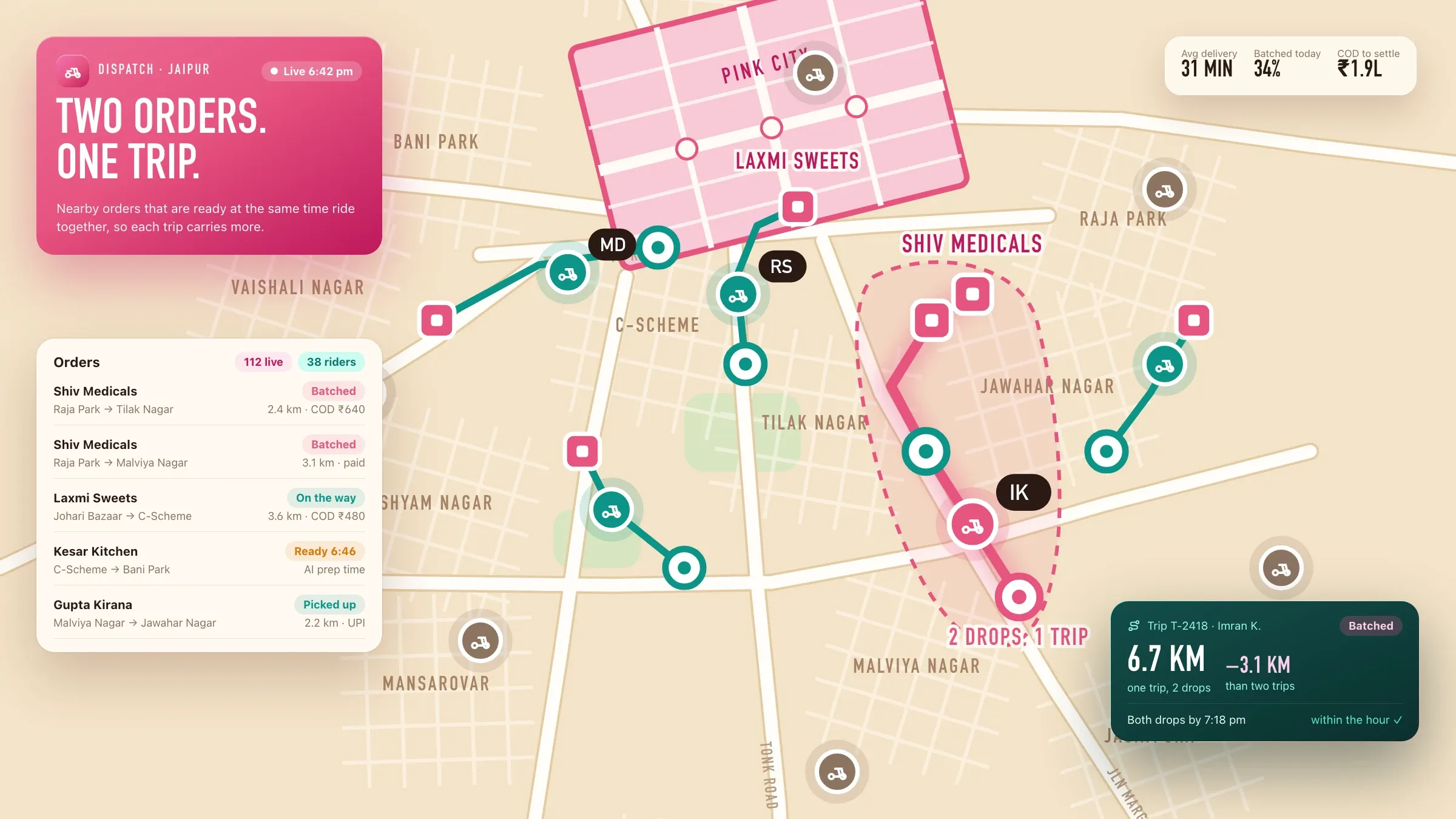 Shops, riders and customers on one network For a Jaipur startup we back, we built the merchant and rider apps and the dispatch engine, and connected it to ONDC so sellers on India's open network can book deliveries. Meet the startup
What a marketplace is, and what makes it work
A marketplace is software that lets many sellers trade with many buyers, and takes a fee for making it easy and safe. The sellers might be shops, farmers, cleaners, tutors or wholesalers; the buyers might be households, traders or businesses. The platform owns neither the stock nor the work. It owns the trust and the transaction.
That makes a marketplace different from an online store. A store has one seller and one price list. A marketplace needs a way for many sellers to join and be checked, a way for buyers to compare them, a way to agree a deal, and a way to split every payment between the platform and the seller.
A marketplace works when a buyer who arrives finds what they need quickly, and a seller who joins gets enough work to stay. Everything we build serves those two moments.
Win one side first
Every new marketplace faces the same problem: buyers won’t come without sellers, and sellers won’t come without buyers. The answer is to win one side first, usually the side that is harder to find, and to win it by hand.
In Austin, cleaners, plumbers and electricians were signed up and checked before the launch, so every area had pros ready on the day customers could book. In Nashik, the farmer producer company’s field staff registered farmers, verified their bank accounts and helped with the first listing.
So the first version of your marketplace often includes tools for that side alone: an easy sign-up, a seller app that works on a basic phone, and an admin your team uses to onboard sellers in person. Buyers come once there is something worth finding.
How deals are made
How buyers and sellers agree a deal is the heart of your marketplace, and it differs by market. Fixed prices suit products and simple services. Upfront prices worked out from a few answers suit jobs such as cleaning, priced by bedrooms, bathrooms and extras. Quotes suit work that needs a look first. Open bids suit produce, scrap or anything sold by lot, where the price is found on the day.
Automatic matching suits requests that need someone now. A job is offered to available sellers who cover that area and service, highest-rated first, and the first to accept takes it. If nobody accepts in time, it lands on your team’s board to place by hand.
Many marketplaces use more than one: fixed prices for standard items, quotes for the rest. We design the rules with you and test them on real deals before launch.
Payments, commissions and payouts
Payments are where marketplaces most often go wrong, so we use products built for them. Abroad that usually means Stripe Connect; in India, Razorpay Route or a similar split-payment product from a payment provider.
The buyer pays once, by card, UPI or whatever your market uses. The provider splits the payment: your commission stays with the platform, and the seller’s share is paid to their bank account, at once, on a schedule, or only when the job is marked complete. Refunds, cancellations and partial payments follow rules you set.
Sellers see what they earned, what was deducted and when they will be paid. Your team sees every payment, fee and payout, matched to the order, and finance gets reports that agree with the bank.
Trust: checks, ratings and disputes
Trust is what buyers pay a marketplace for. It starts before the first sale: identity and bank checks for every seller, plus whatever your market needs, such as a GST number, a trade licence, insurance or a background check through a specialist provider, with the seller’s consent.
During the deal, buyers and sellers talk through masked numbers or in-app chat, and the seller records what was done, with a checklist or before-and-after photos where it helps. Afterwards, both sides rate each other, and only real orders can leave a review.
When something goes wrong, your team opens the order and sees its messages, photos, prices and every status change in one place. Rules for refunds, cancellations and no-shows are written down and applied the same way for everyone.
Apps for each side, and the admin behind them
Buyers, sellers and your team each need software built for them. Buyers want to search, compare and pay in a few taps, usually on a phone, sometimes on a website they found through search. Sellers want to see new requests or orders, accept them, find the address, record the work and see what they will be paid. Your team wants to approve sellers, settle disputes and see the whole market at once.
So a marketplace is usually three products: a buyer app or website, a seller app and a web admin. Sellers often work on low-cost Android phones with patchy signal, so their app has to be light, quick and forgiving offline; in Nashik, listings and photos wait on the phone until a signal returns.
The admin is where the market is run: categories, service areas, fees, payout rules, refunds and reports. New cities and categories are switched on there, not in a new release.
Rules, tax and paperwork
A marketplace takes on duties that a single store does not. In India, platforms collect TCS under GST and deduct TDS under income tax on sellers’ sales, and the e-commerce rules expect the seller’s details and a grievance officer to be shown to buyers.
Elsewhere the duties differ. In the United States, platforms send year-end tax forms to the people they pay, as the Austin marketplace does for its pros. In the European Union, platforms report sellers’ income to the tax authorities.
We build the records and reports these rules need into the platform from the start: seller tax details, deductions on every payout, and statements sellers can download. Your accountant and lawyer confirm exactly what applies to your model, and the system follows their answer.
What we need from you
We need to understand your market better than anyone else does. Who are the sellers, how do they work today, and what would make them switch? Who are the buyers, and what do they find hard? We usually spend time with both before designing anything.
We also need your rules: your commission, when sellers are paid, what checks a seller must pass, how disputes are decided, and what happens when someone cancels. And the accounts that stay in your name: the payment provider, which checks your business before it pays out, any check or messaging providers, the app store accounts and the domain.
Most of all, we need someone on your side who runs the market day to day and can bring the first sellers on board.
How we measure whether it works
A marketplace is healthy when requests turn into deals quickly, and people on both sides come back. Before launch we agree a few measures: how many buyer requests or searches end in a deal, how long a match takes, how many sellers stay active each month, how many buyers return, and how much the platform earns per deal after payment fees.
We read them by city and category, because a marketplace grows one area at a time. They show where to act: a category with buyers but too few sellers, a city where matches take too long, or a step in sign-up where sellers give up.
After launch: growing the market
A marketplace grows by adding sellers, categories and places where it already works. We run it with you: new categories and cities switched on from the admin, search and matching tuned on real data, new pricing or payout rules as your model develops, and new apps or features when one side needs them.
Each month we look at the measures together and pick the next change. Often the most useful work is the least visible: a shorter sign-up for sellers, a better first search result for buyers, or a payout that arrives a day sooner.
How we work with you
From the first call to running it
- Start
Decide who comes first
We map both sides of your market, decide which side to win first, and agree what the first version must do.
- Design
Design each side's journey
The buyer's journey, the seller's journey and the admin, tried out with real buyers and sellers.
- Build
Build the core
Listings, matching, payments and payouts, seller checks, ratings and the admin, tested with real money in small amounts.
- Pilot
Open small
One city, one category or one group of sellers first, with sellers on board before buyers arrive.
- Every month
Grow the market
New categories, cities and features, guided by what buyers search for and don't find.
Safe and in your control
Money handled by a regulated provider
Buyer payments go through a payment provider that splits and pays them out, so sellers' money doesn't pass through your own bank account.
Sellers checked before they sell
Identity, bank account, and any licence or GST details your market needs, checked before the first order.
Numbers kept private
Calls and messages between buyers and sellers go through masked numbers or in-app chat.
Rules applied the same for everyone
Cancellation, refund and no-show rules are applied automatically, not case by case.
A record for every dispute
Each order keeps its messages, photos, prices and status changes, so disputes are decided on facts.
Each person sees their own
Sellers see their own orders and earnings, buyers their own, and your team what its role needs.
Time and cost
The cost depends on how your market works, not on a package. A marketplace with fixed prices and one website costs far less than one with bidding, apps for both sides, payouts and dispatch. Most start with the smallest version that lets real buyers and sellers trade, then grow. After the first call we send a written plan and a quote.
How deals are made
Fixed prices are simplest. Quotes, bids and automatic matching each add rules and testing.
Apps and websites
A buyer website, a buyer app, a seller app and the admin are each designed for their own user.
Payments and payouts
Split payments, held funds, refunds, payouts and tax reports for sellers, in each country you serve.
Seller checks
Identity, bank, licence and background checks through specialist providers each add a connection.
Location and logistics
Maps, service areas, delivery or dispatch bring their own work.
Running costs
Hosting, gateway fees, maps, messages and check providers grow with your market.
Built with
Chosen for each project, never by habit
Questions and answers
12 answered
What is marketplace development?
Marketplace development is building a platform where many sellers offer products or services to many buyers: listings and search, a way to agree a deal, payments split between the platform and the seller, checks and ratings for trust, and an admin to run it.
What kinds of marketplace do you build?
Product marketplaces with many sellers, service marketplaces where customers book providers, B2B and trading platforms with quotes or bids, and rental or booking marketplaces. Our portfolio includes home services in Austin and a farm-to-buyer trading app in Nashik.
How do marketplace payments and payouts work?
The buyer pays the platform through a payment provider, which splits the payment: your fee stays with you and the seller's share goes to their bank account, at once or when the order is complete. We use products built for this, such as Stripe Connect and Razorpay Route.
How do we get the first sellers and buyers?
Win the harder side first, usually sellers, before buyers arrive. In Austin, pros were signed up and checked before launch so every area had someone to book; in Nashik, field staff registered farmers and helped with their first listing.
How much does it cost to build a marketplace?
It depends on how deals are made, which apps and websites each side needs, payments and payouts, seller checks, maps or delivery, and the countries you serve. We send a written quote after the first call, starting from the smallest version that lets real people trade.
How long does it take to build a marketplace?
A focused first version, one category with fixed prices, launches sooner than a full platform. Apps for both sides, payouts and checks take longer: the Austin marketplace took six months, including both apps, pricing, matching, pro checks, payments and the dispatch board.
Should we use ready-made marketplace software or build our own?
Ready-made software suits a standard product marketplace that wants to test demand quickly. Build your own when the way deals happen is your edge: bidding on graded lots, upfront prices by job, matching by location, or checks your market needs.
How do you make a marketplace trustworthy?
Sellers are checked before their first sale, buyers pay through the platform, ratings run both ways and only real orders can be reviewed. Contact goes through masked numbers, and every order keeps its history, so disputes are decided on facts.
Which taxes and rules apply to a marketplace in India?
Marketplaces in India collect TCS under GST and deduct TDS under income tax on sellers' sales, and the e-commerce rules expect seller details and a grievance officer to be shown to buyers. We build these into the platform; your accountant and lawyer confirm what applies to your model.
Can the marketplace work in Hindi, Gujarati or other languages?
Yes. Each side can use its own language: in Nashik, farmers list produce by voice in Marathi while buyers use their own app. We build in English, Hindi, Gujarati and other languages, tested with real users.
Do you build marketplaces for businesses outside India?
Yes. FIRELIFE Ventures works with small and mid-size businesses worldwide from Rajkot, India, on India time. Our marketplace work includes a home services company in Austin, with payouts and year-end tax forms for pros.
What happens after the marketplace launches?
We grow it with you: new categories and cities, better search and matching from real data, new payout and pricing rules, and a monthly look at how many requests are matched, how fast, and how many buyers and sellers come back.
Tell us what you want to build
Write a few lines about the idea and who it is for. We reply with our questions, a first plan and how we would start.
Write to us