Build something new delivery app development
Run deliveries across your city
We build delivery apps for businesses that deliver within a city: ordering from an app, WhatsApp or your online store, a dispatch engine that gives each order to the right rider, a rider app with proof of delivery, and live tracking from pickup to door.
- We start with how you deliver today
- A rider app built for low-cost phones
- English, Hindi, Gujarati and more
Sound familiar?
What we hear before we start
- Orders arrive on WhatsApp, by phone and at the counter, and someone writes them on a pad.
- Riders take one order per trip, even when two addresses are on the same street.
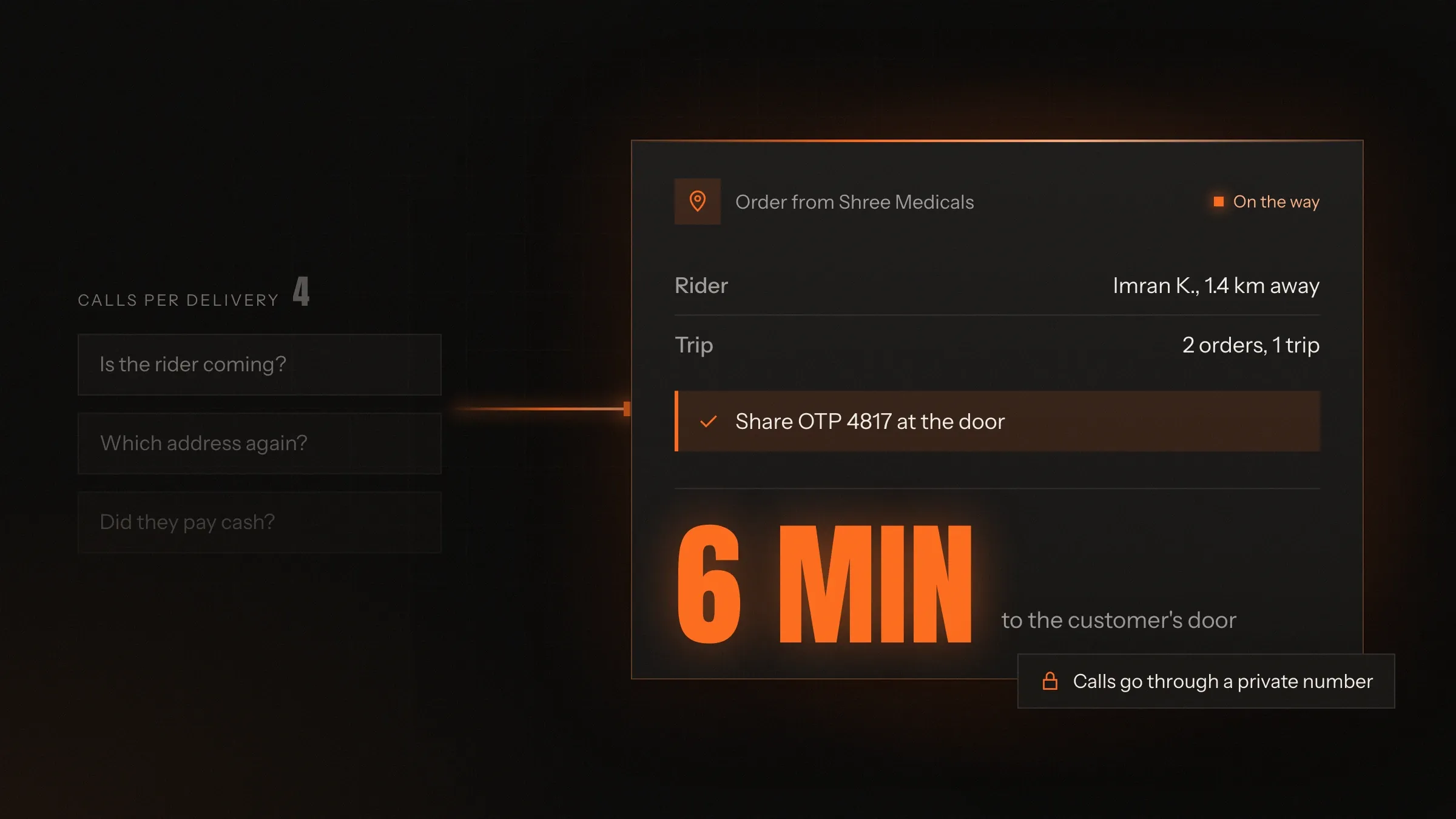
- Customers ring to ask where their order is, and nobody can say.
- Cash collected at the door never quite matches the orders at closing time.
- You pay an aggregator's commission on orders from customers who already know you.
What changes
-
Today: Orders come in on WhatsApp, calls and a pad by the till.
After: Every order lands in one queue, from your app, WhatsApp or your online store.
-
Today: Each rider carries one order per trip.
After: Nearby orders that are ready at the same time go out in one trip.
-
Today: Customers call to ask where their order is.
After: Customers follow the rider on a map, with a message at each step.
-
Today: Proof of delivery is the rider's word.
After: The customer's OTP or a photo closes each delivery at the door.
-
Today: Cash is counted against a notebook at closing time.
After: Each rider's cash and UPI collections are matched to their orders every evening.
What it does for you
-
Take orders from anywhere
Your app, your website, WhatsApp, the phone or your online store, all into one order queue.
For exampleA pharmacy sends the pickup and drop details on WhatsApp, and a rider is assigned without anyone opening an app.
-
Give each order the right rider
Orders go to a free rider nearby, and orders that share a route are grouped into one trip.
For exampleTwo orders from the same market for the same colony leave together on one bike.
-
Time pickups to the kitchen
The engine predicts when an order will actually be ready, so riders arrive as it is packed rather than waiting at the counter.
For exampleA restaurant order is still cooking. The rider is timed to arrive as it comes out of the kitchen.
-
Track every order live
Customers follow the rider on a map, with a message at each step: accepted, picked up, on the way, delivered.
For exampleA customer opens the link from WhatsApp and sees the rider two streets away.
-
Prove every delivery
An OTP from the customer, a photo or a signature, saved on the phone even where the signal drops.
For exampleA rider enters the customer's OTP at the door, and the order closes on the dispatch screen.
-
Settle cash and UPI daily
Riders record cash and UPI collected at the door, and every collection is matched to its order at the end of the day.
For exampleAt closing, each rider's collections are checked against their orders, and any gap is shown order by order.
-
Set zones, slots and prices
Delivery areas drawn on the map, prices by distance, and instant, same-day or scheduled delivery.
For exampleA customer just outside the instant zone is offered a slot the next morning instead of a refusal.
How it works
-
An order comes in
From your app, website, WhatsApp, a shop's booking or your online store.
-
It is placed on the map
The address is pinned, checked against your delivery zones and priced before it is confirmed.
-
A rider is chosen
The engine picks a free rider nearby and groups orders that share a route.
-
Picked up and on the way
The rider confirms the pickup, and the customer receives a tracking link.
-
Delivered with proof
An OTP, photo or signature closes the order, and any cash or UPI payment is recorded.
-
Settled the same day
Collections are matched to orders, and each rider's trips are counted for payouts.
Where we've built it
3 from our portfolio
-
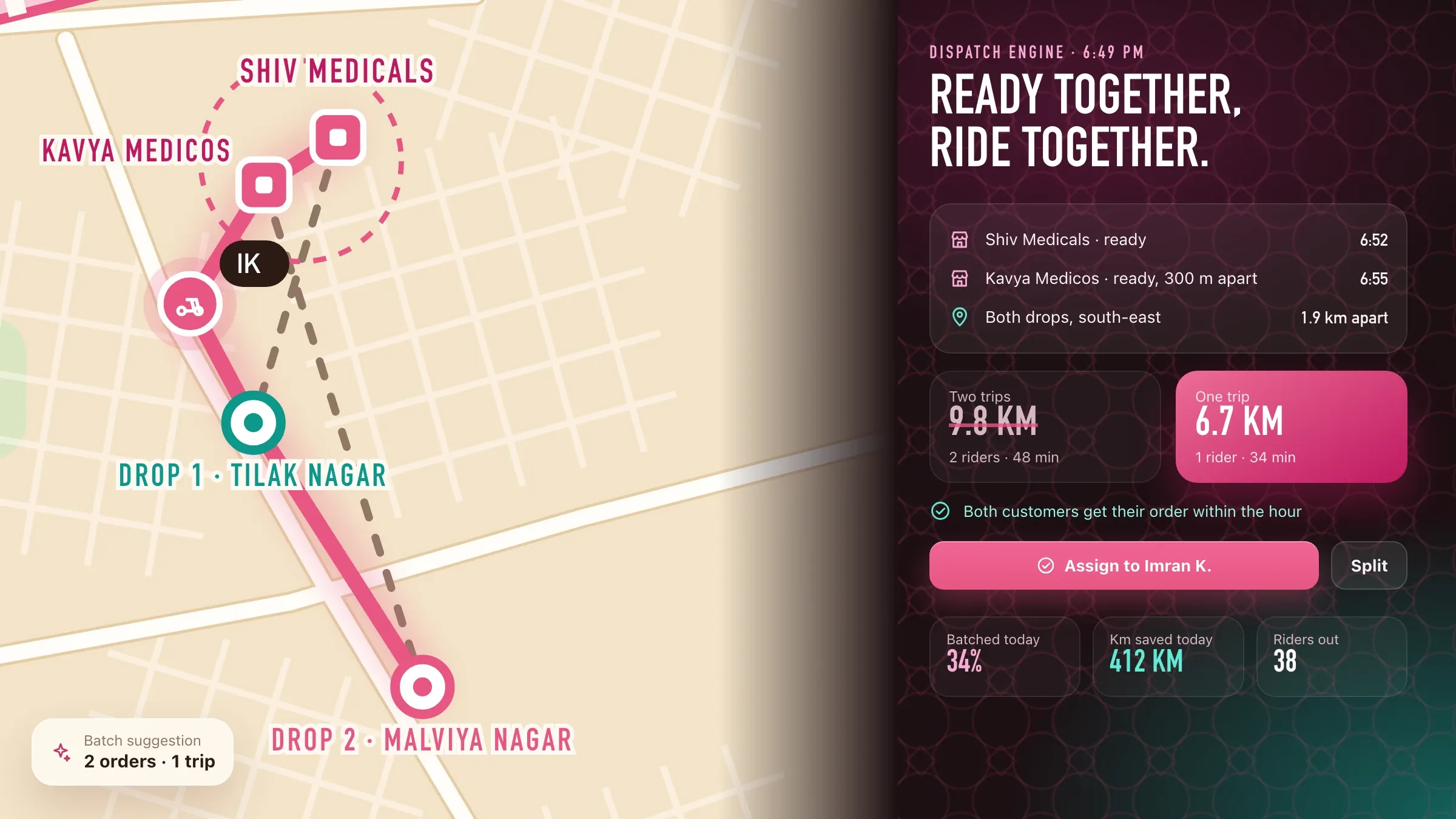 Two orders, one trip For a delivery startup we back in Jaipur, we built the dispatch engine that batches nearby orders, the rider and merchant apps, WhatsApp booking, live tracking and the link to ONDC. Meet the startup
-
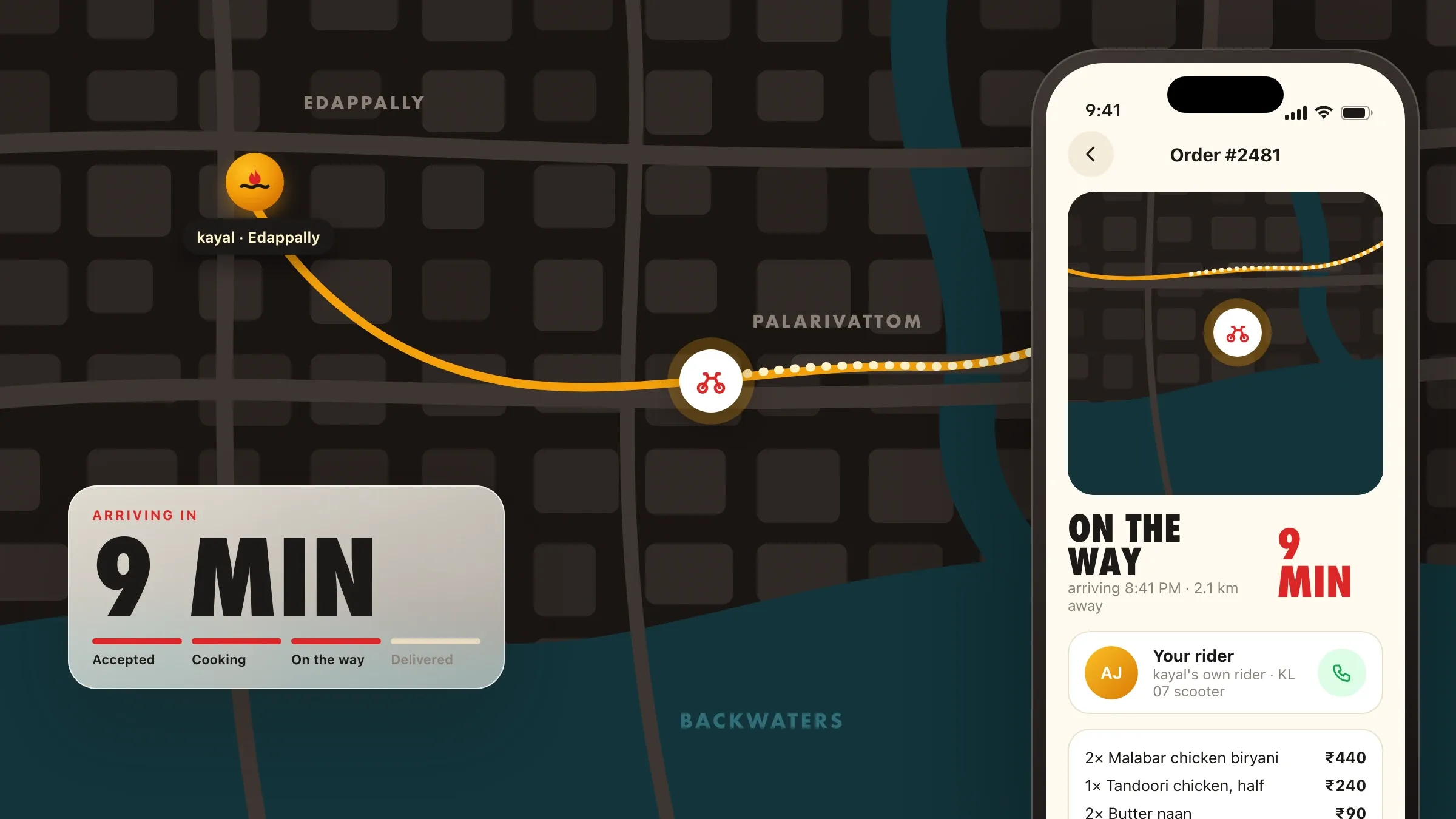 From the kitchen to the door For a restaurant chain in Kochi, we built ordering on web and mobile, a rider app that shares its location while delivering, and cash on delivery settled against each rider at the end of the shift. Read the case study
-
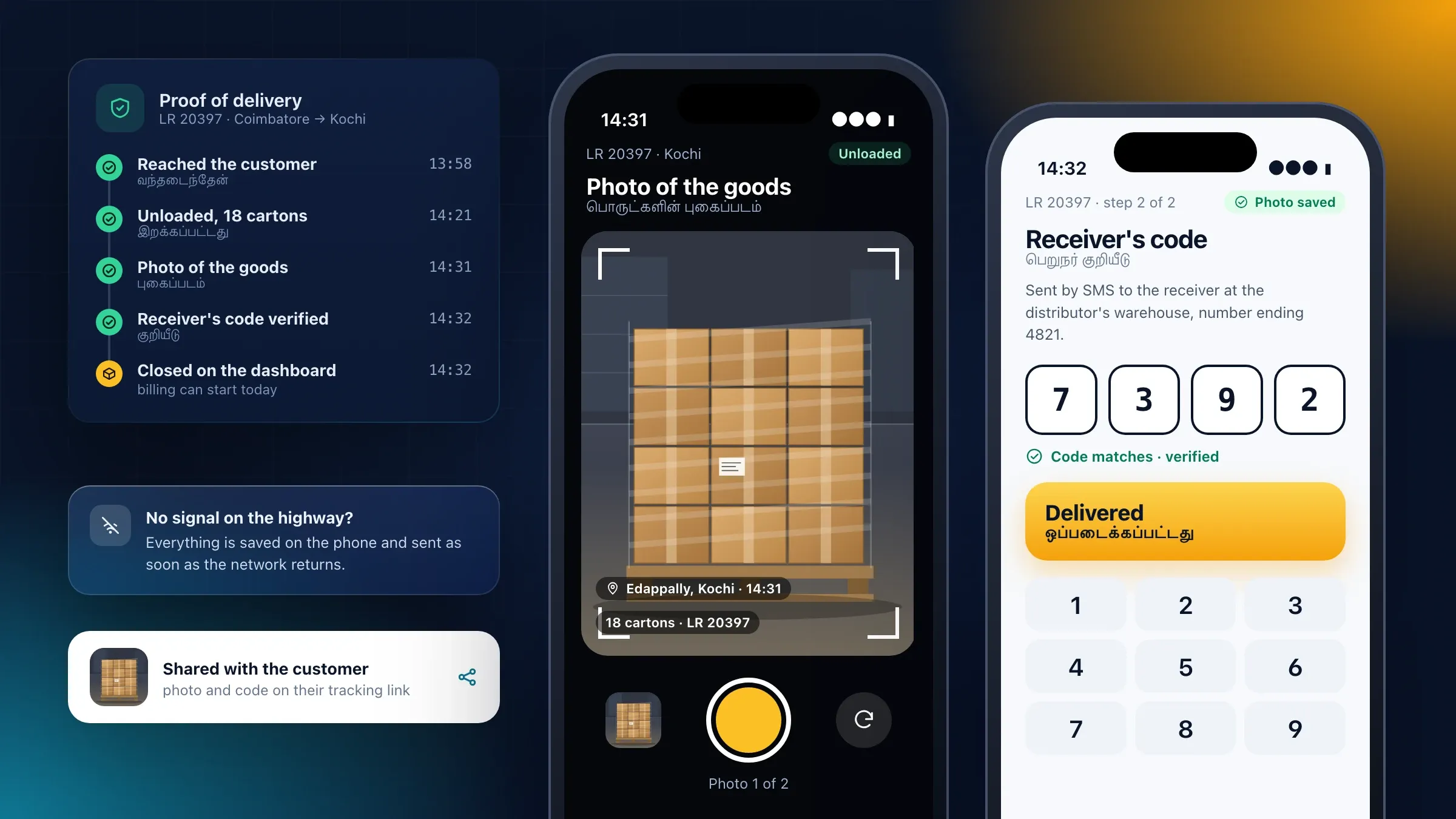 Proof of delivery, even without signal For a transport company in Coimbatore, drivers close each delivery with a photo and the receiver's signature or one-time code, saved on the phone until the network returns. Read the case study
What a delivery app is
A delivery app is the software that runs your deliveries from the moment an order arrives to the moment it is handed over. It is usually four parts working together: ordering for customers, a merchant or outlet view, a rider app and a dispatch screen for your team.
Ordering can be your own app, your website, WhatsApp or your online store. The merchant view is where a shop or an outlet sees its orders and marks them ready. The rider app tells each rider what to pick up, where to take it and how to close the delivery. The dispatch screen shows every order and every rider on one map, so the team steps in only when something needs a person.
What makes it work is not any one screen but the rules between them: which rider takes which order, when to send them, what happens when an address is wrong, and how cash collected at the door gets back to the right account.
Who it pays off for first
It pays off first for businesses that already deliver every day and feel the strain: pharmacies, grocery and sweet shops, restaurants and cloud kitchens, bakeries, distributors delivering to retailers, and startups that deliver for other businesses.
The signs are familiar. Orders are written on a pad, a shop boy closes the counter to deliver, riders carry one order at a time, and customers call to ask where their order is. For restaurants there is another cost: aggregators take a commission on every order, including orders from regulars who would happily order directly. Delivery startups have a different need: they deliver for many merchants, so the merchant app, pricing and settlement matter as much as the rider app.
For a restaurant chain in Kochi, we built a branded ordering app and website, a kitchen display that gathers every channel onto one screen, and a rider app with live tracking. Each outlet delivers within its own area, so every order goes to the nearest kitchen, and regular customers order directly instead of through an aggregator.
The dispatch engine: who takes which order
The dispatch engine decides which rider takes which order, and in what order. A simple version offers each order to the nearest free rider. A stronger one plans trips.
For a delivery startup we back in Jaipur, the engine groups orders that are close together and ready at around the same time into one trip, predicts when a restaurant order will actually be ready so the rider arrives as it comes out of the kitchen, and plans for busy hours and festival peaks around Diwali and Teej so riders are where the orders will be. Every trip that carries two orders instead of one makes each delivery cheaper.
We start with rules your team already uses and add batching and prediction when there are enough orders to learn from. Dispatchers can always override the engine, and every override is a lesson for the next version of the rules.
A rider app built for the road
Riders need an app that is quick, clear and forgiving. It shows the next pickup and drop, opens navigation, and asks for only a few taps: accepted, picked up, delivered. It should run well on low-cost Android phones, because that is what most riders carry; the Jaipur rider app was built for exactly that.
At the door, the rider closes the delivery with the customer’s OTP, a photo or a signature, and records any cash or UPI payment collected. Lanes, basements and lifts often have no signal, so the app saves everything on the phone and sends it when the network returns. Riders can see their trips, collections and earnings for the day, which answers most of their questions before they reach the office.
Ordering from the app, WhatsApp or your store
Customers and shops should be able to order the way they already do. Many small businesses in India take orders on WhatsApp, so the app can accept a pickup and drop sent as a WhatsApp message and create the order without anyone opening an app.
Online stores can book a delivery for every order through a plugin or an API, and your billing software can do the same. Sellers on ONDC, India’s open network for digital commerce, can book your riders too; the Jaipur startup’s platform is connected to ONDC for that reason. Addresses are confirmed with a pin on the map, so riders stop calling for directions.
Live tracking and messages that stop the calls
Live tracking answers the question customers call about most. Once a rider picks up an order, the customer gets a link and follows the rider on a map to the door, with a message at each step: accepted, picked up, on the way, delivered.
Messages go out on WhatsApp, SMS or as app notifications, whichever the customer uses. When something goes wrong, the message matters even more: a delayed order, a wrong address or a failed attempt should reach the customer straight away with a way to fix it, rather than a rider waiting at a locked gate.
Cash, UPI and settlement
Cash on delivery is still common, and it is where money quietly goes missing. The rider app records every cash or UPI payment against its order, and at the end of the day each rider’s collections are matched to the orders they delivered.
Differences show up order by order, the same evening, instead of at a monthly count. If you deliver for other businesses, the same records drive their settlement: the Jaipur startup reconciles collections every evening and settles to each merchant’s bank account the next day. Rider payouts, by trip, distance or shift, are counted from the same trips, so nobody argues about the numbers.
Zones, slots and prices
Where you deliver and what you charge should be settings, not code. Delivery zones are drawn on the map, each outlet or hub covers its own area, and prices can follow distance, the size of the order or the time slot.
Customers choose instant delivery, same-day delivery or a scheduled slot. An address just outside the instant zone can be offered a later slot rather than refused. When you open a new area, you draw it, set its prices and assign its riders, and it is live the same day.
Rider shifts follow the same map. Each rider works a zone or a hub, the dispatch screen shows who is on shift and where, and busy hours are covered by adding riders to the zones that need them rather than to the whole city.
What we need from you, and how we measure it
We need your current orders, your delivery area and an owner on your side. Recent orders, with their addresses and times, show us where demand really is. Your area and rules, such as minimum orders, cut-off times and how cash is handled, become the settings. The owner is usually whoever runs deliveries today and can decide what the riders and counter staff need.
Before we build, we agree how success will be measured: time from order to door, orders per trip, failed deliveries, cash differences and calls asking where an order is. We watch those measures during the pilot, and the rest of the business moves over when they look right to you.
Launching one zone at a time, then improving
A delivery app is best launched where you can watch it closely. In Kochi, one outlet ran the whole system first while we tuned the kitchen display with its chefs and the rider app with its riders; every other outlet then switched in turn.
After launch we run the system with you. We tune the dispatch rules as patterns change, add zones and channels, fix what riders and customers report, and keep the apps working as phones, maps and payment providers change. The Jaipur startup is taking the same playbook to Udaipur and Jodhpur next: merchants first, a local rider team and the same dispatch engine.
How we work with you
From the first call to running it
- Start
Follow a day of deliveries
We spend time at the counter, with riders on their routes and with whoever counts the cash, and agree what the first version must do.
- Build
Build the core loop
Ordering, dispatch, the rider app and tracking come first, connected to your payment gateway and the channels you already take orders on.
- Pilot
One zone, real orders
One outlet or one part of the city runs on the new apps while we tune dispatch and the rider app with the people using them.
- Launch
Every zone, every rider
The other outlets or zones switch in turn, riders are trained as they join, and customers are invited to order directly.
- Every month
Run and improve
We review delivery times and trips with you, tune the dispatch rules, and add zones, channels and features as you grow.
Safe and in your control
Riders tracked only on shift
The rider app shares its location only while the rider is on shift, and riders can see when it is on.
Phone numbers kept private
Riders and customers can reach each other through masked numbers, so neither sees the other's real number.
Card and UPI details never stored
Online payments run through a regulated payment gateway, so card and bank details never touch your servers.
Every payment tied to an order
Each cash or UPI collection is recorded against an order and a rider, so differences are found the same day.
Each person sees their part
Merchants see their orders, riders see their trips, and a customer's link shows only that customer's order.
Nothing lost without signal
The rider app saves pickups, proofs and collections on the phone and sends them when the network returns.
Time and cost
The cost depends on how many apps you need and how clever the dispatch has to be, not on a package. Many businesses start with ordering, a simple dispatch screen and the rider app, then add batching, prediction and more channels once orders grow. After the first call we send a written plan and a quote for the first stage.
How many apps
A customer app, a merchant app, a rider app and the dispatch screen are each designed and tested on their own.
How dispatch decides
Assigning by hand is quickest to build. Automatic assignment, batching and ready-time prediction take more data and more testing.
Order channels and connections
WhatsApp, an online store, your billing software, a payment gateway or ONDC each add an integration.
Languages
Each language in the customer and rider apps is written and tested with real users.
Running costs
Maps, WhatsApp and SMS messages, notifications and hosting grow with the number of orders each month.
Built with
Chosen for each project, never by habit
Questions and answers
14 answered
What is a delivery app?
A delivery app is the software that runs deliveries from order to door: a way for customers or shops to place orders, a dispatch system that assigns riders, a rider app for pickups and proof of delivery, and live tracking for the customer.
Which apps does a delivery business need?
Usually four parts: ordering for customers (an app, website or WhatsApp), a merchant or outlet app if you deliver for others or run several outlets, a rider app, and a dispatch screen for your team. Small operations can start with fewer and add the rest later.
Should we build our own delivery app or stay on an aggregator?
Your own app lets regular customers order directly, without a commission on every order, and keeps the customer relationship with you. Many restaurants and shops keep aggregators for new customers and move their regulars to their own app.
How does the app decide which rider takes an order?
It looks at which riders are free and nearby, where the order is going and when it will be ready, then picks the rider who can deliver it soonest. Orders that share a route can be grouped into one trip.
What is order batching?
Batching means grouping orders that are close together and ready at around the same time into one rider trip. Riders wait less, each trip carries more orders, and every delivery costs less.
Can customers or shops order on WhatsApp?
Yes. A shop or customer can send the pickup and drop details on WhatsApp and the order is created without opening an app. For a delivery startup we back in Jaipur, shops book riders this way every day.
How does cash on delivery work in the rider app?
The rider records the cash or UPI payment collected at the door against the order. At the end of the day, each rider's collections are matched to their orders, and any difference is shown order by order before money is settled.
Can the delivery app connect to ONDC?
Yes. ONDC, India's open network for digital commerce, lets sellers on other apps book your deliveries. We connected the Jaipur delivery startup's platform to ONDC so sellers across the network can book its riders.
Will the rider app work on cheap phones and poor networks?
Yes. We build rider apps to run well on low-cost Android phones, with large buttons and few screens, and they save updates on the phone when the signal drops and send them when it returns.
Can the apps work in Hindi, Gujarati or other languages?
Yes. The customer and rider apps can run in English, Hindi, Gujarati and other languages, and each language is tested with real customers and riders before launch.
How much does it cost to build a delivery app?
It depends on how many apps you need, how the dispatch decides, which channels and systems it connects to and how many languages it supports. Running costs follow your order volume. After the first call we send a written plan and a quote for the first stage.
How long does it take to build a delivery app?
Ordering, a simple dispatch screen and a rider app for one zone is the quickest start; automatic batching, several outlets and more channels take longer. We launch in stages, so real orders run on the first part while the rest is built.
Do you build delivery apps for businesses outside India?
Yes. FIRELIFE Ventures works with small and mid-size businesses worldwide, from Rajkot, India, on India time, and builds in the payment methods, languages and address formats of the country you deliver in.
What happens after the delivery app goes live?
We run it with you: we watch delivery times and trips, tune the dispatch rules, fix what riders and customers report, and add zones, channels and features as your deliveries grow.
Tell us what you want to build
Write a few lines about the idea and who it is for. We reply with our questions, a first plan and how we would start.
Write to us