Build something new fleet tracking software
Know where every truck is
We build fleet tracking software that puts every truck and consignment on one live map, warns your team before a delivery runs late, and gives drivers a simple app to close each delivery with proof.
- We start in your dispatch room
- A driver app in your drivers' language
- Your trip data stays yours
Sound familiar?
What we hear before we start
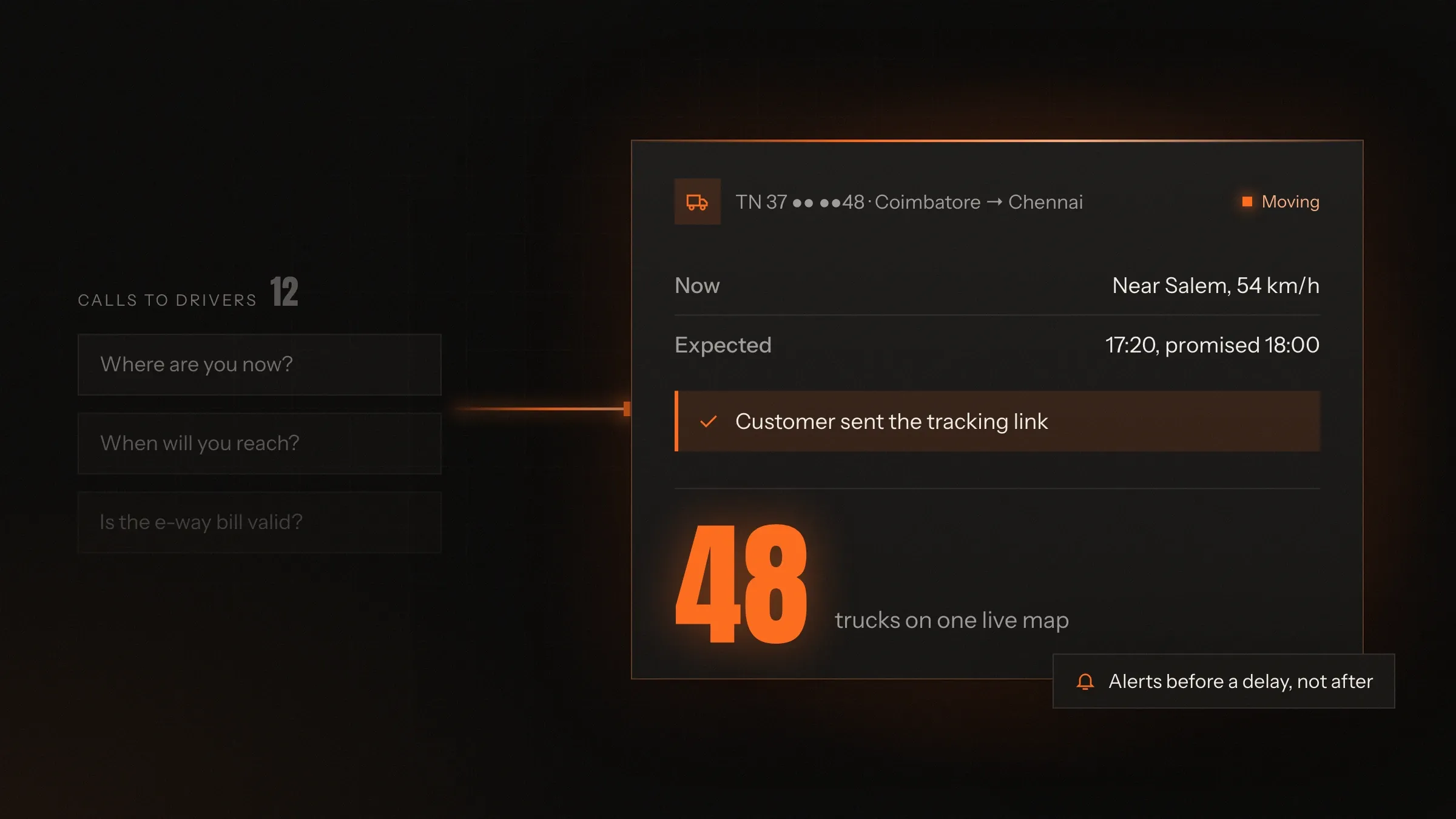
- Your dispatchers spend the day phoning drivers to ask where they are.
- Every GPS supplier has its own website, so nobody sees the whole fleet at once.
- You find out a delivery is late when the customer rings to complain.
- Proof of delivery is a paper slip that comes back days after the truck.
- An e-way bill runs out mid-journey and the truck is stopped with a penalty to pay.
What changes
-
Today: Positions come from phone calls and a different website for each GPS supplier.
After: Every truck and consignment sits on one live map, whatever device it carries.
-
Today: Delays surface when the customer calls.
After: An alert reaches the route's dispatcher when a truck falls behind its usual pace, while there is time to act.
-
Today: Delivery slips come back with the driver, days later.
After: The driver records a photo and the receiver's code, and the trip closes on the dashboard at once.
-
Today: E-way bills, lorry receipts and slips are chased in separate files.
After: Every document is attached to its consignment, and e-way bills are flagged before they expire.
-
Today: Customers ring the dispatch room for updates.
After: Customers open a tracking link and see the truck and its arrival time for themselves.
What it does for you
-
See the whole fleet live
Every vehicle's position, speed and status on one map, with filters by route, branch, customer or status.
For exampleA dispatcher filters to the Chennai route and sees which trucks are halted and for how long.
-
Catch delays early
Each route's normal timing is learned from past trips, and every live trip is compared against it.
For exampleA truck stops near Salem far longer than its usual halt. The route's dispatcher hears before the customer's slot is at risk.
-
Close deliveries on the spot
A driver app for proof of delivery: a photo, the receiver's signature or a one-time code, saved even without signal.
For exampleA driver unloads at a warehouse in Hosur, takes a photo and enters the receiver's code. The consignment closes before the truck leaves the dock.
-
Keep paperwork with the trip
Lorry receipts, invoices, e-way bills and proofs of delivery attached to the consignment they belong to.
For exampleAn e-way bill has three hours left and the truck is still far from its destination. The team is told in time to extend it.
-
Let customers track themselves
A tracking link for every consignment, sent by SMS, WhatsApp or email, that opens on any phone without an account.
For exampleA distributor opens the link from an SMS and sees the truck is on the ring road, due within the hour.
-
Keep vehicles road-ready
Renewal dates for insurance, fitness certificates, permits and PUC, with service reminders and toll records in one place.
For exampleA truck's fitness certificate is due next month. The fleet manager sees it in the weekly renewals list.
-
Bill from complete records
Delivered consignments, distance, halts and detention flow into billing, with each proof of delivery attached.
For exampleAt month end, a customer's invoice is built from the delivered consignments, with the proofs one click away.
How it works
-
The truck reports
Its GPS device, or the driver's phone during a trip, sends position, speed and ignition status.
-
The gateway reads it
A device gateway turns each supplier's data format into one stream, so mixed devices look the same.
-
The trip is matched
Positions are matched to the trip, its consignments and the geofences around hubs and customer sites.
-
It is compared with normal
The trip is checked against the route's usual timing, its usual halts and the arrival time promised.
-
The right person hears
Alerts go to the dispatcher who owns the route, and the customer's tracking link updates.
-
The trip closes with proof
The proof of delivery arrives from the driver app, and the consignment is ready for billing.
Where we've built it
3 from our portfolio
-
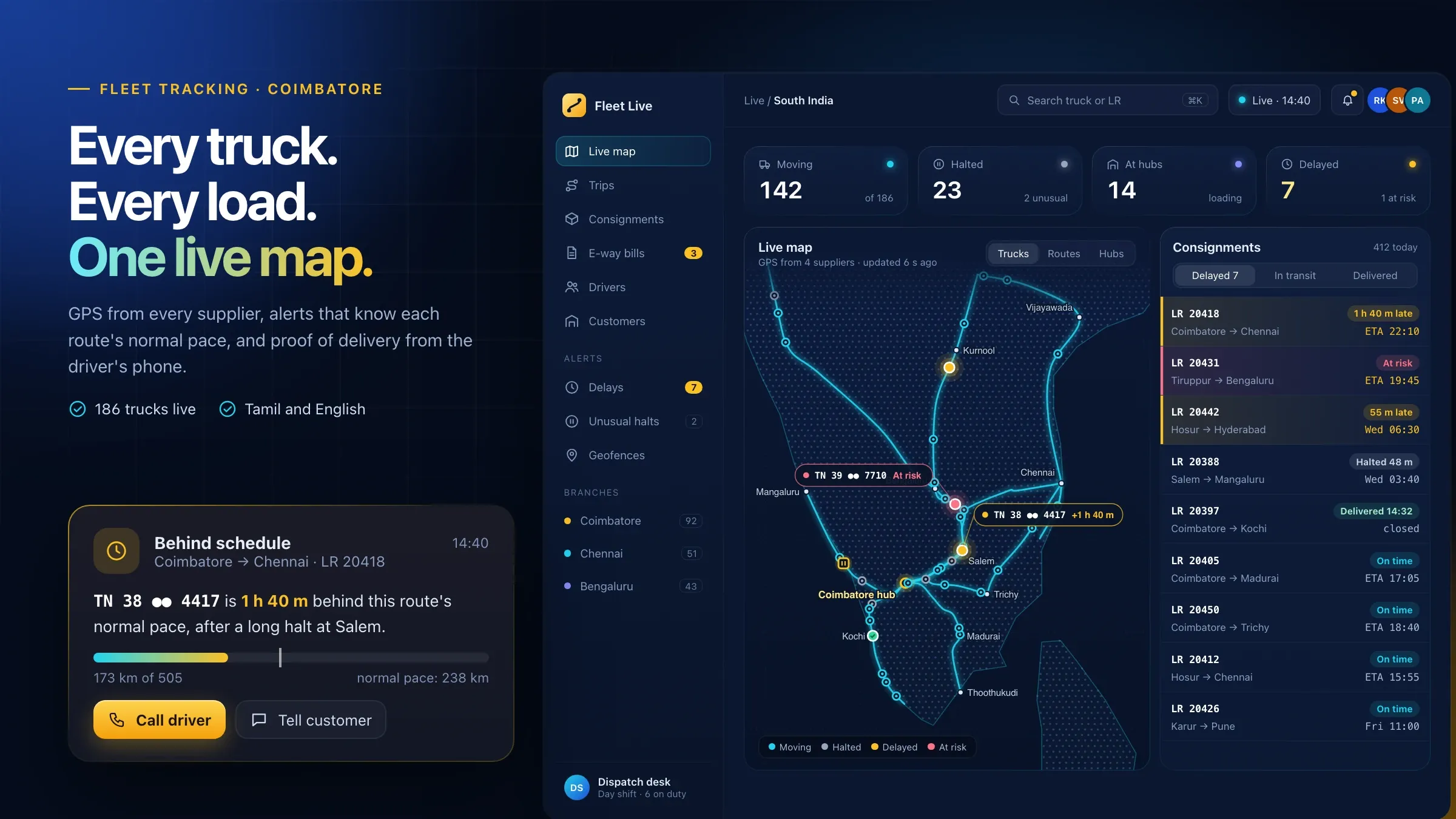 Every truck on one live map For a transport company in Coimbatore, we built a live map of every truck and consignment, delay alerts that learn each route, a driver app with proof of delivery and e-way bills watched before they expire. Read the case study
-
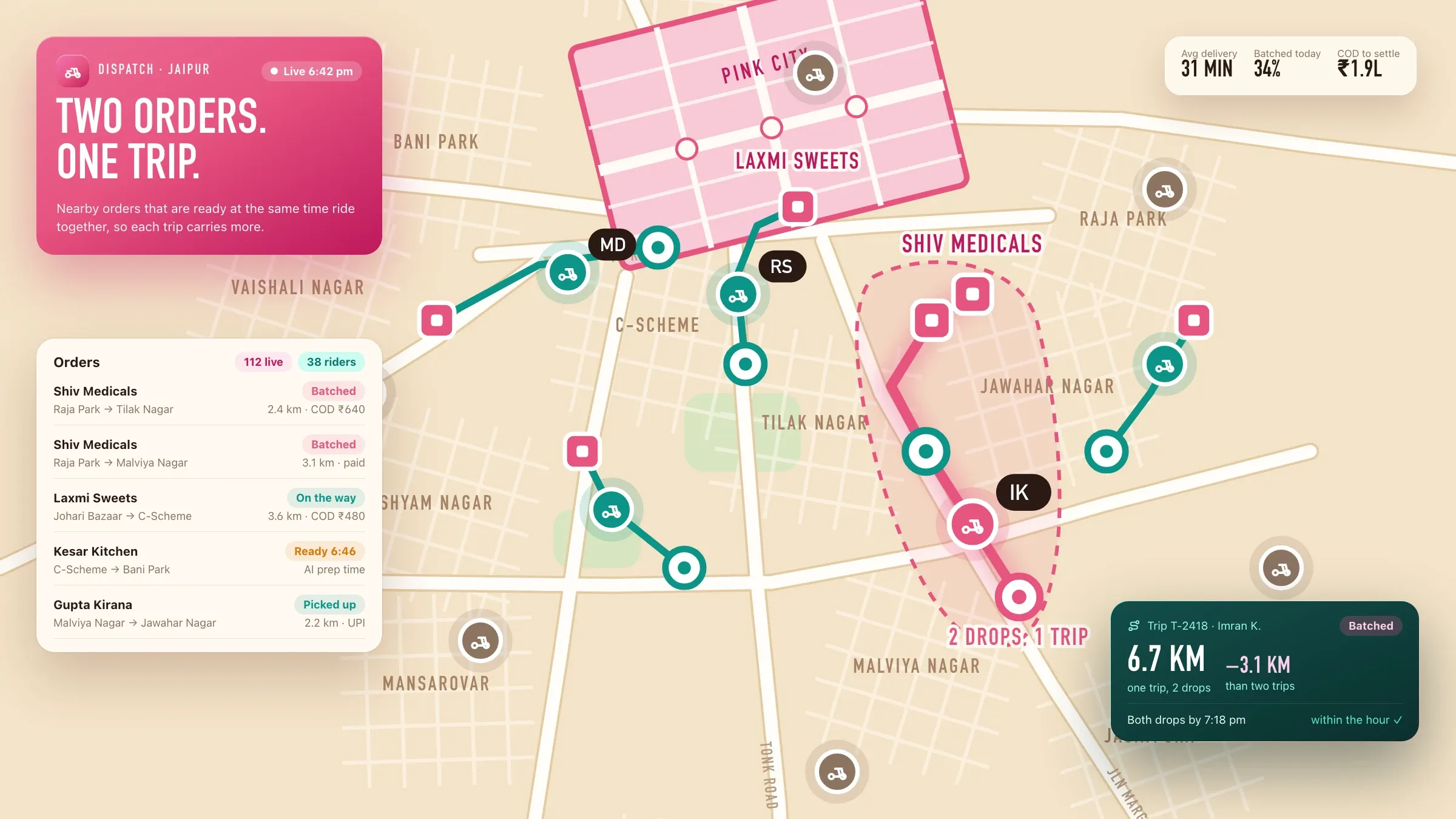 Riders on their routes across Jaipur For a delivery startup we back in Jaipur, we built the dispatch engine that groups nearby orders into one rider trip, the rider app and live tracking for customers. Meet the startup
-
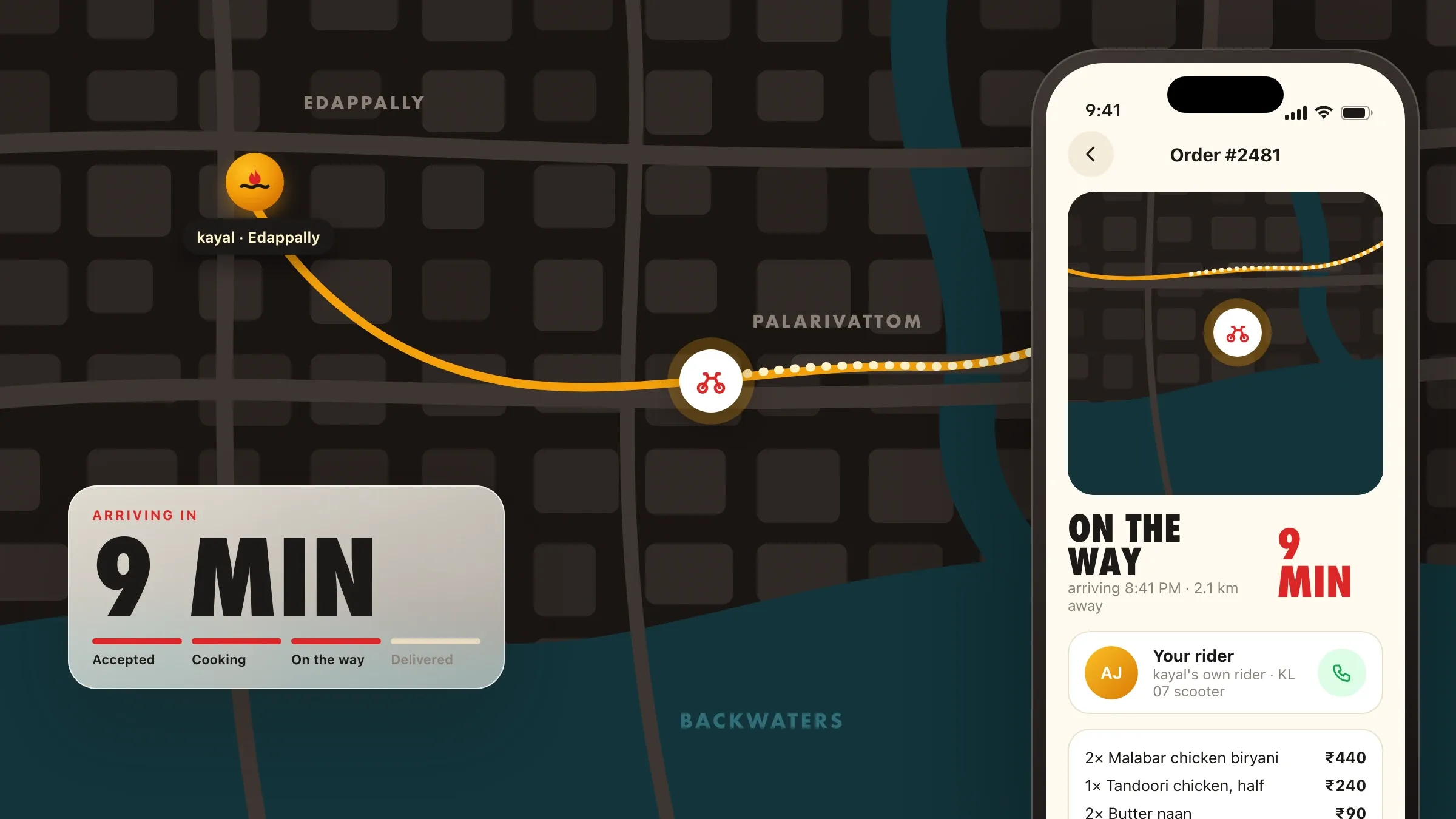 Riders followed to the door For a restaurant chain in Kochi, the chain's riders use a rider app that shares their location while delivering, and customers follow each order on a map. Read the case study
What fleet tracking software does
Fleet tracking software shows where every vehicle is, what it is carrying and whether it will arrive on time, on one screen. It reads each truck’s position from a GPS device or the driver’s phone, matches it to the trip and its consignments, and tells the right person when something needs attention.
A GPS supplier’s portal shows dots on a map. Software built around your operation knows what those dots mean: which customer is waiting, which e-way bill is about to expire, which driver has unloaded and which truck has stopped longer than it usually does. That difference is why transport companies outgrow the supplier’s website once they run more than a handful of trucks.
Most of the work is not the map itself. It is the trips, routes, documents and rules around it, shaped to how your dispatch room already works, so the team uses the software instead of working around it.
Where it pays off first
It pays off first in the dispatch room, where people spend the day on the phone. When a dispatcher can see every truck at once, the calls asking drivers for their position stop, and the calls that remain are the ones that matter.
The next gain is time. Delays that used to be found when a customer rang are flagged while there is still time to warn the customer, plan a handover or send another vehicle. Proof of delivery that came back days later on paper arrives as a photo and a code the moment the goods are unloaded, so billing starts from complete records.
For a transport company in Coimbatore, dispatchers were using five tools and their phones to answer one question: where is this consignment? We spent the first month in the dispatch room and at two hubs. The first live view then went to two dispatchers, who used it beside their old tools, and their feedback shaped the alerts before the whole team moved over.
Working with the devices you already have
Most fleets can keep the GPS devices they already have. Trucks often carry devices from several suppliers, each sending data in its own format to its own website. We build a device gateway that reads each format and turns them into one stream, so the dashboard sees every vehicle the same way.
That was the case in Coimbatore: the trucks carried devices from different suppliers, and none had to be replaced. Because the gateway is built for you rather than owned by a supplier, you can change device supplier later without changing the software.
For small fleets, or vehicles you hire by the trip, the driver’s phone can report the position during a trip instead. Market vehicles and owner-drivers can be tracked this way without fitting anything. Where you need more than position, such as fuel level, temperature for chilled loads or door sensors, the device has to support it, and we read those values alongside the location.
Delay alerts that know each route
A delay alert is only useful if it knows what normal looks like. A truck that has stopped for an hour may be on its usual night halt, or it may be in trouble, and a fixed rule cannot tell the difference.
So the software learns each route’s normal timing from past trips, including the usual halts, loading times and the time of day. Every live trip is compared against that baseline, and alerts are raised in order of urgency: behind schedule, an unusual halt, or at risk, when the expected arrival now falls after the time promised to the customer.
Alerts go to the dispatcher responsible for that route rather than to everyone, so they get read. We tune them during the pilot with the dispatchers themselves, because an alert that fires too often is soon ignored.
A driver app built for the cab
Drivers need an app with a few large buttons, in their own language, that works on the phones they already carry. It shows the trip’s consignments, addresses and contacts, and asks only for what matters: start trip, reached, unloaded, delivered.
At delivery, the driver takes a photo of the goods and records the receiver’s signature or a one-time code sent to the receiver’s phone. The consignment closes on the dashboard straight away. Highways and loading yards often have no signal, so the app saves everything on the phone and sends it when the network returns.
The Coimbatore driver app runs in Tamil and English. For other fleets we write it in the languages your drivers read, such as Hindi, Gujarati or Marathi, and test it with drivers at the hub rather than in an office.
Paperwork that travels with the trip
Documents belong to the trip, not to a separate file. Each consignment carries its lorry receipt, invoice, e-way bill and proof of delivery, so anyone who opens it sees the whole story.
In India, goods above a set value need a valid e-way bill under GST, and its validity depends on the distance. The software records each e-way bill’s number and expiry and warns the team before one runs out on the road, so it can be extended in time. Where it saves typing, e-way bills can be generated through an authorised GST provider instead of entered by hand on the portal.
Vehicles have paperwork too. Insurance, fitness certificates, permits and PUC certificates each have renewal dates, and FASTag toll records show where and when a truck crossed each plaza. Bringing them into the same system turns renewals into a list you check each week rather than a surprise at a checkpoint.
Customers who track their own consignments
A tracking link answers the question customers call about most. Each consignment gets a link that you send by SMS, WhatsApp or email; the customer opens it on any phone, without an account, and sees where the truck is and when it should arrive.
Once the goods are delivered, the same link shows the proof of delivery. Customers check for themselves instead of ringing the dispatch room, and your team keeps its phone time for the conversations that need a person.
Each link shows only its own consignment, so a forwarded message never reveals the rest of your fleet or your other customers.
Connecting to your accounts and other systems
Fleet tracking works best when trips and deliveries flow into the systems you already use. Delivered consignments, distance, halts and detention can feed straight into billing, so month-end invoices start from complete records rather than paper slips.
We connect to accounting software such as Tally, to ERPs and transport management systems, and to customers’ own portals where they expect status updates. Modern systems with an API connect directly; older ones can exchange files on a schedule or through a small bridge we build. Orders can travel the other way too: a customer order in your ERP can create the trip, so nobody types it twice.
What we need from you, and how we measure it
We need three things: access to your devices’ data, the records of recent trips, and one person who owns the project. Most GPS suppliers can forward their data to a new server. Real trips, with their routes, customers and documents, let us build around how you work. The owner is usually the head of dispatch or operations: someone who knows the work and can decide what the team needs.
Before we build, we agree what success looks like: fewer calls to drivers, delays caught before the customer calls, proofs of delivery closed the same day and no e-way bill expiring unnoticed. During the pilot we watch those measures on real trips, and the team moves over when the numbers look right to you.
After launch: running and improving
Fleet software keeps changing because the fleet does. New routes, customers and vehicles arrive, device suppliers change their formats, and new rules change how paperwork works.
We run the system with you: we keep devices connected and maps current, retrain route timings as patterns change, and add reports and features as you ask for them. For the Coimbatore company, that meant new routes, customers and reports in the years after launch, and FASTag toll records brought in once FASTag became mandatory.
How we work with you
From the first call to running it
- Start
Sit in the dispatch room
We spend time with dispatchers, drivers and accounts, list every device, sheet and phone call in use, and agree what the first version must show.
- Build
Connect the trucks
We connect your GPS devices, build the live map and trips, and bring in the routes, hubs and customers you run today.
- Pilot
Run beside the old way
A few dispatchers use it alongside their current tools on real trips. Their feedback shapes the alerts and the screens.
- Launch
Move the team over
The whole dispatch team switches, drivers are shown the app at the hubs as they come in, and the old sheets are retired.
- Every month
Run and improve
We keep devices and maps working, add routes, customers and reports, and retune the alerts as the fleet grows.
Safe and in your control
Drivers tracked only on duty
Phone-based tracking runs only during a trip, and the driver can see when it is on.
Each person sees their part
Dispatchers see their branch or routes, and a customer's tracking link shows only that customer's consignment.
No lock-in to one device maker
Devices are read through a gateway we build for you, so you can change GPS supplier without rebuilding the software.
Nothing lost without signal
The driver app saves trip updates and proofs on the phone and sends them when the network returns.
Every change on record
Who edited a trip, closed a delivery or dismissed an alert is logged with the time.
Your data stays yours
Trip, position and delivery history belong to you, can be exported at any time and are hosted in the region you choose.
Time and cost
The cost depends on your fleet, the devices it carries and what the software must do beyond the map, not on a package. Most companies start with the live map and delay alerts, then add the driver app, customer tracking and paperwork. After the first call we send a written plan and a quote for the first stage.
How many device types
One GPS supplier is simple. Each extra data format needs its own reader in the gateway.
What it does beyond the map
Delay alerts, the driver app, e-way bills, customer links and billing are each a stage you can add when you are ready.
Which systems it connects to
Accounting software, an ERP, an e-way bill provider or customers' own portals each add an integration to build and test.
Languages for drivers
Each language in the driver app is written and tested with the drivers who will use it.
Running costs
Map usage, SMS or WhatsApp messages and hosting grow with the number of vehicles and trips each month.
Built with
Chosen for each project, never by habit
Questions and answers
13 answered
What is fleet tracking software?
Fleet tracking software shows every vehicle, trip and consignment on one live screen. It reads each vehicle's position from a GPS device or the driver's phone, matches it to the trip, and alerts the right person when a delivery is running late or something needs attention.
How is custom fleet tracking different from my GPS supplier's website?
A supplier's website shows where its own devices are. Custom fleet tracking shows what those positions mean for your business: which customer is waiting, which trip is behind its normal pace, which e-way bill is about to expire and which delivery has been closed with proof.
Can it work with the GPS devices we already have?
Usually, yes. We build a gateway that reads each supplier's data format, so trucks with different devices appear on one map. For a transport company in Coimbatore, the dashboard reads the devices already fitted in its trucks, whatever their supplier.
Do we need GPS devices, or can drivers' phones be used?
Phones can be used. The driver app can share its location during a trip, which suits small fleets, hired vehicles and owner-drivers. Fitted devices are better for readings such as fuel, temperature or ignition, and for vehicles where a phone may not always be on board.
How does the software know a delivery will be late?
It learns how long each route normally takes from past trips, including the usual halts and loading times, and compares every live trip against it. When a truck falls behind, halts unusually long or will arrive after the promised time, the route's dispatcher gets an alert.
Can it track e-way bill validity?
Yes. Each consignment records its e-way bill number and expiry, which depends on the distance, and the software warns your team before an e-way bill runs out on the road so it can be extended in time.
Can our customers track their own consignments?
Yes. Each consignment can have a tracking link sent by SMS, WhatsApp or email. The customer sees the truck's position and expected arrival on any phone without an account, and the proof of delivery once it arrives.
Does the driver app work without a network?
Yes. Highways and loading yards often have no signal, so the app saves trip updates, photos and codes on the phone and sends them as soon as the network returns.
Can the driver app work in Tamil, Hindi or Gujarati?
Yes. The app is written in the languages your drivers read. Our driver app for the Coimbatore fleet runs in Tamil and English, and we test each language with drivers at the hub before launch.
How much does fleet tracking software cost?
It depends on the number of device types, the features beyond the live map, the systems it connects to and the languages in the driver app. Running costs follow the number of vehicles and trips. After the first call we send a written plan and a quote for the first stage.
How long does it take to build fleet tracking software?
A live map and delay alerts for one type of device is the quickest start; a driver app, customer tracking, paperwork and billing take longer. We deliver in stages, so the first live view is in use while the rest is built. The written plan sets out the timeline.
Do you build fleet software for companies outside India?
Yes. FIRELIFE Ventures works with small and mid-size businesses worldwide, from Rajkot, India, on India time. For fleets outside India, we build in the documents and rules that apply where you operate instead of e-way bills.
What happens after the software goes live?
We run it with you: we keep devices connected and maps current, retune route timings and alerts, and add routes, customers, reports and new rules as your fleet changes.
Tell us what you want to build
Write a few lines about the idea and who it is for. We reply with our questions, a first plan and how we would start.
Write to us