Build something new agritech app development
Get farmers a fair price
We build agritech apps that help farmers sell at a fair price: produce listed by voice in their own language, a first grade from photos, buyers bidding with the mandi rate in view, and each farmer paid straight to their own bank account.
- We start in the villages and the mandi
- Voice first, in the farmer's language
- Every deduction shown to the farmer
Sound familiar?
What we hear before we start
- Your members sell through commission agents, and nobody knows the price until the day of sale.
- Many farmers won't type on a phone, so the app you tried sits unused.
- Grade decides the price, and grading at the mandi feels like a judgement nobody can question.
- Large buyers want full truckloads of one grade, and each farmer brings a few crates.
- Payments take weeks, and the deductions are never explained.
What changes
-
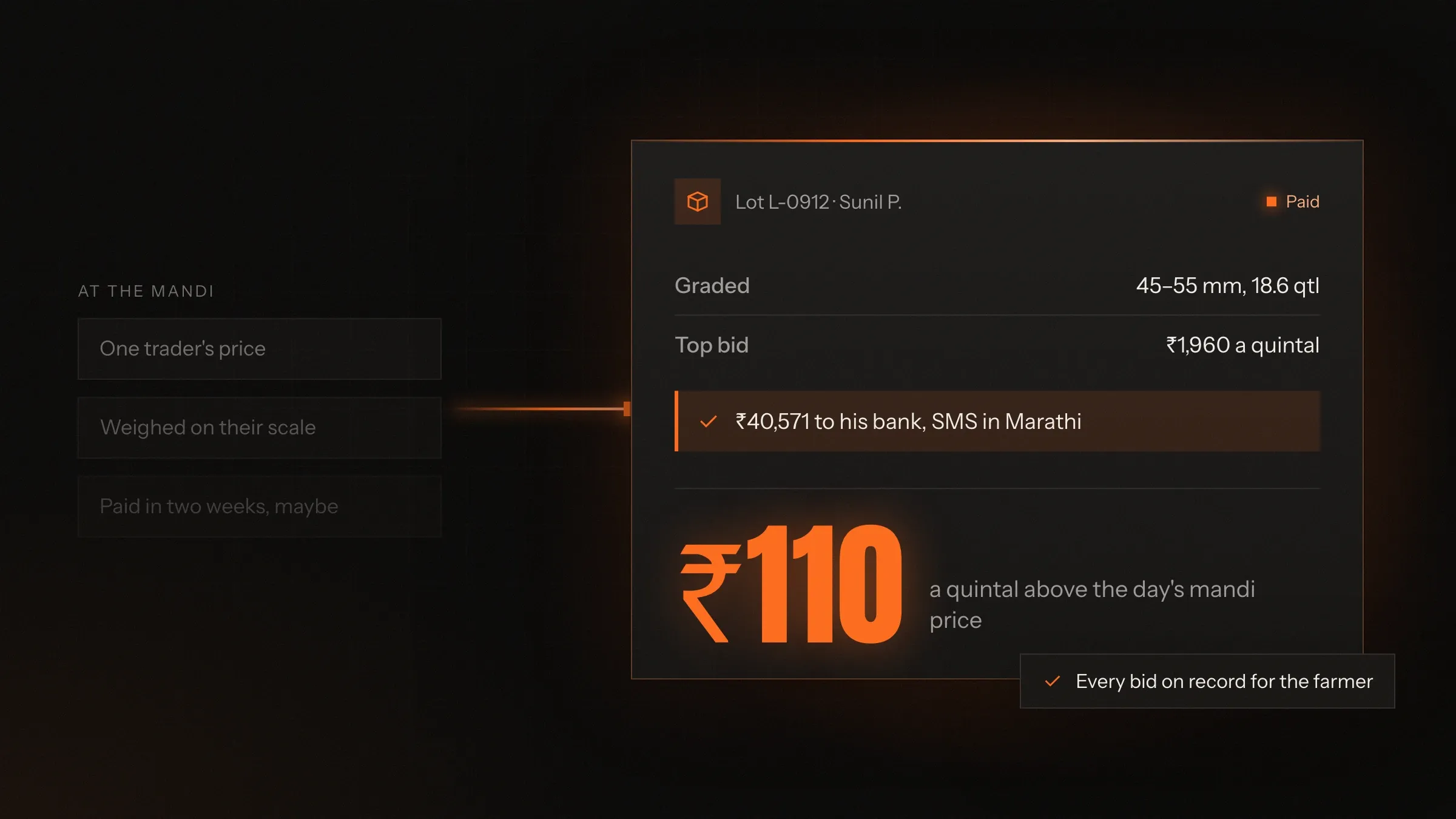
Today: The price is known only at the mandi, on the day.
After: Farmers see every bid on their produce, with the day's mandi prices beside it.
-
Today: Listing produce means typing on a phone, often in English.
After: Farmers list by voice in their own language, and the app reads it back to confirm.
-
Today: Quality is judged by eye at the point of sale.
After: A first grade comes from photos, and your quality staff confirm it on the scale.
-
Today: Small lots can't reach large buyers.
After: Lots of one grade from many farmers fill one truck, with each farmer's share recorded.
-
Today: Payments arrive late, with deductions nobody explains.
After: Each farmer is paid to their own bank account, with every deduction listed.
What it does for you
-
List produce by voice
Farmers say the crop, variety, quantity and harvest date in their own language. The app turns it into a listing and reads it back.
For exampleA grower in Marathi lists stored onions with the date they went into storage, and confirms the listing by voice.
-
Estimate a grade from photos
AI gives a first grade from size, colour and visible damage, so buyers can plan before the produce moves.
For exampleA photo of tomatoes gives an estimated grade while they are still on the farm.
-
Confirm grade and weight at the centre
Quality staff weigh each farmer's produce and confirm its grade on the platform, against your own standards for each crop.
For exampleOnions are weighed at the collection centre and sorted into size bands, and the farmer sees the result on the phone.
-
Open bids with the market in view
Buyers bid on graded lots within a set time or buy at a fixed price, with the day's mandi prices beside every lot.
For exampleA farmer follows the bids on his onions next to the day's Lasalgaon price until the bidding closes.
-
Fill trucks from small lots
Lots of the same grade from many farmers are combined into the truckloads large buyers want, with each share kept by weight and grade.
For exampleTwelve farmers' lots of one grade fill a truck for a processor, and each farmer is paid for their own weight.
-
Pay farmers directly
The buyer pays through the platform, and each farmer's share goes to their own bank account with a receipt in their language.
For exampleA farmer gets an SMS in Marathi with the price, the weight, each deduction and the amount sent to the bank.
-
Trace produce for export
Lots carry the farm registration, residue test details and history that exporters ask for.
For exampleExport grapes are packed with the farm registration and residue test details on their traceability record.
How it works
-
The farmer lists
By voice, with photos, on a basic phone or with help from your field staff.
-
A first grade from photos
AI estimates the grade so buyers can plan before anything moves.
-
Weighed and graded at the centre
Quality staff confirm the weight and the final grade, and the farmer sees it.
-
Buyers bid
Graded lots are open to bids or fixed-price orders, with mandi prices in view.
-
Lots become truckloads
Lots of one grade are combined for large buyers, with every share recorded.
-
Farmers are paid
The buyer pays through the platform, and each farmer's share goes to their bank with every deduction listed.
Where we've built it
1 from our portfolio
What an agritech app does
An agritech app connects farmers to the people who buy their produce, and makes each step of the sale visible. Farmers list what they have, the produce is graded, buyers make offers, and payment reaches the farmer directly, with every deduction shown.
The word covers a lot: crop advisory, input sales, farm records, credit, storage. This page is about the part that most directly decides a farmer’s income, the sale. When farmers can see buyers’ bids beside the day’s mandi price, and know when and how they will be paid, they stop depending on a single commission agent’s word.
The software only works if farmers use it, which is why most of our effort goes into the farmer’s side: voice instead of typing, their own language, basic phones and patchy networks.
Who it is for
It is for organisations that buy from or sell for many small farmers: farmer producer companies and FPOs, cooperatives, agri traders, exporters, processors, and food and retail businesses that want to buy directly from growers.
Each has the same problem from a different side. An FPO wants its members to get better prices and faster payment. A processor or retail chain wants consistent grades and reliable supply. An exporter needs traceability for every carton. All of them are dealing with thousands of small lots, phone calls and paper slips.
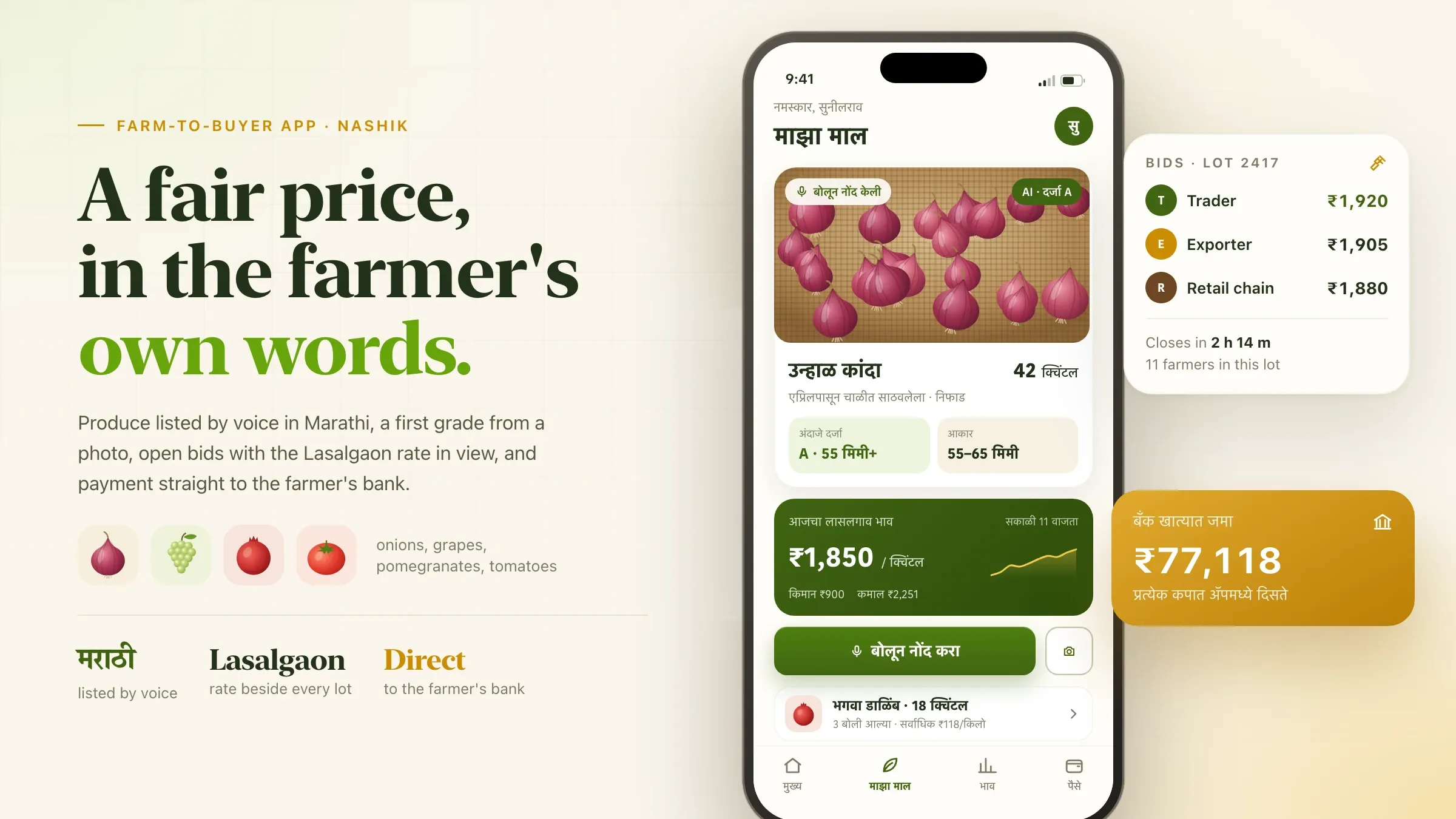
For a farmer producer company in Nashik, whose members grow onions, grapes, pomegranates and tomatoes around Lasalgaon, one of Asia’s largest onion markets, we built a farm-to-buyer trading app with voice listing in Marathi, AI grading from photos, open bids and direct payments.
Start in the field, not the office
We start in villages, at collection centres and at the mandi, because the people who will use the app are not in a meeting room. In Nashik we spent the first month beside farmers, quality staff and buyers, and four lessons shaped the whole platform.
Farmers talk; they don’t type, so voice had to be the main way in. Grade decides price, and grading at the mandi felt like a judgement nobody could question. Small farmers sell small lots, but big buyers want full truckloads of one grade. And late payment hurt more than low prices: farmers needed to know when they would be paid and what would be deducted.
Your crops, region and buyers will teach different lessons. Finding them before we build is cheaper than finding them after launch.
Voice first, in the farmer’s own language
The farmer app speaks the farmer’s language. To list produce, a farmer presses one button and says the crop, variety, quantity and expected harvest date. The app turns the speech into a listing and reads it back for the farmer to confirm or correct, by voice.
In Nashik the app runs in Marathi, using Bhashini, the Indian government’s language AI, and Google Gemini to turn speech into structured listings. Farmers who store onions after the rabi harvest can list stored stock too, with the date it went into storage. The same approach works in Hindi, Gujarati and other Indian languages, and we test each one with farmers, including the local names they use for crops and varieties.
Some farmers will always prefer help. Field staff can register them, verify their bank accounts and make their first listing with them, as the Nashik company’s field staff do.
Grading farmers can trust
Grading is where trust is won or lost, so the platform separates an estimate from a decision. A photo of the produce gives an AI estimate of its grade, from size, colour and visible damage, which lets buyers plan before the produce moves.
The final grade is set by people. At the collection centre, quality staff weigh each farmer’s produce and confirm its grade on the platform, using your own standards for each crop, such as size bands for onions. The farmer sees the weight and grade on the phone. Every confirmed grade is fed back to the AI, so its estimates improve season by season.
Bids, fixed prices and the mandi rate in view
A fair price is easier to recognise when the market is in view. The day’s prices at nearby mandis appear beside every lot, so farmers and buyers judge each offer against the same reference.
Buyers, such as traders, exporters, processors and retail chains, see graded lots by crop, grade, quantity and location in their own app. They bid within a set time or buy at a fixed price your organisation sets. Farmers see every bid on their produce, and the winning price is final once the bidding closes, with every bid on record.
Mandi prices can come from public sources such as Agmarknet, the government’s market price portal, or from your own staff at the market. Either way, the source and the time of each price are shown beside it, so nobody has to take a number on trust.
Truckloads and traceability
Large buyers want full trucks of one grade, and a small farmer brings a few crates. At the collection centre, staff combine lots of the same grade from many farmers into the truckloads buyers want, and the platform records each farmer’s share by weight and grade. The scale belongs to the group, but the payment stays individual. Each truck records its buyer, vehicle and documents with the load, so a question about weight or grade at the buyer’s end can be traced back to every farmer’s lot.
Export produce needs more. Lots can carry the farm registration, residue test details and history that exporters ask for, as export grapes do in Nashik, so traceability is built as the produce moves rather than reconstructed afterwards.
Paying farmers directly
Payment is where a platform earns farmers’ loyalty. The buyer pays through the platform, and each farmer’s share is worked out from the weight and grade of their produce. Every deduction, such as handling, transport and your organisation’s fee, is listed, and the rest goes straight to the farmer’s own bank account.
Farmers receive a receipt by SMS in their language and can see every payment and deduction in the app. Payments run through a regulated payment provider, such as Razorpay in Nashik, so nobody carries cash between the centre and the village.
When farmers are paid is a rule you set and publish, and each farmer sees the expected payment date as soon as the bidding closes. Sales, deductions and payouts can also flow into your accounting software, such as Tally, so your books and each member’s statement always agree.
What we need from you, and how we measure it
We need your crops and grade standards, the records of a recent season, and an owner on your side. Grade standards become the rules quality staff work to. Past sales, prices and payments show us where the money and the time go. The owner is usually whoever runs procurement or member services, someone farmers and buyers already trust.
Before we build, we agree how success will be measured: the price farmers receive against the mandi rate, days from sale to payment, the number of farmers listing each week, the share of produce sold through the platform, and disputes about grades. We watch those measures through the pilot season and report them every month after.
Season by season: pilot, launch and running
Agriculture runs on seasons, so we plan the build around the harvest. In Nashik, the pilot started with onion growers at two collection centres; grapes, pomegranates and tomatoes followed once the first season’s grades, bids and payments had been checked with the farmers.
After launch we run the platform with you. We tune AI grading from the confirmed grades, add crops, centres, buyers and languages, and make sure the platform handles the harvest peak, when listings, bids and payments all arrive at once.
How we work with you
From the first call to running it
- Start
Go to the villages and the mandi
We spend days with farmers, collection centre staff and buyers, watching how produce is graded, sold and paid for today.
- Build
The farmer app first
Voice listing, photos and mandi prices come first, tested with farmers on their own phones, then grading, bids and payments.
- Pilot
One crop, a few centres
One crop at a small number of collection centres runs on the platform, and every grade, bid and payment is checked with the farmers.
- Launch
More crops and centres
Further crops, centres and buyers join once the first season's grades, bids and payments have been checked.
- Every season
Run and improve
We tune the AI grading from confirmed grades, add crops, buyers and languages, and prepare the platform for each harvest peak.
Safe and in your control
A person confirms every grade
AI gives only a first estimate. Your quality staff set the final grade and weight, and that is what the farmer is paid on.
Every bid on record
Each bid is logged with its time and buyer, and the winning price is final once the bidding closes.
Bank accounts verified first
Field staff verify each farmer's bank account when they register, so payouts reach the right person.
Every deduction shown
Handling, transport and your fee are listed on every payment, in the app and on the receipt.
Data kept in India
Farmers' records, prices and payments belong to your organisation and are hosted in India, or in the region you need.
Works on weak signal
The app saves listings and photos on the phone and sends them when a signal returns.
Time and cost
The cost depends on the crops, the languages and the parts of the trade you want on the platform, not on a package. Most organisations start with the farmer app and one crop, then add grading, bids, payments and more crops season by season. After the first call we send a written plan and a quote for the first stage.
Crops and grade standards
Each crop has its own grades, units and photos to learn from. One crop is the quickest start.
Languages and voice
Each language is set up and tested with farmers who speak it, including the words they use for their crops.
Who uses it
Farmers, field staff, collection centres, buyers and your office each need their own screens.
Payments and payouts
Buyer payments, farmer payouts, deductions and receipts add rules and testing with your payment provider.
Running costs
Voice, AI grading, SMS and hosting grow with the number of listings, photos and payments each season.
Built with
Chosen for each project, never by habit
Questions and answers
13 answered
What is an agritech app?
An agritech app is software that helps farmers and the businesses around them grow, sell or buy produce. A farm-to-buyer app lets farmers list produce, buyers bid on graded lots and payments go straight to farmers, without depending on commission agents.
What can an agritech app do for a farmer producer company?
It can take members' listings by voice, grade produce from photos and at the collection centre, combine small lots into truckloads, run bids with buyers, and pay each farmer their share directly. We built this for a farmer producer company in Nashik.
Can farmers use the app without typing?
Yes. Farmers press one button and speak the crop, variety, quantity and harvest date. The app turns the speech into a listing and reads it back so the farmer can confirm or correct it by voice.
Which languages can an agritech app support?
Most Indian languages, including Marathi, Hindi and Gujarati. Our Nashik app runs in Marathi, using Bhashini and Google Gemini to turn speech into listings, and each language is tested with farmers before launch.
How does AI grading from photos work?
The farmer photographs the produce, and AI estimates its grade from size, colour and visible damage. It is a first estimate for planning: your quality staff confirm the final grade and weight at the collection centre, and confirmed grades improve the estimates.
How does the app help farmers get a fair price?
Buyers bid openly on graded lots, or buy at a fixed price you set, and the day's mandi prices appear beside every lot. Farmers see every bid and can judge each offer against the market.
How are farmers paid?
The buyer pays through the platform. Each farmer's share is worked out from the weight and grade of their produce, every deduction is listed, and the rest goes to the farmer's own bank account with a receipt in their language.
Does the app work on basic phones and weak networks?
Yes. We build the farmer app for basic smartphones, and it saves listings and photos on the phone until a signal returns, so fields with patchy coverage are not a barrier.
Can it record traceability for export produce?
Yes. Lots can carry the farm registration, residue test details and history that exporters ask for, as export grapes do in our Nashik app.
How much does an agritech app cost?
It depends on the crops and grade standards, the languages, who uses the platform, and how payments and payouts work. Running costs follow your listings, photos and payments. After the first call we send a written plan and a quote for the first stage.
How long does it take to build an agritech app?
The farmer app with voice listing for one crop is the quickest start; grading, bids, truckloads and payments take longer. We build around the harvest calendar, so a pilot can run in the season that matters to you.
Do you build agritech apps outside India?
Yes. FIRELIFE Ventures works with small and mid-size organisations worldwide, from Rajkot, India, on India time. The agritech work in our portfolio is in India, and the same approach of voice, grading and direct payment applies elsewhere.
What happens after the app goes live?
We run it with you season by season: we tune AI grading from confirmed grades, add crops, centres, buyers and languages, and make sure the platform handles each harvest peak.
Tell us what you want to build
Write a few lines about the idea and who it is for. We reply with our questions, a first plan and how we would start.
Write to us