Build something new lending software development
Lend and verify customers online
We build lending software for NBFCs and other lenders: borrowers apply and complete e-KYC on their phone, your credit team decides with rules it controls, and loans are signed, disbursed and repaid online, with every consent on record.
- We map your loan journey against the rules first
- Your credit team owns the rules
- Borrower data stays in India
Sound familiar?
What we hear before we start
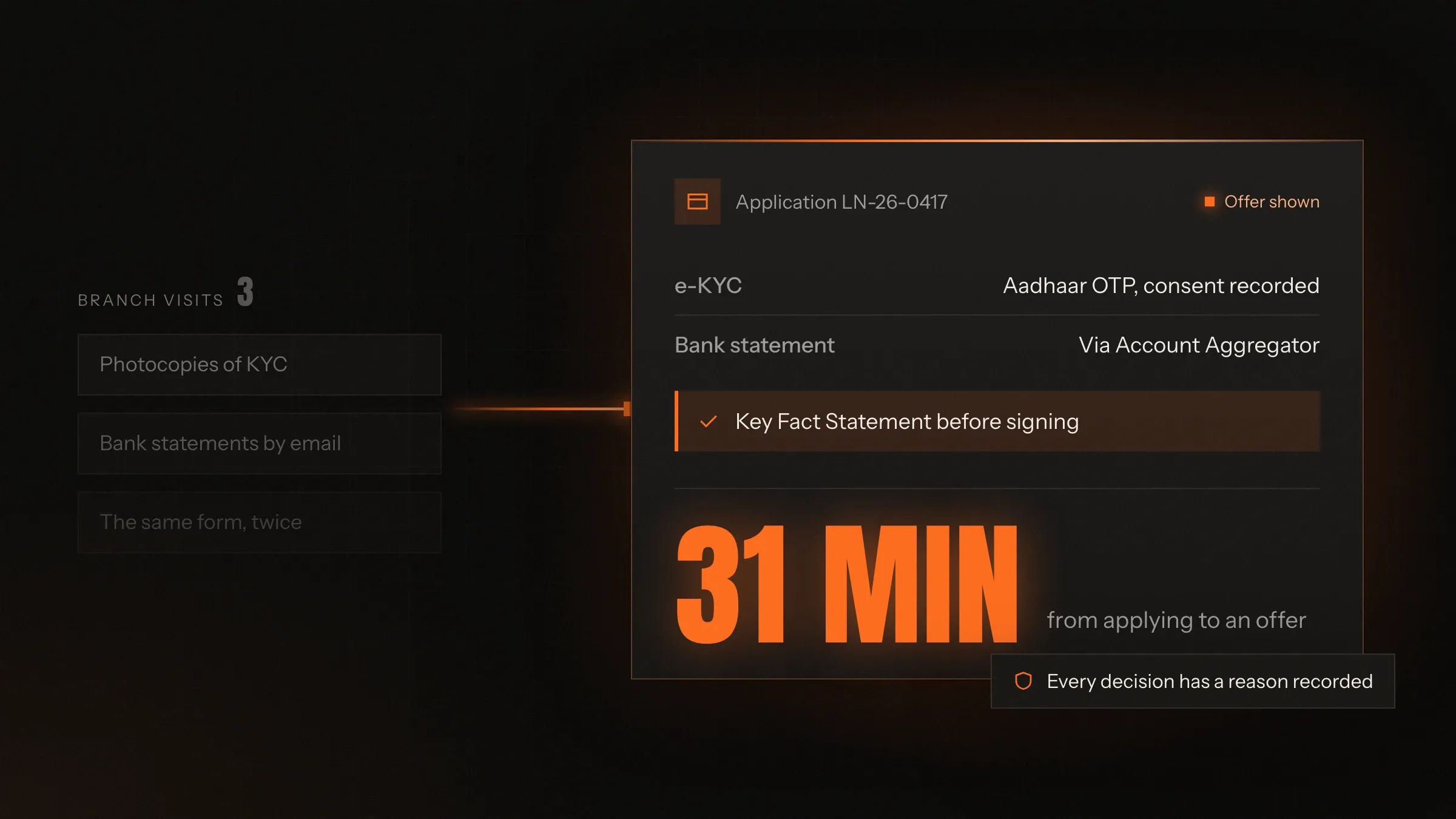
- Loan files travel by courier, and a decision takes days.
- Underwriters spend their time typing figures from bank statements and salary slips.
- Borrowers give up halfway through a KYC process that needs another visit.
- Every change to credit policy waits for the next software release.
- Collections hear about a missed EMI long after it happened.
- When the auditor asks for a borrower's consent, someone searches through emails.
What changes
-
Today: Borrowers fill in paper forms at a branch or with an agent.
After: Borrowers apply on their phone and finish KYC in one sitting.
-
Today: Bank statements are checked line by line by hand.
After: Statements arrive through the Account Aggregator with consent, and AI picks out the figures.
-
Today: Credit policy lives in a document and in people's heads.
After: Credit rules run in a rules engine your credit team edits itself.
-
Today: Agreements are printed, signed, scanned and couriered.
After: Borrowers read the Key Fact Statement, sign with Aadhaar e-sign and set up e-NACH.
-
Today: A missed EMI shows up at month end.
After: Reminders go out before each instalment, and collections see a miss the same day.
What it does for you
-
Take applications online
In an app or on the web: mobile number, PAN, amount and purpose, with only the data the loan needs, each piece collected with consent.
For exampleA shop owner applies for a working capital loan from his phone after closing time.
-
Verify customers with e-KYC
PAN checks, e-KYC through Aadhaar OTP or DigiLocker as your KYC policy allows, a CKYC lookup, bank account verification and video KYC where the loan needs it.
For exampleA salaried borrower completes PAN, e-KYC and a short video call without leaving her desk.
-
Read financial documents
Bank statements, salary slips, income tax returns and GST returns read by AI, with the figures extracted and mismatches flagged for a person.
For exampleThe salary credited in the statement differs from the slip, so the case is marked for a second look.
-
Run credit rules your team controls
Bureau reports, scorecards, eligibility, policy checks and loan terms, in a rules engine your credit team edits without a software release.
For exampleThe credit head tightens the FOIR limit for one segment, and it applies from the next application.
-
Sign, mandate and disburse
The Key Fact Statement, Aadhaar e-sign, an e-NACH or UPI AutoPay mandate, and disbursal straight to the borrower's own bank account.
For exampleA borrower reads the Key Fact Statement, signs with an OTP and sets up his repayments in the same sitting.
-
Service and collect
Repayment schedules, part-prepayment, statements, closure letters, reminders before each EMI and a collections queue for misses.
For exampleAn EMI bounces on the 5th, and it is on the collections team's queue that morning.
-
Keep every step ready for audit
Every consent, document, decision and change recorded with who made it, when and why.
For exampleAn auditor asks why a loan was approved outside policy. The deviation, the approver and the reason are on one screen.
-
Connect your partners
APIs for credit bureaus, KYC providers, sourcing partners, co-lending partners and your loan management or core banking system.
For exampleA partner's app sends applications through your API, and your own rules decide them.
How it works
-
The borrower applies
In the app or on the web, with consent recorded for each piece of data.
-
KYC in one sitting
PAN, e-KYC, CKYC and bank account checks, with video KYC where the loan needs it.
-
Documents are read
Statements arrive through the Account Aggregator or as uploads, and AI extracts the figures.
-
The rules decide or refer
Clear cases follow your rules; the rest go to an underwriter with the whole case on one screen.
-
Offer and signing
The borrower reads the Key Fact Statement, signs with e-sign and sets up the repayment mandate.
-
Disbursal and servicing
Money goes to the borrower's own account; reminders, repayments and statements follow.
-
Reporting
Credit bureau reporting on the schedule the rules set, and the reports your compliance team asks for.
Where we've built it
2 from our portfolio
-
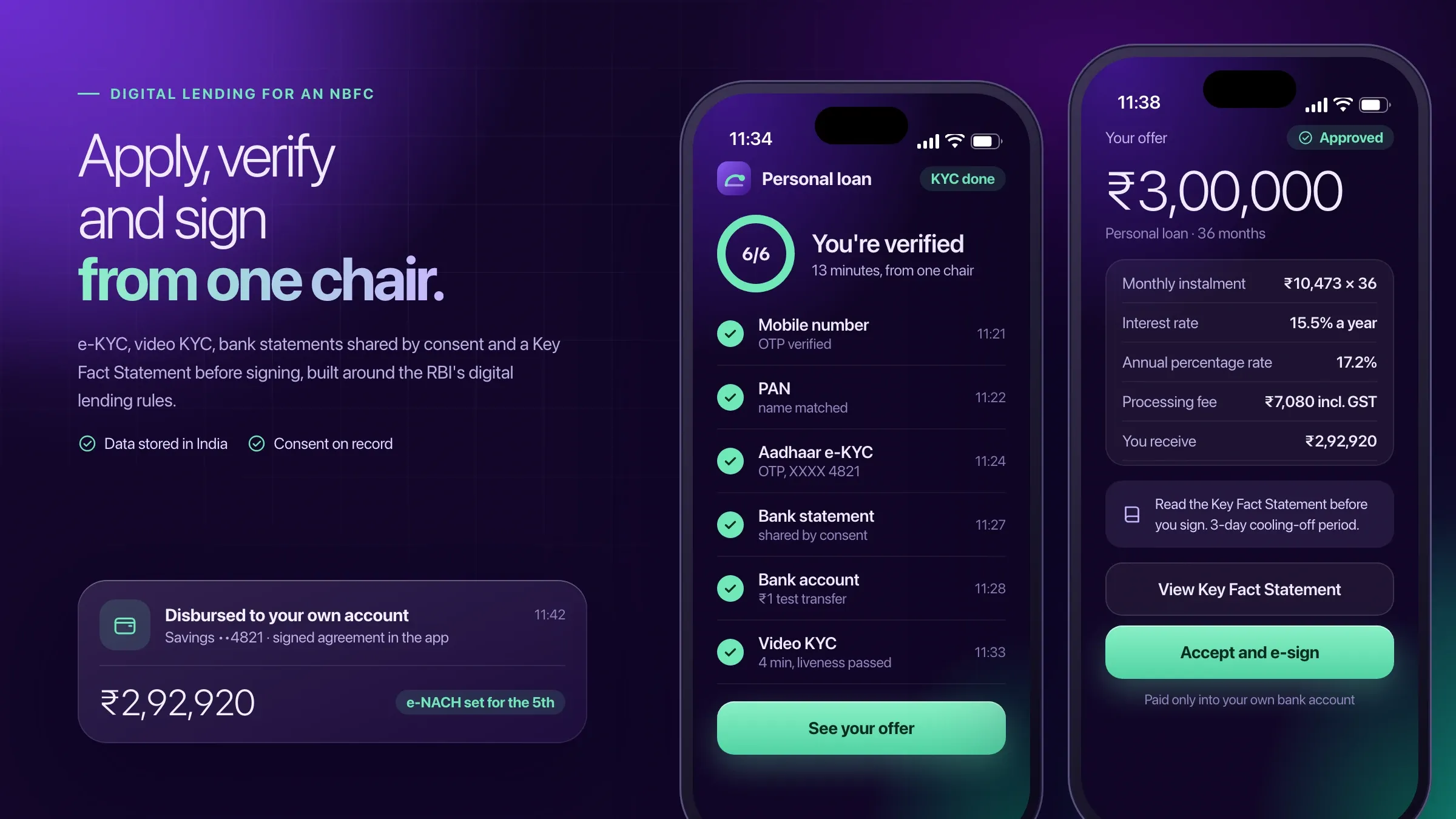 Digital lending with e-KYC for an NBFC For an NBFC in Kolkata, we built loan applications in an app, e-KYC and video KYC in one sitting, AI that reads financial documents, credit rules the team controls, e-sign, e-NACH and loan servicing. Read the case study
-
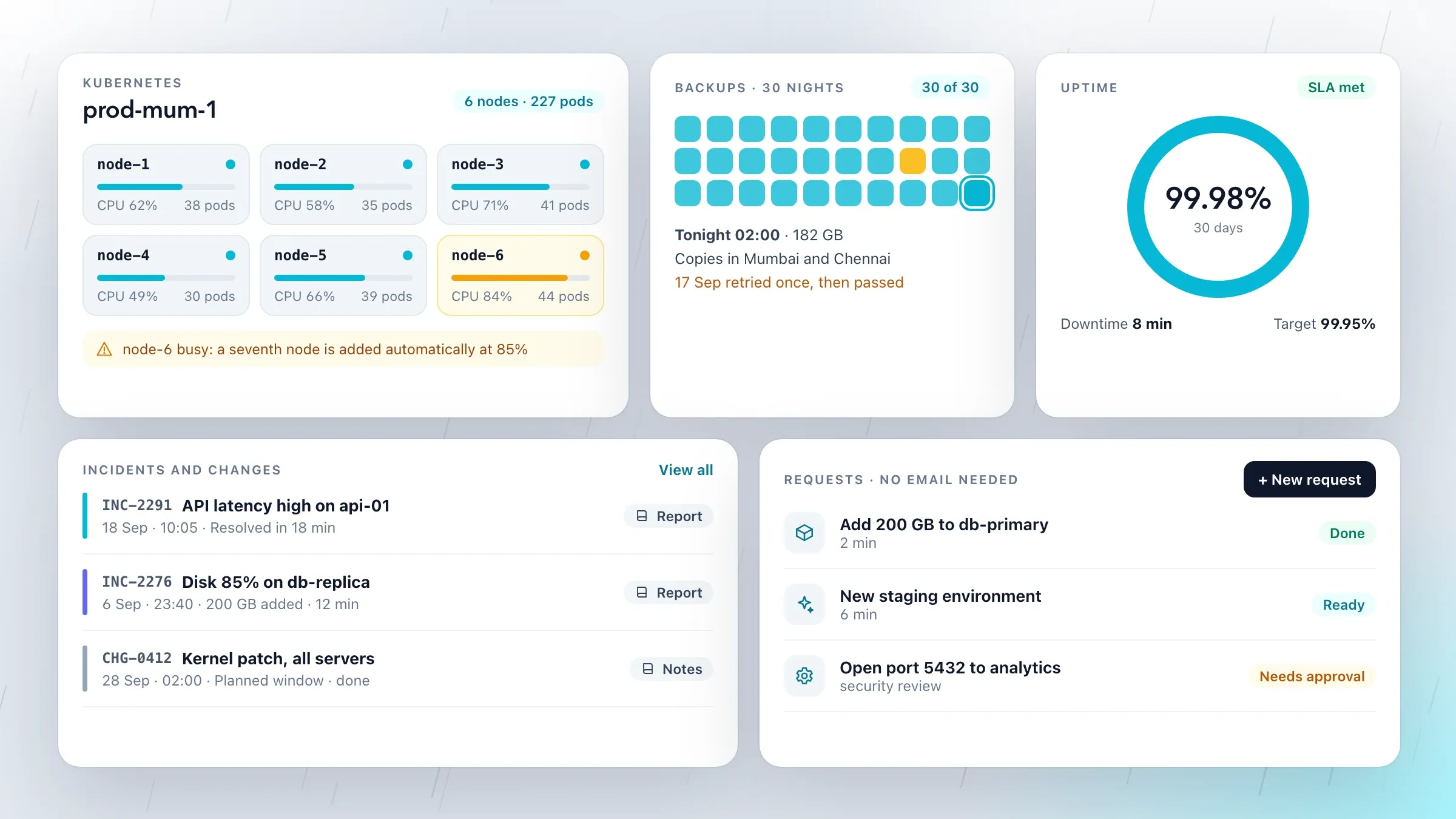 Hosting in India for regulated businesses Our partner in Mumbai runs servers in Indian data centres for businesses whose data must stay in India. We build its customer portal, its automation and its AI support. View the investment
What lending software does
Lending software takes a loan from application to closure without paper. The borrower applies and proves who they are on their phone, the lender checks their documents and credit, the agreement is signed online, the money reaches the borrower’s bank account, and repayments, reminders and statements follow on the same platform.
For a lender, the value is not only speed. It is control: every consent, document and decision in one place, credit rules the credit team can change itself, and a record that stands up to an audit. For the borrower, it is a loan that doesn’t need three visits to a branch.
We build lending platforms for NBFCs, and for the sourcing partners and lending service providers that work with regulated lenders. Personal loans for salaried borrowers, business loans for small shops and traders, loans against property, gold or vehicles, and education or consumer loans each need their own journey, and we build each one around the product.
Built around the digital lending rules
The RBI’s digital lending rules shape the product as much as any user need, so we map them before we design. With your compliance team, we go through every step of the journey and agree how each rule shows up on screen.
- A Key Fact Statement with the annual percentage rate and the total cost, shown before the borrower signs.
- Disbursal straight to the borrower’s own bank account and repayments straight to the lender.
- A cooling-off period in which the borrower can leave the loan without a penalty.
- Need-based data, collected with consent, with no access to the phone’s contacts, call logs or photos.
- Data stored in India, with every consent and decision kept on record.
- The grievance officer’s details visible in the app and on the website, and the lender’s name clear to the borrower.
We build to the rules as your compliance team reads them for your licence. Interpreting them, and regulatory sign-off, stay with you.
Applications and KYC in one sitting
Borrowers drop out when KYC needs another visit, so we put it all in one sitting. The borrower verifies their mobile number, enters their PAN and completes e-KYC through Aadhaar OTP or DigiLocker, as your KYC policy allows. Their CKYC record is checked and updated, and their bank account is verified with a small test transfer before any money moves.
Where the loan needs full KYC, video KYC follows straight away: a live call with your trained staff in India, with liveness and face-match checks, a location check and a random question to confirm the borrower is really there. The call is recorded and kept with the case.
Identifiers are masked wherever staff don’t need to see them in full, and the borrower can stop and pick up later without starting again.
Not every borrower applies alone. Branch staff and loan agents can take a borrower through the same journey on a tablet, with the borrower giving each consent on their own phone, so assisted loans follow the same rules and leave the same record as loans taken in the app.
Reading bank statements and documents
Underwriters should judge risk, not type figures. Bank statements arrive through the Account Aggregator framework, with the borrower’s consent, straight from their bank, which also removes the risk of an edited PDF. Where that isn’t possible, borrowers upload them.
AI then reads statements, salary slips, income tax returns and GST returns. It picks out what underwriters need, such as salary credits, existing EMIs, bounced payments, cash deposits and turnover, and flags anything that doesn’t match, like a salary credit that differs from the slip or a statement whose totals don’t add up. People still decide. The AI removes the data entry and points to what deserves a second look.
Credit decisions your team controls
Credit policy changes often, and it shouldn’t wait for developers. The bureau report is pulled automatically, and a rules engine the credit team edits itself runs the scorecards, eligibility checks, FOIR limits and policy rules, and works out the amount and terms each applicant qualifies for.
Clear cases are decided by the rules. The rest go to an underwriter with the whole case on one screen: KYC, documents, extracted figures, bureau report, rule results and flags. Deviations from policy follow an approval matrix, and every decision records its reasons. A rule change can be tried on past applications before it goes live, so the credit team sees its effect first.
The platform can pull reports from the credit bureaus you work with, such as CIBIL, Experian, Equifax or CRIF High Mark, and read them into the same case. Where you use a statistical scorecard or a model, it runs inside the same rules, so a person can always see which rule or score led to the decision.
Agreement, mandate and disbursal
The borrower sees the offer and the Key Fact Statement before anything is signed. The agreement is signed with Aadhaar e-sign, with e-stamping where the agreement needs it, and repayments are set up by e-NACH or UPI AutoPay in the same sitting.
The loan is then disbursed straight to the borrower’s own verified bank account. The signed agreement, the Key Fact Statement and the repayment schedule are sent to the borrower and kept in the app, so they can read them again at any time.
Servicing, reminders and collections
The loan doesn’t end at disbursal, and neither does the platform. Borrowers see their repayment schedule, pay early or part-prepay, download statements and ask for a closure letter in the app.
Reminders go out before each instalment by SMS, WhatsApp and app notification. When an EMI bounces, it appears on the collections team’s queue the same day, with the borrower’s history and the next step. Messages and calls follow your fair practices code: the times they may go out, the wording your compliance team approved, and a record of every contact, so collections stay firm without crossing a line. Loan data is reported to the credit bureaus on the schedule the rules set, and the reports your credit, collections and compliance teams need are ready without an export from three systems.
Security, audit and data
Lending software holds some of the most sensitive data a person has, so security is part of the design, not a test at the end. Borrower data is stored and processed in India, encrypted in transit and at rest. Each staff role sees only what it needs, and sensitive actions such as rule changes or limit overrides need a second approver.
Every step, consent and decision is logged for audits, and system logs are kept in India in line with CERT-In’s directions. Before launch, the platform goes through an independent vulnerability assessment and penetration test, and every finding is fixed before go-live.
What we need from you
We start with your products and your policies. Product notes, your credit policy, your KYC policy, the forms and agreements you use today and a walk through a few real loan files tell us how lending actually works in your business.
You will also need your own accounts with the services the platform uses: credit bureau memberships, an Account Aggregator registration, an e-sign provider, a NACH sponsor bank and a payment gateway. Most important is a compliance owner on your side who reviews each screen and message, and a credit owner who decides the rules.
Launching and running it
We launch one loan product at a time. The first product goes live, is watched closely and is improved from what borrowers and staff run into; the next product follows on the same platform once the first runs cleanly.
After launch we run it with you: rule changes, new products and partners, updates when the RBI issues new directions, security patches and the monthly reports your teams rely on. Each new product is quicker than the last, because KYC, documents, signing and servicing are already in place.
How we work with you
From the first call to running it
- Start
Map the journey against the rules
With your credit, operations and compliance teams, we map every step of the loan journey against the RBI's digital lending rules and your own policies before designing anything.
- Design
Design for borrowers and staff
The borrower app, the underwriter's case screen and the rule editor, tested with real borrowers and your own staff.
- Build
Build and connect
KYC, bureau, Account Aggregator, e-sign, e-NACH and your loan management system, each connected with the least access it needs.
- Test
Review and secure
Your compliance team reviews every screen and message, and the platform goes through an independent vulnerability assessment and penetration test.
- Launch
Launch one product first
One loan product goes live and is watched closely. The next follows once the first runs cleanly.
- Every month
Run and improve
Rule changes, new products, updates when the rules change, and the reports your teams need.
Safe and in your control
Data stored in India
Borrower data is stored and processed in India and encrypted in transit and at rest.
Only the data the loan needs
Each piece of data is collected with consent, and the app never reads the phone's contacts, call logs or photos.
Money moves between borrower and lender
Disbursals go straight to the borrower's own bank account and repayments straight to the lender, never through anyone else's account.
Every decision explained
Each decision records the rules that ran, the data they used, any deviation and who approved it.
Each role sees its own work
Staff see only what their role needs, and sensitive actions such as rule changes need a second approver.
Tested by someone else
An independent security test before launch and after major changes, with every finding fixed before go-live.
Your compliance team decides
We build to the rules as your compliance team reads them. Regulatory sign-off and your licence obligations stay with you.
Time and cost
The cost depends on your loan products and the checks each one needs, not on the size of your book. One salaried personal loan with digital KYC is a smaller build than several secured and unsecured products with video KYC and co-lending. After the first call we send a written plan and a quote.
Loan products
Each product brings its own journey, documents, rules and repayment schedule.
Verification
e-KYC, video KYC, CKYC, bank verification and fraud checks each add an integration to build and test.
Credit decisions
A few eligibility rules are quick. Scorecards, deviation matrices and statistical models take longer.
Systems to connect
Credit bureaus, the Account Aggregator, e-sign, e-NACH, your loan management or core banking system and your accounts.
Servicing and collections
Schedules, prepayment, statements, reminders and collections queues make up a module of their own.
Security and audit
Independent security testing, audit logs and compliance reports are part of every build, sized to the risk.
Built with
Chosen for each project, never by habit
Questions and answers
14 answered
What is lending software?
Lending software runs the loan journey online: application, KYC, document checks, credit decision, agreement, disbursal, repayment and collections. Built for a lender, it follows that lender's products, credit policy and regulatory obligations.
Do you build lending software for NBFCs?
Yes. We built a digital lending platform for an NBFC in Kolkata, with e-KYC and video KYC, AI document checks, a credit rules engine, e-sign, e-NACH and loan servicing. The same kind of platform can serve sourcing partners and lending service providers that work with a regulated lender.
Does the software follow the RBI's digital lending rules?
We design every step around them with your compliance team: the Key Fact Statement before signing, disbursal to the borrower's own account, a cooling-off period, need-based data with consent, data stored in India and a visible grievance officer. Reading the rules for your licence and regulatory sign-off stay with you.
What is e-KYC in a lending app?
e-KYC verifies a borrower's identity electronically instead of with paper copies. In a lending app the borrower verifies their PAN, completes e-KYC through Aadhaar OTP or DigiLocker as your KYC policy allows, and their CKYC record is checked and updated.
What is video KYC?
Video KYC is a live video call between the borrower and the lender's trained staff in India, with liveness and face-match checks, a location check and a random question to confirm the borrower is really there. It lets a borrower complete full KYC without visiting a branch.
How does the Account Aggregator help underwriting?
The Account Aggregator lets a borrower share bank statements straight from their bank, with consent, so you get genuine data instead of an edited PDF. AI then picks out income, existing EMIs and bounced payments for the underwriter.
Can our credit team change rules without developers?
Yes. Scorecards, eligibility, limits and policy checks run in a rules engine the credit team edits itself. Changes can be tested on past applications, need a second approver and take effect without a software release.
Is borrower data kept in India?
Yes. Borrower data is stored and processed in India, for example in AWS's Mumbai region, encrypted in transit and at rest, and each staff role sees only what it needs.
How much does lending software cost?
It depends on the loan products, the verification each one needs, how credit decisions are made, the systems it connects to and whether servicing and collections are included. After the first call we send a written plan and a quote.
How long does it take to build a lending platform?
It depends on the products and checks involved. We launch one loan product first, often a salaried personal loan, and add the next once it runs cleanly, so borrowers come on board sooner than if everything waited for one big launch.
Can the borrower app work in Hindi, Gujarati and other languages?
Yes. The app, messages, Key Fact Statement and agreement can be shown in English, Hindi, Gujarati or other languages, so borrowers read their terms in a language they understand.
Can it connect to our loan management or core banking system?
Yes. The platform can hand approved loans to your existing loan management or core banking system, or run servicing itself. We connect through their APIs, or through a small bridge where an older system has none.
Do you build lending software for lenders outside India?
Yes. FIRELIFE Ventures works with businesses worldwide from Rajkot, India. KYC and lending rules differ by country, so we map the journey against your country's rules with your compliance team before we design it.
What happens after launch?
We run and improve it with you: rule changes, new loan products, updates when regulations change, security patches, and the monthly reports your credit, collections and compliance teams need.
Tell us what you want to build
Write a few lines about the idea and who it is for. We reply with our questions, a first plan and how we would start.
Write to us