Build something new salon software
Keep every chair booked
We build salon and spa software that keeps every chair and room booked: online and WhatsApp booking by stylist and chair, a calendar that knows how long each service really takes, GST billing, commissions, packages and the reminders that bring clients back.
- We start with a Saturday at your front desk
- Bookings on WhatsApp, even after closing
- One salon or a chain
Sound familiar?
What we hear before we start
- The phone rings while your hands are in someone's hair.
- Clients message at midnight and book elsewhere by morning.
- The diary says a stylist is busy for two hours, but half of it is colour processing.
- Commissions are worked out in a notebook at the end of the month, and someone always disagrees.
- Package balances and memberships live on paper cards that get lost.
- Regular clients drift away, and nobody notices until they've gone.
What changes
-
Today: Bookings come by phone, Instagram and walk-in, into a paper diary.
After: Every booking lands in one calendar by stylist and chair, from any channel.
-
Today: Messages after closing wait until the next afternoon.
After: An AI receptionist on WhatsApp answers and books at any hour, and hands the unusual to your staff.
-
Today: A two-hour colour blocks a stylist for two hours.
After: Processing time is free for another client, so the same stylist does more in a day.
-
Today: Commissions and package balances are added up by hand.
After: Every bill records who did what, and commissions and balances work themselves out.
-
Today: Clients who stop coming are noticed months later.
After: A reminder goes out when it's time for their next cut or colour, with a link to book.
What it does for you
-
A calendar by stylist and chair
Stylists, chairs, rooms and beds, with each service's real duration, buffer time and the steps inside it, so double bookings can't happen.
For exampleA root touch-up blocks the colourist for application and rinse, but frees her for 40 minutes of processing in between.
-
Online booking
A booking page linked from Google, Instagram and WhatsApp, where clients choose a service, a stylist and a time.
For exampleA client books a facial from the link on the salon's Google profile at 7 am on a Sunday.
-
An AI receptionist on WhatsApp
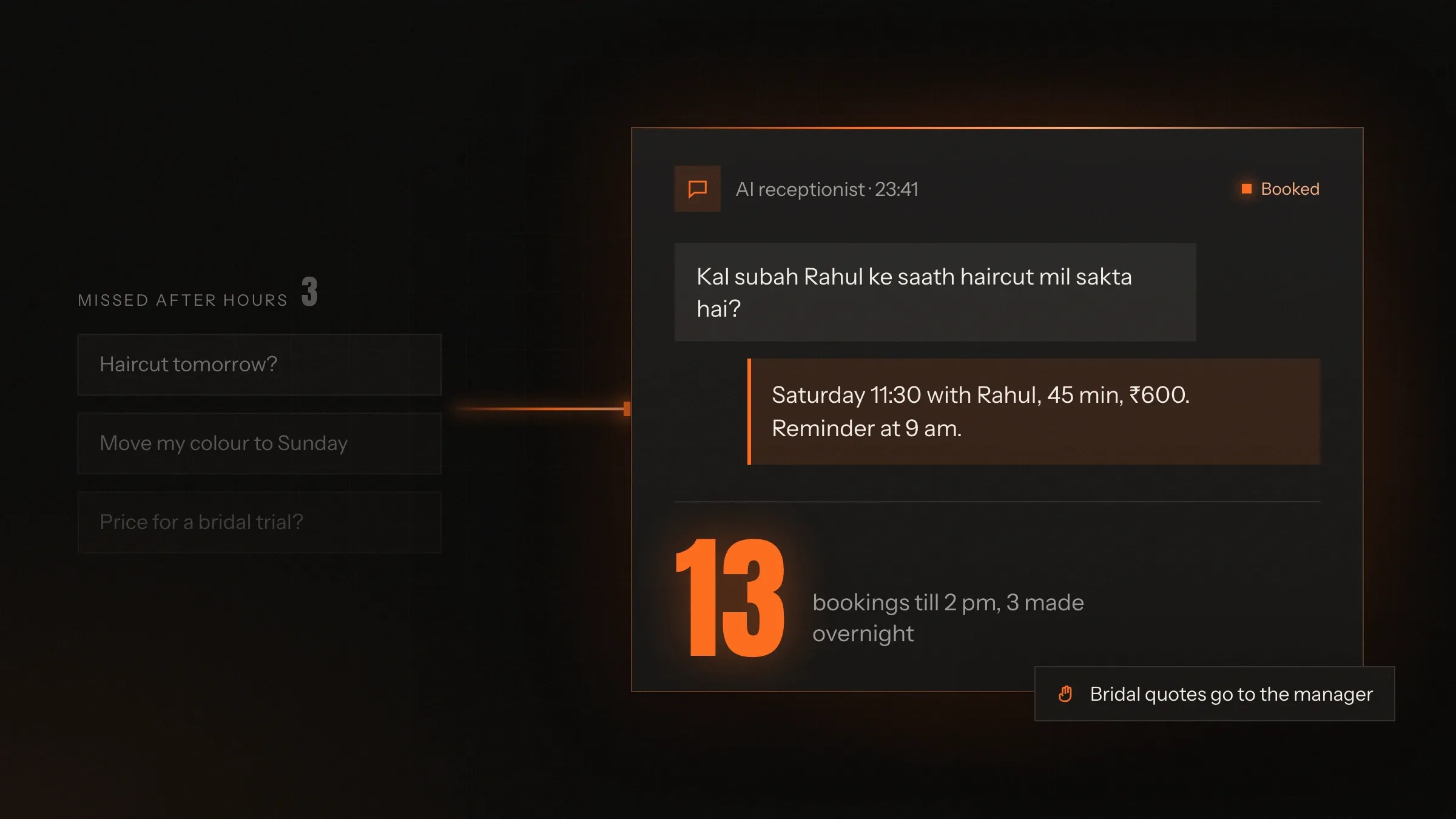
Answers questions about services and prices, books, moves and cancels appointments, and passes anything unusual to your staff.
For exampleAt 11:40 pm, a client asks for a haircut with Rahul tomorrow and is booked into his 11:30 slot.
-
GST billing and payments
Services and products on one bill with GST, paid by UPI, card or cash, with the bill on WhatsApp.
For exampleA colour, a blow-dry and a bottle of shampoo are billed together in a few taps.
-
Commissions worked out
Commission per service, per product or against monthly targets, from bills that record who did the work.
For exampleAt month end, each stylist sees their services, products sold and commission, already added up.
-
Memberships and packages
Memberships with discounts, prepaid packages and gift vouchers, drawn down visit by visit, with balances clients can see.
For exampleA client on a six-session spa package sees three left after today's massage.
-
Client history
Services, colour formulas, patch tests, allergies, skin and hair notes and preferences, ready for the next visit.
For exampleA new stylist sees the client's colour formula and last patch test date before she starts.
-
Stock, including what's used
Retail products and the colour, treatments and consumables used in services, with reorder alerts.
For exampleThe salon is told to reorder shade 7.1 before it runs out on a busy Saturday.
How it works
-
The client books
Online, on WhatsApp at any hour, by phone or at the desk, into the stylist's calendar.
-
Reminded, and confirmed
A reminder goes out before the visit, with a link to confirm, move or cancel.
-
In the chair
The stylist sees the client's history, formulas and notes, and processing time opens up for another client.
-
Billed at the desk
Services and products on one GST bill, paid by UPI, card, cash or a package balance.
-
Commissions and stock update
The bill records who did the work and what was used, so commissions and stock look after themselves.
-
Brought back
When it's time for the next cut or colour, the client gets a reminder with a link to book.
Where we've built it
2 from our portfolio
-
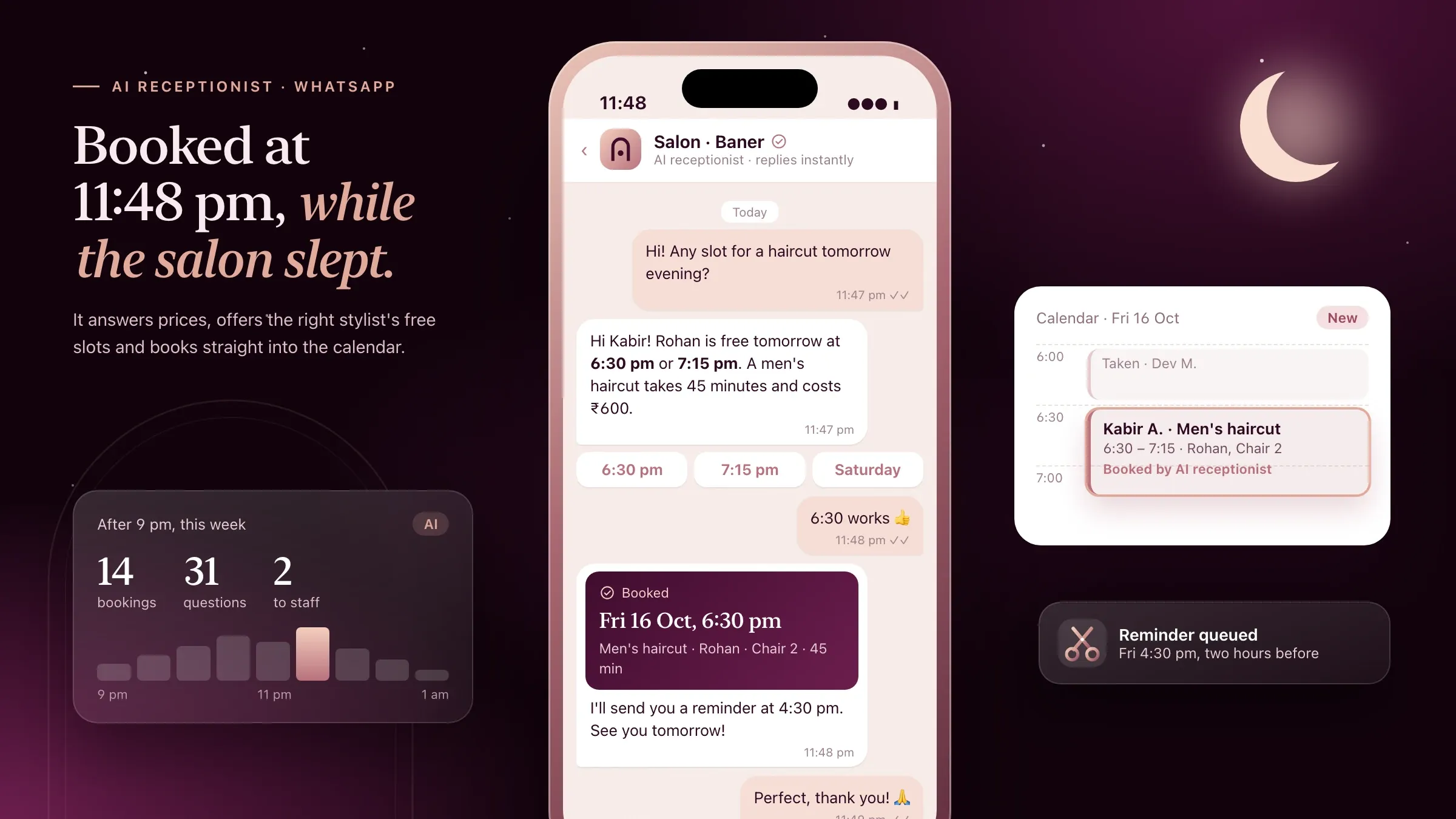 An AI receptionist for salons For a salon and spa software startup we back in Pune, our engineers build the product with its team, including the AI receptionist that books appointments on WhatsApp. Meet the startup
-
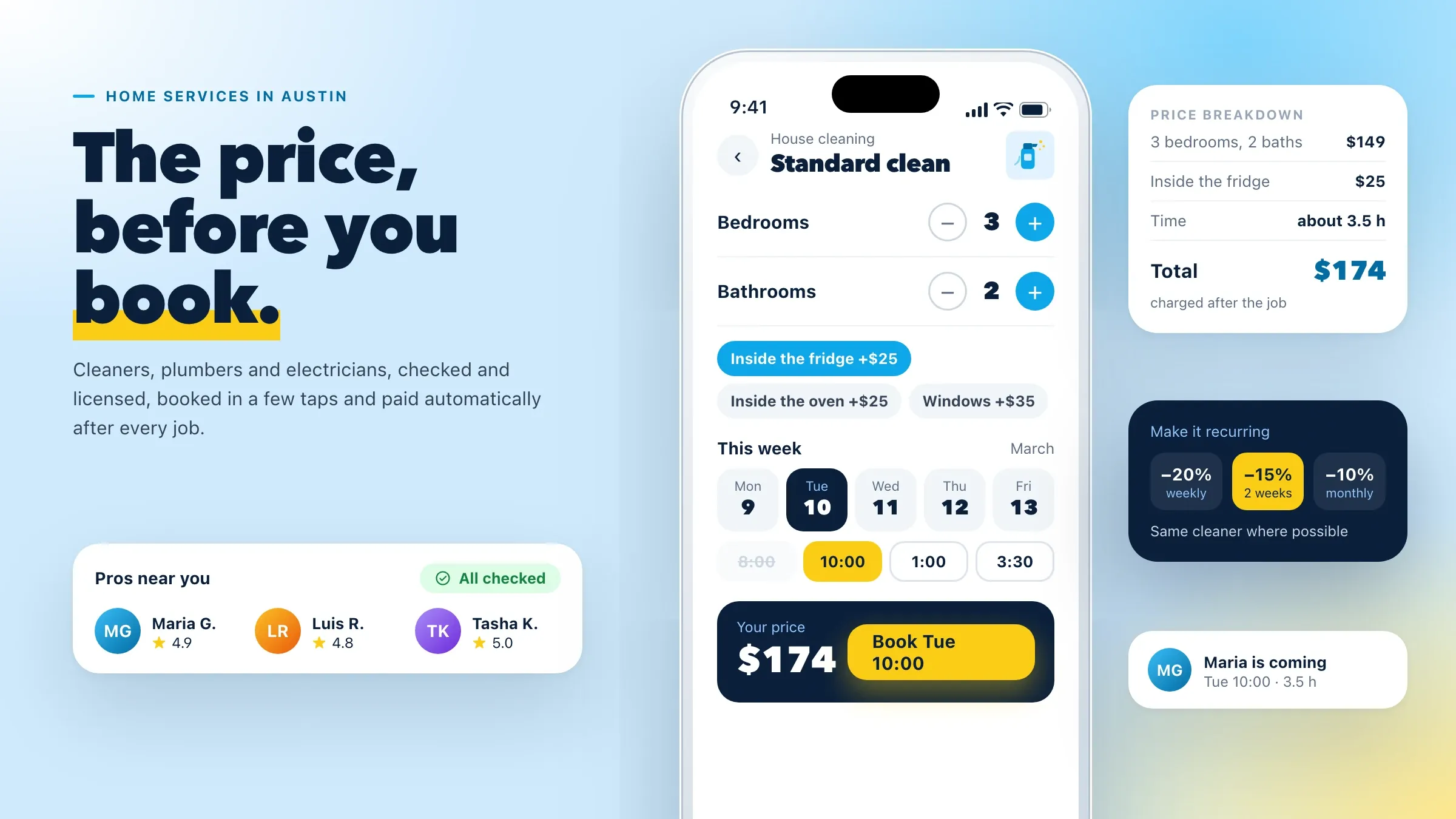 Bookings with upfront prices For a home services company in Austin, customers book cleaners, plumbers and electricians with upfront prices and time slots, and pros are paid automatically after each job. Read the case study
What salon software does
Salon software runs a salon’s whole day in one system: appointments by stylist and chair, online and WhatsApp booking, billing with GST, commissions, memberships and packages, stock, and every client’s history. It replaces the diary at the desk, the billing book and the notebooks kept on the side for commissions and package balances.
What makes it salon software, rather than general billing or booking software, is that it understands how a salon works. Services take different times with different stylists. A colour has steps, and the stylist is free while it processes. Commissions differ by service and product. Packages are used one visit at a time. Software that doesn’t know these things gets worked around with paper, and that is where bookings and money slip. The same software suits hair salons, beauty and nail studios, barbershops, spas, and skin and hair clinics that work by appointment.
Ready-made, or built for your salon
If you run one or two salons and a ready-made product fits your day, use it. There are good ones, and we will tell you if one suits you better than anything we would build.
A custom build fits better when your business doesn’t look like a typical salon: a chain with its own brand, rules and client app; a salon combined with a spa, a skin clinic or an academy; at-home services where stylists travel to clients; a franchise with its own reporting; or a company building salon software to sell to other salons. We back a salon software startup in Pune and build its product with its team, so we know the trade from the inside.
Where it pays off first
The calendar is usually where salon software earns its keep first. When every booking lands in one calendar by stylist and chair, with real service times and processing gaps, double bookings stop and the gaps in the day become visible, and bookable.
Next comes the phone. Online booking and a WhatsApp receptionist take bookings while your hands are busy and your doors are closed, and the messages sent at midnight become appointments instead of lost clients. Then come the clients who drift away: a reminder when it’s time for their next cut or colour brings many of them back without a single call.
The calendar: stylists, chairs and real service times
Each service has its own duration, which can differ by stylist, and its own steps. A root touch-up, for example, has application, processing and rinse. The colourist is busy for the hands-on steps and free during processing, so a short service for another client fits in between.
The calendar knows chairs, wash stations, spa rooms and beds as well as people, so a facial can’t be booked into a room that is already taken. Buffer times between services, breaks and staff leave are built in. Walk-ins are added at the desk into the same calendar, and the next free stylist for a service is one tap away. Stylists’ shifts, days off and leave live in the same calendar, and each stylist sees their own day on their phone, with each client’s notes, before the first appointment.
Booking online and on WhatsApp
Clients book from a page linked to your Google Business Profile, Instagram and WhatsApp, choosing a service, a stylist and a time. Long services such as bridal packages can take a deposit at booking, so a no-show doesn’t cost a whole afternoon. No-shows are tracked per client, so a client who often misses can be asked for a deposit next time.
On WhatsApp, an AI receptionist answers questions about services and prices from your own menu, and books, moves or cancels appointments with the right stylist, at any hour. It replies in the language the client writes in, sends reminders before each visit, and passes complaints and unusual requests to your staff with the conversation attached. It never invents a price or a promise; it works only from what you have given it.
Billing, commissions and stock
At the desk, services and products go on one GST bill in a few taps, paid by UPI, card, cash or a package balance, with the bill sent on WhatsApp. Each bill records who did each service and who sold each product.
That record is what makes commissions simple. Commission can be set per service, per product or against monthly targets, and at month end every stylist’s commission is already worked out, with the bills behind it. Products used in services, such as colour, developer and treatments, come off stock along with retail sales, so the salon knows what it uses and when to reorder. Tips are recorded against the stylist who earned them, and the owner sees the day’s sales by stylist, service and payment method before closing.
Memberships, packages and bringing clients back
Memberships give regular clients a discount; prepaid packages, such as six facials or ten hair spas, are drawn down visit by visit, and clients see their balance on WhatsApp after each one. Gift vouchers are sold and redeemed in the same system.
Bringing clients back is where much of a salon’s income is decided. When it has been six weeks since a haircut or a colour, the client gets a friendly reminder with a link to book their usual stylist. Reminders can follow each client’s own pattern rather than a fixed gap: a client who colours every five weeks hears at five weeks. After a visit, a short message can ask for a Google review. Clients who haven’t been back in a while appear on a list for the desk to call.
Client history, patch tests and privacy
Every client has a profile with their history: services, stylists, colour formulas, skin and hair notes, allergies and preferences. A new stylist can pick up exactly where the last one left off.
Hair colour needs extra care. Patch test dates and any reactions are recorded on the profile, and colour services can be set to need a recent patch test before they are booked. Before and after photos are taken and kept only with the client’s consent. Client data is encrypted, each person sees only what their work needs, and for salons in India it is handled in line with the Digital Personal Data Protection Act.
What we need from you, and how we build it
We start with a Saturday at your front desk, because the busiest day shows what the software must handle. We talk to stylists, therapists and the desk, and collect your service menu with times and prices, your commission rules, packages and memberships, and your client list. We also need one person who owns the project, usually the owner or salon manager, and an hour with your senior stylists to set real service times, which are often longer or shorter than the menu says.
Then we design the calendar, the bill, the client profile and the booking page, try them with your team, build, and pilot in one salon with the paper diary kept for a week as a safety net. Other branches follow one by one.
After launch: keeping chairs full
Before launch we agree what to watch: how full each stylist’s day is, bookings that arrive outside opening hours, no-shows, and how many clients come back within their usual gap. The software records these as it runs.
Every month we review them with you, keep the receptionist’s menu and prices current, fix what the desk and stylists find, and add what comes next: another branch, a client app, or an offer for the quiet weekday afternoons. For chains, the same review compares branches: which fill their weekday mornings, which sell the most packages, and where clients return most often.
How we work with you
From the first call to running it
- Start
A Saturday at your front desk
We watch your busiest day, talk to stylists, therapists and the desk, and collect your service menu, prices, commission rules and packages.
- Design
Screens your team tries first
The calendar, the bill, the client profile and the booking page are tried by your desk and stylists before we build them.
- Build
Build and connect
We build the software, set up services, staff and rules, import your clients, and connect payments, WhatsApp and your booking links.
- Pilot
One salon first
One salon runs on the new system while we fix what the desk and stylists find, with the paper diary kept for a week as a safety net.
- Launch
Every chair, every branch
Booking links go live on Google, Instagram and WhatsApp, and other branches follow one by one.
- Every month
Run and improve
We look after the software, review bookings, no-shows and returning clients with you, and add what the salon asks for.
Safe and in your control
Patch tests and allergies on record
Patch test dates, allergies and reactions sit on the client's profile, and colour services can require a recent patch test before they are booked.
Photos only with consent
Before and after photos are taken and kept only with the client's consent, and never shared without it.
Each person sees their part
Stylists see their own calendar and clients, the desk sees the day, and owners see sales, commissions and every branch.
The AI knows its limits
The receptionist answers from your own menu and rules, never invents a price, and hands complaints and unusual requests to your staff.
Every bill and discount on record
Discounts, refunds, deleted bills and commission changes are logged with who made them and when.
Your clients, yours to take
Client lists, histories and sales can be exported at any time, so you are never locked in.
Time and cost
The cost of salon software depends on how your salon works, not on a package. Many start with the calendar, booking, billing and commissions, then add the WhatsApp receptionist, packages and more branches. After the first call we send a written plan and a quote.
One salon or a chain
A single salon is the simplest. A chain needs shared clients, stylists who move between branches and one view for the owner.
Services and rules
Processing times, rooms and beds, commission tiers, memberships and packages each add rules and tests.
The AI receptionist
A WhatsApp receptionist that books needs your menu, rules and tone written in, tested and kept up to date.
Apps or links
Booking links and WhatsApp reach every client without a download. A client app under your name costs more.
Clients and records to move
A clean client list imports quickly. Years of history in old software or a diary take longer.
Built with
Chosen for each project, never by habit
Questions and answers
12 answered
What is salon software?
Salon software runs a salon's day in one system: appointments by stylist and chair, online booking, billing, commissions, memberships and packages, product stock and every client's history. It replaces the diary, the billing book and the notebooks kept for commissions and packages.
Should we use ready-made salon software or build our own?
If you run one or two salons and a ready-made product fits, use it; we'll tell you if it does. A custom build fits salon chains with their own brand and rules, salons combined with spas, clinics or academies, at-home services, or anyone building salon software to sell.
How much does salon software cost to build?
It depends on the number of salons, your services and rules, the AI receptionist, whether clients get an app, and how many records need moving. We send a written plan and a quote after the first call.
How long does it take to build salon software?
It depends on the scope. A calendar, booking, billing and commissions for one salon is a matter of weeks; a chain with a WhatsApp receptionist, packages and its own app takes longer. A pilot in one salon comes before the full switch.
How does an AI receptionist on WhatsApp work?
Clients message the salon on WhatsApp at any hour. The AI answers questions about services and prices from your own menu, books, moves or cancels appointments with the right stylist, sends reminders, and passes anything unusual to your staff with the conversation attached.
Can it handle colour processing time?
Yes. Services can have steps, such as application, processing and rinse. The stylist is busy for the hands-on steps and free during processing, so another short service can be booked in the gap.
How are stylist commissions calculated?
Commission can be set per service, per product or against monthly targets, and every bill records who did the work. At month end, each stylist's commission is already added up, with the bills behind it.
Can clients book from Google and Instagram?
Yes. Your booking page can be linked from your Google Business Profile, your Instagram profile and WhatsApp, and bookings land straight in the calendar.
Does it handle GST billing?
Yes. Services and products go on one bill with GST, paid by UPI, card, cash or a package balance, and the bill reaches the client on WhatsApp.
Can it work in Hindi, Marathi or Gujarati?
Yes. The booking page, WhatsApp replies and reminders can be in English, Hindi, Marathi, Gujarati and other languages, and the AI receptionist replies in the language the client writes in.
Do you build salon software for salons outside India?
Yes. FIRELIFE Ventures works with small and mid-size businesses worldwide, from Rajkot, India, on India time. Outside India, the software takes local card payments and deposits and bills in the local tax format, such as VAT.
What happens after the salon software goes live?
We look after it with you: updates and fixes, a monthly look at bookings, no-shows and returning clients, keeping the receptionist's menu and prices current, and new branches when you open them.
Tell us what you want to build
Write a few lines about the idea and who it is for. We reply with our questions, a first plan and how we would start.
Write to us