Build something new AI customer support
Answer every customer, day and night
We build AI customer support that answers your customers on WhatsApp, web chat, email and the phone at any hour, from your own orders, policies and help pages, and passes anything it shouldn't handle to your team with the conversation summarised.
- Answers only from your information
- A person is one tap away
- Replies in the customer's language
Sound familiar?
What we hear before we start
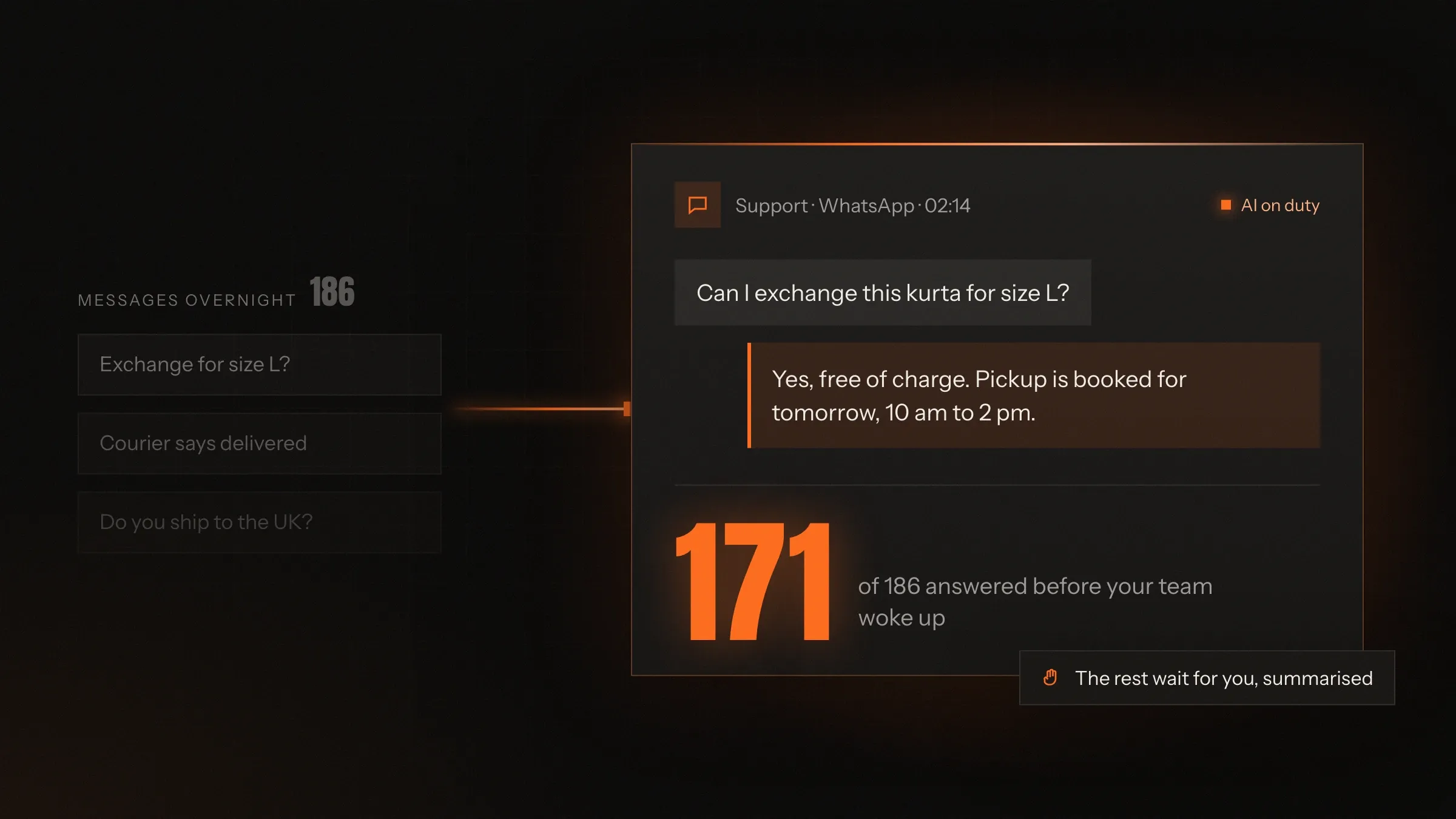
- Messages that arrive after closing wait until morning, and by then the customer has bought elsewhere.
- Most of your team's day goes on "where is my order?" and "can I change my booking?"
- Customers ask on WhatsApp, then email, then call, because nobody replied the first time.
- Sale days and festive weeks bury your team, and replies take days instead of minutes.
- Your help pages answer most questions, but customers message you instead of reading them.
- A night shift for support costs more than the messages seem worth.
What changes
-
Today: Customers who write at night hear back the next afternoon.
After: They get a correct answer in seconds, at any hour, and a person follows up when needed.
-
Today: Your team answers the same questions from nine to six.
After: The AI takes the routine questions; your team takes the cases that need a person.
-
Today: A hard case reaches a person with no history, and the customer explains it all again.
After: Each hand-over arrives with a summary, the order and what the customer has been told.
-
Today: Reply times collapse on sale days and during courier delays.
After: A wave of the same question is answered as fast as on a quiet Tuesday.
-
Today: Nobody knows which questions your website fails to answer.
After: Every question the AI couldn't answer is listed, so the gaps get fixed.
What it does for you
-
Reply in seconds, at any hour
On WhatsApp, web chat, email or the phone, from your policies, help pages and product details.
For exampleA customer asks at midnight whether a jacket runs small. The AI answers from the size guide and suggests the right size.
-
Look up the real answer
Orders, deliveries, bookings, refunds and account status, checked in your systems at the moment of the question.
For exampleA customer asks about a refund. The AI sees it was paid yesterday and shares the bank reference.
-
Make simple changes
Move a booking, update an address before dispatch, cancel within policy or resend an invoice, only where your rules allow.
For exampleA guest moves a table booking from Friday to Saturday without calling the restaurant.
-
Collect the details first
Order numbers, photos of a damaged item, serial numbers or screenshots, gathered before a person opens the case.
For exampleA customer reports a cracked mug. The AI asks for a photo and the order number, then opens the case.
-
Hand over with a summary
When a person should take over, the case moves to the right queue with the history, the account and a suggested reply.
For exampleAn upset customer asks for a manager. The case lands with the team lead, summed up in three lines.
-
Draft replies for your team
For cases it may not answer alone, it writes a reply your team checks, edits and sends.
For exampleA warranty claim arrives with a draft that quotes the warranty terms, ready to approve.
-
Ask how it went
A short rating after each resolved conversation, so you see how customers feel about the answers.
For exampleA customer rates a delivery answer 2 out of 5, and the conversation goes to your review list.
How it works
-
A customer writes
On WhatsApp, web chat, email or the phone, in their own words and their own language.
-
It checks who is asking
Before sharing anything about an order or an account, it confirms the customer's identity.
-
It finds the answer
From your help pages and policies, or live from your order, booking or billing system.
-
It replies or acts
It answers, or makes a change your rules allow, and tells the customer exactly what it did.
-
It hands over when it should
Refunds, complaints and anything unusual go to the right person, summed up in a few lines.
-
You see every conversation
Each one is logged, rated and counted in a monthly report your team can read.
Where we've built it
4 from our portfolio
-
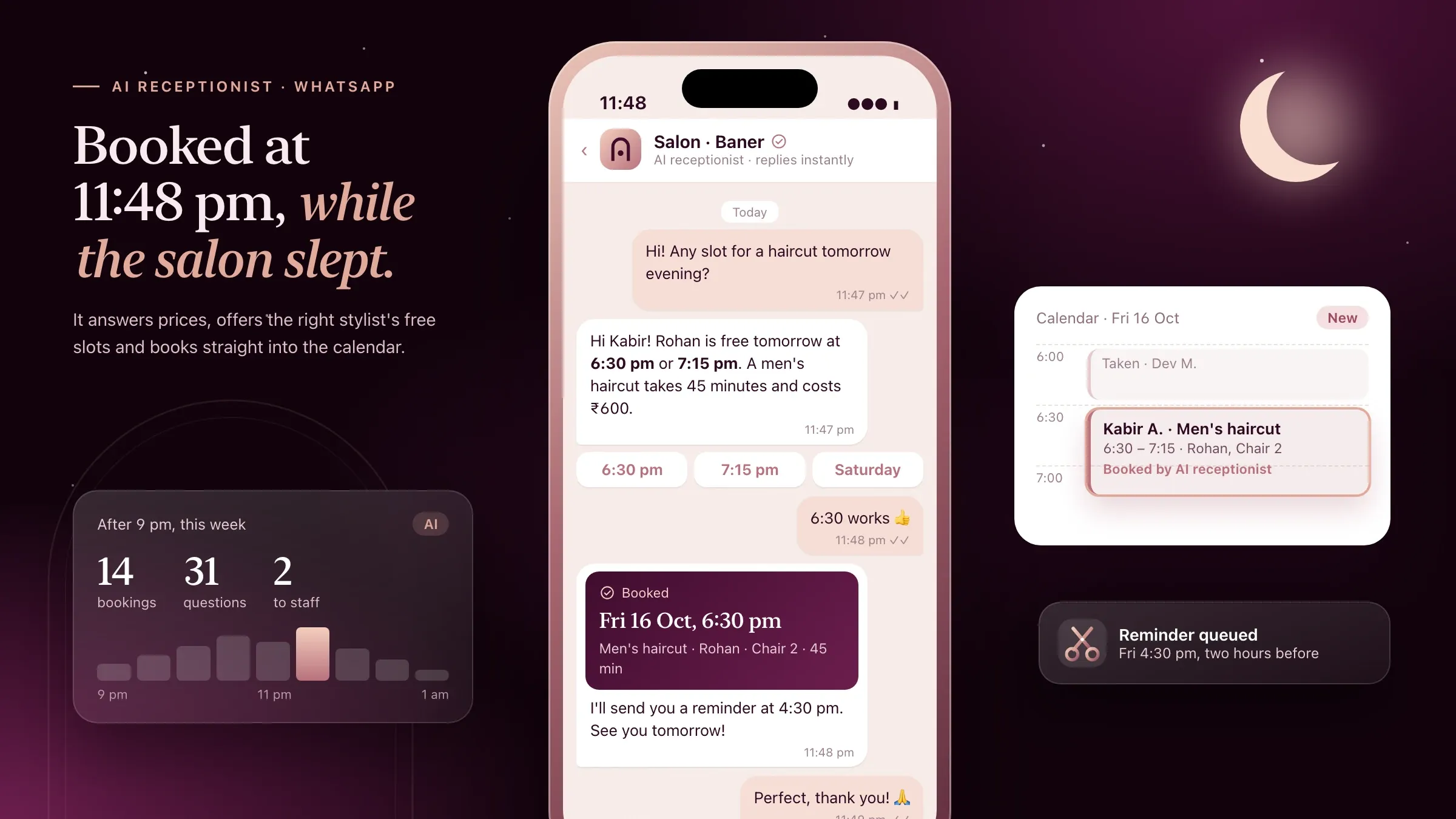 A receptionist on WhatsApp, at any hour For a salon software startup in Pune, we built the AI receptionist that answers clients on WhatsApp, books and moves appointments, and passes anything unusual to the staff. Meet the startup
-
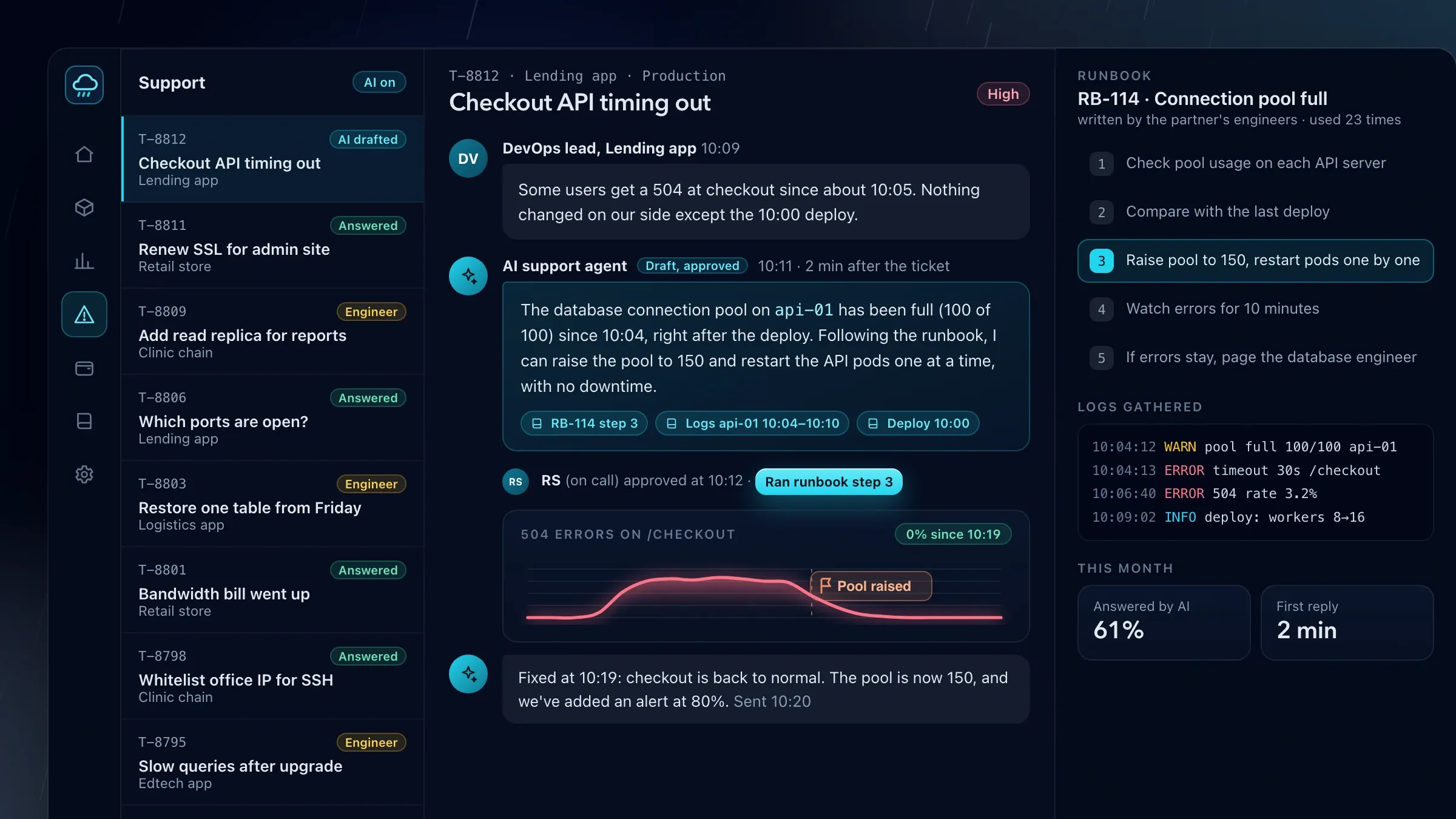 First-line tickets, answered from runbooks For our managed cloud partner in Mumbai, an AI agent reads each support ticket, answers routine questions from runbooks and gives engineers the rest with the logs gathered. View the investment
-
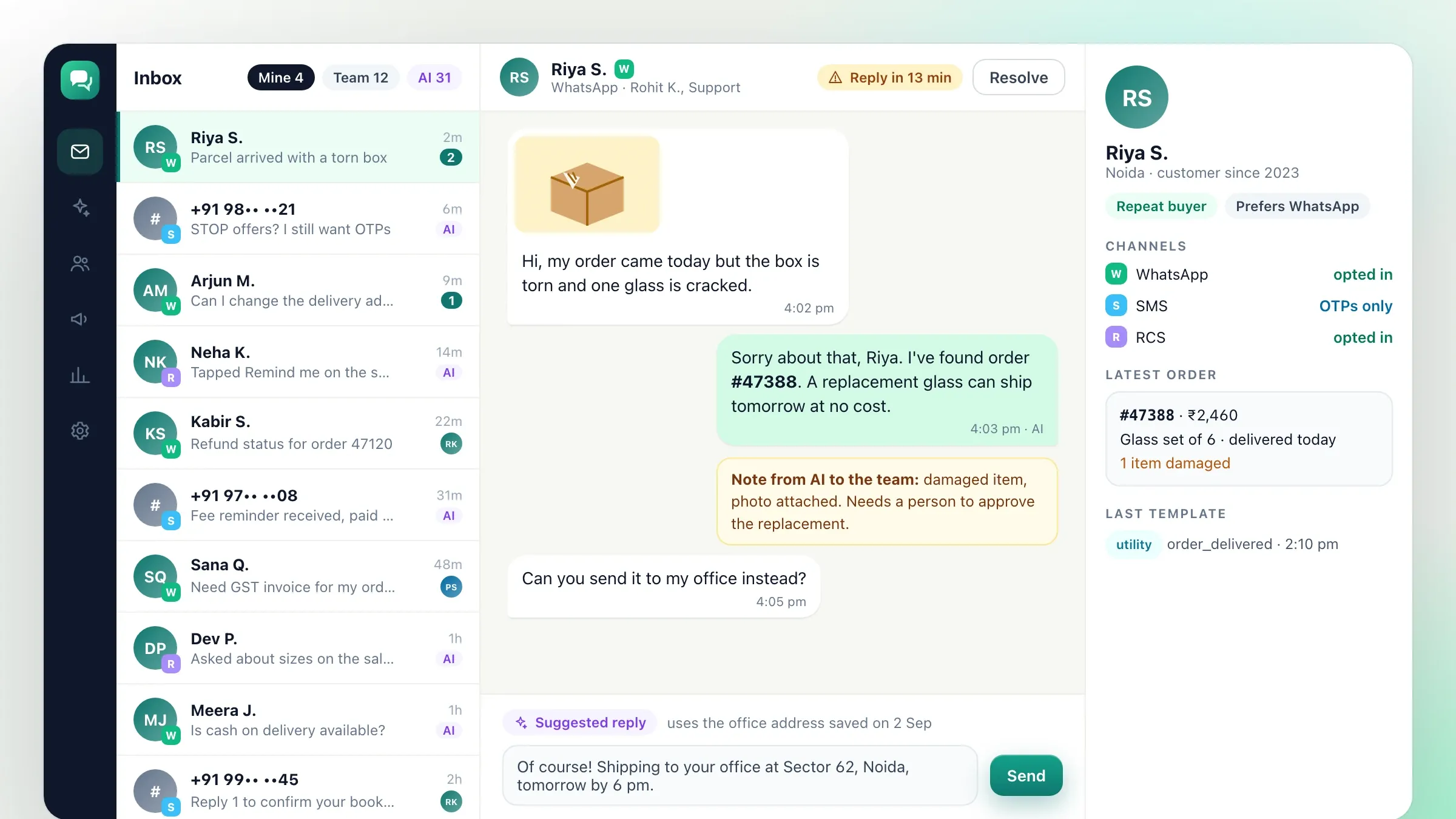 AI agents and a shared team inbox For the messaging platform we invest in, we built the AI agents its customers run on WhatsApp and a shared inbox where a person picks up any conversation. View the investment
-
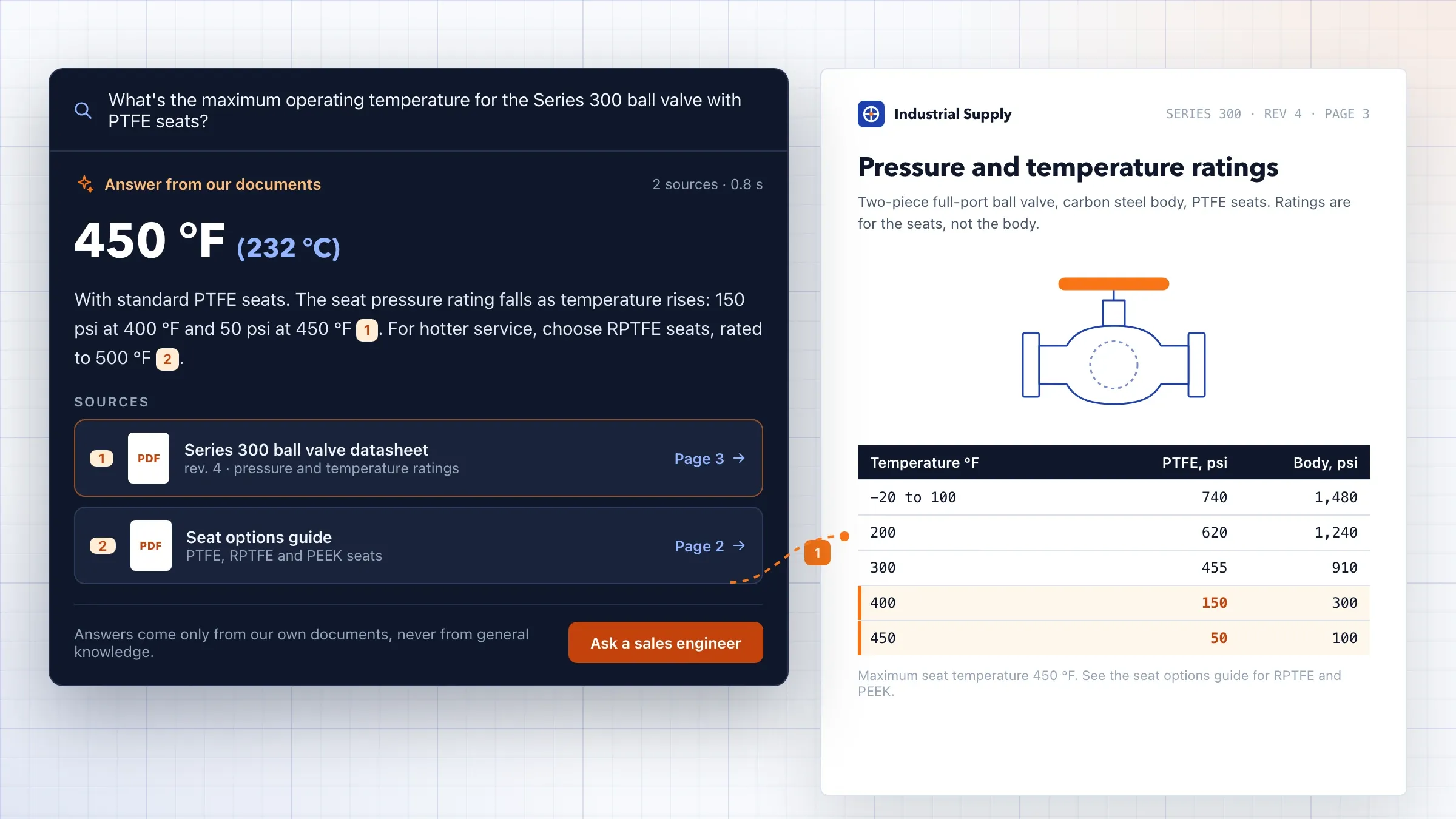 Technical questions, answered with the source For an industrial equipment distributor in Ohio, customers ask technical questions in plain words and get answers from the datasheets, with a link to the exact page. Read the case study
What AI customer support does
AI customer support answers your customers’ messages from your own information and passes the rest to your team. It reads a message on WhatsApp, web chat or email, works out what the customer wants, checks the facts it needs, such as an order, a booking or a policy, and replies, usually within seconds.
It is not a menu of buttons or a page of canned answers. Customers write in their own words, often in a hurry and in two languages at once, and expect a real reply. AI customer support handles that, and when a question is outside what it may answer, it says so plainly and brings in a person.
For most businesses the aim is not to take people out of support. It is to stop your team spending its day on questions that already have an answer, so they can give real attention to the customers who need them.
The questions to hand over first
Start with the questions your customers ask most. We read a few months of your tickets, chats and emails, group them by what customers actually wanted, and count how often each one comes up.
In most support queues a small group of questions makes up a large share of the work: where is my order, can I change my booking, what is your return policy, is this in stock, how do I reset my password, when will my refund arrive. Each has a clear answer that lives in your systems or your policies, which makes them the right first job.
Questions that need judgement come later, or stay with your team for good: a complaint about a staff member, a large refund, a damaged product where it is unclear who pays. The AI can still collect the details for those, so the person who picks them up starts with the whole story.
Every channel, one set of answers
AI customer support gives the same answer on every channel, in the form that suits each one. Customers don’t care which channel your team prefers: they write on WhatsApp, use the chat on your website, reply to an order email or call. Everything works from one store of knowledge and one set of rules.
On WhatsApp, replies are short, with buttons for common choices. Under WhatsApp’s rules, a business can reply freely within 24 hours of the customer’s last message; after that it must use a template approved by Meta, so follow-ups are planned around that window. Email replies can be longer and carry links and attachments. On the phone, speech is turned into text, answered, and spoken back in a natural voice, with a person one key press away.
Because the history is shared, a customer who starts in web chat and follows up on WhatsApp is not asked to explain everything again.
The hand-over to a person
A clean hand-over matters more than a clever answer. Customers forgive “let me bring in a colleague” far more easily than a loop of wrong replies.
We agree the triggers with you: the customer asks for a person, sounds upset, mentions a safety or legal issue, asks for something above a set amount, or the AI is not confident in its answer. When one of them fires, the conversation goes to the right queue with a short summary, the order or account it concerns, what the customer has already been told and a suggested next step.
The customer is told honestly what happens next. During your working hours, that means a person will reply shortly. At two in the morning, it means your team starts at nine, and the case will be at the top of the queue. Nobody is left waiting without knowing why.
Queues, priorities and your team’s morning
Your team’s morning changes most. Instead of a pile of unread messages, they open a short queue of cases that genuinely need a person, sorted by urgency and already summarised.
Routing follows rules you set: by topic, by language, by the value of the order or by the product involved. Billing questions go to accounts, warranty claims to the service desk, and Gujarati conversations to someone who speaks Gujarati. Each case shows how long it has waited against the reply time you promise.
For cases the AI may not send on its own, it still drafts the reply. Your team reads the draft beside the conversation, changes what needs changing and sends it, which keeps the human answers fast too.
Tone, language and honesty
A support reply should sound like your best support person on a good day. We write the AI’s tone from your own best replies: how you greet customers, how you apologise, which words you never use and how formal to be.
Language follows the customer. Someone who writes in Hinglish gets a reply in the same mix; someone who writes in Gujarati gets Gujarati. Product names, prices and order numbers stay exactly as they are in your systems.
Customers are told they are talking to an AI assistant, and they can ask for a person at any point. Being open about it builds more trust than pretending otherwise, and it sets the right expectations for what the assistant can and cannot do.
Keeping what it knows up to date
AI customer support is only as good as the information behind it. It uses two kinds: fixed knowledge, such as policies, help articles and product details, and live data, such as orders, bookings, stock and account status.
Fixed knowledge sits in a searchable store that your team can edit, with a named owner for each topic. Live data is fetched from your systems at the moment of the question, so the AI never answers from yesterday’s stock count.
Every question it could not answer goes on a list. Reading that list each week is the quickest way to find missing policies, out-of-date pages and questions your website never answered.
Measuring support quality
We measure AI customer support the way you would measure a support team. Before launch we take a baseline from your history: how quickly customers get a first reply, how many conversations end without a person, how many customers come back with the same problem and what they say when asked how it went.
During the pilot, the AI drafts and your team approves, so its answers can be compared with theirs on real cases. After launch, a monthly report shows the conversations handled, the hand-overs and their reasons, repeat contacts and ratings, alongside a set of conversations your team reviews by hand.
A good report is not the one with the fewest hand-overs. It is the one where the right cases were handed over and everything else was answered correctly.
Privacy and safety in support conversations
Support conversations are full of personal details, so the rules are strict. Before the AI shares anything about an account or an order, it confirms who it is talking to, for example with the order number and the phone number on the order, or a one-time code.
Card numbers, Aadhaar numbers and passwords are never asked for in chat, and are masked if a customer types them. The AI can only take the actions its account allows, so a customer who tries to talk it into a refund outside your policy gets a polite no: the software doesn’t let it, whatever the customer writes.
Conversations are kept for the period you choose, in the region you need, and handled in line with India’s data protection law, or the GDPR where your customers are in Europe.
Sale days, launches and the months after
Support follows your calendar. Sale days, festive weeks, a product launch or a courier delay bring sudden waves of the same questions, and the AI answers each wave without overtime.
We prepare it for each one: new offers and their terms, delivery cut-off dates, or an honest message about a known delay. After launch we review conversations with you every month, fix wrong answers, add new topics and widen what it may do on its own as your team’s trust in it grows.
How we work with you
From the first call to running it
- Start
Read your support history
We go through your past tickets and chats with your support lead, pick the questions to hand over first and agree how we will measure success.
- Build
Connect and write the rules
We connect your channels and systems, load your policies and help pages, and write the tone and hand-over rules with your team.
- Pilot
Drafts on real messages
The AI drafts replies to real customers and your team approves each one, so we can compare its answers with theirs and correct it.
- Launch
Answering on its own
It starts replying by itself on one channel, for the topics you have approved, then moves to the next channel.
- Every month
Review and widen
We read conversations with you, fix wrong answers, add new topics and prepare it for sale days, launches and policy changes.
Safe and in your control
Identity checked first
No order or account detail is shared until the customer is confirmed, by details on the order or a one-time code.
A person is always reachable
Customers can ask for a person at any time, and are told honestly when your team will reply.
Limits the system enforces
Refunds, discounts and changes beyond its permissions are blocked by the software, not left to the AI's judgement.
Sensitive numbers kept out
Card numbers, ID numbers and passwords are never asked for in chat, and are masked if a customer types them.
Every conversation open to review
Your team can read any conversation and see what the AI looked up and why it replied as it did.
Conversations stay private
They go only to AI providers' business services that don't train their models on them, and are stored in the region you choose.
Time and cost
The cost of AI customer support depends on what it answers and where, not on a seat licence. Most businesses start with their most common questions on one channel, then add more. After the first call we send a written plan and a quote.
Channels
WhatsApp, web chat, email and the phone each need their own set-up and tests. Most businesses start with one or two.
Live lookups
Answering from policies alone is the quickest start. Checking orders, bookings or accounts means connecting those systems.
Actions it may take
Answering is simpler than changing bookings or addresses, which need more rules and more tests.
Languages
Each language is tested on your own past messages before it goes live.
Volume
Running costs follow the number of conversations each month: AI usage, plus WhatsApp's per-message charges where templates are used.
Built with
Chosen for each project, never by habit
Questions and answers
13 answered
What is AI customer support?
AI customer support is software that answers customer messages on channels such as WhatsApp, web chat and email, using your own policies and live data from your systems, and passes anything it shouldn't handle to a person. It works at any hour and replies in the customer's language.
Will customers know they are talking to AI?
Yes. We recommend telling customers they are chatting with an AI assistant, and every conversation has a clear way to reach a person. Being open about it sets the right expectations and builds trust.
Which channels can AI customer support answer on?
WhatsApp, the chat on your website or app, email and the phone, with the same answers and rules on each. Most businesses start with the channel where most questions arrive, which in India is often WhatsApp.
Can a customer reach a person at any time?
Yes. A customer can ask for a person whenever they like, and the AI hands over by itself when someone is upset, the question is sensitive or it isn't sure. Out of hours, it tells the customer when your team will reply.
Can it reply in Hindi, Gujarati and other languages?
Yes. It understands and replies in English, Hindi, Gujarati and many other languages, including the mix of Hindi and English many customers write in. We test each language on your own past messages before it goes live.
Does it work with our helpdesk, online store or CRM?
Usually, yes. It connects through those tools' APIs to read orders, bookings and accounts and to create or update tickets, so your team keeps working in the tools it knows. Older systems may need a small bridge, which we build.
How much does AI customer support cost?
It depends on the channels, the systems it has to check, the actions it may take, the languages and the number of conversations each month. There is a one-time cost to build it and a running cost that follows volume. We send a written quote after the first call.
How long does it take to set up AI customer support?
Answering common questions on one channel from your policies is a matter of weeks. Live order lookups, more channels, more languages or actions such as rebooking take longer. The plan after the first call sets out the steps and the timeline.
What if the AI gives a customer a wrong answer?
It answers only from your information, checks live facts in your systems and hands over when it isn't sure. Every conversation is logged, so a wrong answer can be traced to its cause, corrected and tested before the fix goes live.
Will AI customer support replace our support team?
No. It changes what your team spends its day on: fewer repeated questions, and more time for complaints, complex cases and customers who need a person. The AI also prepares each hand-over, so those cases are quicker to resolve.
Is customer data safe with AI customer support?
Identity is confirmed before account details are shared, sensitive numbers are kept out of chats, and the AI can only do what its permissions allow. Conversations go to AI providers' business services that don't train on them, and are stored in the region you choose.
Do you build AI customer support for businesses outside India?
Yes. FIRELIFE Ventures works with small and mid-size businesses worldwide from Rajkot, India, on India time. Our portfolio includes AI that answers customers for a client in the United States, and for a messaging partner and a startup we back in India, in their channels and their customers' languages.
What happens after AI customer support goes live?
We keep running it with you: we review conversations every month, correct wrong answers, add new topics and prepare it for sale days, launches and policy changes.
Tell us what you want to build
Write a few lines about the idea and who it is for. We reply with our questions, a first plan and how we would start.
Write to us