Build something new CRM development
Follow up every lead
We build CRM software around the way your team sells: every enquiry from every channel in one list, a pipeline everyone can see, WhatsApp inside each deal and a next step with a date on every lead.
- We start from how your team sells today
- Your old leads come with you
- English, Hindi, Gujarati and more
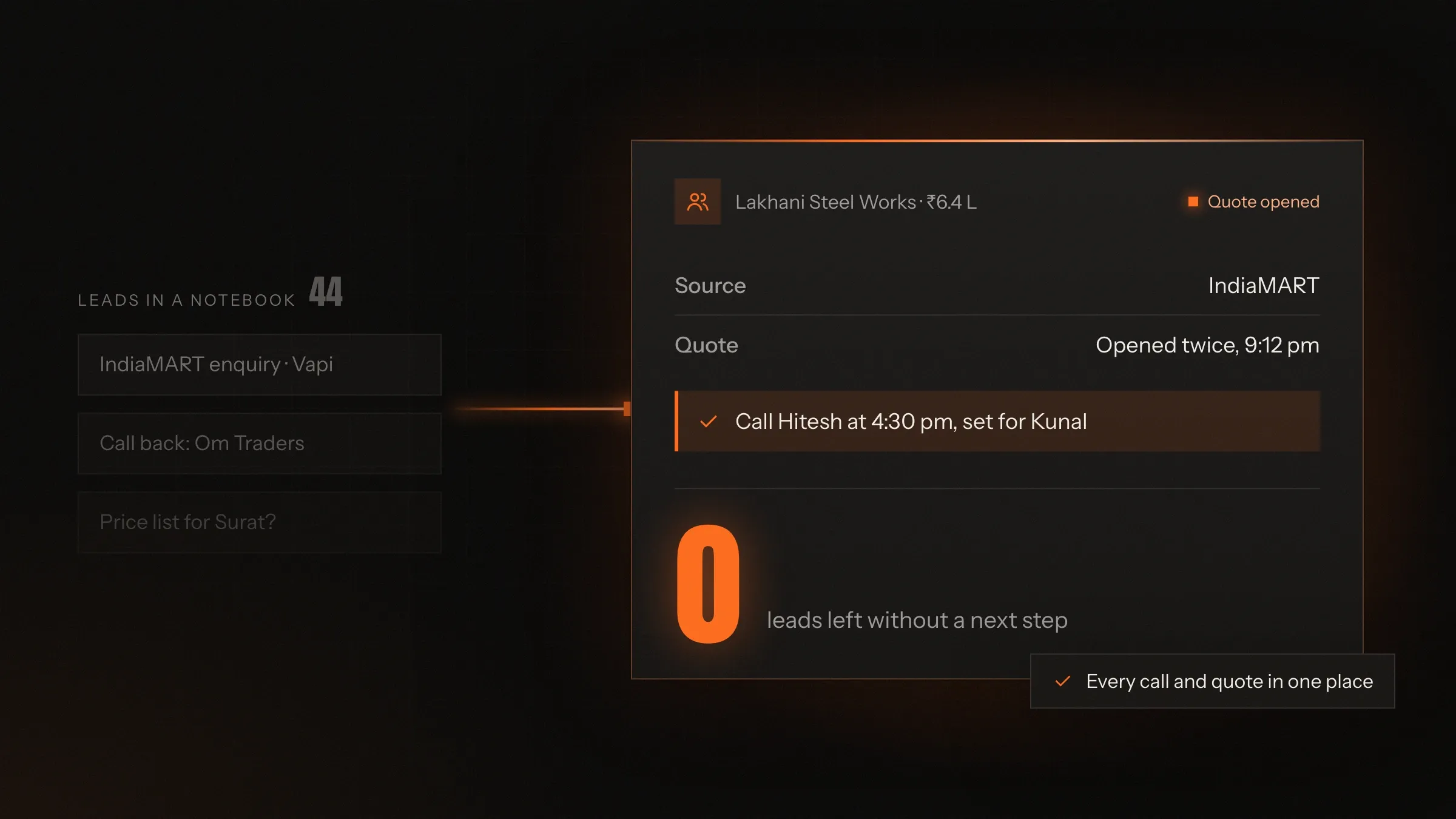
Sound familiar?
What we hear before we start
- Enquiries arrive on WhatsApp, IndiaMART, the website and the phone, and live in five different places.
- A lead waits a day for a reply, and buys from whoever answered first.
- Follow-ups depend on someone remembering, so the ones that matter most slip.
- When a salesperson leaves, their customers and chats leave with their phone.
- You can't tell which ads bring buyers and which only bring calls.
- You tried an off-the-shelf CRM. The team was back on the spreadsheet within a month.
What changes
-
Today: Leads sit in inboxes, notebooks and personal phones.
After: Every enquiry lands in one list with its source and an owner, the moment it arrives.
-
Today: Follow-ups happen when someone remembers.
After: Every open deal has a next step and a date, and today's list is waiting each morning.
-
Today: WhatsApp chats live on salespeople's own phones.
After: Chats run on a shared business number and stay with the deal.
-
Today: Quotes are typed one by one, and nobody knows if they were read.
After: Quotes come from your price list with GST, and you see when they are opened.
-
Today: The Monday sales meeting starts with "where are we on this?"
After: The pipeline shows what moved, what is stuck and who needs a hand.
What it does for you
-
Catch every lead
Website forms, WhatsApp, Meta and Google lead ads, IndiaMART, JustDial, email and calls arrive in one list, matched to the right contact and never duplicated.
For exampleA buyer's IndiaMART enquiry arrives at night and is waiting, assigned and tagged, when the team starts at 9.
-
Share leads out by your rules
By region, product, language or turn, with an alert to the owner and a nudge to the manager when a new lead goes untouched.
For exampleA Gujarati-speaking buyer from Surat goes to the salesperson who covers Surat.
-
Keep every deal moving
A pipeline with your own stages, a next step on every open deal and a list each morning in order of deal value.
For exampleA deal can't be saved without a follow-up date, so nothing quietly goes cold.
-
Sell on WhatsApp, on the record
Replies from inside the deal on a shared business number through the official WhatsApp Business API, with approved templates for reminders.
For exampleA salesperson goes on leave, and the colleague covering sees every message the customer sent.
-
Quote in minutes
Quotations from your price list, with discounts within limits, GST and your terms, sent as a PDF and tracked when opened.
For exampleA dealer opens a quotation twice in one evening, and the deal rises to the top of tomorrow's list.
-
Fit the way your trade sells
Fields and stages for what you sell: site visits for property, test orders for manufacturers, trial accounts for software, counselling for admissions.
For exampleA property team books a site visit from the lead, and the buyer gets a reminder the day before.
-
Show where deals come from
Reports by source, stage, salesperson and product, built around the questions owners actually ask.
For exampleThe owner sees which ad campaign brought deals that closed, not just phone calls.
-
Draft the next message with AI
AI reads the conversation and drafts a reply, a quote email or a reminder, for a person to check and send.
For exampleAfter a call, the AI drafts the follow-up in Hindi; the salesperson changes a line and sends it.
How it works
-
A lead arrives
From a form, an ad, WhatsApp, a marketplace, an email or a call.
-
It's matched and routed
Joined to the existing contact if there is one, then assigned by your rules.
-
Someone replies fast
The owner is alerted and replies from the deal, on WhatsApp, email or phone.
-
It moves through your stages
Each stage asks for what it needs: a quote, a visit, a drawing, an approval.
-
A next step is always set
Every open deal has a date, so it appears on someone's list.
-
Won, lost or kept warm
Won deals pass to billing or delivery; lost ones record why.
Where we've built it
3 from our portfolio
-
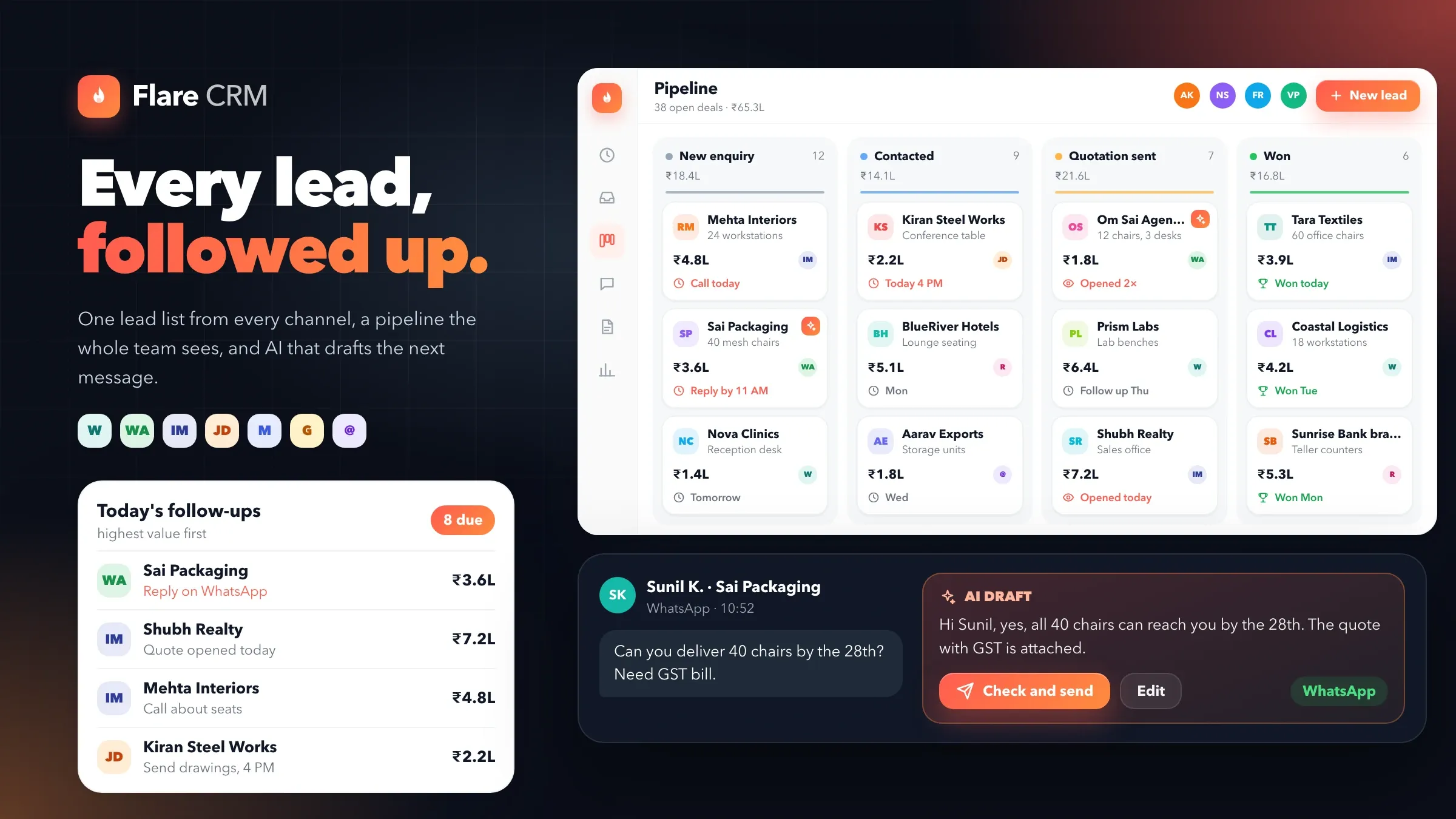 Flare CRM, our own CRM Our CRM for small and mid-size sales teams, in development: leads from every channel in one list, a pipeline, WhatsApp built in and AI that drafts replies. See the product
-
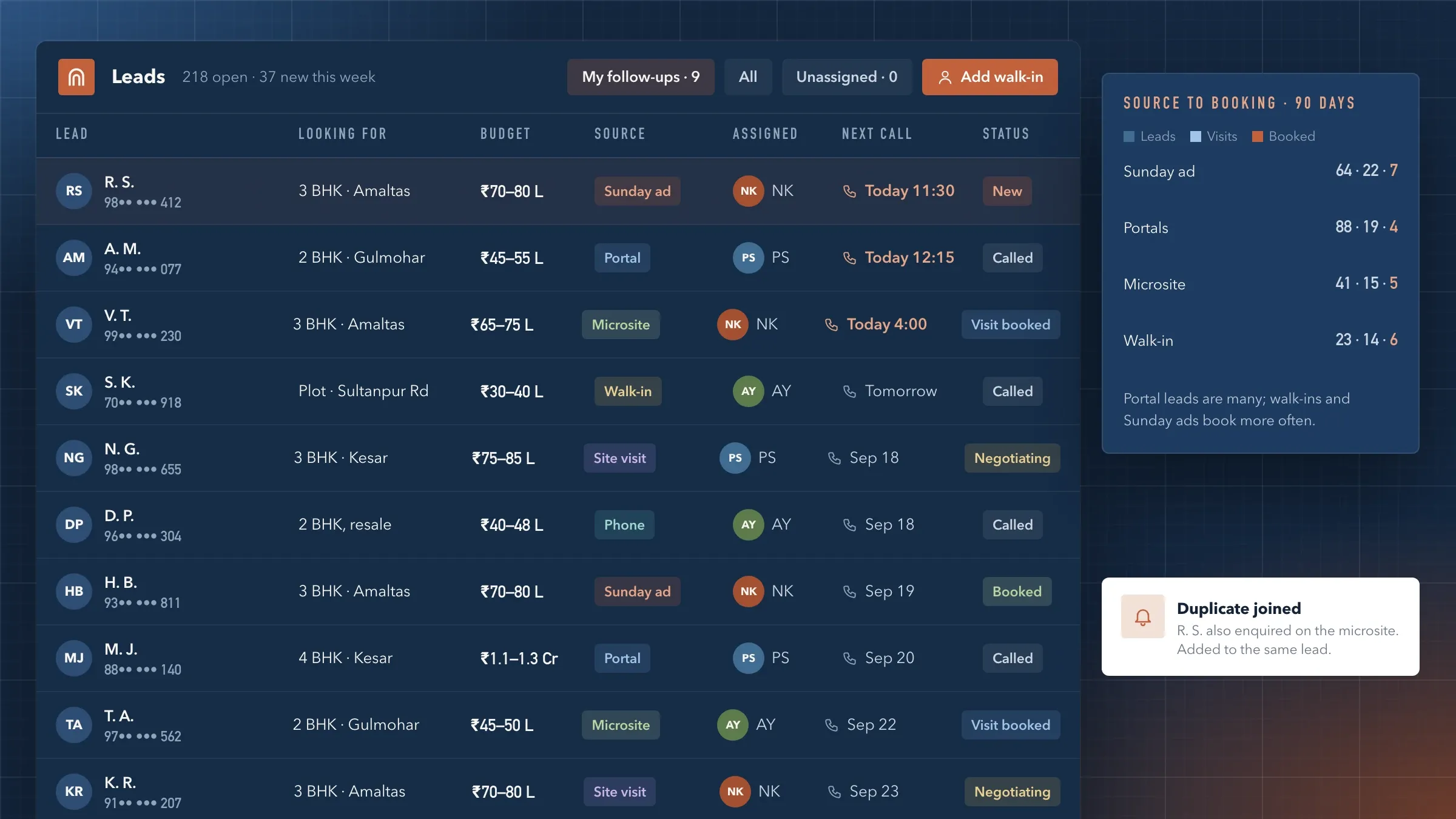 Every enquiry on record For a real estate developer and brokerage in Lucknow, every enquiry is captured with its source, assigned to a salesperson and alerted by SMS and email at once. Read the case study
-
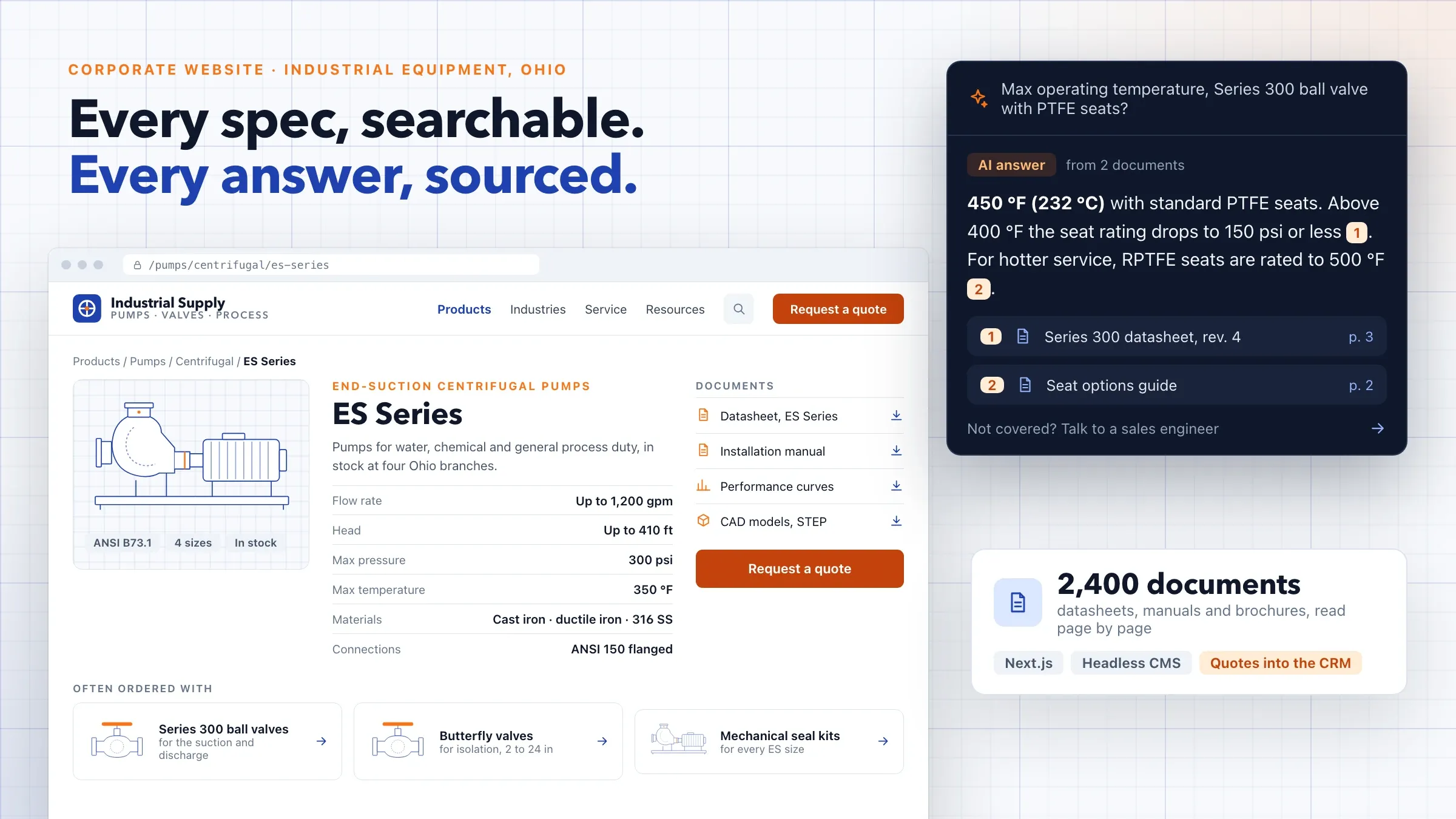 Quote requests straight into HubSpot For an industrial equipment distributor in Ohio, each quote request reaches HubSpot with the product, quantity and application, assigned by region and product line. Read the case study
What a CRM actually does
A CRM is one place for every lead, customer, conversation and deal, so your team knows who to contact, what was said and what happens next. It replaces the notebook, the shared spreadsheet and the WhatsApp chats on personal phones.
A good CRM does three jobs. It catches every enquiry, wherever it comes from. It makes sure each one has an owner and a next step. And it shows the owner where sales come from and where they get stuck. Everything else, from quotes to reports, supports those three jobs.
CRM development means building that system around the way your team already sells, instead of asking the team to learn someone else’s idea of a sales process.
Build, buy or both
Buy a standard CRM when it fits the way you sell and your team will use it; build one when it doesn’t. That is the honest answer, and we give it at the first call.
A custom CRM pays off when your sales run in ways standard tools handle badly. Most conversations happen on WhatsApp. Leads arrive from IndiaMART and JustDial as much as from your website. You sell through dealers or distributors. A deal needs a site visit, a trial order or a technical approval. Quotes follow your own price lists, discounts and GST rules. It also pays off when the CRM has to work closely with your billing, ERP or production software.
Sometimes the answer is in between. If you already use HubSpot or another CRM, we can connect your website and other systems to it, as we did for an industrial equipment distributor in Ohio whose quote requests reach HubSpot with the product and quantity attached. We are also building our own CRM, Flare CRM, for small and mid-size sales teams. It is in development, and if it fits the way you sell, you can ask for early access.
Where your leads come from
Most growing businesses get enquiries from many places at once, and each needs its own connection. A typical list:
- website and landing page forms;
- WhatsApp chats, including click-to-WhatsApp ads;
- Meta and Google lead ads;
- IndiaMART, JustDial and other trade portals;
- emails to the sales inbox;
- phone calls, walk-ins and trade fairs, entered by the team.
Each source is connected so its leads arrive on their own, tagged with where they came from. A new enquiry is matched to an existing contact by phone number or email, so a buyer who writes on WhatsApp and then fills in a form is one person, not two. Your routing rules then assign it by region, product, language or turn, with an alert to its owner and a nudge to the manager if nobody picks it up.
Speed of reply matters more than anything else here. A developer and brokerage we built a property portal for in Lucknow learned this early: leads were lost in the gap between an ad running and someone calling back. Every enquiry now reaches a salesperson by SMS and email the moment it arrives.
What we need from you
We need three things: a few hours with the people who sell, real examples of your leads, and one person who decides.
The sales team shows us how a lead really moves today, including the shortcuts no process document mentions. Real examples, such as a month of enquiries, a few quotes and the spreadsheet everyone uses, let us design fields and stages that match your work rather than a template. One person on your side, usually the sales head or the owner, agrees the stages, the routing rules and what each report must answer.
We also need access to your lead sources (ad accounts, IndiaMART, the website), your WhatsApp Business number and any system the CRM should talk to, such as accounting or billing.
A pipeline your team will actually use
A CRM fails when it asks for more than it gives back, so we design it to save each salesperson time from the first day.
That means fewer fields, filled in for them wherever possible. Stages named the way your team talks: “site visit done”, “drawing approved”, “rate approved”. A next step and a date on every open deal, so nothing goes quiet. And a list each morning, on the phone, of today’s calls and replies in order of value, with overdue follow-ups at the top.
Each stage can ask for what it needs before a deal moves on: a quotation before “quote sent”, a reason before “lost”. Managers see who has too much, which deals are stuck and which leads nobody has touched. Owners see the whole pipeline without asking anyone for a report.
WhatsApp, calls and email in one record
In India many deals are won on WhatsApp, so WhatsApp belongs inside the CRM, not beside it.
We connect the official WhatsApp Business API on a shared business number. Salespeople reply from inside the deal, on a phone or a computer, and every message is saved with the deal it belongs to. When someone goes on leave or moves on, their conversations stay with the company. Approved message templates handle reminders outside WhatsApp’s 24-hour reply window, and each customer’s opt-in is recorded.
Emails to and from the sales inbox attach themselves to the right contact, and calls are logged with a note and an outcome. An AI assistant can read the conversation and draft the next message in English, Hindi or Gujarati, for a person to check and send.
Quotes, GST and the handover after a win
A quotation is often where a deal is won or lost, so it should take minutes, not an evening. Quotes are built from your own price list, with discounts within the limits you set, GST worked out and your terms attached. They go out as a PDF on WhatsApp or email, and the CRM shows when the customer opens them.
A discount beyond a salesperson’s limit goes to a manager for approval first. When the customer accepts, the deal moves to won and its details pass on: to Tally or your accounting software for the invoice, to your ERP or order system for delivery, or to the team that onboards the customer. Nobody types the same order twice.
Reports that answer the owner’s questions
Before we build, we agree how success will be measured: how fast new leads get a first reply, how many open deals have no next step, how many deals each source brings, and where deals are lost.
The reports are built around those questions:
- which lead sources bring deals, not just leads;
- the stage where deals stall or are lost, and the reasons recorded;
- how long deals take to close, by product and salesperson;
- what is likely to close this month;
- who on the team is overloaded, and who needs a hand.
Because every lead carries its source from the first message, you can finally see which ad campaign, trade portal or exhibition is worth what it costs.
Moving in and keeping data safe
Most teams arrive with spreadsheets, a phone full of contacts or an old CRM. We import contacts, leads and deals, map your columns to the new fields and merge duplicates on the way in. The new CRM can run beside the old sheet for a while, until the team trusts it.
Customer data is encrypted, backed up and kept in the cloud region you need. Access is set by role: salespeople see their own leads, managers their team, owners everything. Every change to an owner, a price or a stage is logged, and you can export all of your data whenever you want.
After launch
A CRM gets better the more the team uses it. In the first months we watch what people use and what they skip, remove fields nobody fills in, and tune the routing and reminders.
Then we add what comes next: a new lead source, a portal for your dealers, a link to accounting, or AI drafts once the basics are settled. We run and update the CRM with you on India time, so it keeps up as your team and your products change.
How we work with you
From the first call to running it
- Start
Map how you sell
We sit with your sales team, follow real leads from first message to invoice, and write down your stages, routing rules and the reports you want.
- Build
Build and connect
We build the lead list, pipeline and screens around your stages, connect your lead sources and WhatsApp, and import your existing leads.
- Pilot
One team first
One team or branch works in it for real, with the old sheet beside it, and we fix whatever slows them down.
- Launch
Everyone moves in
The whole team switches, with short training on their own leads, and the old spreadsheets are retired.
- Every month
Review and improve
We look at what the team uses, what it skips and where deals stall, then add the next improvement.
Safe and in your control
Each person sees their own
Salespeople see their own leads, managers see their team, and owners see everything, set by role.
Every change on record
Who changed a deal, a price, a stage or an owner, and when, is logged and can be checked.
Chats stay with the company
WhatsApp runs on a shared business number, so customers and history stay when someone leaves.
Consent recorded
Each customer's opt-in for WhatsApp and email is stored with the contact, and approved templates are used outside the reply window.
Your data, yours to take
Every lead, deal and conversation can be exported whenever you want, in a standard format.
Kept where you need it
Data is encrypted, backed up and kept in the cloud region your business needs.
Time and cost
The cost of a CRM depends on how leads reach you and how much of your sales process it has to carry, not on a package. Many teams start with the lead list, the pipeline and WhatsApp, then add quotes, reports and links to other systems. After the first call we send a written plan and a quote.
How many lead sources
Each source, from forms and ads to IndiaMART, JustDial and email, is a connection to build and test.
How your deals move
A simple pipeline is quick. Quotes, approvals, site visits or trial orders add screens and rules.
WhatsApp and messages
Setting up the WhatsApp Business API and its templates is part of the build; WhatsApp's own message charges follow your volume.
Your old data
One clean spreadsheet imports quickly. Years of mixed sheets and an old CRM take longer to clean and merge.
Other systems
Links to accounting, billing or your ERP add time, and more for older software without an API.
A phone app or not
A phone-friendly web app costs less; a mobile app for field sales adds to the build.
Built with
Chosen for each project, never by habit
Questions and answers
13 answered
What is CRM development?
CRM development is building customer relationship management software around the way your team sells: where leads come from, the stages deals go through, who follows up and which reports you need. The CRM is shaped to your process instead of your process being bent to fit a standard tool.
Should we build a custom CRM or buy one?
Buy one if a standard CRM fits how you sell and your team will use it. Build one when you sell in ways standard tools handle badly, such as WhatsApp-first sales, dealer networks, site visits or complex quotes, or when the CRM must work closely with your own systems. We tell you which at the first call.
Do you have a ready-made CRM?
We are building our own, Flare CRM, for small and mid-size sales teams: leads from every channel in one list, a sales pipeline, WhatsApp built in and AI that drafts replies. It is in development, and businesses that want early access can ask. When your process needs more, we build a CRM for you.
How much does CRM development cost?
It depends on how many lead sources you have, how your deals move, which systems it connects to and how much old data comes with you. Starting with leads, pipeline and WhatsApp keeps the first version small. After the first call we send a written plan and a quote.
How long does it take to build a CRM?
A focused CRM with a few lead sources and one pipeline is a matter of weeks. One with quotes, approvals, a mobile app and links to accounting takes longer. The written plan after the first call sets out the timeline.
Can the CRM capture leads from IndiaMART, JustDial and ads?
Yes. Enquiries from IndiaMART and JustDial, Meta and Google lead ads, website forms and emails can arrive in the lead list on their own, each tagged with its source, so you can see which channel brings deals.
Does a custom CRM work with WhatsApp?
Yes. We connect the official WhatsApp Business API on a shared business number. Salespeople reply from inside the deal, every message is saved with it, and approved templates send reminders outside WhatsApp's 24-hour reply window.
Can the CRM connect to Tally, our ERP or our website?
Yes. Won deals can pass to Tally or your accounting software, orders to your ERP, and website forms straight into the lead list. Modern software with an API connects quickly; older software may need a small bridge, which we build.
Can we move our leads from spreadsheets or another CRM?
Yes. We import contacts, leads and deals, map your columns to the new fields and merge duplicates on the way in. The new CRM can run beside the old sheet until the team trusts it.
Can the CRM work in Hindi and Gujarati?
Yes. Screens, templates and AI-drafted messages can be in English, Hindi and Gujarati, so each salesperson works and writes to customers in the language they use.
Will my sales team actually use it?
They will if it saves them time from the first day. We design it with them: fewer fields, today's list on the phone and replies from inside the deal. One team pilots it first, and we fix what slows them down before everyone moves.
Do you build CRM software for businesses outside India?
Yes. FIRELIFE Ventures works with small and mid-size businesses worldwide, from Rajkot, India, on India time. Our portfolio includes lead and CRM work for clients in the United States and India.
What happens after the CRM goes live?
We run it with you: we watch what the team uses and skips, tune routing and reminders, keep it updated and add what comes next, such as a new lead source, a dealer portal or a link to accounting.
Tell us what you want to build
Write a few lines about the idea and who it is for. We reply with our questions, a first plan and how we would start.
Write to us