Build something new telemedicine app development
See patients by video, in their language
We build telemedicine apps that let your doctors see patients by video, audio or chat, in the language each patient speaks, with consent, e-prescriptions, payments and follow-ups built in and the rules for online consultations followed on every screen.
- Built within the telemedicine rules where you practise
- Calls that hold up on weak networks
- Gujarati, Hindi, English and more
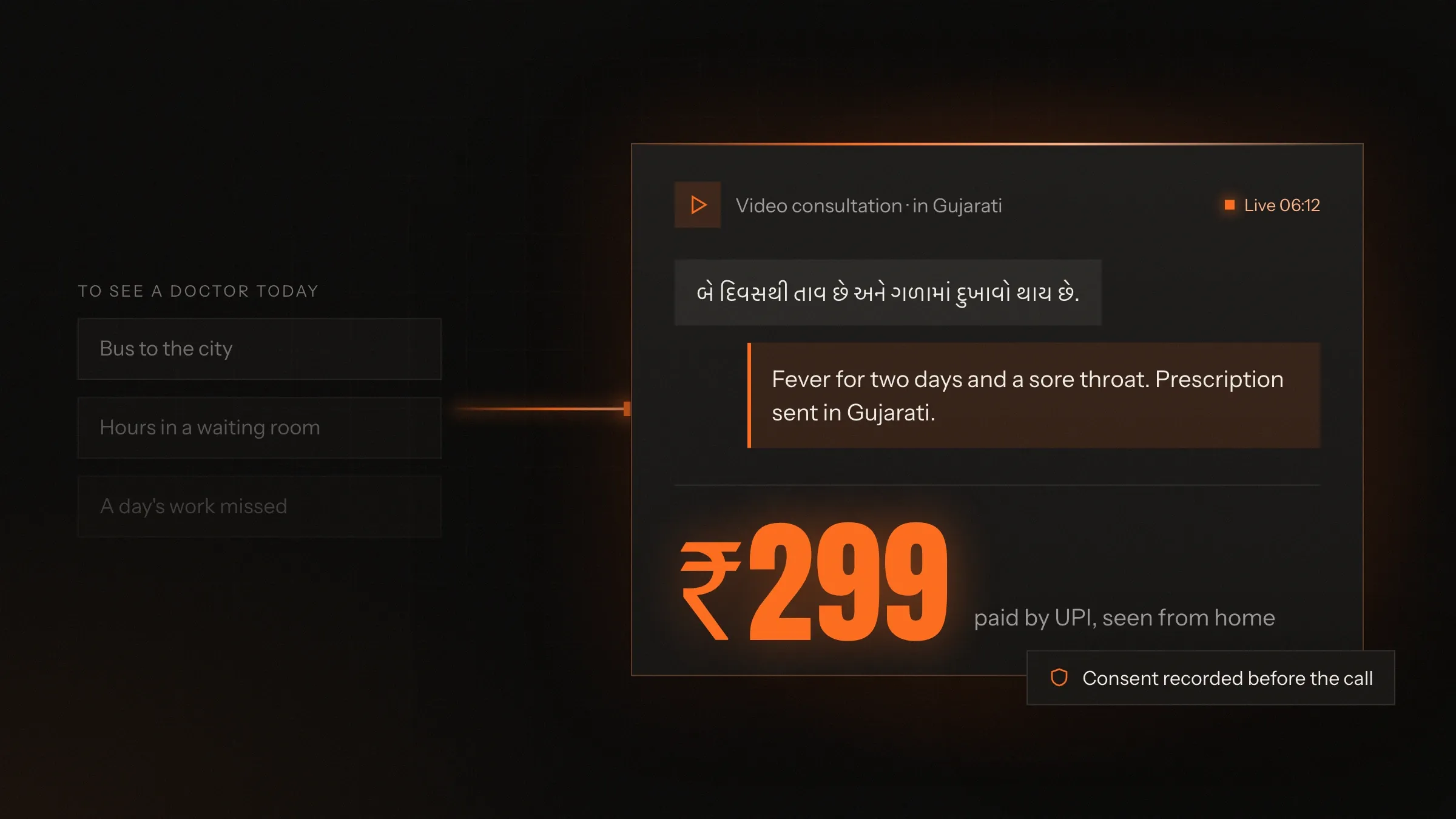
Sound familiar?
What we hear before we start
- Patients travel half a day for a follow-up that could have been a ten-minute call.
- Your doctors already consult on WhatsApp video, with no consent, no record and no proper prescription.
- The telemedicine apps you've tried speak only English, and many of your patients don't.
- Calls freeze and drop the moment a patient's network gets weak.
- Patients who should come back for a review quietly don't.
- You're not sure what the rules allow a doctor to prescribe online.
What changes
-
Today: Consultations happen on personal phones and WhatsApp calls.
After: Every consultation is booked, paid, consented to and recorded in one app.
-
Today: Patients struggle to describe symptoms in a language they don't think in.
After: Patients choose a doctor who speaks their language, and read their advice in it.
-
Today: A weak network ends the call, and the patient is left waiting.
After: The call drops to clear audio when video can't keep up, and reconnects on its own.
-
Today: Prescriptions are typed into a chat or photographed from a pad.
After: E-prescriptions carry the doctor's registration number and follow the online prescribing rules.
-
Today: Follow-ups depend on the patient remembering to call.
After: Reviews are booked from the prescription, with reminders on WhatsApp.
What it does for you
-
Booking and payment
Patients book a speciality, a doctor and a time in the app, on the web or on WhatsApp, and pay by UPI or card before the call.
For exampleA patient in Mehsana books a Gujarati-speaking paediatrician for 7 pm and pays by UPI in the same chat.
-
Video, audio and chat consultations
Calls in the app and the browser, with no download needed for the patient, and audio or chat when that suits the case.
For exampleA diabetes review that only needs the latest readings happens by audio in five minutes.
-
A waiting room with a real wait
Patients join a virtual waiting room and see when their doctor will be with them, so nobody sits staring at a frozen screen.
For exampleA doctor running ten minutes late is shown to every waiting patient, without a phone call.
-
Consent and identity, on record
The patient's consent and identity are confirmed before the call and kept with the consultation.
For exampleA daughter booking for her mother confirms who the patient is, and the consent is recorded in the mother's name.
-
E-prescriptions within the rules
Prescriptions built from templates, carrying the doctor's name, qualifications and registration number, and limited to medicines allowed for the type of consultation.
For exampleA medicine that can't be prescribed by teleconsultation simply can't be added to an online prescription.
-
Patient history beside the call
Past consultations, reports, medicines and allergies on the doctor's screen while they talk, linked to ABHA where the patient chooses.
For exampleThe doctor sees last week's lab report the patient uploaded, without asking for it to be sent again.
-
Notes drafted for the doctor
With the patient's consent, AI drafts the consultation notes and prescription from the conversation for the doctor to check and approve.
For exampleAt the end of the call, the draft is ready; the doctor corrects one dose and signs.
-
Labs, medicines and follow-ups
Lab tests booked from the prescription, medicines ordered from partner pharmacies, and review calls booked with reminders.
For exampleA patient books a home blood test from the prescription, and the report appears in the app for the doctor.
How it works
-
The patient books
In the app, on the web or on WhatsApp, choosing a speciality, a language, a doctor and a time, and paying up front.
-
Consent and identity
Before the call, the patient confirms who they are and gives consent, and both are recorded.
-
The waiting room
The patient waits in a virtual room that shows when the doctor will join, with a reminder if they step away.
-
The consultation
Video, audio or chat, with the patient's history beside the call and captions in the patient's language where needed.
-
The prescription
The doctor signs an e-prescription that follows the online prescribing rules, and it reaches the patient in their language.
-
Tests, medicines and review
Lab tests and medicines are ordered from the prescription, and the review is booked with a reminder.
Where we've built it
3 from our portfolio
-
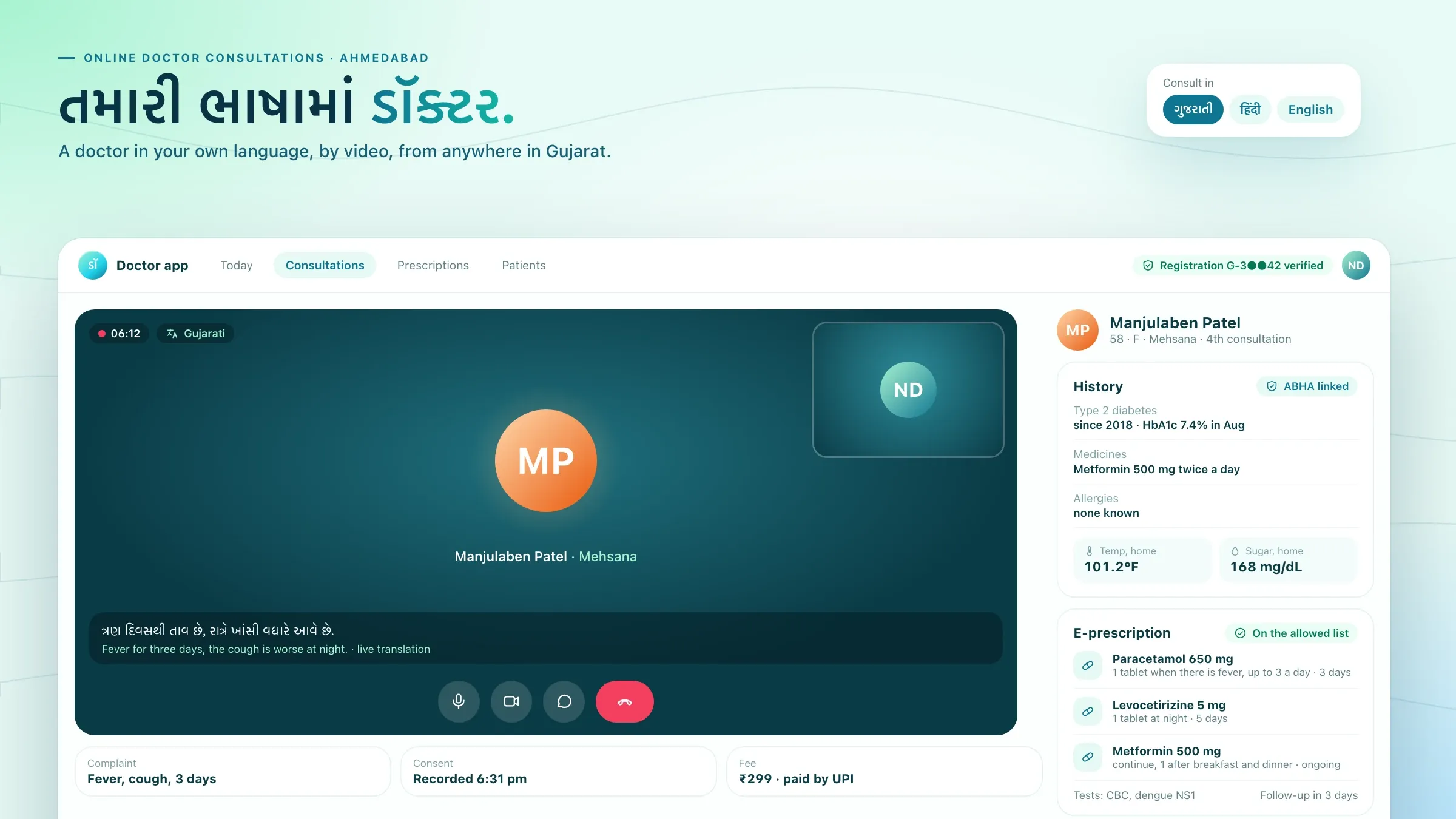 Doctor consultations in Gujarati For a HealthTech startup we back in Ahmedabad, we build the patient and doctor apps: video consultations in Gujarati, Hindi and English, e-prescriptions, an AI scribe and ABHA linking. Meet the startup
-
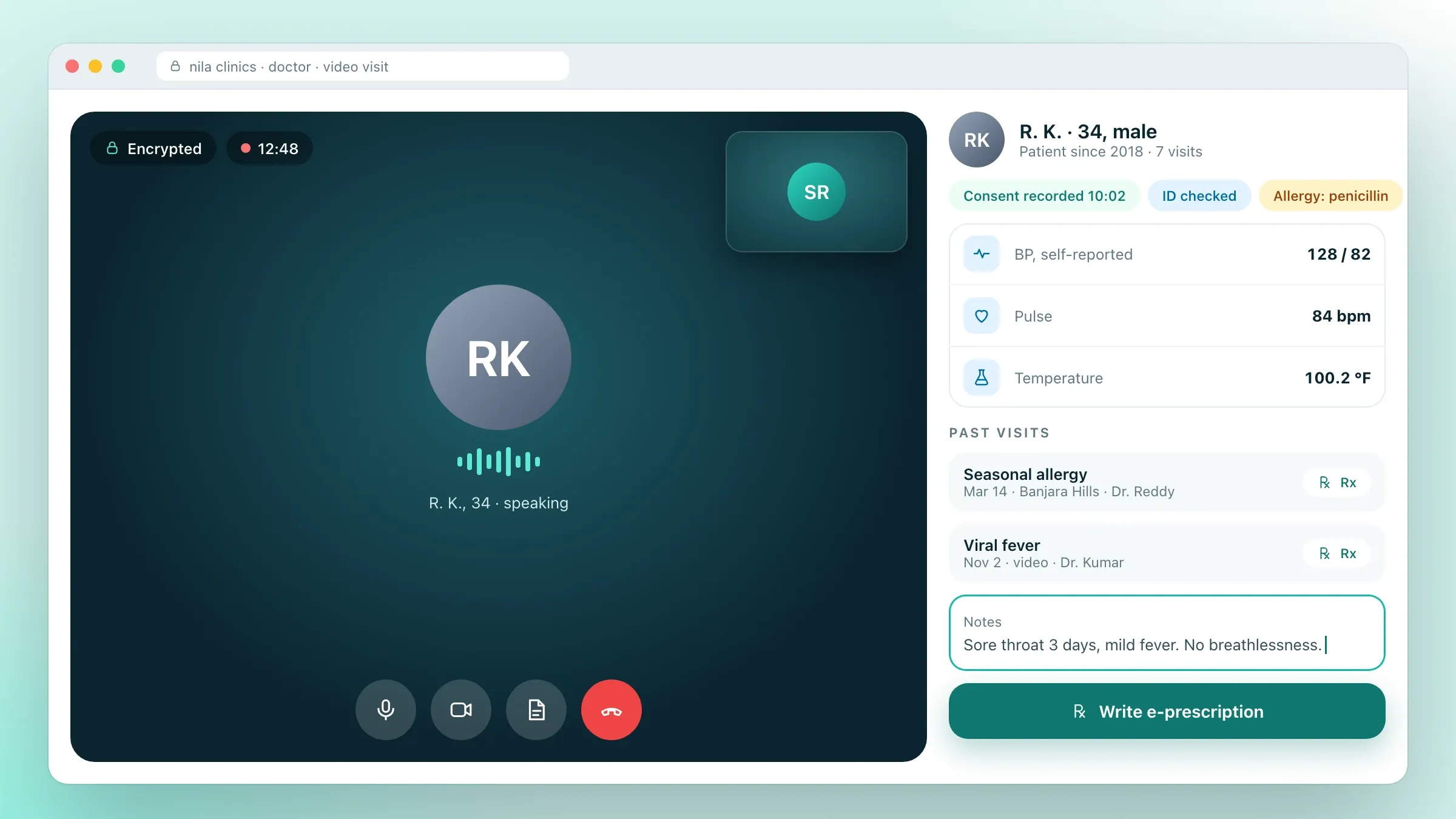 Video visits beside the clinic For a multi-speciality clinic group in Hyderabad, we built video consultations under India's 2020 telemedicine guidelines, with e-prescriptions, online payment and one calendar for every branch. Read the case study
-
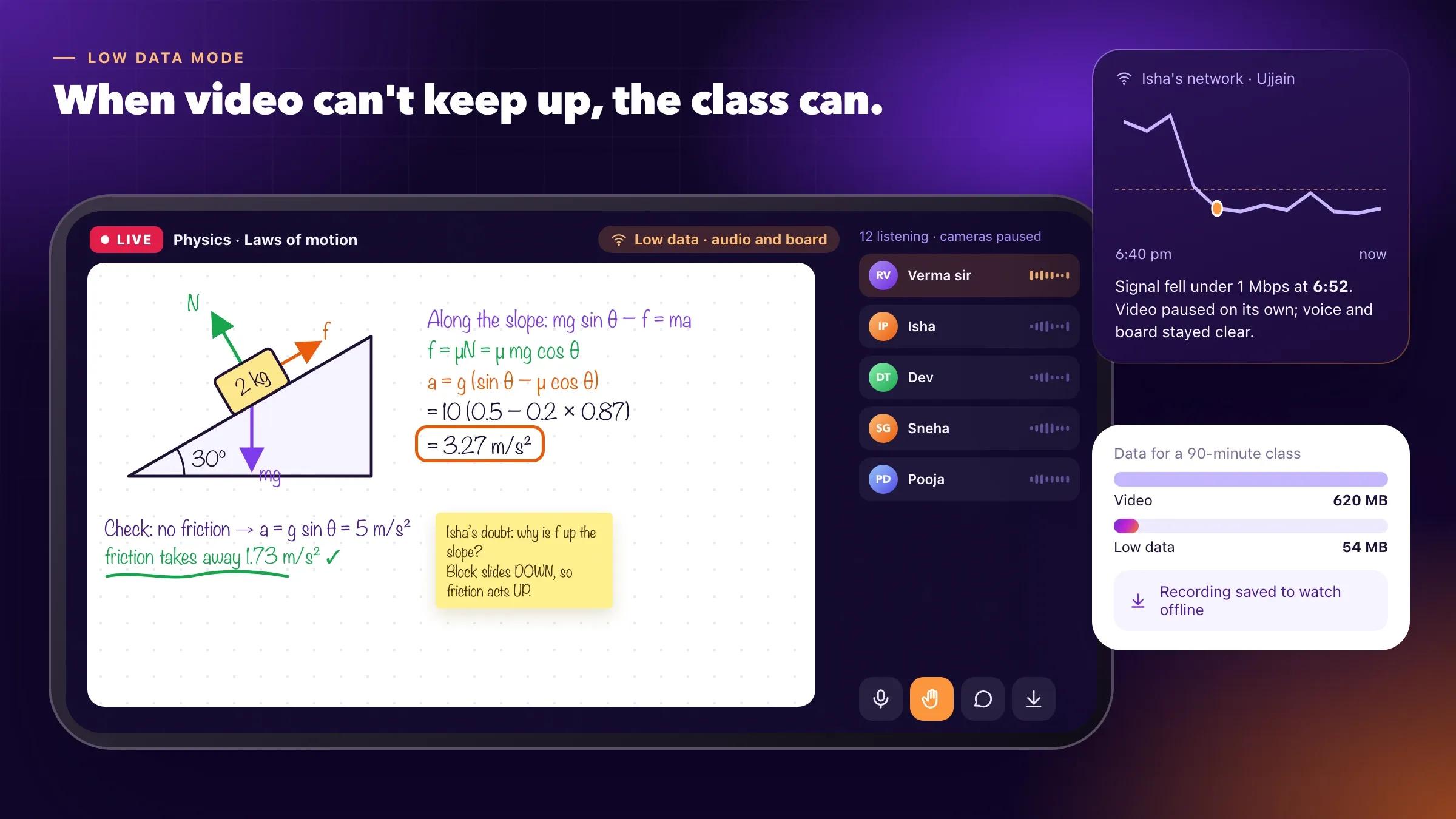 Live video on weak networks For an EdTech startup we back in Indore, we built live classes in Hindi and English with a low-bandwidth mode that keeps the teacher's voice and board clear. Meet the startup
What a telemedicine app does
A telemedicine app lets doctors see patients without either of them travelling. The consultation happens by video, audio or chat, and everything around it happens in the same app: booking, payment, consent, the patient’s history, the prescription and the follow-up.
That last part is what separates telemedicine from a video call. A doctor can already see a patient on WhatsApp video. What they can’t do there is confirm who the patient is, record consent, see the patient’s history beside the call, issue a proper prescription and book the review. A telemedicine app puts all of that around the call, so an online consultation is as complete as a visit to the clinic.
A clinic adding video, or a telemedicine service
We build telemedicine for two kinds of clients. Clinics and hospital groups want video consultations for their own patients, alongside in-clinic visits: follow-ups, test results, repeat prescriptions and patients who can’t travel. HealthTech companies want a telemedicine service of their own, with their own doctors, brand, apps and partners.
The first usually fits into the clinic’s existing booking and records, with one calendar for in-clinic and video slots. The second needs everything: patient and doctor apps, doctor verification, payouts, partner labs and pharmacies, and support. We help you decide which you are building before anything is designed, because the two cost very different amounts.
Where video consultations pay off first
Follow-ups are where telemedicine earns its place first. A patient who travelled for the first visit often needs only a short conversation for the second: how the medicine is working, what the report says, whether the dose should change. By video, that takes minutes instead of a day.
Next come test results and repeat prescriptions for long-term conditions such as diabetes, high blood pressure and thyroid disorders, where regular reviews matter more than a physical examination. Patients who would otherwise skip a review because of the journey keep up with their treatment.
Then there are the patients who can’t easily come at all: older parents, people in towns far from a specialist, new mothers, and families whose child needs a quick check in the evening. For them, an online consultation is often the difference between seeing a doctor today and waiting until it gets worse.
Some consultations still need the clinic. A good telemedicine app knows that too: the doctor can convert a video call into an in-clinic appointment in one step, with the history already on file.
Built within India’s telemedicine rules
India’s Telemedicine Practice Guidelines, issued in March 2020, allow registered medical practitioners to consult by video, audio and text, and to issue e-prescriptions. They also set rules, and we build them into the screens rather than leaving them to memory.
Every doctor’s medical registration is checked before they can consult. The patient’s identity and consent are confirmed and recorded before the call. Prescriptions carry the doctor’s name, qualifications and registration number. The guidelines’ lists of medicines that can and can’t be prescribed online are enforced by the prescription screen, depending on the type of consultation, and records of each consultation are kept.
Outside India the rules differ: in the United States, for example, a doctor generally needs to be licensed where the patient is, and HIPAA governs health information. We design for the rules where you practise, agreed with your adviser. Meeting them stays with your practice; our job is to build the controls they ask for.
In the patient’s language
Patients describe symptoms most clearly in the language they think in, and follow advice better when they understand it. For many families in India that means Gujarati, Hindi, Marathi or Tamil, not English.
We build the app, the booking flow and the messages in the languages your patients use, and let patients choose a doctor who speaks theirs. Prescriptions and advice can reach the patient in their language. Live captions can help when the line is unclear, and an AI scribe can draft the doctor’s notes in English from a consultation held in Gujarati, for the doctor to check.
Each language is written and tested with real patients. A screen that is translated correctly but reads stiffly loses an older patient’s trust in the first minute.
Video that holds up on weak networks
Many patients join from a phone on a mobile network that comes and goes. A telemedicine app has to plan for that, not hope it won’t happen.
We build calls that lower video quality before they freeze, fall back to clear audio when video can’t keep up, and reconnect on their own when the line drops. Patients join from a link in the browser without installing anything, and can switch to audio or chat at any time. The doctor sees the patient’s connection, so a frozen picture isn’t mistaken for a silent patient.
Prescriptions, labs and pharmacies
The consultation ends with an e-prescription, and in a good service that is where the next steps begin. Lab tests on the prescription can be booked with a partner lab, with a technician visiting the patient’s home and the report arriving in the app for the doctor. Medicines can be ordered from a partner pharmacy for delivery.
Follow-ups are booked from the prescription, with reminders on WhatsApp. For long-term conditions such as diabetes or thyroid disorders, regular reviews and tests can be scheduled as a care programme, so patients don’t drop out of treatment.
Records, AI notes and privacy
Every consultation, report and prescription stays together in the patient’s record, so the next doctor sees the whole picture. Patients can link their ABHA health ID and keep their records under India’s digital health mission, sharing them with other providers when they choose.
AI notes are optional. With the patient’s consent, the AI listens to the consultation and drafts the notes and prescription. The doctor checks, edits and approves everything, and nothing reaches the patient without the doctor’s approval.
Health data needs more care than any other data an app holds. Calls and records are encrypted in transit and at rest, each role sees only what it needs, and every access to a record is logged.
Calls are not recorded unless your policy needs it and the patient agrees; the notes and the prescription are the record of the consultation. Consent for the consultation, for AI notes and for ABHA linking is recorded separately, and patients can see what they agreed to. For Indian patients, data is kept in India and handled in line with the Digital Personal Data Protection Act.
What we need from you, and how we build it
We need time with a few of your doctors and the people who book and support patients. They know which consultations work online, what patients ask before and after the call, and where today’s process breaks.
We also need your doctors’ details for verification, the specialities and fees, the partners you work with or want to, and the languages your patients speak. Then we design the screens and test them with real patients in each language, build, and pilot with a small group of doctors before opening to every patient.
After launch: measuring and improving
Before launch we agree what to measure: calls that connect first time, calls that drop to audio, the wait in the virtual waiting room, prescriptions issued, and follow-ups that happen. The app records these as it runs.
Every month we review them with you, fix what patients and doctors find, and add what comes next: another speciality, another language, a care programme or a new partner.
How we work with you
From the first call to running it
- Start
Map the consultation
We sit with your doctors and the people who book and support patients, and agree which consultations go online first and which rules apply.
- Design
Try it in your patients' language
The booking, waiting room, call and prescription screens are tested with real patients and doctors, in each language, before we build them.
- Build
Build and connect
We build the patient and doctor apps, verify your doctors, and connect payments, WhatsApp, labs, pharmacies and ABHA where you need them.
- Pilot
A few doctors first
A small group of doctors consults real patients while we watch call quality, consent and prescriptions closely and fix what they find.
- Launch
Open to every patient
More doctors and specialities join, with booking links on your website, Google profile and WhatsApp.
- Every month
Run and improve
We look after the apps, review call quality and follow-ups with you, and add specialities, languages and care programmes.
Safe and in your control
Consent before every call
The patient's consent and identity are confirmed and recorded before the consultation starts.
Verified doctors only
A doctor can't consult until their medical registration has been checked, and it appears on every prescription.
Prescribing rules built in
Online prescriptions are limited to the medicines the rules allow for that type of consultation.
Not recorded by default
Calls are not recorded unless your policy needs it and the patient agrees; the notes and prescription are the record.
Encrypted, and kept where it should be
Calls and records are encrypted in transit and at rest, and data for Indian patients stays in India.
Every look at a record is logged
Each role sees only what it needs, and every access to a patient's record is kept on a log.
Time and cost
The cost of a telemedicine app depends on what happens around the call, not on the video itself. Many start with booking, video and e-prescriptions for a few specialities, then add labs, pharmacies and care programmes. After the first call we send a written plan and a quote.
Apps and channels
A web app with WhatsApp booking is the quickest start. Patient and doctor apps for Android and iPhone add design and testing.
Specialities and consultation types
Each speciality has its own templates, and video, audio and chat each need their own handling.
Languages
Each language is written and tested with real patients, and live captions or translated prescriptions add more.
Partners and records
Labs, pharmacies, payment gateways, ABHA and your existing clinic or hospital software are each a connection to build.
Minutes and messages
Running costs follow use: video minutes, WhatsApp and SMS messages, and AI notes if you use them.
Built with
Chosen for each project, never by habit
Questions and answers
12 answered
What is a telemedicine app?
A telemedicine app lets doctors consult patients remotely by video, audio or chat. A complete one also handles booking, payment, consent, the patient's history, e-prescriptions and follow-ups, so an online consultation is as properly recorded as a visit to the clinic.
Are online doctor consultations allowed in India?
Yes. India's Telemedicine Practice Guidelines, issued in March 2020, allow registered medical practitioners to consult by video, audio and text and to issue e-prescriptions, within rules on consent, identity, records and which medicines can be prescribed online.
How much does it cost to build a telemedicine app?
It depends on the apps and channels, the specialities, the languages, and the labs, pharmacies and systems it connects to, plus running costs for video minutes and messages. We send a written plan and a quote after the first call.
How long does it take to build a telemedicine app?
It depends on the scope. Video consultations with booking and e-prescriptions for a clinic is a matter of weeks; a full telemedicine service with its own apps, partners and several languages takes longer. The written plan sets out each stage and the pilot.
Can patients consult in Gujarati, Hindi or another language?
Yes. Patients can choose a doctor who speaks their language, use the app in it, and receive advice and prescriptions in it. Live captions help when the line is unclear.
What if the patient's internet is weak?
The call adjusts. Video quality lowers first, then the call falls back to clear audio, and it reconnects on its own if the line drops. A patient can also switch to audio or chat at any time.
Can doctors prescribe any medicine online?
No. India's telemedicine guidelines set lists of medicines that can and can't be prescribed by teleconsultation, depending on the type of consultation. We build those rules into the prescription screen.
Do patients need to download an app?
Not necessarily. Patients can book on WhatsApp or the web and join the call from a link in the browser. An app suits services with regular patients, such as care for long-term conditions.
Can it connect to ABHA?
Yes. Patients can link their ABHA health ID so their consultations and prescriptions are kept under India's digital health mission, and shared with other providers when they choose. ABDM's approval steps are planned into the timeline.
Is a telemedicine app like this suitable for a single clinic?
Yes. A clinic can add video consultations for its own patients, alongside in-clinic visits, without building a whole telemedicine service. Many start with follow-ups by video for regular patients.
Do you build telemedicine apps for practices outside India?
Yes. FIRELIFE Ventures works with small and mid-size businesses worldwide, from Rajkot, India, on India time. Rules on consent, prescribing, records and where a doctor may consult differ by country, so we start by agreeing with your adviser which apply.
What happens after the telemedicine app launches?
We run it with you: updates and fixes, a monthly look at call quality, missed calls and follow-ups, and new doctors, specialities, languages or partners when you are ready.
Tell us what you want to build
Write a few lines about the idea and who it is for. We reply with our questions, a first plan and how we would start.
Write to us